

Yes. What is worth more than the yes is the itemised answer that comes with it, because a private label retail box is not one decision but eight, and only two or three of them are usually in the buyer's head when the request is sent. A buyer who sends artwork to a supplier and asks for the box price gets a quotation for artwork and a die, and then discovers in month two that the inserts for a third market need a labour slot that nobody reserved.
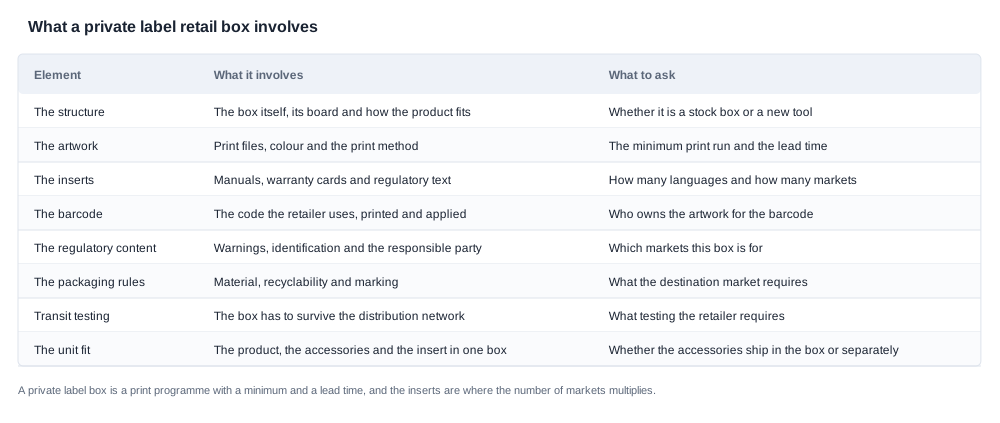
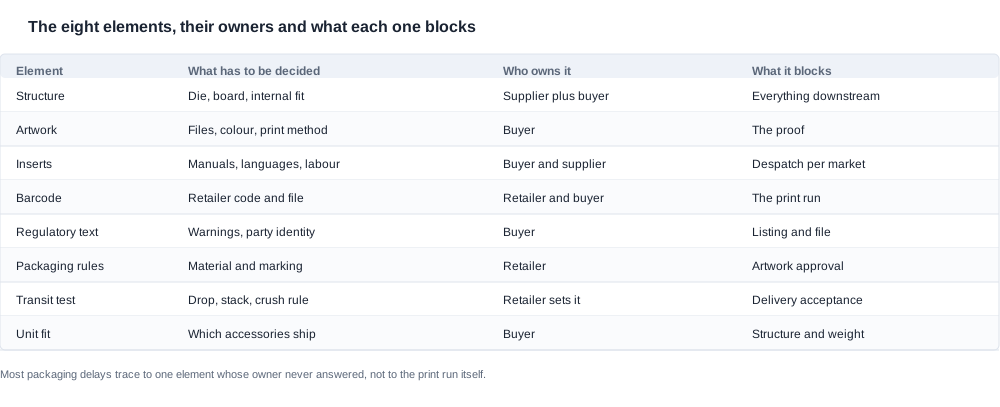
The eight elements below are the working list. Each one has an owner, and most of the delays buyers blame on the supplier are actually an element whose owner never answered.
Can you customize the box for retail: eight elements that decide the cost
The structure. The board, the shape, and how the product and its accessories sit inside it. A stock structure that already fits the product is the cheap and fast route, and it is a legitimate private label — your print, their tooling. A new die is a tool: a one-off cost, a lead time, and a decision about how the product is protected in transit. It is worth noticing that the structure decision is downstream of everything else, because it cannot be finalised until you know what goes in the box.
The artwork. Print-ready files, colour definition, the print method and the minimum print run. This is the element buyers most consistently underestimate, because the minimum run is a commercial fact rather than a technical one. The same box at a few hundred units and at tens of thousands is not the same price per unit, and the minimum print run is a number you should have in writing before you compare two quotations.
The inserts. Manual, warranty card, quick start, regulatory text and any market-specific leaflet. Inserts are where the number of markets multiplies into labour: a product sold in four European markets with four languages needs four insert sets, and inserts are frequently printed, folded and placed by hand. That is a labour line inside the packaging cost, and it scales with your market count, not with your unit count.
The barcode. The retailer's own code, printed and applied. Ownership matters here in a way that surprises people: the retailer owns the code, you own the artwork file, and somebody has to own the process when the retailer changes it. A barcode artwork dispute inside a print run is a production stop, and production stops are why launches slip.
The regulatory content. Warnings, the identity of the product and of the responsible party, instructions for use, and in some markets recycling marking. In the European Union the General Product Safety Regulation has applied since 13 December 2024, and for a product sold online the required information has to accompany the listing, not only sit in the box. That means the box artwork, the online listing and the technical file all have to agree — three artefacts that are usually owned by three different people in a brand.
The packaging rules. Material, recyclability marking, and in some markets a minimum recycled content. Increasingly this arrives as a question from the retailer's own sustainability or compliance team, and it is far cheaper to answer it before the artwork is finished than after. The certification checklist covers the document set that a private label has to line up with, and the packaging rules usually arrive as one more item on the same list.
The transit requirement. A retail box is dropped, stacked and crushed inside a distribution network, and many retailers specify a test that incoming deliveries have to pass. This is a process requirement rather than a product claim, and the point to hold on to is that the box has to satisfy it — not the device. Ask what the retailer requires, in writing, and ask who arranges and pays for the test.
The unit fit. Which accessories travel in the box. The charging case, the cable, the tool and the inserts all change the internal volume, and the box is priced by volume, so a case in the box is a more expensive box, a heavier shipment and a different unboxing.
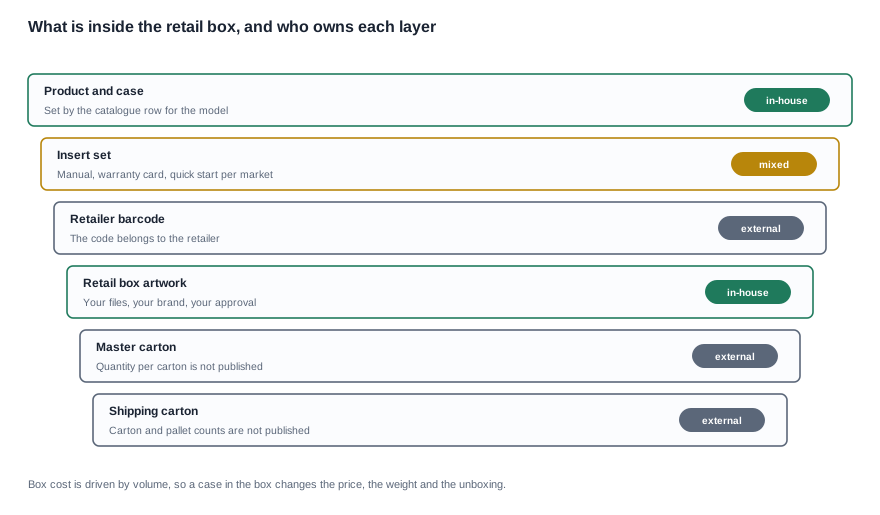
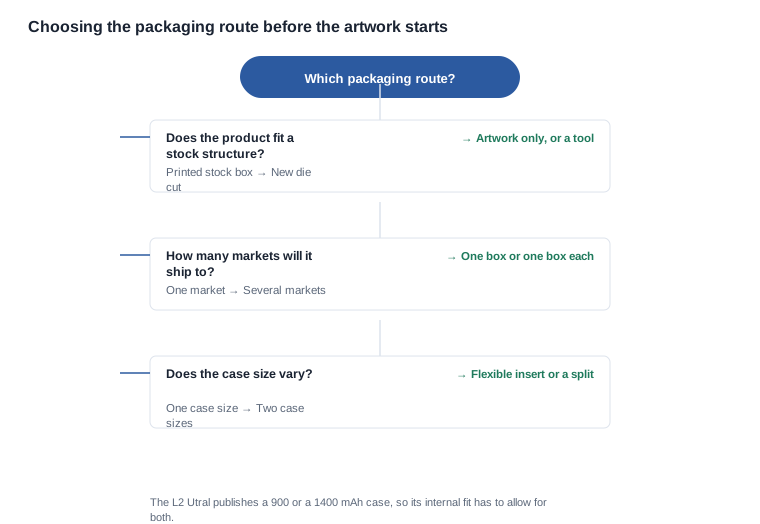
The unit fit is where the catalogue bites hardest, and it is worth walking through the cases because it shows how a small specification choice turns into two packaging programmes. Five models publish a charging case capacity: the CY03, the CY05 and the L1 Pro at 1400 mAh, the L2 Utral at 900 or 1400 mAh, and the MT6 at 1200 mAh foldable. The KY06 and the MT5 have a case with no published capacity, the V03, the V06 and the S7 have no case row at all, and the V03 Pro is explicitly a no-case model. A retailer-facing box for the L2 Utral therefore has to cope with two possible case sizes, which means either an internal insert that flexes or two box structures — and those two answers have completely different costs and lead times. Meanwhile the MT6 is the only model in the catalogue that publishes a weight, at 158 g for the glasses alone and explicitly excluding its foldable case, so the published figure is not the figure that belongs on the shipping carton.
Two more catalogue facts change box artwork rather than box structure, and both are the kind of thing that is easy to print by mistake. Only the V06 and the S7 publish an IP rating, IP54; nothing else in the range carries an IP marking, so an IP statement printed on a box has to appear only on the packaging for those two models. And 26 models publish a charge time of two hours or less, with only the D17 and the ZH12 publishing about one hour, so the quick start card has to match the model it ships with rather than the range it came from. Our catalogue publishes no certification row per model at all, which means a box that asserts a certification has to be asserting something the technical file actually supports.
That last point deserves expanding, because it is the most common packaging compliance exposure in this category. Our catalogue body publishes no CE, FCC, RoHS or RED marking for any model, and our export-certification page is a picture page: ten patent certificate images, eight design patents and two utility models, with no per-model test report and no certificate number. A retail carton that prints a conformity mark therefore has to be backed by a document that names that model, and a supplier who waves a generic certificate at you has not closed the question. Ask for four fields — the certificate number, the model it covers, the standard it was tested against, and the date — and hold the artwork until they arrive. The same logic applies to the identification of the responsible party and, in the European Union, to the online listing that the carton points at.
Note the asymmetry in who owns that risk. The printer prints what you approve. You approve it. The retailer may audit the documentation behind it. Nobody in that chain will remind you that the box, the listing and the technical file have drifted apart, because each of them is correct on its own.

What a supplier needs before can you customize the box for retail becomes a quotation
A quotation that can be compared across suppliers needs the same inputs from every one of them. Six, in this order.
- The artwork file, not a picture of a box. Vector or print-ready PDF, with the dieline if the artwork wraps a die-cut structure. A reference photograph is a mood, not a file.
- The market list. Not "Europe" — the countries, because the regulatory content and the insert languages follow the list.
- The unit fit. Which accessories ship in the box, and which case variant, if the model has more than one.
- The retailer's own packaging rules, if you have them. Recycled content, barcode placement, approved material list, transit test requirement.
- The route. Printed stock structure, new die, or a hybrid with market-specific labels over a common master box.
- The quantity split. How many units of each market variant, because a split across three markets is three print runs unless you choose otherwise.
The route decision is worth dwelling on, because it is the trade-off buyers most often make by accident. One global box with a common artwork and a market label applied in the warehouse is cheap to print and flexible in the market, but it means the regulatory content on the physical box may be a generic panel rather than the market text. One box per market puts the correct content in the customer's hands from the carton, but it divides your print run and it multiplies the minimums. For a product whose price point is modest and whose channels are broad, the second option is usually right; for a product with a long lead time on structure and a small first order, the first is often the only one that lands on time. Decide it deliberately rather than discovering it in the quotation.
The market list is the input that most often arrives in a form nobody can quote from. "Europe" is not a market; a market list has countries, a retailer per country, a language per country, and the date each market goes live. Two countries with the same language still differ on labelling content and on the identity of the responsible party, and the retailer in each country may impose a different barcode placement and a different transit requirement. A supplier who asks for "which countries and which languages" is telling you they have done this before; a supplier who quotes from a country list is telling you something else.
The quantity split matters for a reason that is easy to miss: the print minimum applies per artwork, not per unit. Three markets with three artworks is three minimums. Three markets with one artwork and a variable label is one minimum and a labelling cost, which is a different line and a different trade-off. If you are undecided, ask the supplier to quote all three routes — one global box with labels, two market boxes, three market boxes — at your quantity, and compare. The comparison usually makes the decision obvious, and it takes one message.

The sequence that keeps can you customize the box for retail on schedule
The order of operations below is not bureaucratic. It is arranged so that the decisions that cannot be undone happen while they are still cheap.
- Send the artwork file and the market list, and state whether the structure changes.
- Confirm the unit fit in writing, including the case variant, so the internal dimensions are settled before any dieline is drawn.
- Confirm the regulatory content per market and name who signs it off. This is usually the longest internal lead time in the whole project, because it sits with the compliance owner rather than with you.
- Ask for each element's number separately: the print minimum, the die cost, the insert labour per language, the transit test cost, and the lead time for artwork, for the die, and for the print run. Three separate lead times, because they run partly in parallel and the longest one sets your date.
- Order a physical proof, not a render. A render cannot show how a fold creases, how the print sits on the board, whether the board delaminates at a corner, or whether the product actually fits inside with the inserts in place.
- Approve the proof in writing, with a named signatory and a date, and keep the approved proof with the artwork file.
The proof is the step that saves the most time, and skipping it is the classic cause of a packaging launch that moves twice. A print proof takes about a week and catches the class of problems a render hides — fit, creasing, board quality, print registration and colour.
Make the proof a physical proof of the thing that ships, not a proof of the empty box. A proof with the product and the inserts inside it tells you whether the fit is right, whether the case closes, whether the accessory pouch is crushed by the insert, and whether the unit is easy to lift out or has to be pried. These are the findings that generate support tickets afterwards. It is also worth checking the sound of the box — a light board with a heavy product inside will rattle, and rattling is a quality perception that no specification line will fix.

One thing to raise early because it is easy to forget: what happens to the print files afterwards. Private label packaging has a shelf life that outlives most relationships — you will reorder, and the reorder will be from a supplier who no longer has your die because somebody bought the same mould and it now sits in a different factory. Ask who stores the print-ready files, in what format, for how long, and what you receive if the relationship ends. In most cases the answer is that you receive the files and the dieline, which is the right answer, and it costs nothing to secure it if you ask at the beginning.
Why can you customize the box for retail is mostly a scheduling problem
Here is the part that changes the shape of the conversation. The product cost does not move when the box changes; the box cost moves a little; the schedule moves a great deal. Packaging work has an approval chain, and the chain is rarely as short as the person requesting the artwork assumes.
The longest item is usually regulatory sign-off rather than printing. The second longest is usually the die, if a new structure is involved, and the die cannot start until the internal dimensions are confirmed, which cannot happen until the unit fit is confirmed, which is often the same conversation where the case variant is discovered. The print run itself is comparatively fast. Inserts are the quiet item, because they are a labour slot inside the line and a print run in their own right, and they scale with the number of markets rather than the number of units.
There is a second scheduling consequence that bites hardest on a first order: the packaging lead time can exceed the product lead time, and when it does, the packaging becomes the critical path for the entire launch. Suppliers who quote a single combined lead time for the goods and the packaging are hiding the part that determines whether you launch on time. Ask for the packaging schedule separately, in weeks, and compare it against the product schedule.
While you are looking at schedules, it is worth understanding the shape of the box cost, because it tells you which parts of the request are worth negotiating and which are simply expensive. The product cost does not move when the box changes. The box is a print programme with a minimum, so the first units carry the amortised tool and the setup, and the marginal cost of the next thousand boxes is materially lower — which means the first order is always the worst order per unit and the re-order is where the packaging negotiation actually pays. The structure is a one-off tool and the transit test is a one-off test, both small and both sunk. The inserts are a labour cost that scales with the number of markets, and the insert labour is the line that grows every time you add a country.
Which means the private label cost that matters is rarely the box price. It is the artwork, the insert management and the schedule, and a buyer who negotiates hard on the print price and then adds two markets has optimised the smallest line on the invoice.
Our own published figures for print minimums, box tooling cost, minimum order quantities and lead times are not published, because they are open internally and move with the configuration and the quantity. A general figure would be wrong in a way that matters, and we would rather quote you a real number than a memorable one.
The terms to settle when can you customize the box for retail goes commercial
The negotiation that buyers run is usually about the unit price of the box, which is the smallest number on the invoice. The numbers that move your margin are the ones that determine how many runs, how many markets and how many reprints you pay for.
The list worth taking into the negotiation:
- Print run size against market count. The trade-off, stated explicitly by the supplier, so you can see the unit cost at three markets and at one.
- Whether the die is amortised across your first order, and what the re-order price is once it is paid off.
- Artwork ownership and file custody. Who holds the print-ready files, in what format, for how long, and what you receive at the end of the relationship.
- Insert labour per language, and whether inserts can be printed in the same run rather than separately.
- Who arranges and pays the transit test, and whether the report is issued in your name or the factory's.
- The barcode change process. Who absorbs a reprint if the retailer changes its code or its artwork after the run.
- Spare packaging. Whether extra cartons and extra insert sets can be supplied separately from the sale units, so that replenishing a warehouse two years later does not require a new print run. This is very often worth more to a buyer than the discount on the box price.
- Proof turnaround on your side, and whether the supplier can hold a print slot against your approval. A print slot held and then missed is a week of dead time.
- Who carries the cost when a delivery fails the retailer's transit requirement. A box that does not survive the network is reworked or claimed, and in a retailer's distribution centre that is a deduction against the invoice rather than a conversation with the factory.
Certification cost and test lead time follow the process and the testing body rather than the negotiation, and they are frequently bundled into a single line that hides which is which. Packaging tooling is a one-off amortised over the first order, while certification work is per product family, so ask for them as three separate figures — artwork, tooling, certification — whenever they appear together in a quotation.
The agreement itself should carry a short list: the approved artwork version and the date it was approved, the physical proof that was signed off, the box structure and board specification, the insert set per market and per language, the barcode file and its owner, the regulatory content per market, the transit requirement and who arranges the test, the spare packaging arrangement, and the file custody position.
Two warnings for the listing side. A private label box has to agree with the online listing, and in the European Union the online listing itself has to carry the required product information under the General Product Safety Regulation. And nothing on the box should assert a specification the catalogue does not publish for that model — the IP54 marking belongs only on the V06 and the S7, and no model in the range carries a published drop rating, so a carton that claims one is making a claim nobody can support.
Packaging sits in our published list of standard customisation points, alongside logo, colour, temple shape, system and user interface, and Bluetooth device name and firmware. The standard OEM options page sets out that list in full, and selecting by market covers the market differences that change the inserts and the regulatory content.
Related reading
- The customisation points in full — standard OEM options
- The document set a private label has to match — certification checklist
- The market differences that change the inserts — selecting by market
Send the artwork and the market list, and we will tell you which elements drive the cost and which one will set the schedule.


