

"Can you expedite?" arrives with a date attached and usually leaves with a range attached. The reason is structural: the question is asked as one thing when it is four, and a supplier who answers any one of the four has not answered the one you needed. The four are where the schedule actually sits, what can physically move, what the movement costs, and what the early units look like if they arrive early.
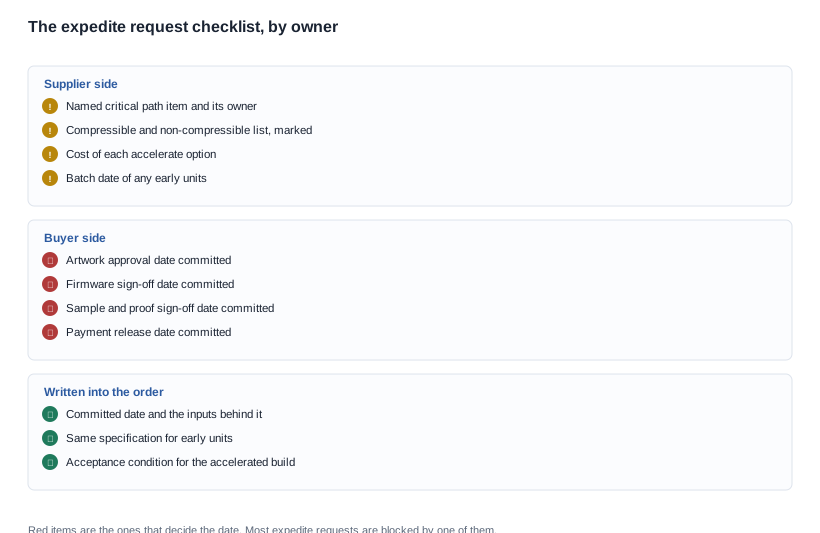
The other thing worth saying at the start is that most expedite requests are not requests to compress the factory. In our experience of this category, the binding constraint is more often on the buyer's side of the table — an artwork approval, a firmware sign-off, a packaging proof sitting in somebody's inbox, a payment that has not cleared. A factory can work around almost anything except a decision that has not been made. So the useful expedite question is not "can you hurry" but "what would you have to receive from us, and by when, to pull the date in".
We do not publish our own lead times in weeks, so this page is a method rather than an offer. It is, however, a method that produces a usable answer in one exchange instead of five.
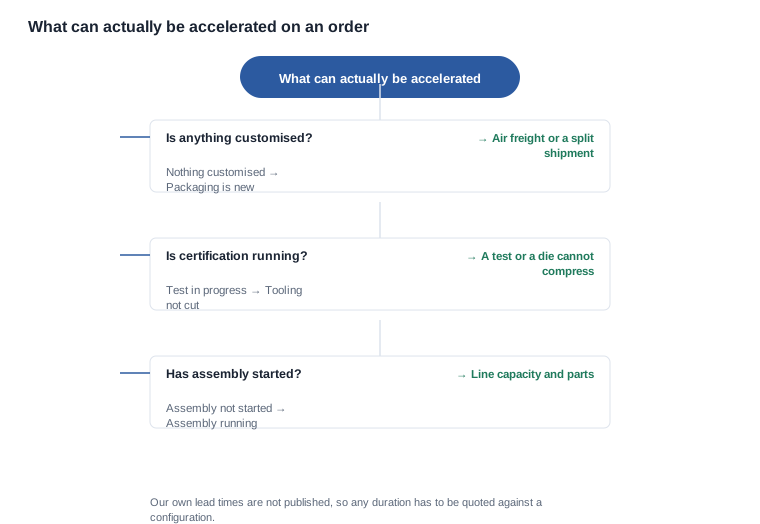
Can you expedite: the four questions hidden in one request
Where the schedule actually sits. Ask for the longest single item on the critical path, not a total. "The electronics are on hand, the tooling is cut, and the current constraint is the packaging proof" is an actionable sentence. "Eight to ten weeks" is not, because there is nothing in it you can act on.
The useful form of this question names the constraint and its owner: which stage, who owns it, and what it is waiting on. If the answer turns out to be your own late artwork, your own unapproved firmware, or your own outstanding payment, then no amount of factory urgency helps and pretending otherwise costs you a week.
What can physically move. The honest list of compressible items is short. Ask the supplier to mark each one as available, unavailable, or dependent on something else.
What the movement costs. In the same message, because an expedite quoted without a price is a promise without a number attached.
What the early units look like. Only relevant if a partial shipment is on the table, and the most important of the four, because a half-finished shipment with different firmware is a support problem that arrives before the rest of the order.
The distinction that makes the first question useful is between a lead time and a critical path. A lead time is a duration; a critical path is a named chain of dependent events. Buyers who only ever receive durations cannot prioritise, because they cannot tell which delay matters. A supplier who answers with a named constraint has given you something you can put in your own plan and hold them to.
Before you send the request, assemble five facts, because each of them removes a round trip:
- The model and the exact configuration, including the charging method, the colour and the packaging route.
- The quantity, split into the first release and the balance if you can commit to a split today.
- The destination market and the destination country, because freight mode and labelling both follow from it.
- What is already fixed: the sample approved, the firmware signed off, the artwork released, the certification position.
- The date you need, and what happens commercially if you miss it.
That fifth point matters more than it looks. "We need it for the Amazon listing on the 12th" and "we need it for the trade show on the 12th" produce completely different answers, because a trade show date can be met with a partial shipment of display units while a listing date cannot. Suppliers respond to the consequence, not to the date, and a buyer who states the consequence gets a better answer than one who states the date alone.
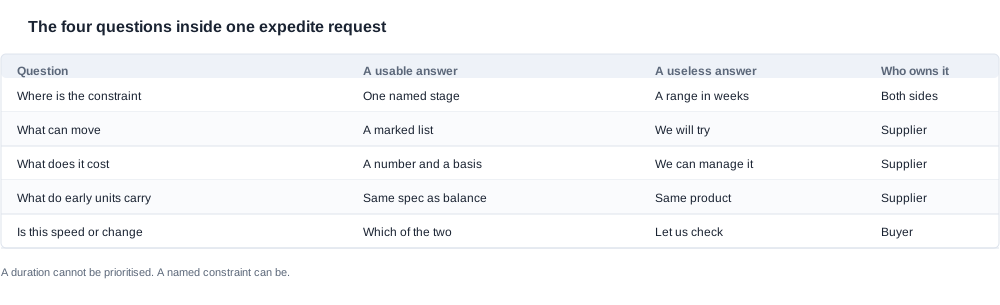
There is a second framing question that changes the answer before anyone does any work: is this an acceleration or a renegotiation? Acceleration means compressing the existing plan. Renegotiation means changing the plan — a different model, a different specification, a smaller first run, a different packaging. Many requests that arrive as "can you expedite" are actually the second, and they are answered much faster than the first because they are not schedule questions at all. If your date is impossible with the current specification, ask what would have to be true about the order for the date to work, and treat the answer as a change request rather than as an escalation.
One more thing to establish before you ask anything: whether your date is a hard date at all. A date that is soft — a campaign that could move, a buyer whose own timeline slipped — can often be met by changing the plan rather than by accelerating it, and a supplier who is told the date is hard will price accordingly.
A worked example of what a good exchange looks like. A distributor asks for 2,000 units of a camera model to land eight weeks before their retail launch, with private label packaging. The answer that helps is not "eight to ten weeks" and not "yes, we can hurry." It is: the electronic build can start once the artwork is released, the packaging proof is the constraint, the proof needs three working days with your signatory, and the units can ship by air four weeks after the build completes if the artwork is released on a stated date. That answer contains an item, an owner, an action and a consequence, and the distributor can now go and close the one thing that is actually in their hands. Buyers routinely overstate the hardness of a date and then pay for the urgency they created.

What can you expedite depends on, and what cannot move at all
The compressible list is short enough to memorise, and knowing it saves you from asking for things that cannot happen.
Freight mode. Air instead of sea is the largest single lever available to a buyer and the one with the least effect on the production schedule. It changes cost and it changes nothing upstream, which is why it is the first thing to price.
Partial or staged shipments. Shipping what is finished in two releases converts one date into two, which is often more valuable than one earlier date because it lets you start selling.
Existing production. If your chosen model is already running for another customer in a configuration close enough to yours, an order that follows the running configuration rather than starting a new one can be dramatically quicker. Which configurations are currently running is not published, so this is a question to ask rather than a plan to make.
Express handling on identified long-lead components. If a specific part is the constraint and it has already been identified, express sourcing moves it. Note the limit: express only helps once the part is known. Expediting an unidentified part is not a thing.
Senior attention on the remaining tests. Sometimes the remaining work is not slow, it is unattended. This is a scheduling intervention rather than a capacity one, and it is cheap when it works.
The list of things that cannot compress is longer and matters more.
Certification testing. A test does not compress because you asked. If certification is on your critical path, that is a project, and the honest answer is a start date rather than a shortened one. The catalogue publishes no per-model certification row at all — the export-certification page is a picture page carrying ten patent certificate images — so this is exactly the kind of item that has to be established per model before it can even be scheduled.
Tooling that has not been cut. A new die has a lead time that is set by the tool maker. The only thing that compresses it is not needing it.
Any stage waiting on a buyer decision. Firmware sign-off, artwork approval, packaging proof sign-off, sample approval, payment release. These are the most common real-world bottleneck in this category, and no factory can solve them.
The physical steps. Printing, folding, drying, packing and the transit time for a pallet that has to be built before it can be shipped.
There are two further items that sit on the compressible side but only under conditions. Parallel working is one: an assembly line that normally does the same model across four stations can sometimes run two configurations at once, which halves the elapsed time without changing the labour. It requires a second set of materials and a line that can hold both. Splitting a large order into two production runs is another: it does not make the first run faster, but it makes the first delivery earlier, which for a launch is the only thing that matters. Both are worth asking about by name, because a supplier will not volunteer them.
The diagnostic question that distinguishes the two lists in one exchange is: does this item need time, or does it need a decision? Items that need time can sometimes be parallelised or paid for. Items that need a decision need you.
That last category deserves a short list of its own, because it is where expedite requests actually die. Firmware and the Bluetooth device name are published customisation points in our catalogue, so a private-name or private-firmware order has a firmware sign-off inside it, and firmware sign-off is a buyer decision with your reviewer on it. Add to that the packaging proof, the golden sample sign-off, the artwork release, the payment release, and any decision to change a specification mid-build. A buyer who sends an expedite request with all six of those still open will get a date, and it will not be a good one.
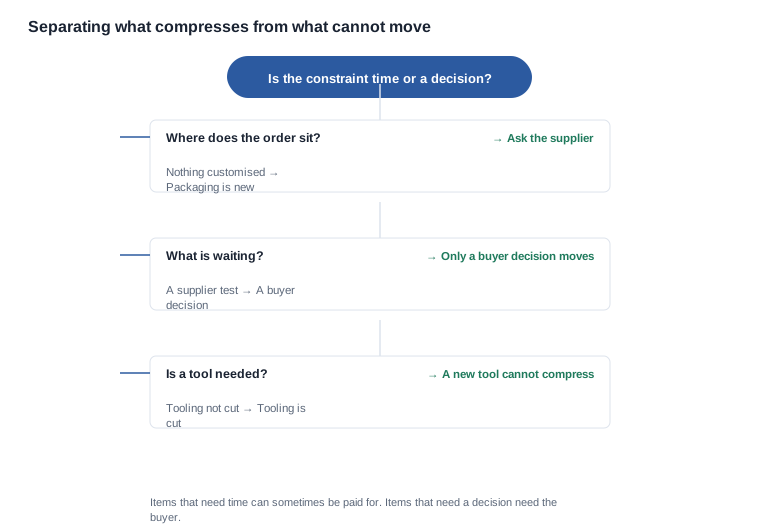
One thing a supplier should never do, and one you should watch for: compress a test. If the answer to an expedite request involves shortening a certification test, changing the sample under test, or shipping against a document that does not name your model, that is not a faster delivery. It is a unit that cannot be sold in the market you intended. A refusal to compress a test is the single clearest sign that a supplier is managing the schedule rather than managing your anxiety.

What can you expedite costs, and the question that reveals the answer
Expedite has a cost, and it should be quoted before it is agreed. The components are a freight premium, priority material sourcing with a surcharge, express air on components, the handling cost of splitting a shipment, the administrative cost of a second customs entry, and in some cases overtime or a different supplier for a component.
A supplier who says yes to expediting without saying what it adds has either absorbed the cost quietly or has not understood the question. Neither is a good basis for a schedule.
Ask the reverse question as well, because it reveals more than the price does: if the date slips by two weeks because of something on your side, does the expedite premium disappear? A supplier who has costed the premium as a fixed fee will have to answer that question. A supplier who has costed it as a real pass-through will tell you it falls away, and you will know which kind of arrangement you are dealing with.
One cost that buyers often discover rather than negotiate is the amortisation effect of splitting an order. A small first release carries the whole set-up — the material call-off, the line set-up, the first-article inspection — so the unit price of a rushed half-order is higher than the unit price of the full order, and it is higher by more than the freight premium alone. If you are going to ask for a partial shipment, ask for the unit price of the partial as a number, not only for the date it moves.
The other hidden cost is a quality one. Compression concentrates decisions. A factory that rushes a build to hit a date is a factory making fewer checks, and the units that come out of that build are the ones you will be dealing with when the customer complains. This is not an argument against expediting; it is an argument for attaching an acceptance condition to it, so that the accelerated units are inspected to the same criteria rather than to a relaxed version of them. Two ways to do that, both cheap: keep the same inspection method and frequency for the accelerated build, and have the accelerated units inspected by the same acceptance level as the balance of the order rather than by a first-article check.
And a third cost that is easy to leave out of the arithmetic: the effect on the relationship and on the next order. An expedite that was achieved by skipping a step is a precedent. If the factory learns that a date can be met by compressing a check once, it will remember. Buyers who expedite once and then expect the standard process to return are asking for something the supplier has no way to price.


How can you expedite handles a partial shipment
If the answer is that some units can go early, the specification of those early units is the whole question. They need to be the same product as the ones that follow, or the early units are a customer service problem that arrives three weeks before the main order.
Ask specifically whether the early units carry the final firmware, the final packaging artwork, the final accessory set and the same regulatory content as the balance of the order. Then check each of those four answers against what the later units will have, because the most common version of this problem is not a different product but a different version of the same product.
There are two further consequences that sit outside the factory and are easy to forget.
The market split. If the early units are destined for one market and the balance for another, the labelling, the inserts and the responsible-party information may differ. That is manageable if it is planned, and it is expensive if it is discovered at the consolidation step.
The warranty start. Units built at different times on different production windows have different build dates, and the warranty period is usually defined from shipment. Ask for the batch date of the early units so that your own records can distinguish them, and decide in advance whether the warranty starts at the first shipment or at the last. It is a small clause and it prevents an argument a year later.
And then the commercial mechanics, which are more expensive than people expect: a split shipment means a second freight booking, often a second customs entry, sometimes a second set of certificates for the destination, and a different cash cycle for the balance. Ask what the split costs in freight and in administration, not only in schedule.
There is one more thing to check before you accept a split, and it is the one that decides whether the early units are useful to you at all: are they the same in every respect the customer will see? That includes the packaging artwork, the accessory set, the insert language for the destination market, and the responsible-party information. A set of early units that differs only in the insert language is a small problem; a set that differs in firmware or in the accessories is a support queue.
Two inventory consequences that follow once the split is agreed. First, your spare and warranty replacement units should come from the same batch as the early units if the early units are the ones going into service, because a replacement that differs from the installed base creates a second support question. Second, your own receiving and inspection capacity has to absorb two deliveries instead of one, and the second one usually arrives when nobody is scheduled to receive goods.
The request that works when can you expedite is not the real question
Two formulations do most of the work in this category.
The first: what would you have to receive from us, and by when, to move the date? This converts a request into an exchange, and it is the form a factory can actually answer. It also has the useful side effect of exposing whether the constraint is theirs or yours, because the answer either names a date and an input, or it names your missing input.
The second: if a partial shipment is proposed, what specification does it carry? Ask it immediately, in the same message, because the answer determines whether the split is worth having at all.
Underneath both, there is a third move that experienced buyers make and that nobody writes down: volunteer your own dates first. State when the artwork will be approved, when the sample will be signed off, when the payment will release, and what is already fixed. Suppliers answer a specific commitment with a specific commitment, and they answer a vague request with a range. This is the difference between an expedite conversation and a scheduling conversation, and it costs one paragraph.
When the answer to all of this is no — the date does not work, the constraint is a certification test or a new die, and no amount of urgency changes it — the useful follow-up is not a harder request but a smaller one. Ask which of three things is true: the date moves, the specification changes, or the order splits. Then price each of those three and choose. A buyer who arrives at that decision in week one has a project; a buyer who arrives at it in week eight has a missed launch.
The three-way split is worth naming explicitly, because it maps onto three different conversations with three different suppliers' answers. Moving the date is a schedule negotiation. Changing the specification is an engineering and cost conversation, and it can be cheaper than you expect — a different model in the same family, a different colour, a standard packaging route instead of a private label one. Splitting the order is a logistics and cash conversation. Buyers who keep these separate make faster decisions, because each one has a different owner and a different approval path.
There is a fourth option that buyers sometimes do not consider because it feels like giving up: reducing the scope of what ships in the first release. If the constraint is a packaging proof, then the first release can go out with the approved structure and the artwork can follow in the second release, provided the customer-facing experience is unaffected. That is only safe when the two releases are not sold as the same SKU, which is a decision about your channel rather than about the factory, and it belongs to you.
Our practice is to answer all four questions against a specific configuration — the model, the specification, the quantity, the destination and the date you need — and to say so in week one if the honest answer is that the date does not work. That is not a negotiating position. It is the only way a schedule holds.
For the full picture of where a lead time comes from, the lead time and expedite factors page sets out the components; the development process and freeze points page shows where a specification becomes fixed, which is usually the point buyers want to accelerate; and the standard OEM sample process page shows the sample-to-order sequence that most expedite requests are actually trying to shorten.


