

Sometimes. And the reason the answer has to be conditional is that "a product that does not exist yet" describes at least four quite different pieces of work, separated by something close to an order of magnitude in cost and in schedule. Most of the disagreement in this category comes from a buyer describing one of them and expecting the price and the timeline of another.
The question also gets asked more often than it needs to be, because buyers tend to read a catalogue as a statement of what a factory is capable of. It is not. A catalogue is the configured subset of what the tooling, the electronics and the existing supplier base can already produce. The interesting engineering sits in the gap between the catalogue and the capability, and that gap is where a well-specified brief earns its money.
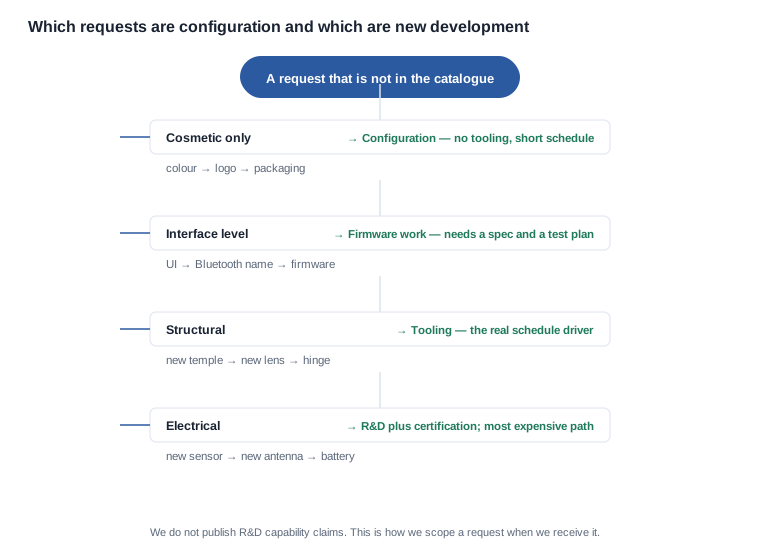
Can you make a product that does not exist yet: four categories of change
Cosmetic. Logo, colour, packaging, a printed accessory, a branded insert. This is configuration work on the existing hardware, with no tooling and the shortest schedule in the range. Our published customisation scope starts here, and it covers logo, colour, temple shape, system and user interface, Bluetooth device name and firmware, and packaging. The word to watch is temple shape: that entry refers to the profiles the existing tooling already supports. A profile that does not exist yet is not a configuration request, and it moves into the third category.
Interface. The system and user interface, the Bluetooth device name, the firmware. This is engineering work on hardware that already exists, and it is the category where the buyer's contribution matters most. A firmware request without an acceptance test produces an argument at the end of the project rather than a decision during it. It is also worth noting what our catalogue does not publish: there is no capacitive-touch row and no translation row anywhere in the range. If you want capacitive touch on a specific model, or a specific language interface, that is not a selection from the published options — it is interface development, and it needs to be scoped as such.
Structural. A new temple profile, a different lens mount, changed hinge geometry. This is tooling work, and it is the most common genuine schedule driver in this product class. It is also where the buyer who said "it is just a shape change" discovers that the antenna keepout, the battery volume and the acoustic cavity all sit inside the space they wanted to alter. A temple is not an empty shell; it is a housing for three things that were sized for the shape that already exists.
Electrical. A different sensor, a repositioned antenna, a different cell. This is the most expensive path, because it usually triggers certification work as well as engineering, and because the approvals that exist for the current product may not extend to a changed radio configuration. The catalogue publishes no per-model certification row at all, and the export-certification page is a picture page carrying ten patent certificate images, so there is nothing in the published documentation that transfers automatically to a changed electrical design. That has to be established for the new product, not inherited from the old one.
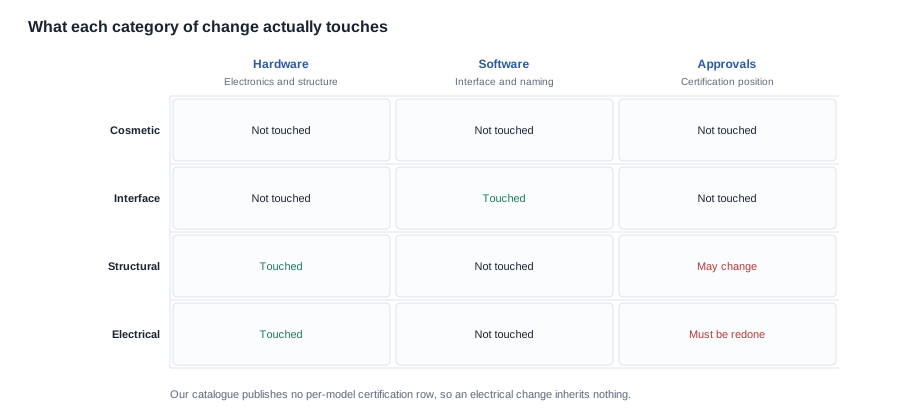
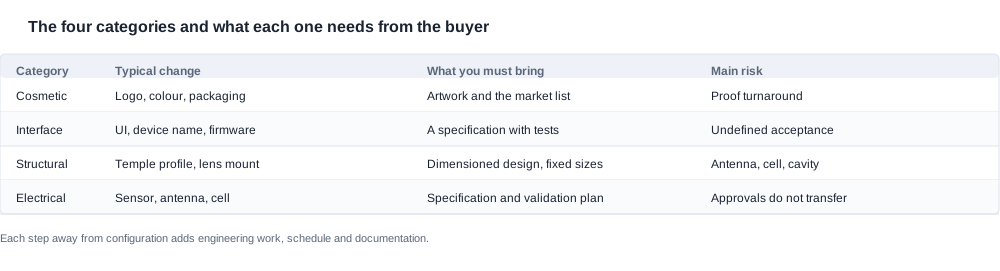
The order of these four is worth keeping in mind when a request arrives: they run from configuration, through engineering, through tooling, to engineering plus certification. A request that is presented in the language of category one and answered in the cost of category four is the most common way a new product development project goes wrong before it starts.
Worked examples, because the categories are easier to recognise with something concrete attached.
A brand owner wants its logo on the temple of an existing model, in two colourways, with a matching box. That is category one, and it is a configuration and artwork request — except for one question that turns it towards category three, which is whether the temple profile that carries the logo exists in the tool set today or has to be cut.
A channel buyer wants the Bluetooth device name to show their brand instead of the factory's, because the units will sit on a shelf next to a competitor's. That is category two, and it is small: it is a firmware and configuration item with a short validation, and the specification is one line. It is also the kind of request that becomes expensive if it is treated as a packaging job, because a printed brand and a connected brand are different commitments to the customer.
A sports brand wants a different lens tint on a camera model. That sounds cosmetic and is not, because photochromic and coloured lenses change the optical path, and in our catalogue only the V03 Pro publishes photochromic lenses with three colour options, while the V06 publishes four colours. Moving a tint onto a model that does not publish one is a development item with an optical validation behind it.
A distributor wants the camera model with a longer battery. That is category four. The camera range publishes batteries of 220 to 290 mAh and a runtime of about five to eight hours with no test condition published, so a different cell changes the volume inside the frame, the runtime claim, and possibly the charging method — magnetic charging is published for 17 models and Type-C for 7, with the method not published for the CY03, the CY05, the L1 Pro and the MT6. It is also the category that reliably triggers validation and certification work.

Why can you make a product that does not exist yet depends on how far you move
"Is this possible?" cannot be answered, and a supplier who tries will give you a non-answer that sounds like an answer. "Is it possible to change the temple profile, keep the existing electronics, and add a second colourway?" can be answered, and the answer contains a category, a cost structure and a schedule.
So the first job is to push every request to that level of specificity before it is sent. Concretely, four things have to be pinned down:
- The reference platform. Which catalogue model is the starting point, and which of its published rows are being kept.
- The acceptance test. What a working sample looks like, how it will be checked, and what happens when it does not pass.
- The market. Where it will be sold, because the certification position, the labelling and the inserts all follow from that.
- The date. Not the launch date, the date by which you need something in your hands to work with — a sample, a first article, a pre-production run.
The reference platform is the one buyers skip and the one that matters most, because it is what turns an abstract request into a delta. Without it, two suppliers will quote two different products and the quotations will not be comparable. With it — "the L2 Utral, keeping the 1400 mAh case, changing only the temple profile and the logo" — the request becomes an engineering brief that can be costed, scheduled and compared.
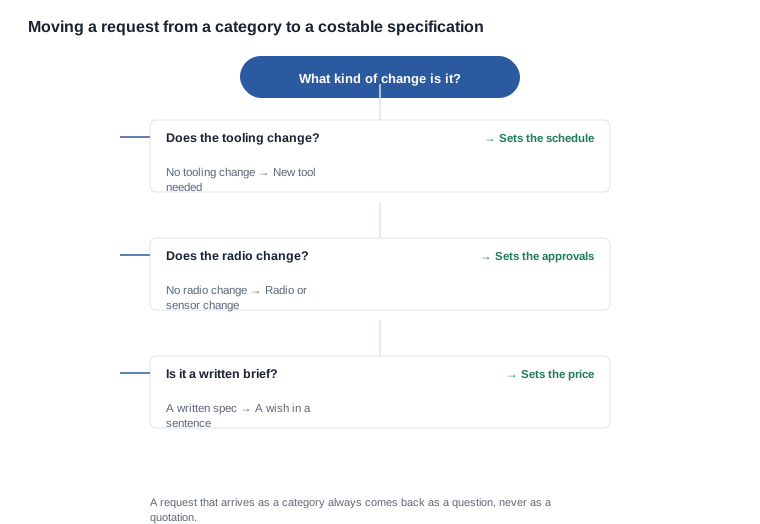
A second thing worth separating early: a capability question and a project question. "Can you do this at all?" is a capability question and it deserves a straight yes or no, with the conditions attached. "Can you do this for our launch?" is a project question, and the answer depends on the date, the quantity, the market and how much of the work is already defined. Suppliers who are given both at once tend to answer the first and leave you with the impression that the second has also been answered. Splitting them takes one extra message and saves an expensive misunderstanding.
There is also a version of this question that is really a different question: "can you make this cheaper by changing the design?" That is a value-engineering request, and it is often the most profitable conversation a buyer can have, because it starts from a product that already works. Asking what could be simplified — a different case, a different accessory set, a different packaging route — usually produces a better outcome than asking for a new product that would do the same job.
A fourth distinction that catches people out: between a product that does not exist yet and a specification that does not exist yet. A new product is a new product whichever way you arrive at it, and the honest answer to "can you make this that does not exist" is sometimes that the request is really asking for a feature inside an existing product, which is a cheaper and faster project with a much better chance of hitting a date. It is worth testing every brief against that question before the brief is written, because the discovery is cheap at that point and expensive afterwards.

What to bring so can you make a product that does not exist yet can be answered
For interface and electrical work, what you bring is a specification rather than a wish. The distinction is the whole trick: a request expressed as an aspiration produces a quotation for the cheapest thing that satisfies the words, and then the first sample does not do what you imagined.
A specification that survives contact with a factory contains seven things:
- What the product must do, written as behaviour rather than as a feature name.
- What it must not do, because the failure modes you have excluded are the ones you will be shown.
- How each requirement will be verified, by whom, and with what equipment.
- What happens when it does not meet the requirement — the rework path and the acceptance level.
- Which version it applies to, so that later changes are priced rather than absorbed.
- The interface points the change touches: the firmware, the Bluetooth device name, the user interface, the packaging.
- The market and the date, again, because they change the cost of the same work.
For structural work, bring a dimensioned design or a reference you trust, and mark explicitly which dimensions are fixed — usually the ones that set the battery volume and the acoustic cavity. Be explicit about tolerances, because "close enough" between a 3D file and a mould is a mould you pay for twice. And bring the template question in advance: does the new structure reuse the existing electronics, and if so, what has to change around them?
For everything, bring the quantity and the forecast beyond the first order, because tooling amortisation and the unit economics of a new product depend entirely on the volume you will actually run. A new product designed for a 200-unit pilot and a new product designed for 20,000 units are different projects, and a quote that does not distinguish them is not a quote.
Bring also the decision process on your side, because it is usually the thing that stops the project. Who signs the specification, who pays the engineering, who owns the design, and how long each of them is allowed to take. A brief that has to be approved by four people in three departments with no named decision-maker at any point will sit in someone's queue, and the supplier's schedule will quietly absorb that delay while looking like a manufacturing problem. Naming the approver before the brief goes out is one of the cheapest things you can do for the project.
And bring the one thing buyers almost never bring, which is the answer to "what will we do if this does not work". A development project has at least two plausible outcomes: the design lands as specified, or it lands close enough and you accept a variation. Deciding in advance which variations you would accept, and which you would not, is what prevents the project from ending in a dispute about a requirement nobody wrote down.
The engineering customization page sets out what a custom brief needs to contain, and the ODM development and validation route covers how a development project is structured and validated. Both are worth reading before the brief is written rather than after it is rejected.


Where can you make a product that does not exist yet gets expensive
The cost jumps do not come from the visible change. They come from the three things that sit inside the space you want to change, and from the approvals that follow.
The antenna. It occupies a keepout that cannot simply move, because moving it changes the radio behaviour in ways that a Bluetooth version number cannot describe. Our catalogue publishes a Bluetooth version for 14 of the 28 models, and not for the eleven camera models, the A05, the A06 or the bone-conduction entries. A version number is a protocol statement; it is not evidence that a repositioned antenna performs. That is why an electrical change triggers validation work rather than a firmware task.
The battery volume. The camera models publish batteries between 220 and 290 mAh with a rated runtime of about five to eight hours and no test condition published. The audio range publishes per-side cell figures of 55 mAh on the doubled-cell models and 100 mAh on the single-cell ones. Change the cell and you have changed the volume that has to fit inside the temple, the runtime that is published for the model, and in most cases the charging approach — magnetic charging is published for 17 models and Type-C for 7, with the method not published for the CY03, the CY05, the L1 Pro and the MT6.
The acoustic cavity. An open-ear frame works because the cavity is shaped to let sound out while keeping the microphone useful. Change the cavity and you change the sound characteristics. Only the D11 publishes surround audio in our catalogue, and the D17 publishes Surround Sound while the ZH12 publishes 立体环绕音, so those published claims are precisely the ones a temple change would put back in question.
The approvals. A structural change is usually inside the existing approvals. An electrical change often is not, and where it is not, the work has to be established per model rather than inherited. Our catalogue does not publish a per-model certification row, so there is no published position to point at in either direction.
The market paperwork. A new product is a new product for the purposes of the documentation that travels with it. In the European Union, the General Product Safety Regulation has applied since 13 December 2024, which means the responsible party identification, the warnings and the instructions have to be established for the new configuration rather than copied from the model it was derived from. A changed temple does not change those obligations; a changed electrical design may change them entirely, because the identity of the manufacturer and importer information sits on the device and the packaging and has to match the technical file for the product as it now exists.
The tooling and its ownership. A new tool is a one-off cost with a lead time set by the tool maker, and its ownership, storage and end-of-life terms belong in the agreement from the first day. Buyers who have not thought about who owns the mould at the end of the relationship are making a decision later, under pressure, when they have no leverage.
The practical consequence is that the visible change and the project cost are only loosely related. A temple profile change can be a modest tooling item or a full re-architecture, and the only way to know which is to have the engineering look at the reference platform and tell you what is in the way.
The commercial terms behind can you make a product that does not exist yet
A development quotation should be separable into at least four lines, because each one behaves differently and each one is negotiable on different terms:
- Engineering. The hours and the disciplines needed to turn your specification into a working design, usually quoted per line of the specification rather than as a lump sum.
- Tooling. The physical asset, its ownership, its storage, and whether it is amortised across your first order.
- Validation. The testing, the test articles, and any certification work, which follows the testing body rather than the negotiation.
- Unit price at volume, with the tier boundaries written down.
Ask for these separately. A single bundled figure hides which part is a one-off that you might amortise and which part recurs on every order, and it makes the quotation impossible to compare with a quotation structured the same way by somebody else. The same applies to the boundary between engineering hours and new tooling: a change that can be absorbed into existing tooling looks very different from one that needs a new tool, and the answer determines the schedule more than the engineering does.
The negotiation list for a development project:
- Which requirements are fixed and which are open, and the price of moving each one after the design starts.
- The validation plan, with the acceptance level for the first article and what happens if it fails.
- Who owns the tooling, where it is stored, and what you receive at the end of the relationship.
- Who owns the design and the firmware, and whether those can be used with a second supplier.
- The pilot order, its quantity, and the unit price at the volumes you actually forecast.
- Whether the sample you receive becomes the golden sample for production, and how it is recorded.
- The engineering support position after the launch — whether changes to the design are billed at an hourly rate or absorbed.
That fourth item deserves a moment of its own, because it is the one buyers most often defer and most often regret. In a category where a hardware brand can be built on someone else's platform, the design and the firmware are the part of the business that stays with you. If they cannot be used elsewhere, the relationship is the moat, and the relationship should be priced accordingly. If they can, you have an option, and an option is worth negotiating for rather than paying for.
Two more commercial items that belong in the same conversation. The first is the amortisation question: if the engineering is a one-off and the tooling is a one-off, then both are sunk costs that a first order carries entirely, and the second order is where the unit economics actually appear. Ask for the unit price at two quantities rather than one, because a single quoted price hides the whole shape of the curve. The second is the transition question: what happens to the product you were selling before. If the new one replaces it, there is a question about the last order of the old one, the spare units for the old one, and the warranty stock for the old one, and those three numbers belong in the launch plan rather than in the launch week.
When you shortlist two factories for a development project, the criteria are not the same as the criteria for a catalogue order. A catalogue order is judged on unit price, lead time and the published specification. A development project is judged on the engineering depth, the validation plan, the schedule realism of the answer, and who owns the design at the end — and on whether the factory gave you a specific, checkable risk rather than a general reassurance. The due diligence question that is worth asking is which one of them has taken a development project through to production, and the answer is checkable through a reference call, a development project reference, or a visit to the engineering bench rather than to the showroom.
One more decision that belongs here rather than in the engineering section: which model becomes the reference platform. This is a commercial choice as much as a technical one, because the reference platform determines the tooling that may already exist, the certification position that may partly carry over, the accessory set that has to be bought, and the parts of the current design you are inheriting whether you wanted them or not. Choose the platform that makes the change you care about cheapest, and accept the compromises elsewhere, rather than starting from the platform that is merely the most popular.
One practice we would recommend to anyone starting a development project: ask for the feasibility answer before you commit the brief. A supplier who tells you, in week one, that the change you want requires a new antenna configuration and a new certification route has saved you a month. A supplier who tells you in week six has taken the month. The most useful single question in this category is not "can you build it" but "what would have to be true for this to be a two-month project instead of a six-month one" — and the answer is usually a specific, actionable item rather than a refusal.
And the question that should be asked even when everything else is going well: is this project worth doing at all? Sometimes the honest answer is that a product that does not exist yet costs more than the market it opens, that the specification will grow by half again before it is signed, or that a close variant of an existing model achieves most of the benefit at a fraction of the cost. That answer is worth more than an optimistic quotation, and it is the answer a supplier who wants a second order will give you if you ask for it in the first week rather than in the third month.
The OEM and ODM engagement models page sets out how this kind of work is scoped and priced, including where a development project sits relative to a standard OEM order. Send the reference platform, the specification, the market and the date, and you will get a category, a cost structure and a next step rather than a vague answer.
Related reading
- engineering customization requirements
- ODM development and validation
- smart glasses OEM engagement models
Send the change at specification level with your market and date, and we will tell you the category and the next step.


