
Consumer vs industrial smart glasses what buyers most often ask is a set of questions that looks like a list of features and is actually a list of assumptions. Each one below has a short answer, and the short answer is usually not what the question is really about.
The reader is a brand-side product or sourcing manager, a channel buyer or an e-commerce selection team who has been asked to find a grade for a deployment. What they are managing is a spend that is easy to over-specify and expensive to under-specify, and the questions below are the ones that decide which of those two mistakes they are about to make.
Consumer vs industrial smart glasses: the questions underneath the questions
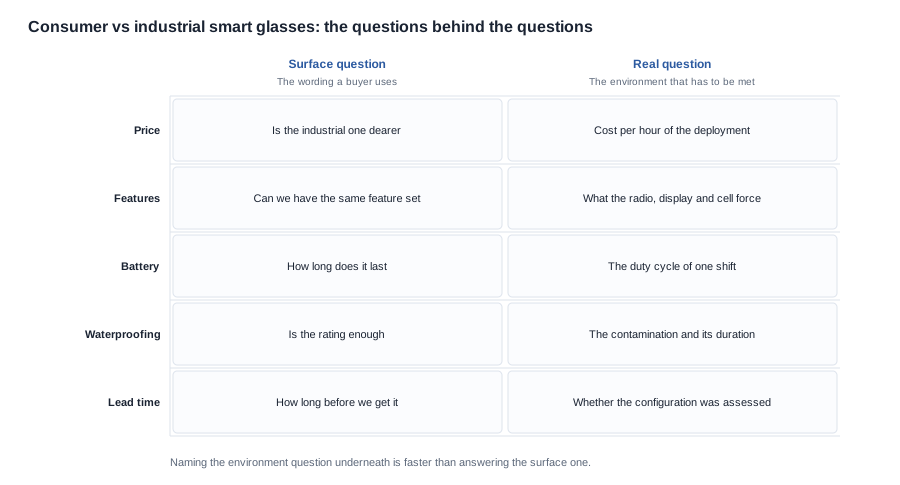
Almost every question in this category is a feature or a price question sitting on top of an environment question. The buyer asks about the battery because they are worried about a shift; they ask about the price because they suspect they are paying for a grade they do not need; they ask about the waterproofing because they have a specific contamination in mind.
Naming the environment question underneath is faster than answering the surface one, and it produces an answer the buyer can act on. The matrix above is the whole set in one picture: five surface questions and the environment question that actually decides each of them.

The price question is a deployment-cost question
Is the industrial one much more expensive?
Often not proportionally, and the comparison is misleading because the price difference is mostly documentation, service and qualification rather than materials. The useful comparison is against the cost of the deployment over its life, and the number that usually decides it is the cost of downtime.
Two things follow from that. The first is that a per-unit price comparison is the wrong comparison for this decision, because it does not include the failure cost, and the failure cost is what separates the grades. The second is that the industrial grade earns its price in a specific set of deployments rather than in all of them — and a buyer paying the premium for a deployment that does not need it is buying insurance against a risk that was never present.
The cost items that are not in the unit price are worth listing, because they are what the grade actually buys: the qualification work against a named standard and class, the documentation scope, the availability of a defined spare and replacement path, the traceability that allows a single unit to be identified, and the service commitment. A supplier quoting an industrial grade without pricing those is quoting a grade, not a deployment.
The trade-off to watch is the one where a cheaper unit fails more often and each failure is more expensive because the units are not individually tracked. That is a cost of ownership question, and it is usually answered by the traceability question rather than by the price question.
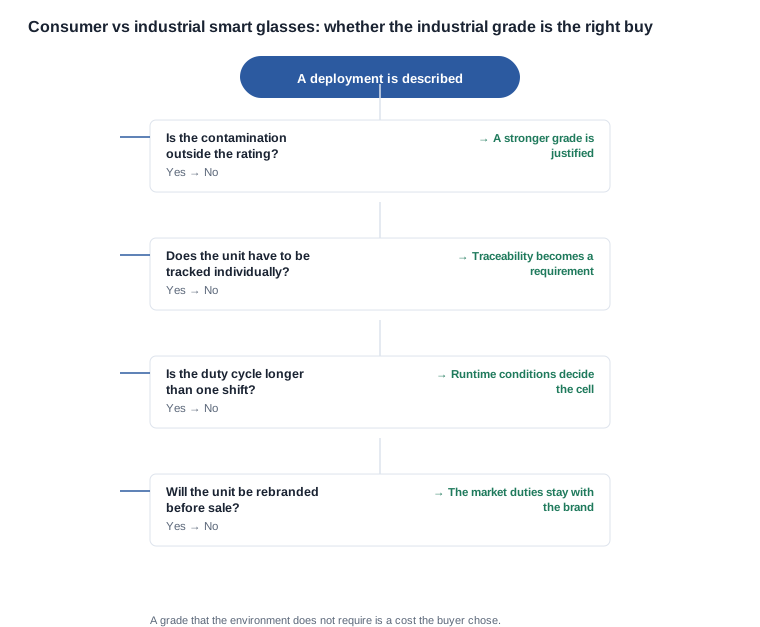
The decision tree above is the version to take into the specification meeting. Each branch removes a reason to buy the stronger grade: contamination outside the consumer rating, individual tracking, a duty cycle longer than a shift, and rebranding before sale. Where none of the four applies, the buyer has a justification for the consumer grade and the supplier has a reason to quote it.
The environmental question behind every other one
Can we get the same features in the industrial version? Often, yes. The construction and the sealing are where industrial units differ, not the electronics, and a feature set is usually not what forces the grade. If a supplier is quoting a different feature list for the industrial version, ask why — the honest answer is usually about the radio, the display or the battery, all of which have real reasons to differ.
Will it survive our warehouse? That is a qualification question and it has a specific answer format — standard, version, class, configuration. A supplier who answers in adjectives has not performed one for your warehouse, whatever the website says.
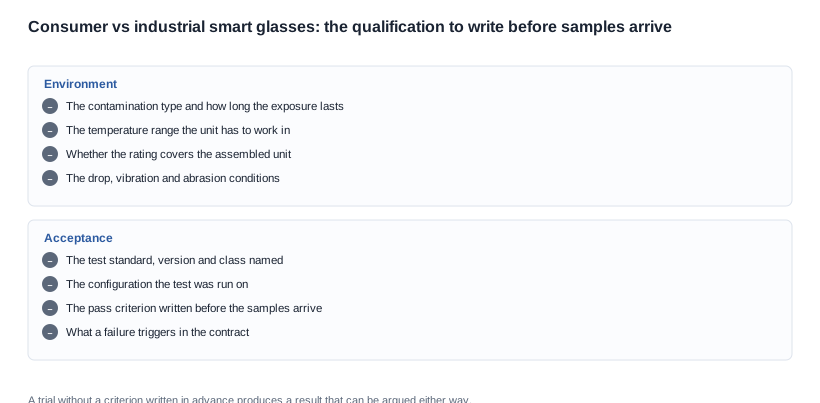
Can we trial it first? Yes, and the value of a trial depends entirely on whether the acceptance criteria were written before the samples arrived. A trial without criteria produces a result that can be argued either way, and the argument goes in the direction of the order.
Who do we call when a unit fails? The service model, and it is a question worth asking early because the answer determines whether a failure is an outage or a replacement. A unit that is individually tracked can be replaced; a unit in an untracked deployment is a unit that is out of service until someone notices.
The programme questions, which are really schedule questions
What is the lead time? Longer than the consumer equivalent, and the reason is usually qualification rather than manufacturing. A configuration that has been assessed before is a shorter conversation than one that has not, which is worth asking about explicitly.
The lead-time question is where the grade premium usually shows up, and it is worth decomposing it. Part of the lead time is the qualification itself, part is the tooling and the fixture work, and part is the documentation and the assessment. Only the third of those is affected by whether the product is consumer or industrial, and a supplier who quotes a single number for the lead time is not separating them. The question that separates them is whether the configuration has been qualified before, and the supplier who has done it will say so in terms rather than in adjectives.
Do we need the certification for the EU as well? That depends on where the product will be sold and who is placing it on the market, and it is a separate question from the grade. The market-access regimes attach to whoever sells the product, and the industrial qualification attaches to the product. A brand that rebrands a product inherits the market obligations and inherits none of the environmental evidence automatically.
This separation is a common source of confusion in programmes that start in one market and expand into another. The environmental qualification and the market-access position travel on completely different vehicles: one travels with the physical product and its records, the other travels with the party that sells it. A supplier who can describe the environmental evidence for the product has still told you nothing about the market position for the destination, and the reverse is equally true.
Can the grade be changed later? Sometimes, and the answer depends on what changed rather than on the grade itself. A different enclosure, a different finish or a different packaging configuration generally leaves the environmental qualification intact, though it may touch the labelling. A different cell, a different charging arrangement or a different radio module is a different question entirely, and for a device whose environmental qualification is the reason for the grade, it may reopen the qualification itself.
The battery question is missing its conditions
How long does the battery last? The question is missing its condition, and the answer is meaningless without it. What matters is the working hours, the display brightness, the radio activity and the temperature. Given those, the answer is a shift rather than a headline.
This is where the catalogue rows in this category need to be read carefully rather than quoted. A published runtime is a figure produced under a condition the buyer does not know, and a published charge time is a ceiling rather than an exact value — our own range publishes a charge time of two hours or less for twenty-six of its models and about an hour for two others, with no starting state and no end criterion stated. A buyer comparing two units on a headline runtime is comparing two numbers whose conditions are unknown to both sides.
The useful question to ask a supplier is the condition, not the number: under what duty cycle, at what radio duty, at what temperature, and with what display state was this measured. A supplier who can answer is describing a measurement. A supplier who repeats the catalogue figure is relaying it.
The waterproofing question has three variables and one that decides it
Is the waterproofing enough? The question has three variables and one of them usually decides it: whether the rating was obtained for the assembled product or for a sub-assembly. The other two are the type of contamination and the duration of exposure. See the IP rating article for what each digit of the code actually establishes.
The assembled-versus-sub-assembly distinction is the one that decides the answer, because a rating on a sub-assembly tells you nothing about the seam, the connector and the button that are the actual weak points of a finished device. And the rating itself is not a claim about capability in any given environment: it is a statement about a test performed under a stated condition, and the condition is where the comparison happens.
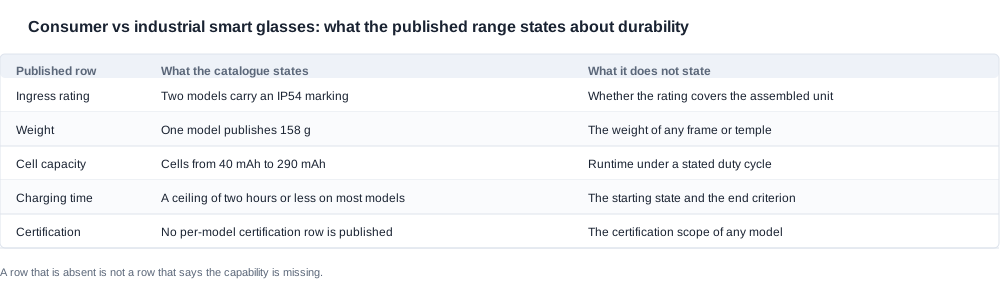
The table above is what our own published range says about durability, and it is worth reading as a specimen of how sparse a catalogue's environmental rows usually are. Two models in the range of twenty-eight carry an IP54 marking. One model publishes a weight, and it is the weight of the glasses body of a camera model, excluding its folding charging case. Cell capacities run from 40 mAh to 290 mAh with no runtime stated against a duty cycle. And no model carries a certification row at all.
Every one of those is a row that exists, and the point is not that the products are weak. The point is that a catalogue is a summary, so an absent row tells you what the catalogue prints rather than what the product does. Where a buyer needs a durability position, it is written material to request, and the request should name the configuration and the environment.

What our range publishes about environmental durability
Two models in our published range carry an IP54 marking. That is the whole of it, and it is worth being precise about what the marking does and does not establish, because a buyer who treats a published rating as a general durability claim will build a deployment around it that the data does not support.
An IP54 marking states that the unit resists dust ingress and splashing water, under a defined test. It does not state a period of immersion, it does not state a resistance to a directed jet of water, it does not state a temperature range, it does not state a chemical resistance, and it does not state which configuration was tested. Where a deployment involves a wash-down routine, a high-pressure cleaning regime or a solvent, an IP54 marking is not evidence for any of them, and a supplier asked to support such a deployment has to produce something more specific than the marking.
What our range publishes beyond that is the electrical and physical rows that describe each model. Cells from 40 mAh to 290 mAh. A charge time of two hours or less on twenty-six models and about an hour on two, which is a ceiling rather than a precise figure, with no starting state and no end criterion. One published weight of 158 g for the glasses body of the MT6 camera model, which excludes the folding charging case, whose own weight is not published. No frame weight is published for any model, and no capacitive touch row is published for any model.
We publish no per-model certification row, and the company-level export certification page in our catalogue is a page of images rather than text, so the catalogue text names no certification standard for any model. The certification scope of a given model is written material to request rather than something we will quote, and the same is true of the environmental qualification of any model in this range.
We will describe what our catalogue holds and we will not print a figure we do not hold. A buyer who needs a durability position, a certification scope or a runtime under a stated duty cycle should ask for it in writing against a named model and configuration, and should treat the answer as the specification rather than as a summary of one.

The qualification question worth adding to the list
Almost every question above is a feature or a price question sitting on top of an environment question. There is one question that buyers rarely ask and that tells you more about the supplier than any of the others.
What does the supplier do when the deployment is wrong? Not the return policy, and not the warranty, but the question of whether the supplier will look at the failure data and change the product, or whether the contract treats it as a return.
The answer tells you what kind of relationship you are buying into. A supplier that asks for failure descriptions has understood that the deployment is where the information is, and a supplier that accepts returns without asking what happened is going to ship the same product again.
There are two related questions worth adding alongside it. What happens to the qualification if the configuration changes — does the qualification follow the configuration or the product name? And who owns the evidence, the supplier or the buyer? A supplier that keeps the failure data and the qualification records, and can show them to the buyer on request, is a supplier whose position improves with volume. A supplier that treats both as internal has a position that has to be re-established every time the arrangement changes.
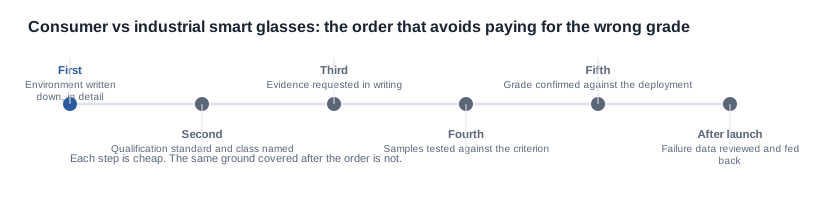
The order on the timeline is the whole of the recommendation, and each step is cheap. The environment is written down before anyone is asked for a price, so that the grade is a consequence rather than a preference. The qualification standard, version and class are named, so that the answer has a format. The evidence is requested in writing, so that the answer is a document rather than a claim. The samples are tested against a pass criterion written in advance, so that the result cannot be argued either way. The grade is then confirmed against the deployment, and the failure data is fed back afterwards.
The one step that is skipped most often is the third. Asking for the evidence in writing costs one message and it converts the whole evaluation from a conversation about capability into a review of documents, which is the only basis on which two suppliers can be compared fairly.
What the industrial grade actually changes in the product
The word "industrial" describes several different things in this category, and a buyer who does not separate them will pay for a grade that does not address the failure mode the deployment actually has.
The environmental qualification. A documented test against a named standard, version and class, for a named configuration. This is the part that most people mean, and it is the part that a documentation request can establish: ask for the standard, the version, the class, the configuration tested and the test method, and ask for the result as a document rather than as a marking on a listing.
The construction. Sealing, the material of the enclosure, the connector and the mechanism design. This is the part that is invisible in a specification and visible in a sample, and it is the part that determines whether the qualification would hold for a unit built to a different tolerance than the sample.
The traceability and the service. Whether individual units are identified and can be tracked, what the replacement path is, and how long a failed unit takes to come back. This is the part that converts a failure into an outage or into a replacement, and it is often worth more than the environmental qualification itself in a deployment where units are individually assigned.
The documentation scope. A wider set of records, retained for longer, with an index. This is the part that determines what you can answer three years later, and it is the part that costs nothing per unit and is almost never quoted as a line item.
The trade-offs between them are the reason the grade question is worth separating before the price is discussed. A buyer who needs only the service and the traceability can often get them without the full environmental qualification, and a buyer who assumes the four always travel together will over-specify a product that has to survive an office rather than a warehouse. Conversely, a buyer who assumes the environmental qualification implies the traceability will discover that the qualification is a document about a sample rather than a system that follows a production unit.
The criteria for the shortlist are therefore four separate questions rather than one. What is the environmental qualification, and against which standard, version, class and configuration. What is the construction, and can it be seen on a sample. What is the traceability and the service commitment, in numbers. And what is the documentation scope, with the retention period stated.
What to ask a supplier, then, is short: which standard, which version, which class, which configuration was tested, what the retention period is, how a unit is identified, and how long a replacement takes. None of those requires a supplier to hold a certification for a category the deployment may not need, and all of them can be answered in writing by a supplier who has done the work. The question that cannot be answered in writing is the one that decides most programmes — whether the supplier has ever had a device in a deployment like this one — and the way to ask it is to ask about a specific configuration and a specific environment rather than to ask about the category.
Related reading
- Consumer vs Industrial Grade — the framework
- IP ratings — what each digit of the code establishes
- Consumer vs industrial smart glasses: how to choose
- Consumer vs industrial smart glasses: the certification rules
- Consumer vs industrial smart glasses: do you actually need them
Every one of these is an environment question wearing a feature question's clothes.


