

Material is the decision that changes a product most and shows up least in a catalogue. A logo is a photograph, a color is a swatch, a firmware build is invisible until it behaves differently — but the material of the front, the temple and the hinge decides how the product feels in the hand, how much it weighs on the face, how it survives a pocket, and whether the color you approved in sample form will still be there in year three. Choosing correctly among the customization options for frame materials is therefore less about finding a premium-sounding name and more about matching a physical behaviour to a channel.
The published position is thinner than a buyer expects, and it should be read before a brief is written rather than after a sample arrives. Per model, our catalogue publishes weight for exactly one product, an ingress rating for exactly two, and no composition, no coating, no hinge, no mount and no material row at all. The material options themselves are published separately, as a range-level list, on our materials and ergonomics page.
Customization options for frame materials: the published position
Here is what the catalogue actually gives you to work with, model by model.
Weight. One figure exists in the entire range: 158 g for the MT6, published as the glasses only and explicitly excluding its 1200 mAh foldable case. That single number is worth reading twice, because it is published for the one model where a camera, a larger cell and a folding case coexist. Every other model in the range — the eight audio-tier models, the three sport-tier models, the eleven camera models, the three kids-tier models — publishes no weight at all.
Ingress. Two models carry an ingress rating: the V06 and the S7, both published as IP54. No other model in the range publishes an ingress figure, which means a program that assumes a sealed or splash-resistant product outside those two models is assuming something the catalogue does not support.
Material composition. Not published per model. The range publishes its material options as a list on the materials and ergonomics page, and the standard OEM programme describes the configurations those materials are used in, but no product row in the catalogue states what a given model is made of.
The remaining structural rows are absent as well. There is no published hinge specification, no published temple adjustability row, no published lens mount row, no published coating or finish row, no published temperature rating, and no published composition or substance statement for any model. There is no per-model certification row anywhere in the catalogue: the export certification page carries ten patent certificate images and nothing else — eight design patents and two utility models — and the catalogue body itself mentions CE, FCC, RoHS, RED and EN 18031 not at all.
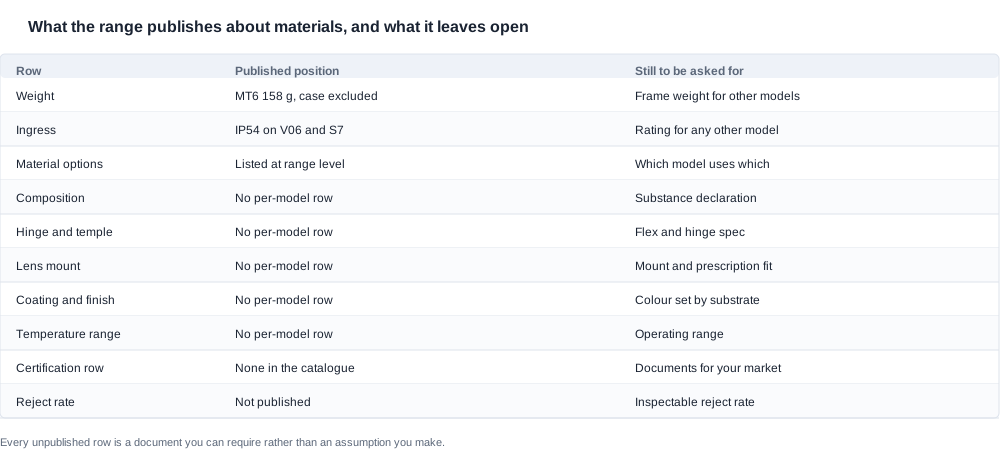
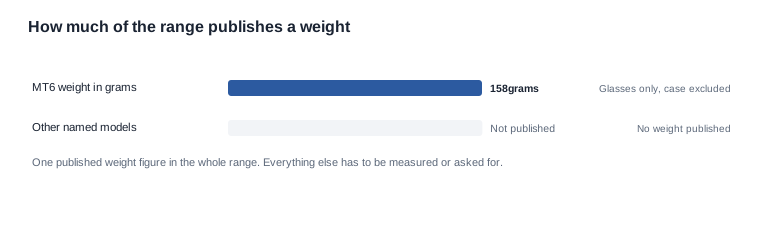
Read that table as a shopping list of questions rather than a list of gaps to complain about. Each unlisted row is a document you can require, and each document is a better foundation for a quotation than an adjective in an email.
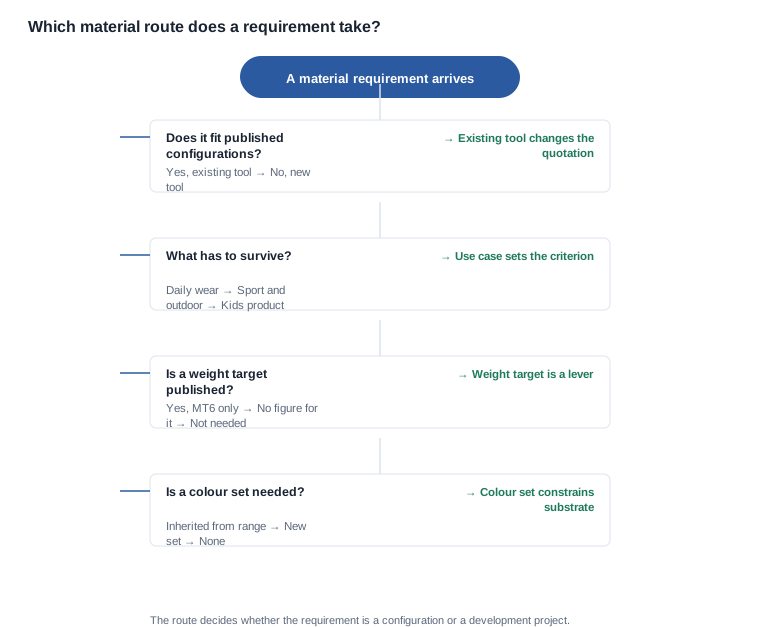
The route matters because it decides which quotation you should ask for. A material that already runs in a standard configuration is a configuration question, and its lead time, its minimum order quantity and its color set are known. A material that does not is a development question, and everything about it is open until an engineering sample has been built.
The selection criteria for a material, in the order that actually decides it:
- What has to survive? A sport program has a different answer to drops, sweat, heat and salt water than an eyewear program has to a hinge and a lens fitting. Start from the use, not from the material name.
- What is the weight budget? If your program has a published weight figure to hold against — and only the MT6 does — the material is the main lever you have.
- What color set does the program need? Color availability is a property of the substrate as much as of the pigment, so the color list constrains the material.
- What does the design have to look like in three years? A premium material that ages badly is a warranty conversation later, not an aesthetic choice now.
- What tooling does it create? A material change is a tool change, and a tool change is capital, lead time and an amortisation question. The standard OEM programme page sets out the configurations in which the existing tooling can absorb a change, and the engineering customisation page covers the cases where it cannot.
That fifth question is the one that most often arrives too late. Material is discussed in the design phase, chosen in the sample phase and discovered as a tooling cost in the quotation phase. Moving it to the front of the sequence is the single highest-value change in most programmes.
Customization options and what each material decision changes
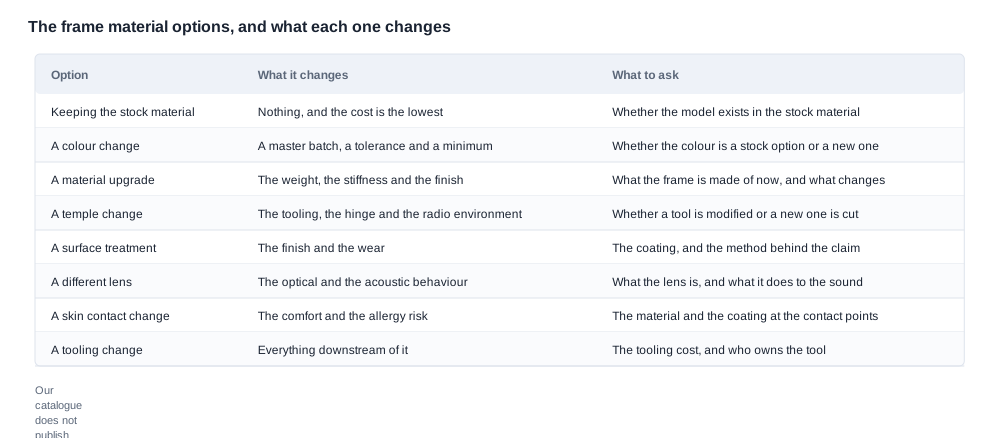
A material decision is never one decision. The front, the temples, the hinge and the temple tips can all be different materials, and each combination changes a different thing.
Weight and balance. Material density is the largest single contributor to frame weight after the electronics and the cell. On a camera model the electronics dominate; on an audio model the frame dominates. A program with a weight target needs to decide which parts it is willing to make heavier to save elsewhere, and the answer is usually the temple, because a lighter temple moves the centre of mass towards the front of the frame and away from the ear. That is the trade-off our sports and cycling weight write-up works through, and it is a trade-off, not a free reduction.
Temple flex and hinge behaviour. Flex is what makes a frame comfortable over a long day, and it is a property of the material and the section together. A temple that is too stiff transfers impact straight to the hinge; a temple that is too soft loses the geometry that keeps the electronics and the camera pointing the right way. Hinge longevity, and whether the temple can be adjusted by a shop, are not published for any model, so a program that expects either has to ask for the specification rather than infer it from the design.
Environment and durability. Heat, ultraviolet exposure, sweat and salt water each attack a different material system, and a rating that applies to the product as sold may or may not apply to the material after a coating or a color treatment is added. Only the V06 and the S7 publish IP54, so a program that needs a published ingress figure has two anchors, and the third option — establishing a rating on a different model — is a test programme with its own cost and its own lead time.
Finishing and color. Whether a color is achievable on a given substrate depends on the pigment and the surface treatment together, and the failure mode is a color that passes on a sample and fails across a production lot. This is why the color matching article treats a master part as mandatory rather than desirable, and why the color list is agreed after the material, not before it.
Lens mounting and prescription. A frame that has to accept a prescription lens has constraints that a fashion frame does not: edge thickness, the depth of the front, the shape of the groove, and the tolerance between the lens and the frame that keeps the lens seated. The lens materials article covers the optical side, and for the frame side the practical point is that a material change can move the mounting geometry.
Tooling. This is where a material decision gets expensive. Tool material, tool life, surface finish, shrinkage and warpage tolerance, and the fixture that holds the part are all set by the material choice, and a material that moulds well but warps badly is a scrap problem, which is a unit-cost problem, which is a quotation problem.
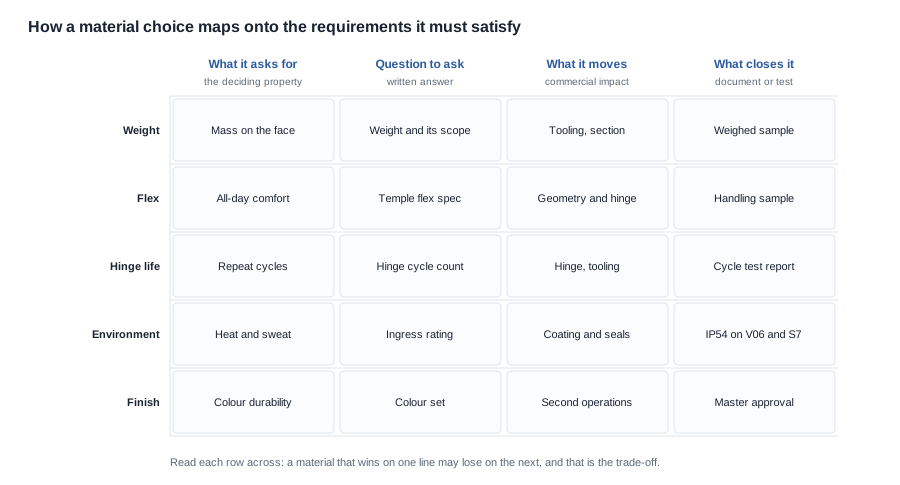
The matrix above is the negotiation aid we would use with a buyer. Read it across, not down: a material that scores well on weight and badly on finish is a material for a different program, not a material for this program with a compromise.

Customization options: what to ask whichever material is chosen
These questions are material-agnostic on purpose. They apply whether the answer is a standard configuration from the published range or a new material developed for your program.
- Which material options are published for the range, and which of them are used in which standard configuration?
- For my specific model, what is the weight of the frame alone, and what does the published figure exclude?
- What is the temple profile and section for the material I am choosing, and is the hinge integrated or separate?
- What tolerance do you hold on the critical dimensions, and how is it inspected?
- Which colors are available on this material, and which are development items with a setup cost?
- What is the effect of the material and finish on the ingress position of the model — and if the model is the V06 or the S7, does the published IP54 apply to the finished, coated product?
- What happens to the material at the extremes of the operating temperature range, and what is that range?
- What composition or substance documentation can you supply for the material, and from which laboratory?
- What conformity documents accompany the shipment for my destination market, and under whose name are they issued?
- What is the tooling implication — new tool, new insert, new fixture — and what is the lead time for each?
- What is the scrap or reject rate you plan for on this material, and how is it controlled?
- What is the warranty on the frame and the hinge, expressed as a period and a term, and does it differ from the electronics warranty?
Questions 8 and 9 belong together, and they are the pair most often skipped. The certification side of a supplier evaluation has to be verified against documents rather than assumed from a catalogue — the certification checklist exists for exactly this reason. Note that our own catalogue carries no per-model certification row and does not itself name CE, FCC, RoHS, RED or EN 18031, so the honest position is that the documents for a specific model and a specific market are requested, received and checked, not assumed.
Question 11 is the commercial one wearing a technical uniform. A material with a good finish and a high reject rate is an expensive material, and the reject rate is invisible in a quotation until someone asks where it appears. It belongs in the acceptance criteria, because a reject rate is an inspection criterion as much as a production statistic.
Question 12 matters more than it looks. A frame warranty and an electronics warranty are different commitments with different failure modes, and a buyer who assumes they are the same discovers it in the returns queue.

Customization options and the trade-offs that decide a material
Five arguments recur in material programmes, and all five are decided by criteria rather than by preference.
Weight against durability. Stiffer, harder materials are usually heavier and last longer; lighter materials flex more and may deform. The resolution is not a compromise on the frame but a deliberate split: a harder front and hinge where impact happens, a lighter temple where the frame is held, and a stated weight budget to judge the result.
Cost against finish. The cheapest material that can carry a color is not always the cheapest material that can carry it well. Coatings, secondary operations and tighter tolerances add cost, and the question to ask is what each addition buys in terms of the color holding up over the product's life.
Flexibility against structural stability. A temple that flexes well can lose alignment, and alignment matters more when the temple carries a camera than when it carries nothing. The camera tier's geometry is a different design problem from the audio tier's.
Perceived quality against evidence. A material name on a spec sheet persuades nobody in a buyer's meeting and nobody on a shelf. What persuades is a weight figure, a published ingress rating, a material that feels right in the hand, and a durability statement you can stand behind.
Sustainability without documentation. Environmental claims are increasingly required in tenders, and they are only useful if they come with a document. Ask for the declaration, ask what it covers, and ask whether it covers the finished product or only the raw material.
The negotiation levers on material are fewer than on unit price, and they operate earlier in the programme:
- Tooling amortisation. Whether the tool is a one-off payment spread across orders, or a recurring charge per unit, changes the second order more than any first-order discount.
- The split of materials. Using a premium material only where it is visible can deliver most of the perception benefit at a fraction of the cost, and it is worth pricing both splits explicitly.
- Volume commitments. A material with a supplier-side minimum needs a forecast, and a forecast is a negotiation instrument in both directions.
- Reject rate. A stated and measured reject rate in the acceptance criteria is worth more than a promised one in an email, because it moves the cost to where it can be controlled.
Two red flags to watch for. The first is a specification written in material names with no properties, which cannot be inspected and cannot be compared between suppliers. The second is a published ingress rating quoted for a model whose finish has changed — the rating was published for the product as it was specified, and a new coating or a new substrate is a new question.
The pitfalls are familiar: choosing the material at sample stage, approving a color on a material that was never quoted, treating a weight figure that excludes the case as a total weight, and assuming a frame warranty covers a hinge that the buyer replaced.
Customization options in a material program: from sample to order
The sequence below is the one we would run, because each step removes a decision from the steps that follow.
Step one — write the requirement as behaviour, not as material. "Must survive daily wear, must hold a hinge adjustment, must not discolour in sun, target weight for the frame alone." That statement can be answered by any of several materials, which is the point: it keeps the door open until the published options have been priced.
Step two — shortlist against the published range. Take the material options published for the range and the standard configurations in which they are used, and keep the two or three that could meet the behavioural requirement. The materials and ergonomics page is where the range-level list sits, and the standard OEM programme shows which configurations those materials already run in.
Step three — check what the material does to the programme. New tool or existing tool? New colour set or inherited one? New lens mount or unchanged? New weight target? Each answer is a commercial term, and each one belongs in the quotation.
Step four — build the sample and handle it like a real product. A material sample that has been handled, flexed, sat in heat and been dropped tells you more than a pristine one. What you are looking for is feel, flex, hinge action, surface quality, and how the color and the finish behave after handling.
Step five — approve a golden sample and write the acceptance criteria. The acceptance criteria for a material are physical and measurable: dimensions with stated tolerances and an inspection method, weight with a stated scope, color against a retained master under a stated light, hinge cycles if the program relies on them, and the documentary items from the list above.
Step six — settle the commercial position. Unit price for each material split, minimum order quantity, lead time per configuration, sample fee, warranty, and the tooling and NRE position. None of these is published, and all of them belong in the quotation and the purchase order rather than in a later negotiation.
Step seven — plan the repeat order. The question a buyer should ask before the first order is whether the second order is cheaper. A material and tool combination that amortises well makes the second order structurally cheaper; one that does not makes it the same price with more volume risk. That difference is visible at quotation time and invisible afterwards.
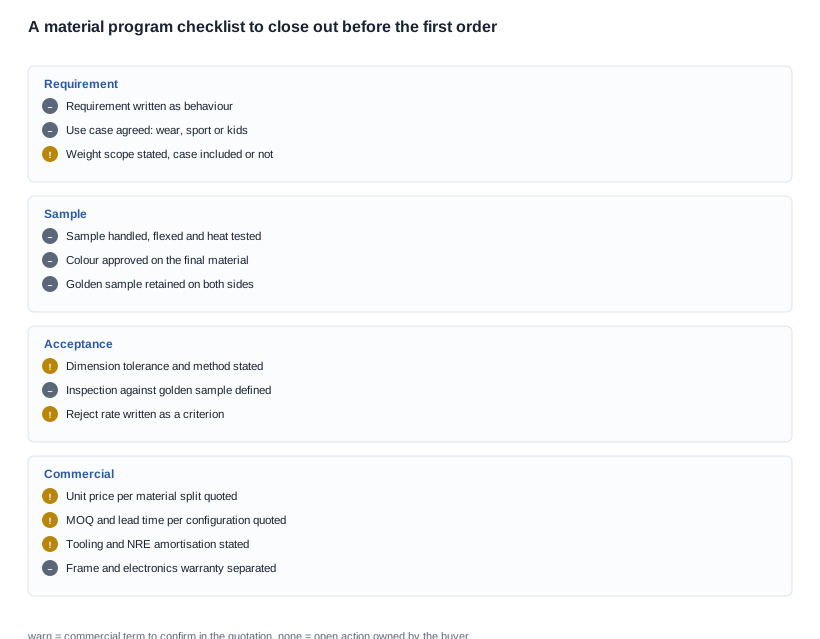
The checklist is deliberately a mix. The items marked as open actions belong to the buyer, because they are the decisions a supplier cannot make for you. The items marked as commercial terms belong in the quotation, because they are the ones that decide whether the program is worth running.
The questions to ask the supplier, in the order that surfaces the commercial answers earliest:
- Which material options are published for the range, and which configurations use them?
- For my model, what is the frame weight, and what does that figure exclude?
- Is my material choice compatible with existing tooling, or does it need a new tool, insert or fixture?
- What is the lead time for each material configuration, and does it differ from the standard configuration?
- What colors are available on each material, and which are development items?
- What tolerance and inspection method apply to the critical dimensions?
- What documentation accompanies the shipment for my market, and who issues it?
- What is the warranty on the frame and hinge, and how does it differ from the electronics?
- What is the tooling and NRE position, and how is it amortised into the second order?
- How do you verify a material or finish change against the approved golden sample?
The last one is the acceptance question, and it is the one that decides whether a change of material can be absorbed later. If the supplier cannot describe how a material or finish change is verified against the golden sample, then a change is not a change request — it is a restart.
A material programme is worth taking slowly at the front and quickly at the back. The decisions that are expensive to reverse — the material, the split, the tooling, the colour set — belong in the first two conversations. Everything after that is execution.
Our published position on materials is deliberately modest. The range publishes its material options and its standard configurations, and the product rows publish weight for one model, ingress for two, and nothing else about what a product is made of. Where a number is missing, we will tell you which document has to be produced to fill it, and we will not fill it with a value from a comparable product. Send the behavioural requirement rather than the material name, and we will tell you which published options could meet it, what each one changes, and what each one costs.
Related reading
- Customization options
- The standard OEM route
- Engineering customization
- Materials and ergonomics
- Certification checklist
- Lens material options
- Weight optimization for sports and cycling brands


