
Lens material is one of the customization options that arrives latest in most smart-glasses programmes, and it is the one that moves cost the most when it is finally discussed. Buyers can settle a frame colour, a temple profile and a logo treatment in a first meeting, then discover in week six that the lens category sitting underneath all of it was never defined. The published range cannot close that gap on its own: it carries no lens material row, no transmittance figure, no coating description and no polarisation rating for any of its 28 models. The gap therefore has to be closed with a written requirement, a sample in the agreed tier, and a specification that survives contact with a production order.
This guide is written for the buyer who has to sign off a specification and defend it later. It covers four things: what the range actually publishes, what it leaves unstated for every lens material, the three questions that are genuinely different from one another, and where a prescription requirement collides with a tint decision. It closes with a clear account of where we stand, so that you can separate what is documented from what still has to be negotiated.
Customization options for lens materials: what the range publishes
The honest answer to the first question is short: nothing about lens material is published in this range. That answer is more useful than it first appears, because the catalogue is not uniformly vague. It is specific about a number of engineering fields and completely silent about lens construction. That pattern tells you the silence is deliberate rather than a formatting accident, and it tells you where you will have to generate your own evidence.
Across the range of 28 camera models, charging time is published for all 28. For 26 of them the published figure is an upper bound of 2 hours or less, and for the remaining two — D17 and ZH12 — the published figure is about 1 hour. Charging interface is published for 24 models, split between magnetic and Type-C, with four models — CY05 and L1 Pro, and CY03 and MT6 — carrying no interface line. Bluetooth version is published for 14 models, while 11 camera models publish no version at all. Ingress rating appears for exactly two models, V06 and S7. Pixel count is published for 11 models in total: 8MP across eight models and 13MP across three.
Against that density of published engineering data, the lens section of the same catalogue contains no material designation, no light transmission value, no coating reference, no refractive index and no polarisation line. Not one model out of 28 carries such a row.
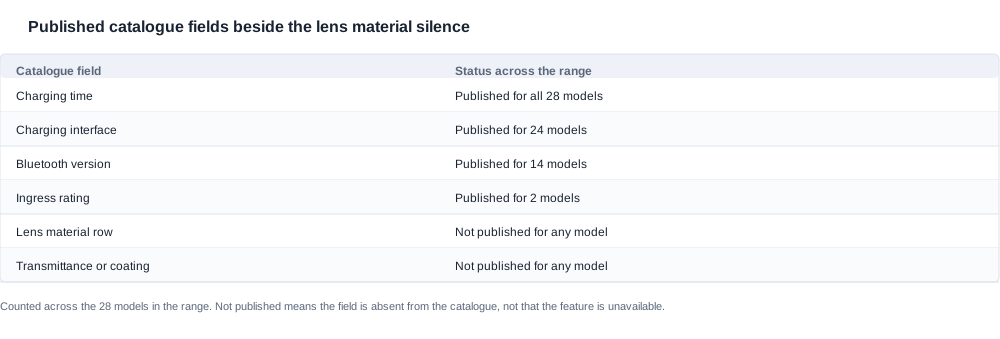
The table above is deliberately a comparison, not a specification. It is the fastest way to brief a colleague who has been told that "the lens is standard". The right-hand column shows which of those fields a buyer can read directly from the published data and which have to be raised as an open question with the supplier.
The practical reading of this comparison is a set of four categories that any lens material conversation should name explicitly. First, the base material tier: the construction category the quote is based on, which determines optical clarity, surface robustness and the unit cost band you are working with. Second, tint density: the darkness category that changes how the product reads in product photography, in a shop, and in the hand of a user. Third, the coating treatment: the surface layer that governs reflection, smudge behaviour and the way the lens looks under indoor lighting. Fourth, the optical function: a separate axis entirely, covering behaviour such as light-responsive tinting, which is a different engineering commitment from a static tint.
Treat those four as four conversations, not one. A supplier who answers a question about material tier has not answered a question about tint density, and a sample delivered in a dark tint says nothing about coating behaviour. This is the same discipline used in the frame and temple material guides, where the four axes are also separated before any sample is requested.
Translating those four axes into a sample request is what stops a material conversation from turning into an opinion exchange. A sample request should name the tier, the tint density, the coating treatment and the optical function, and it should state whether one unit is expected to demonstrate all four or whether they are being evaluated separately. When the four are bundled into a single physical unit, you lose the ability to attribute an outcome to any one of them, and you can no longer tell whether a disappointing result belongs to the material or to the finish.
Keep the material discussion separate from the specifications the range does publish, because those fields are already fixed points. Pixel count, charging interface and ingress rating are documented for the models that carry them, and a lens tier decision does not silently change them. When a supplier answers a material question with a performance figure taken from a different part of the specification sheet, that is a signal the question was not received as a material question at all.

What is not published for any lens material
Because silence is so complete on this topic, it is worth listing the missing fields precisely, so that no one on the buying side later mistakes an absent row for a decided one. The following are not published for any of the 28 models in the range.
- No lens material row, and no grade or category naming.
- No light transmission or transmittance percentage.
- No coating, anti-reflection or surface treatment reference.
- No refractive index value.
- No polarisation rating or polarised designation.
- No prescription, degree or focal power row of any kind.
None of these absences means the capability is unavailable. The same is demonstrably true elsewhere in the catalogue: 11 camera models publish no Bluetooth version, and four publish no charging interface, yet every one of them is a working camera product. A missing row is evidence about the document, not about the hardware. The question to ask your supplier is therefore never "do you have this feature" — it is "which tier are you quoting, and what evidence will travel with it".
One entry in the range needs careful handling. The V03 Pro page carries a colour-changing lens reference. That reference describes a light-responsive, photochromic behaviour, and it must be kept separate from the electrically driven colour-change entry that appears elsewhere in the range without a model designation. They are two different engineering approaches to a similar word. Treating them as one feature, or quietly widening either into a polarisation or ultraviolet-protection claim, is a straightforward route to a specification that cannot be delivered. When you write a requirements document, name the behaviour you want in physical terms — for example a lens that darkens under outdoor light — and require the supplier to state which mechanism delivers it.
Two other absences are worth noting because buyers raise them constantly in lens discussions. The range contains no prescription or degree information for any model, and it makes no functional claims about blue light filtering, reading support or vision correction. There is also no capacitive touch or gesture control row anywhere in the range, so a touch-controlled interface should not be assumed to exist simply because it is common in the category. If your programme depends on any of these, they belong in your written requirement rather than in your reading of the catalogue.
The practical checklist for this stage is therefore short. Write down which of the six absent fields your programme actually depends on. Rank them by commercial consequence. Take the highest-ranked one and ask for it in writing. Repeat for the second. Resist the temptation to write a paragraph covering all six at once — a broad request receives a broad, unfalsifiable answer, and the only thing you can act on is a specific one.
It is worth testing whether the silence on lens material is specific to this range or general to the document, because the two carry different consequences. Where a field is published for some models and absent for others, the absence usually reflects a data-collection boundary rather than a capability boundary: 11 camera models publish no Bluetooth version, and 4 publish no charging interface, yet those products are complete. A field that is absent across all 28 models is the stronger signal that the document was assembled without it, which means external evidence is the only source open to you and the due diligence burden sits on your side of the table.
Three questions that are different from each other
Most lens material negotiations collapse because three different questions are asked at once and answered with one paragraph. Separating them is the single highest-value habit in this part of the programme. The questions to ask a supplier are not variations on one theme; they concern different parts of the order, carry different risks, and need different kinds of evidence.
-
Which base material tier does your quotation assume, and what changes if the tier moves? This question fixes the commercial baseline. Ask for the tier naming you use, the properties that separate it from the tier below, and whether a tier change alters the unit cost, the tooling or sample cost, or both. A supplier who cannot name the tier they quoted has given you a price for an undefined object, and any later discussion becomes a negotiation about something neither side described. This is where a total cost view matters more than a unit price view, because the cost of a late material change is usually spread across three lines.
-
Which optical behaviour is being promised, and is it static or reactive? This question fixes the product claim. Static behaviour — a fixed tint, a fixed transmission level — is confirmed by a sample and a photograph. Reactive behaviour — a lens that changes with ambient light — is a different commitment, with different verification steps and different expectations of consistency across production units. If the supplier answers both questions with the same sentence, ask again in narrower terms: does the lens change during use, and what causes the change?
-
What written evidence will travel with the sample and with the production units? This question fixes your own risk. Ask what documentation accompanies a delivery: a material or tier line on the order confirmation, an agreed sample reference, and whatever test or inspection record the supplier normally issues for that category. Record the answer before the order, not after. The due diligence value of a written answer is that it can be compared with what physically arrives; a verbal answer cannot.
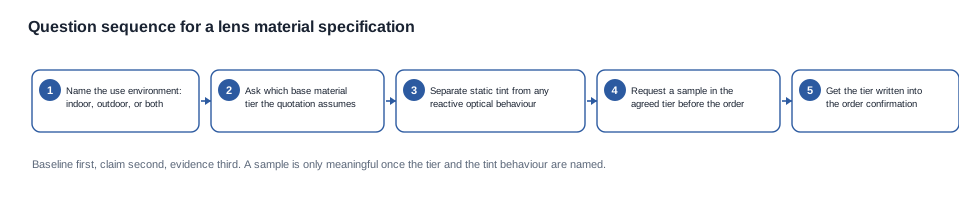
The sequence above is deliberately ordered. Baseline first, claim second, evidence third. Working the other way round is common and wasteful: a compelling demonstration of reactive behaviour in a showroom is much less useful before you know which tier is being quoted and what a unit should cost.
Recording the answers is a separate discipline from receiving them, and it is the part that protects the programme when a price argument starts. Keep one row per supplier and one column per question, with each answer quoted in the supplier's own words rather than paraphrased in yours. Add a fourth column for the evidence that will accompany the answer, because a supplier who names a tier in an email and another who names it in a signed document are not in the same position, whatever the wording of their replies.
When you negotiate the tier naming, ask for the naming before you discuss any price movement attached to it. Tier names carry information about material, and material carries information about cost, so a conversation that opens on price tends to close on ambiguity. Ask the neutral question first, take the definition, and only then ask what the definition does to the order. It is a small sequencing change, but it is the difference between a comparison you can act on and a negotiation you can only interpret.
How to evaluate the answers you get back is a separate exercise from how to obtain them. Three signals deserve attention. The first is a reply that uses optical terms without defining them — that is a sign of a catalogue answer rather than a specification answer. The second is a reply that changes tier language between messages — that is a sign the quotation was built on a default assumption. The third is a reply that answers only the material question and stays silent on evidence, which usually means the evidence does not exist yet in a form you can file.
When you shortlist suppliers, the comparison is not between brochures. It is between the clarity of the written answers to those three questions, and between how each supplier handles the request for a sample at a named tier. The sample process guide explains how to run that comparison without burning your own schedule on samples that answer the wrong question.

Where prescription and tint collide
Prescription support and tint are separate axes, and the most expensive confusion in lens specification happens when one is used as a proxy for the other. The range publishes no prescription or degree rows and no functional claims of that kind, so nothing in the catalogue will separate the two for you. You have to do it in the requirement.
The two axes behave differently. Tint is a density and appearance decision about the lens as it is manufactured. Prescription is a power requirement about the user's vision, which in a wearable frame is normally met either with a finished prescription lens or with a removable insert that the user fills themselves. The choice between those two routes changes the mechanical design of the frame, the way the lens is seated, the tolerance for user error, and the after-sales conversation you will have with customers who wear glasses.
Where they collide is in the sentence "we need tinted lenses for our prescription range". That single sentence contains at least four decisions: whether the tint applies to the finished lens or to a blank insert, whether the tint is fixed or reacts to light, whether the material of the finished lens is the same as the frame's default, and whether the colour shown in the product photography is the colour the user receives. A supplier quoting against that sentence will price one interpretation and deliver another.
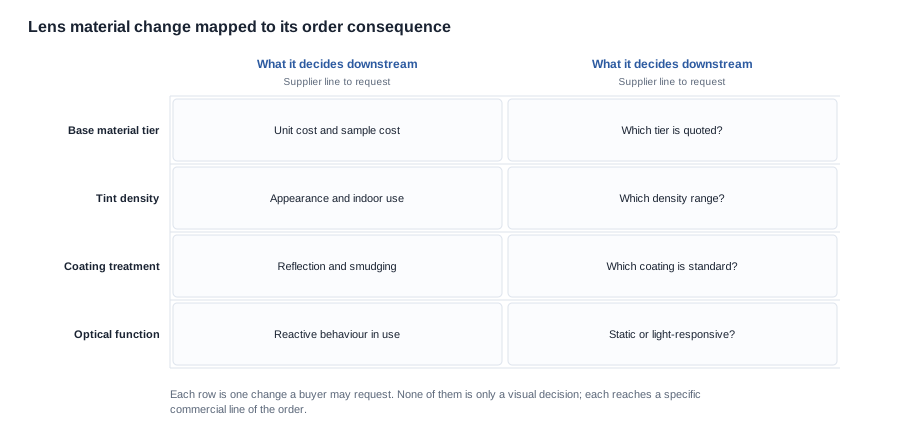
The matrix shows why a tint decision is not a visual decision. Each row is a change a buyer might request, and each one reaches past appearance into the commercial terms of the order. The trade-off is rarely between looks and nothing; it is between looks and a specific downstream line.
The insert route and the finished-lens route also divide the after-sales conversation in different ways. With a finished prescription lens, the correction sits permanently in the product and the customer owns the fitting. With a removable insert, the customer owns the insert, the frame has a sealed interface that must survive assembly and shipping, and the tolerance for a user fitting the wrong insert sits with your support team. Both routes are legitimate. What is not legitimate is discovering which one you have after the tooling has been cut, so put the route in the requirement rather than in the expectation. The cost of getting it wrong follows the same pattern as every other late change in this programme: re-sampling is not only the sample cost, but the calendar around it and the risk that a fresh sample reopens decisions you believed were closed.
A workable approach is to write two separate requirement blocks. The first block describes the visual outcome: the intended use environment, the tone of the lens, and the behaviour under indoor and outdoor conditions. The second block describes the fit and vision outcome: who wears the product, whether they need a correction, and how the lens is to be replaced or adjusted. Send them together, but ask for them to be answered separately. When you ask "how to evaluate" the responses, check that each block received a response of its own rather than a single combined paragraph.
The red flags at this stage are specific and easy to spot. A sample that is dark but has no stated density, when your requirement named one, means the requirement was never operational. A phrase like "same as the frame" used to describe the lens material means the supplier is defaulting, not specifying. And a request to remove a prescription insert being treated as a trivial change is a warning sign: if inserts are removable, the frame has an interface that has to be engineered and inspected.
Before you order, the evidence you should hold is correspondingly specific: a written material and tint definition for the lens as delivered, a sample reference that ties the visual block to a physical unit, and confirmation of which route the prescription requirement follows. Whether you are buying a standard range or OEM-ready products, these are the lines that should appear in the order file. If they are not there, they will not appear in the delivery either.
Where CYNRIN stands on lens material options
The position is deliberately narrow, and it is worth stating plainly because the alternative — inventing a grade the data does not support — is exactly the failure this article is about. We will not claim a published lens material grade, because the range does not publish one. There is no material row to point at, and describing one would be a fabrication regardless of how plausible it sounds.
What we will do is work from your requirement rather than from an assumed catalogue entry. Concretely, that means we treat the four axes separately in any quotation, we name the tier being quoted in writing, we separate a static tint requirement from any reactive optical behaviour, and we require that the same description travels with the sample and with the production units. We do not treat a colour photograph as a material specification, and we do not treat a missing catalogue row as a missing capability.
That distinction also shapes what we need from you before we can quote a lens material. A short written brief — the use environment, the expected tone, whether the product is sold as a fashion item or as a functional one, and any correction requirement — produces a specific, comparable answer. A request for "the best lens" produces a generic one. When you ask how to compare two supplier answers, the fairest test is whether you can write the answer into a specification row without translating it first.
The same discipline applies to the documentation that accompanies a delivery. The export certification page in this range is an image page showing 10 patent certificates — 8 design patents and 2 utility model patents. It contains no CE, FCC or RoHS text, and it is not a materials compliance record. Any claim about regulatory or material compliance has to come from a document you have seen, named by the supplier, before the order is placed.
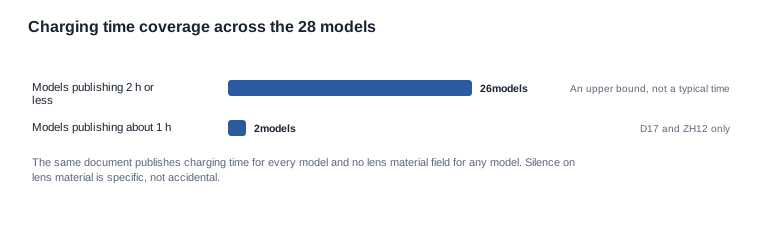
The chart is a reminder of where this range is precise and where it is not. Charging time is published for every one of the 28 models, with 26 models giving an upper bound of 2 hours or less and two models giving about 1 hour. The same document publishes no lens material field at all. That contrast is why a lens material programme has to be built from written questions and samples rather than from a data sheet.
The order file you assemble from this work should contain four entries, and they are the same four whichever supplier you end up with. A written material tier for the lens as it will be delivered. A tint and surface treatment definition stated separately from the tier. A sample reference that ties the visual outcome to a physical unit. And a statement of what evidence travels with the production units. If any of the four is missing when the order is placed, it will not appear at delivery, and the argument will happen at goods-in rather than at specification stage, where it is always more expensive.
The same file should record the questions that were not answered, with the date they were asked. That record is what lets you decide later whether an unanswered question is a supplier gap or a requirement you have not yet made precise. Most lens material programmes that end badly were never short of answers; they were short of a record showing which answers were still open when the order was released.
If you want the same discipline applied to the visual side of the programme, the lens colour guide covers the tone decisions, and the frame material guide covers the parallel questions on the frame side. To see how the individual decisions combine into one brief, start with the customization options overview.
Related reading:
- Choosing the frame material before the lens material
- Lens colour decisions and how they differ from material decisions
- Running a sample request that answers the right question
- The full customization options brief and its decision order
Send us the lens requirement — the use environment, the intended tone, and any correction expectation — and we will return a written tier definition with sample options, rather than a catalogue claim we cannot substantiate.


