

The CY03 publishes a 290 mAh frame cell, a 1400 mAh charging case, a charge time of two hours or less and roughly seven hours of rated use. It publishes no test condition behind those seven hours, and no case recharge count — which is the most useful number that could be added to this model, and the one that nobody publishes.
The CY03 also publishes no charging method row. The catalogue page for this model carries five rows: pixel class, cell capacity, charge time, runtime and case capacity. There is no row saying whether the frame charges magnetically or over Type-C, and no row for how the case itself is replenished. That absence sits awkwardly next to a published 1400 mAh case, and it is one of the questions worth resolving before this model goes into a range.
This article treats the two published cells as two different questions, explains what the missing charging-method row does to a private-label programme, and sets out how to obtain the case recharge count yourself rather than estimating it.
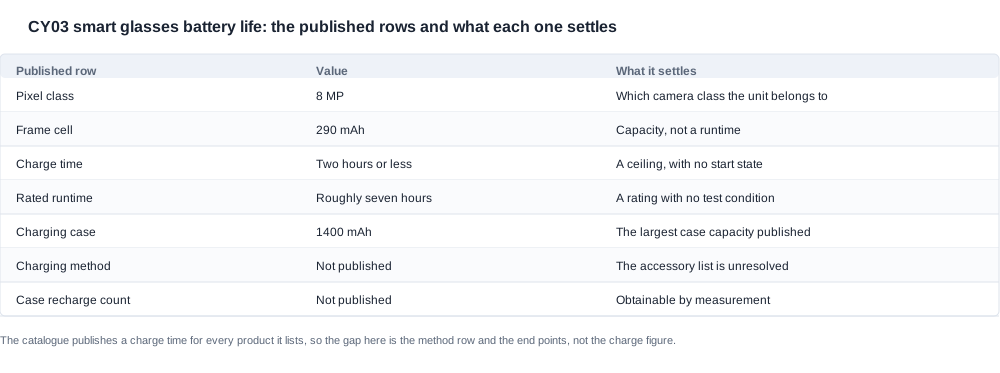
CY03 smart glasses battery life: the two cells
A camera product with a charging case has two batteries, and the published rows describe them separately because they answer different questions.
What the frame cell answers
A 290 mAh cell is a capacity, not a runtime. It is the joint-largest frame cell in the camera range, shared with the L2 Utral and the CY05, and the L1 Pro. On a camera product the camera is the dominant draw, so a cell of this size produces a very different result depending on how long the camera runs and how often the radio is awake.
The published runtime is roughly seven hours, and it carries no test condition. No volume or capture state, no radio duty cycle, no sample size, no ambient temperature. Treat it as a rating rather than a measurement, and treat the rating as a statement about a duty cycle rather than about the cell.
This is the same caution that applies across the range, where the published runtimes do not track cell capacity at all: paired 55 mAh cells appear against both six-hour and eight-hour figures. An untested number should never be used comparatively, and the smart glasses battery life guidance covers why.
What the case answers
A 1400 mAh case is the commercially important row on this page. It is the largest case capacity published in the catalogue, and it is what makes a sample-then-carry-every-day retail proposition possible for a camera product. It is also a documented, weightable number: the buyer can model the parcel, the insert and the landed cost today rather than after a sample arrives.
Three of the camera models publish a 1400 mAh case as their only case figure — the CY05 and the L1 Pro, and the CY03 — while the L2 Utral publishes two case options at 900 mAh and 1400 mAh, the MT6 publishes a 1200 mAh folding case, the KY06 and the MT5 have cases whose capacities are not published, and the catalogue lists no case row at all for the S7 and the V06, and the V03, while publishing the V03 Pro explicitly without one. All eleven camera models publish a runtime, which is a more complete picture than the case story, and it is worth knowing the two stories are not the same.
The row that is missing
No charging method is published for the CY03. The page has no charging interface row, and the same is true of the CY05 and the L1 Pro, and the MT6, while the L2 Utral has a Type-C row and the MT5 a magnetic row. For a private-label programme, that means the cable in the box, the accessory in the bill of materials and the charging arrangement the customer uses are all unresolved, and each of them is a decision with a cost attached.
The charging solutions guidance sets out how the different arrangements affect the accessory list and the customer routine, and this model is one where the buyer has to ask rather than read.
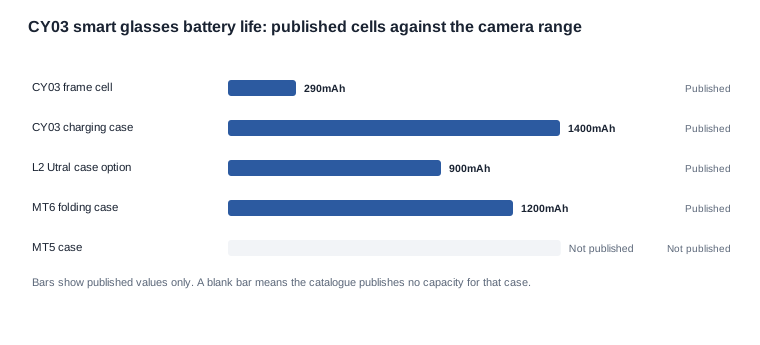

Why 290 mAh and 1400 mAh are different questions
The two numbers are routinely treated as one figure, and combining them is where the arithmetic goes wrong.
The ratio is a derived figure, and it is fragile
1400 divided by 290 is about 4.8, which invites a simple conclusion: five recharges from the case. That division is arithmetic, and it is not a specification. Three things sit between the two published capacities and the number of full recharges the customer will actually get: the charge the case retains when the frame is removed, the point at which the frame is called empty, and the conversion losses in both stages.
A derived figure should be labelled as one wherever it is used. A product page that says "up to five recharges" is making a claim that the published rows do not support, and a support team will be asked to defend it.
What the case changes about the proposition
The case changes the shipping model, not the endurance. A 290 mAh frame with roughly seven hours of rated use is a product for a session; a 290 mAh frame with a 1400 mAh case is a product for a week of sessions, provided the customer charges the case as well as the frame, and provided the customer knows they have to.
That last point is a design question rather than a battery question, and it is a real commercial risk. A customer who charges the frame but not the case will experience the product as a short-endurance product, and the review that results will describe the battery rather than the routine. The charging solutions guidance covers the handling side, and the instruction sheet that ships in the box is the place where the routine has to be set.
The weight line, and why it is not published here
Frame weight is not published for the CY03, and weight affects the power budget indirectly through the design it constrains. The catalogue publishes a weight exactly once across the range, for the MT6 glasses body at 158 g excluding its folding charging case, so the row exists in the catalogue's vocabulary and this model does not carry it.
The case weight is a separate number from the frame weight, and for a product where the case is a 1400 mAh cell in a housing, the case is likely to be the heavier object in the parcel. A buyer modelling the parcel should ask for both weights rather than assuming the frame figure dominates.
The charging method row this model does not publish
It deserves its own section, because it is the kind of gap that looks trivial on a product page and turns into a logistics project later.
What the missing row leaves unresolved
Three questions, and all three have commercial consequences. How does the frame reach the charger: magnetically, over Type-C, or by a dock that has to be in the box? How does the case itself get replenished, and is that a cable, a dock or an induction pad? And does the case arrive charged, and can the customer put a frame in a flat case, or does the case have to be open for the frame to charge?
Each answer adds or removes an accessory from the bill of materials, changes the parcel, and changes the instruction sheet. A model that publishes no charging method row is a model whose accessory list has to be negotiated rather than specified, and the negotiation is much harder after the artwork is approved than before it is released.
What the catalogue does tell us about the pattern
Across the camera range, the charging method splits into three groups. Across the wider catalogue seventeen models publish magnetic charging, seven publish Type-C and four publish no method row at all. Within the camera models specifically, the S7 and the V03, and the KY06 and the V06, and the MT5 publish magnetic charging, the V03 Pro and the L2 Utral publish Type-C, and the MT6 and the CY05, and the CY03 and the L1 Pro publish no method row at all.
That pattern tells a buyer that the row exists and is being maintained for most models, which is what makes its absence here meaningful rather than incidental. The four camera models without a method row are exactly the four that publish a case capacity, and that relationship is worth asking about directly: a product with a case may have a different charging arrangement for the frame, and the catalogue's silence may be a consequence of the arrangement rather than an oversight.
The five questions about the charging row
- How is the frame charged, and what is in the box?
- How is the case replenished, and what does that require?
- What does the case hold when the frame is removed, and how is that described to a customer?
- What is the measured case recharge count, and under what end-point conditions?
- What are the frame weight and the case weight separately?
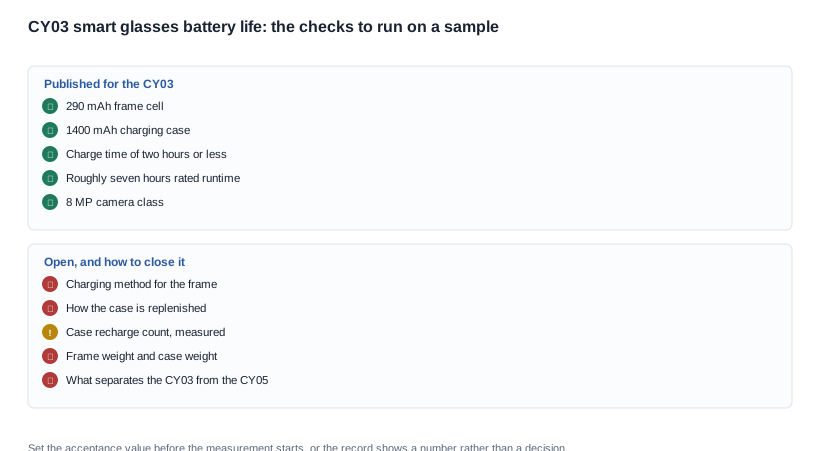

Measuring the case recharge count yourself
This is the one figure on the model that a buyer can produce in an evening, and it is more useful in a listing than any calculated number.
The protocol
Start with a full charge of the case and a full charge of the frame, and record both starting states. Then run the frame down to a stated end point, recharge it from the case, and repeat until the case reaches its own end point. The count that matters is the number of complete frame charges, and the end point has to be the same one in every cycle, because a count that mixes end points is not a count at all.
Record three numbers, not one. The number of full recharges. The residual charge left in the case at the end. And the frame runtime measured in the same test, because the two are only meaningful together: a case that delivers four recharges into a frame that runs for seven hours is a different proposition from the same case feeding a frame that runs for three.
Measure on a unit that has been used, not on a new one, and record the number of cycles the case has seen. A case that has been cycled is a different object from a new one, and a buyer who plans to ship thousands of units needs the number that holds after repeated use, not the number that holds on day one.
Why a measured number beats a calculated one
A measured figure with its conditions attached is defensible in a listing, in a channel conversation and in a tender response. A calculated figure is a rounding of two published numbers with an unstated end point, and the first question it receives will be "after how many cycles, and to what end point".
It also answers a question the catalogue cannot. The recharge count is the observable outcome of the two published capacities interacting, and it is also the only figure that shows whether the customer routine the listing describes is realistic. A buyer who measures it also learns how the case behaves as it empties, which is exactly where customers report problems.
The acceptance value
Set the minimum number of complete recharges before the measurement starts, along with the end point and the cycle count. A buyer who has not decided the acceptance value in advance will find a number and then decide it is acceptable, and the record will show a measurement rather than a decision.
What the sample order has to cover
A sample order for a model like this needs more than one unit, and the reason is specific rather than general. The questions that matter cannot be answered from a single device: the recharge count needs a unit that has been cycled, the case and frame weights need both objects, and the CY03 versus CY05 question needs one of each.
Three units in the sample order is the practical minimum for the protocol described above: one for the baseline measurement, one for the cycle measurement, and one as a spare for destructive or handling checks. The cost of that third unit is trivial against the cost of a range built on a figure nobody can reproduce.
The quotation request has to name the model and ask for the case with the frame, because the case is a published row on this model's page and a sample delivered without it tests a different product from the one that will be shipped. Quality control has a matching interest, since a sample that arrives without its case is a packaging failure, not a battery finding, and the two are easy to confuse.
The five questions to ask about the case
- Does the case arrive charged, and what state of charge is that?
- How does the case get replenished, and does the buyer need to hold two cables?
- What is the measured recharge count, and under what end-point conditions?
The third question has to be asked at sample stage rather than at quotation stage, because a supplier that has not measured it will answer with the ratio of the two published capacities, and that answer is what the buyer is trying to avoid receiving.
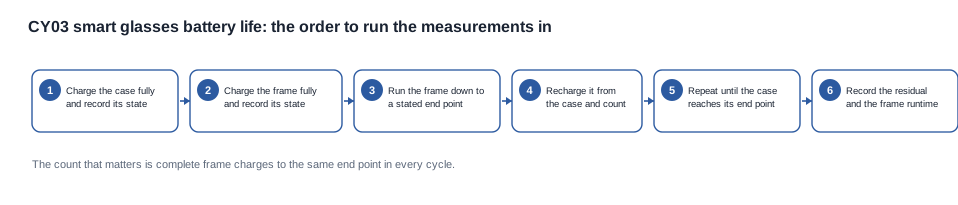
The three models that publish identical rows
One question has to be answered before this model is treated as a distinct option in a range.
What the catalogue publishes
The CY03 and the CY05 publish identical rows: 8 MP, 290 mAh, a charge time of two hours or less, roughly seven hours of rated use and a 1400 mAh charging case, with no charging method row on either page. The L1 Pro publishes the same battery and case rows — 290 mAh, two hours or less, roughly seven hours and a 1400 mAh case, again with no charging method row — but its camera class is 13 MP rather than 8 MP.
So three of the eleven camera models publish the same battery and case rows, and the catalogue does not state what separates the CY03 from the CY05. The L1 Pro is distinguished by its pixel class; the CY03 and the CY05 are not distinguished by anything on their pages.
Why this matters commercially before it matters technically
A range of two indistinguishable models is a stock problem as well as a documentation one. If the buyer cannot tell them apart, the buyer cannot tell which document applies to which unit, cannot write two accurate product pages, and cannot explain to a channel why one of them costs more.
The question to ask is precise: which published rows or unpublished attributes differ between the CY03 and the CY05? The answer might be a component, a supplier, a certification scope, a colourway or nothing at all. Until it is answered in writing, the prudent approach is to treat the two as one product with two names rather than as two products, because a range built on a distinction nobody can describe is a range that cannot be compared like for like.
How to choose between the three
How to choose between the three models is a decision a buyer should not make on the published rows alone, and the criteria that work are narrow: what the sample shows, what the supplier confirms in writing, and what the two models are actually for. The questions to ask are the ones above, in that order, and the red flags to watch for are a manufacturer that treats the two models as interchangeable, a case shipped without a measured recharge count, and a quotation that bundles the case into an accessory line.
The battery question is the one to ask first
Because the battery and case rows are identical, the recharge behaviour is the most likely place for a difference to appear if one exists, and it is also the row that is unpublished for all three. A sample programme that measures the case recharge count on both the CY03 and the CY05 will produce the first hard evidence of a difference, if there is one, and it costs the buyer an evening per unit.
What we will and will not state for the CY03
The case is this model's real battery asset and the runtime figure its weakest row, and we will not convert an untested seven hours into a working day or a derived ratio into a published number.
We will publish the 290 mAh frame cell, the 1400 mAh case, the charge time of two hours or less, the roughly seven-hour runtime rating and the 8 MP camera class, because those are the catalogue's rows for this model. We will not state a charging method, because the catalogue publishes no charging method row for it, and we will not describe it as magnetic or Type-C. We will not publish a case recharge count, a unit price, a minimum order quantity, a lead time, a frame weight, a case weight, a sensor model, an ingress rating or a certification status, because none of them is published for this model.
We will also not describe the CY03 and the CY05 as two products when the catalogue does not say what separates them, and we will not describe either of them as the better choice for a scenario. The published rows are a screening structure, not a recommendation, and a buyer who wants to know what differs should ask the question in writing and measure the answer.
Tell us the volume, the destination market and the intended channel, and we will tell you which of these rows we can evidence in writing and which have to come from a sample.
Related reading
- How case capacity changes your economics — charging solutions
- How runtime is measured on camera glasses — smart glasses battery life
- The camera range this model belongs to — AI camera glasses
Send us the volume and the market, and we will tell you which of these rows we can evidence in writing and which need a sample on the bench.


