

A specification comparison between two camera-equipped models settles only what both product pages answer. Where one page publishes a row and the other leaves it out, the gap is neither a strength nor a weakness — it is an open line that has to be closed in writing before either model can be shortlisted, quoted or listed. The pair examined here sits inside the same eleven-model camera group, publishes the same resolution class, and differs on precisely the rows that determine how a unit is powered, packed and shipped. This review reproduces the published rows side by side, separates the settled rows from the open ones, and converts every open row into a written question for the supplier. It does not rank the two models, because a ranking built on published rows alone would rank what was written down rather than what the hardware does.
CY05 against V03: what the catalogue actually publishes
A comparison starts by defining what a "published row" is, because these two models are documented at different levels of completeness. On these pages a row means a labelled line on the product page: a cell value, a runtime, a charge time, a charging method, a resolution class, a charging case capacity where one is given, and the feature rows where any are given. A label that exists elsewhere in the catalogue but is absent from these two pages is not a negative finding. It is an unpublished line, and the two situations need different handling in a procurement file.
Six standard rows are common to the group, and each of these two models answers five of them:
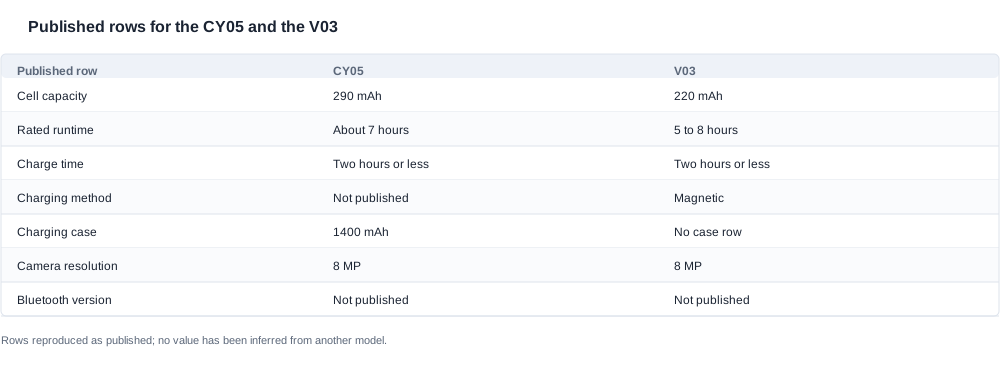
The table above is the whole of the documented comparison. Every value is reproduced as published, and no value has been carried across from a neighbouring model to fill a blank — a common shortcut in this category, and one that quietly manufactures a difference the source never made.
The rows that both models answer
Both pages publish a cell capacity, a charge time, a rated runtime, a resolution class and a charging method, and on both pages the charge time is published as two hours or less. On resolution the two are indistinguishable: eight megapixel on both. On power they diverge in a way that is easy to misread. The CY05 publishes 290 mAh and a point estimate of about seven hours. The V03 publishes 220 mAh and a range of five to eight hours.
That difference in kind matters more than the difference in value. A point estimate is a single figure produced under one set of conditions, whatever those conditions were. A range is a statement that the measurement varied, usually with volume, content or ambient conditions, and that the publisher is declining to pick one number. For a buyer building a product page, the range is the more honest of the two, because it can be republished as a range without further conditions, while a point estimate travels with an implicit condition that has to be restated or dropped.
The two rows that only one model answers
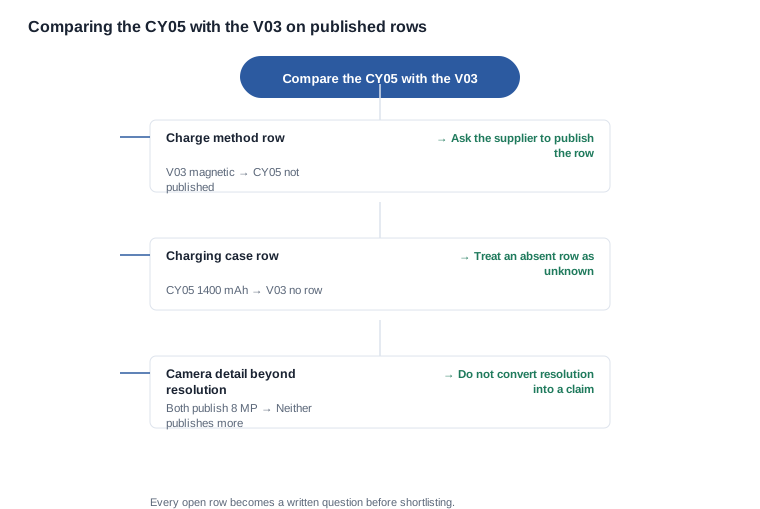
The CY05 publishes a charging case of 1400 mAh and does not publish a charging method. The V03 publishes a magnetic charging method and does not publish a charging case row at all.
These two gaps are not equivalent, and the difference is where most of the practical work in this comparison sits. An unpublished charging method is a single missing parameter. A supplier can close it in one line of an email, and the answer will name a connector or a contact arrangement. An unpublished charging case row leaves two questions open at once: whether a case exists in the configuration being quoted, and, if it does, what its capacity is. One of those needs a supplier answer; the other needs a sample and a carton measurement.
It is worth being precise about a distinction that is easy to carry into a specification file. A catalogue page with no charging case row is not a page that publishes a case without a number. The camera group carries three states: five models with a published case capacity, two models that publish a case but no capacity, and four models with no charging case row at all — the V03 among them. The V03 belongs in the third state. The difference between a blank row and a published figure is the difference between an unknown and a fact, and procurement files routinely collapse the two. No model in this catalogue is published as having no case, so the fourth position that an older reading of these rows described does not exist.
Where the CY05 sits inside the eight-model eight megapixel group
Eight of the eleven camera models publish an eight megapixel resolution class: the CY05 and the CY03, the MT6 and the KY06, and the MT5 and the V03, and the V03 Pro and the V06. The remaining three publish a thirteen megapixel class: the S7 and the L1 Pro, and the L2 Utral.
Resolution therefore splits the group into two blocks and separates neither of these two models from the other. The CY03 publishes the same rows as the CY05 — the same 290 mAh cell, the same rated runtime, the same charge time, the same 1400 mAh case and the same resolution class — which tells a buyer that the CY05's open charging method row is a documentation pattern rather than a one-off gap in a single product file. The CY03 and the L1 Pro, and the CY05 and the MT6 are the four camera models whose pages carry no charging method row.

CY05 capacity and case rows versus the V03 baseline
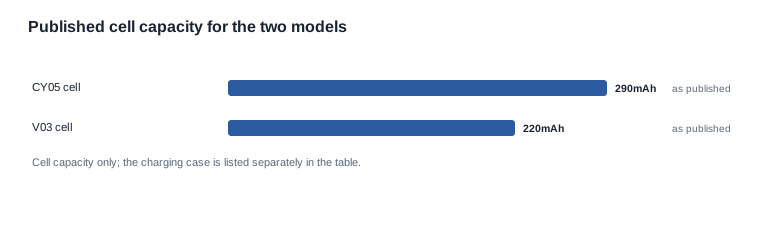
The capacity comparison is the simplest part of this review and also the part most often misused in a buying conversation. 290 mAh against 220 mAh is a difference of seventy milliamp hours between two published figures. It is not a runtime difference, it is not a quality difference, and it is not a ranking, because the two runtimes were not produced under a documented common protocol and the catalogue does not claim that they were.
What 290 mAh against 220 mAh does and does not settle
What the two figures do settle is the order of the power budget. On the published numbers the CY05 carries the larger single cell and the V03 carries the smaller one. What they do not settle is how long either unit runs under a workload a buyer cares about, because a cell capacity only becomes a runtime once volume, content, radio state and test protocol are fixed. Two pages publishing cell values without publishing a protocol leave the buyer with a sizing input and no conversion.
There is a second consequence, and it is logistical rather than technical. Cell capacity feeds directly into the battery documentation file, and battery documentation feeds directly into the shipping paperwork. A buyer comparing two camera models is therefore comparing not only a hardware feature but the size of the evidence package that has to travel with the goods.
The three charging-case states in the camera group
Within the eleven camera models, the charging case appears in three states, and quoting a case figure without naming which state the comparison is in is how sourcing conversations go wrong:
- Five models publish a case capacity — the CY03 and the L1 Pro, and the CY05 — each at 1400 mAh, the L2 Utral at 900 mAh or 1400 mAh, and the MT6 with a 1200 mAh folding case.
- Two models publish a case but no capacity — the KY06 and the MT5.
- Four models publish no charging case row — the V03 and the S7, and the V06 and the V03 Pro.
Against that list, the CY05's published 1400 mAh case is the higher case figure published in the camera group, and the V03's position is the third state. The two models therefore differ in packing logistics, in accessory chain, and in the battery documentation that has to be assembled for each.
Why the case row changes the document set
A published case capacity is the start of a document chain rather than the end of one. The chain runs: cell specification, battery test summary for the cell, transport paperwork for the cell and for the case, packing instruction derived from the watt-hour rating, and a packing list stating what is actually in the carton. Where a case row is absent, each of those steps has to be confirmed against the sample and the supplier's documentation rather than read off a product page.
For procurement purposes, the useful output of this section is not a preference. It is a list of what has to be closed. If the configuration under consideration is a frame-only unit with a cable, the CY05's published case capacity is not part of the quote. If the configuration includes the case, the V03's configuration has to be established before its carton, freight class and document set can be compared at all.
CY05 runtime and charge-time rows read side by side
Both pages publish a charge time of two hours or less, and both publish a rated runtime — about seven hours for the CY05, a five to eight hour range for the V03. Two observations follow, and neither of them is "one model lasts longer".
A point estimate against a range
The published runtimes describe the same category of measurement with different precision. Seven hours for the CY05 is a single figure. The V03's five to eight hours is a band, which tells a buyer that something in the measurement varied enough for the publisher to record a range. A buyer who republishes about seven hours for the CY05 without the measurement condition is publishing a firmer statement than the source did, and a buyer who republishes the V03's band is publishing a weaker one. Neither is a purchasing advantage; both are documentation decisions that belong to the supplier that owns the condition.
All eleven camera models publish a runtime, so the comparison inside this group is complete on that row. The audio models publish different figures on different cells, and the sport models publish their own, which is why a single cross-category runtime table invites exactly the misreading that a like-for-like comparison avoids. See smart glasses battery life for the general method of reading a runtime figure.
The charge-time row is a ceiling, not a measurement
Two hours or less is a ceiling. It permits a two-hour charge and it forbids a three-hour one, and it does not say how long the charge actually takes. Across the catalogue, twenty-six models publish a charge time at this ceiling and only two — the D17 and the ZH12 — publish a figure of about one hour. A charge time of two hours or less, taken on its own, therefore cannot distinguish a fast charger from a slow one, and it cannot be used to plan a shift break, a turnaround window or a case replenishment cycle.
What a runtime row never states
Every one of these rows is missing the same set of conditions, and for the buyer these are the questions that turn a rating into a figure:
- What was running during the measurement — playback, a call, or both.
- What the volume level was and what the content was.
- Whether the radio link was active and how it was behaving.
- The state of charge at the start and at the end.
- The temperature and the age of the cell.
- Whether the figure came from one unit or from a batch average.
These are not pedantic. A seven-hour rating measured at low volume with a disconnected link is not a seven-hour rating in a depot, a store or a call centre. The buyer who asks for the condition gets a usable figure; the buyer who does not gets a number to repeat and a return rate to explain.
CY05 charging rows: one published, one open
Charging is where the two models are most obviously not equivalent, and it is where a comparison must be careful about what "different" means.
The V03 publishes magnetic charging. The CY05 publishes no charging method row. Across the catalogue, seventeen models publish magnetic charging, seven publish Type-C, and four publish no charging method row at all — the CY05 and the MT6, and the CY03 and the L1 Pro. Four models, all of them camera models, all of them publishing a charging case capacity, and none of them publishing how the charging is done.
The four camera models without a charging-method row
That those four models share a pattern is itself informative for a procurement file. It means the absence is a documentation state rather than a hint that these products charge in some unusual way. It also means the four models have to be handled identically in a shortlist: each one carries a question that must be answered before its logistics can be modelled.
Why an absent row is an open line and not a weakness
For a buyer, the practical consequences of an open charging row are concrete. The accessory chain differs — a magnetic charging unit and a Type-C unit do not share cables or cradles, and a frame-only configuration has no accessory chain at all. The packing list differs. The after-sales story differs, because the failure mode a customer experiences depends on how the unit is recharged. The compliance file differs as well, because a charging interface is part of the accessory scope that has to be described in the technical file. See charging solutions for how the accessory chain changes the commercial picture across this catalogue.
None of that is an argument for one model over the other; it is an argument for writing the question down. The useful question is not which charging method is better, but what the charging method is, what ships with the unit, and what the spare-parts path is when the charging accessory fails.
CY05 imaging and structural rows: the same class, different detail
Both models publish eight megapixel. That single fact is the whole of the documented imaging comparison, and it is worth resisting the temptation to treat it as more than that.
Resolution without a sensor
For the eleven camera models, the catalogue publishes the resolution class and nothing further about the imaging chain. There is no sensor model, no field of view, no frame rate, no video format, no stabilisation rating, no low-light performance figure, no storage capacity and no file format. Two units at the same resolution class can differ in every one of those respects, and the published rows cannot tell a buyer which is which.
This is why a resolution class converts badly into a product claim. "Eight megapixel" is a defensible line on a listing because it is a published number. "Sharp enough for a given use" is not, because it depends on the very details the catalogue leaves out. Buyers who need an imaging claim for a specific application should treat the field of view, the frame rate and the low-light behaviour as supplier questions rather than as marketing lines. See AI camera glasses imaging for the wider treatment of resolution-class claims.
The structural rows neither model publishes
The structural rows follow the same pattern, and a shortlist should note every one of them:
- Ingress protection is published on only two models in the whole catalogue, the V06 and the S7. Neither the CY05 nor the V03 carries an ingress rating, so neither may be described as waterproof, splash-resistant, or anything of that kind.
- Colour options are published on only two models, the V03 Pro with three colours and the V06 with four. Neither model in this comparison publishes a colour row.
- Weight is published on one model in the entire catalogue, the MT6 at 158 grams for the frames alone, excluding its folding case. Neither the CY05 nor the V03 publishes a weight, so a freight calculation for either one has to wait for a measurement.
- Bluetooth versions are published for fourteen models across the catalogue, but the eleven camera models publish no radio version. Neither model in this comparison can be described by a Bluetooth version, which matters when a buyer writes a specification sheet that has to match a tender document.
Every one of these absences is normal for a catalogue of this type and none of them is a defect. They are simply the edges of what a comparison can be built on, and the specification file has to say so rather than leave the line blank.
CY05 comparison method: five checks before a shortlist
A comparison that only reproduces rows is a description. A comparison that closes rows is a decision input. The method below turns the published rows into a shortlist with a defensible basis, and it is written so that any buyer can repeat it with a different pair of models.
The shortlist criteria are deliberately ordered by cost of delay. A red flag in a quotation is not the same kind of problem as a red flag in a specification file: an unevidenced figure that has already been printed on a product page costs a correction and a customer conversation, while the same figure still sitting in a spreadsheet costs one email. That is why the sequence below starts with the row inventory and ends with the sample, and why the total cost of leaving a row open is treated as a scheduling question rather than a detail. Before you order either of these two models, every open row should either be closed in writing or be carried into the purchase order as a named open item with an owner and a date. The five checks are the due diligence sequence; the questions to ask at each step are given below, and the trade-offs are stated where two published rows pull in different directions.
The five checks
- Inventory the published rows for both models. Copy every labelled line verbatim, including the feature rows and the accessory rows. Do not fill a blank from a similar model, and do not assume a blank means the opposite of the neighbouring model.
- Classify each row as settled, incomplete or open. Settled rows can be republished as they stand. Incomplete rows, such as a case with no capacity, need one more question. Open rows, such as an absent charging method, need the specification itself.
- Convert every open and incomplete row into a numbered question. One row, one question, one answer, written down with the date and the responder. This is the step most comparisons skip, and the step that makes the file usable later.
- Check the model against the group, not only against the pair. The four camera models with no charging method row, the two models that publish an ingress rating, the single published weight and the models that publish a colour row all change how a single model's evidence should be read.
- Reconcile the answers against the sample before anything is published. A sample that contradicts a published row is a finding, not a nuisance, and it has to be resolved with the supplier before the figure goes onto a listing.
The order of operations matters

The sequence above is not stylistic. Questions asked in the wrong order produce answers that have to be re-asked: asking about packaging before the charging method is known invites a packing list that changes; asking about the runtime before the duty cycle is defined produces a figure that cannot be reproduced on the sample; and publishing before the sample arrives means the same research is done twice.
Where the comparison usually goes wrong
Four failure modes account for most of the bad comparisons in this category, and each of them has a matching check in the method above.
The first is borrowing a value. A row that is not published for the model being quoted is filled in from a neighbouring model in the same family, usually because the two share a cell value or a charging method. This manufactures a specification and removes the need to ask a question. The check is step one, and the discipline is to leave the line empty and record the question.
The second is reading an absent row as a negative statement. A page without a charging case row is not a page stating there is no case; it is a page that does not answer the question. The camera group contains four models with no case row, and that one situation needs a written request rather than an assumption. The question is the same for all four of them, and it is a question for the supplier rather than a reading of the page.
The third is comparing runtimes across models as if the figures were produced the same way. The catalogue publishes no protocol for any of them, and the audio group alone shows why: two models publish about eight hours on twin cells while two others publish about six hours on the same cells.
The fourth is treating a feature row as a specification. Surround sound and long battery life appear as feature labels on some pages. They are names, not measurements, and a listing built on them alone is a listing built on nothing measurable.
A hypothetical comparison, worked through
Consider a hypothetical brand team assembling a camera-glasses line and comparing these two models on published rows only.
The team records the rows and finds the resolution class identical, so the imaging decision cannot be made from the catalogue and is deferred to the sample and to a supplier question about field of view and frame rate. The team finds the CY05 carries the larger published cell and a documented 1400 mAh case, and the V03 carries the smaller published cell with no case row, so the packing and freight question for the V03 goes to the supplier rather than being assumed. The team finds that the V03 publishes a charging method and the CY05 does not, so both models go into the supplier questionnaire with a request for the charging method, the cable inclusion and the accessory scope.
The team also notes that the CY03 publishes rows identical to the CY05, which tells them the charging question is a documentation request rather than an anomaly worth escalating. They note that no camera model publishes a Bluetooth version, so the tender response cannot quote one, and that no camera model publishes a weight, so the freight calculation stays open until a sample is weighed.
The outcome is not a winner. It is a shortlist with two open rows each, two numbered questions per model, a sample review booked, and a specification file that states exactly which lines are documented and which are pending.
The limits of this comparison
Our position is narrow and deliberate: we publish the electrical rows, the feature rows and the accessory rows for every model in the catalogue, and we publish nothing else. For the CY05 that means a 290 mAh cell, a charge time of two hours or less, an approximately seven-hour rated runtime, an eight megapixel resolution class and a 1400 mAh charging case, with no charging method row. For the V03 that means a 220 mAh cell, a charge time of two hours or less, a five to eight hour rated runtime, an eight megapixel resolution class and magnetic charging, with no charging case row. We do not publish a price, a minimum order quantity, a delivery schedule, a warranty term, a production capacity figure, a frame weight, a charging input, a field of view, a frame rate, a storage capacity, an ingress rating or a per-model certification row, and we will not substitute a typical value for any of them.
We will not present the resolution class as an image quality claim, we will not present two hours or less as an actual charge duration, and we will not fill the open charging row or the open case row with a value borrowed from a neighbouring model. This review compares published rows and nothing else: it does not measure either model, it does not state which model is better for any application, and it sets no price position, because no price is published and no price comparison is made here. The four camera models without a charging method row, the two models that publish an ingress rating, the single published weight and the models that publish a colour row are all stated as published. Everything else in this file is a question to the supplier, written so that it can be sent without editing.
Where to begin the comparison
Start with the row inventory, because it takes an hour and it determines everything else. Separate the settled rows from the open ones, send the open ones as numbered written questions, and put the sample review in the diary before any drafting begins. The comparison is finished when every open row has an owner, an answer and a date.
Where CYNRIN stands on comparing two rows. Both rows are quoted exactly as the catalogue prints them, and nothing is added to either. A value that the page does not carry is reported as absent rather than estimated, and it stays absent until a written answer arrives against the model designation. We will not carry a figure across from a neighbouring model, and we will not present a published ceiling as a reading taken from a bench. Where a specification decides your order, the answer you need is the one that names the model and carries a date — ask for it in that form and we will answer in that form.


