

The D12 is one of the least complicated products in our audio range, and that is precisely why buyers mishandle it. Its published specification is Bluetooth V5.4, a 100 mAh cell, a charge time of two hours or less, about seven hours of rated use and Type-C charging. There is no feature line, no charging case row, no weight, no acoustic figure and no per-model certification row. Every review mistake that follows comes from one source: treating a statement about the company, or a rated figure, or an absent row as though it were a model-level fact that a shipment can be checked against. A review checklist for a product like this is therefore mostly about order, because a deviation found in the paperwork costs nothing, while the same deviation found after the packaging is printed costs a redesign. What follows is a review sequence, in the order the checks should happen, with the completion standard for each one written down so that the review ends in a record rather than in an opinion.
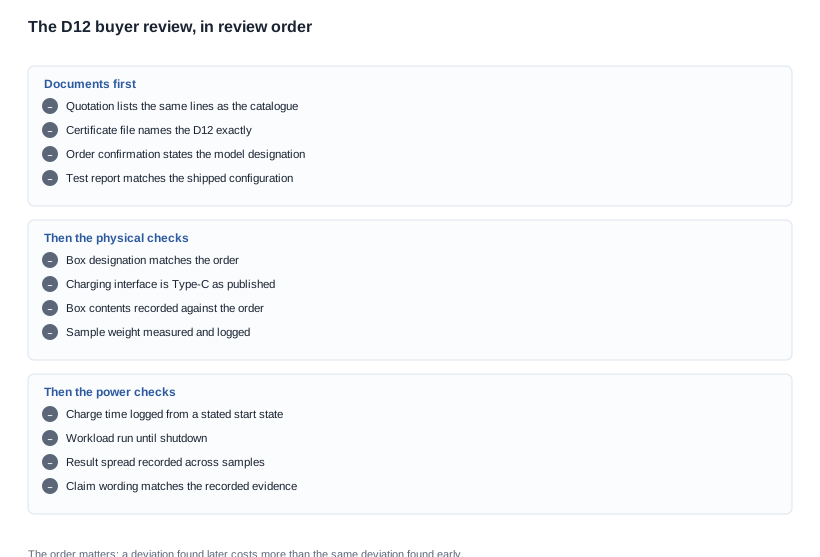
D12 review: what to check and in what order
Three stages, each with a different purpose
A review that mixes the three stages produces a result nobody can act on, so the sequence is fixed.
Stage one, the documents. Everything that can be checked against a requirement before a carton is opened. The paperwork review answers a single question: is this shipment the shipment that was ordered, and does it carry the documents the target market needs?
Stage two, the physical checks. Everything that can be seen, weighed, counted or connected. The physical review answers a second question: does what is in the box match the order line and the published rows?
Stage three, the power checks. The measurements. The measurement review answers a third question: do the figures the channel intends to publish hold on the units that actually arrived, and how much do they vary?
The three stages have different failure consequences, which is why the order matters. A paperwork failure is discovered before any money has been spent on packaging. A physical failure is discovered at goods-in, where it is still a conversation with the supplier. A measurement failure is discovered at the worst possible moment, because the copy that depends on it has usually been written by then.

The completion standard
Each check needs a completion standard, otherwise the review produces opinions. A check is complete when it can be recorded as a pass or a fail against a stated requirement, with the evidence attached. A check that produces a description is not complete. This is the discipline that separates a review from a walk-through of the warehouse, and it is the same discipline that applies to any acceptance process in this category.
What a completed review produces
A completed D12 review produces four documents, and they are the reason for the effort.
- A document register, listing every file received, what it covers and whether it names the exact model designation.
- A physical check record, listing the box contents against the order line, with the measured weights.
- A measurement record, with the workload, the start state, the elapsed times and the spread across the units tested.
- An acceptance decision, with any deviations listed, each with its consequence, its cause and the action agreed.
The three-stage summary
| Stage | Question it answers | Evidence it produces | Cost of finding it late |
|---|---|---|---|
| Documents | Is this the ordered shipment, with the right papers? | A file register keyed to the model designation | A redesign or a blocked market |
| Physical | Does the box match the order line and the published rows? | A check record with measured weights | A goods-in dispute and rework |
| Power | Do the figures hold on the units that arrived? | A measurement record with a spread | A claim that cannot be defended |
The table is the argument for the sequence. The same deviation found one stage earlier is cheaper than the same deviation found one stage later, and the reason is that the later stages consume the packaging, the copy and the schedule before the finding exists. A review that runs in the wrong order still finds the problems; it just finds them at the most expensive possible moment.
The document checks, before anything is opened
What the catalogue does and does not give you
The starting point for any documentation check is knowing what you are checking against, and for the D12 the catalogue gives very little. No certification row is published against any model. The only sheet in the catalogue is one export certification page at company level, written in images rather than in text, and the written catalogue names no CE, FCC or RoHS reference. Ten certificates appear on that sheet — eight appearance-design patents, together with two utility-model patents — which is a statement about the company rather than about any model.
So the D12 review cannot confirm compliance from a catalogue reference. It can only confirm that the documents in the shipment are the right ones, which is a different and still valuable check.
The four document checks
- Does the order confirmation state the model designation exactly as the supplier uses it? A designation that is a near-match is a future dispute, because a file and a product can both be technically correct and still be about different things.
- Does the certification file name that designation, and not only a family or a company? A file that covers a sibling model with an identical specification does not cover the D12.
- Does the test report correspond to the shipped configuration? A report for a previous revision, a different cell or a different module does not describe what arrived.
- Does the documentation cover the market the shipment is going to, and not another one? The radio requirement in the European Union sits under the Radio Equipment Directive, framework reference 2014/53/EU, and it attaches to a specific configuration; the restricted-substance file is separate work. A product can satisfy one and fail the other.
The two conclusions a document review may reach
A document review produces one of two outcomes, and only one of them is worth writing down at length. Either the file set is complete and names the exact model, in which case the check is recorded in one line and the review moves on. Or something is missing, misnamed or mismatched, in which case the finding has to name the file, the designation it carries, the designation that was ordered, and the action.
The action matters more than the finding. A missing file is a request, a misnamed file is a request, and a file for a different configuration is a request plus a re-check of whether the shipment is the right product at all. What is not acceptable is the outcome where the file is missing, the shipment is accepted anyway, and the issue appears at a customs office or a market inspection several weeks later.
The six questions to ask before the order is released
The document stage is cheaper when it happens before the shipment moves, and six questions cover most of it.
- Which file covers the D12 under its exact model designation, and can a copy be sent before production?
- Does that file describe the configuration as configured for this order, including any private-label changes?
- What is the cell specification and the cycle life, and is there a document for it?
- What workload, volume level, connection count and start state produce the published figure of about seven hours?
- What is the measured frame weight and the packed weight for the packed configuration?
- What are the exact box contents, and is a cable included?
The red flags to watch for in the answers are recognisable. A supplier who describes the certification position rather than supplying the file has answered a different question. A runtime answer with a number but no workload cannot be repeated, and therefore cannot be published. A weight given as a range with no method is a guide, not a figure. And a box-contents answer that changes with the quantity usually means the accessory is not a fixed part of the product.
The timing rule
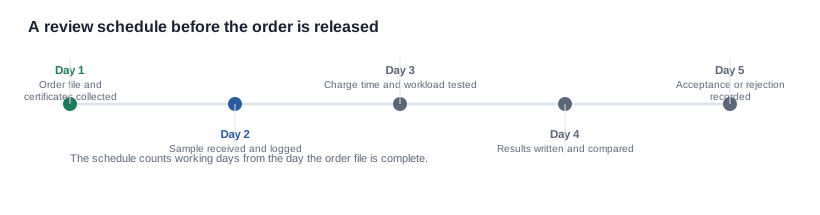
The document check is the stage that takes longest to close, because it depends on other people, and it is the stage with the earliest deadline. A schedule that puts the document work in the middle of the review process will always produce a shipment that arrives before its paperwork. The order we suggest is the one in the schedule above: collect the order file and the certificates first, receive the sample second, measure third, record fourth and accept or reject at the end, with the days counted from the day the order file is complete.
The physical checks, against the order line
What can be checked without any instrument
Most of the physical check needs no equipment at all, and the discipline is to record the answer against the order line rather than against an impression.
- The model designation on the carton and on the product, checked character by character against the order confirmation, because this is the first moment the designation can be verified against something physical.
- The box contents, counted against the order line, including whether a cable is supplied. No charging case row is published for the D12, so the accessory content is a quotation item and has to be verified against the order rather than against the catalogue.
- The charging interface, confirmed as Type-C by inspection, because the interface row is one of the few published rows that can be confirmed in seconds.
- The surface condition and the presence of the standard accessories, recorded as a condition note with a date.
What needs an instrument
Two checks need a scale and a bench, and both of them close rows the catalogue leaves open.
The frame weight. No weight is published for the D12, or for any audio model in the range. The only weight the catalogue states anywhere is for one camera model, and it is not a number that can be borrowed. The measured frame weight, taken with one scale in one method across every unit in the delivery, is what closes the row.
The packed weight. This is the number the freight and the parcel cost depend on, and it is the number most often discovered after the order rather than before it.
Recording the physical check
The record should be a table with one row per unit and one column per check, and it should carry the exception rather than only the pass. A check register that only records passes is a register that records nothing, because the second delivery is where the real information appears. The exceptions are also what tells a supplier where to look, and a supplier who receives a precise exception list usually resolves it faster than one who receives a general complaint.

The power checks, and the acceptance protocol
The measurement, in the order it has to run
- Fix the workload in writing before the units are charged: the volume level, the content, the number of connected devices, and whether the product runs continuously or intermittently.
- Start every unit from the same state of charge, confirmed the same way each time.
- Run the workload to shutdown and log the elapsed time. Not to a warning, and not to a cut-off chosen by the tester.
- Repeat the charge from the same start state and log it, with the charger used and the end-point definition, because the published figure is a ceiling of two hours or less rather than a measurement.
- Repeat the run on every unit in the delivery, because a single unit cannot show the spread and the spread is the acceptance band.
- Record the results as a range, with the workload attached to the range.
The claim that follows from the results
The measurement exists to support a claim, and the claim has to match the evidence. If the measured runtime under the stated workload is a range, the channel's copy can state that range, with the workload attached. If the published figure of about seven hours holds, the copy can say the catalogue rates the product at about seven hours. If neither holds, the copy says what the measurement says, and the catalogue figure is not used.
What no result can support is an all-day claim on a product whose measurement stops before the end of a shift, and what no result can support is a comparison against another model measured on a different workload. Those two claims are the ones that generate returns, and they are the ones most often written because they are the most persuasive.
The acceptance criterion
The acceptance criterion has to be agreed before the measurement, and the agreement is a commercial term rather than a technical one. Three ways to set it are common: the lower end of the measured range has to meet the figure in the order, or a percentage of units has to meet it, or the average has to meet it with the spread recorded for the support team. The third is the most common and the least useful, because a support team deals with the worst unit rather than the average one. A buyer who wants the claim to survive a complaint should set the criterion at the lower end of the range.
Three review errors that cost buyers money
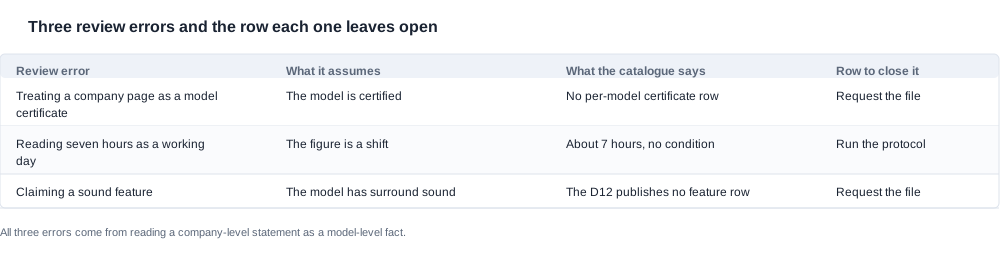
Error one: treating a company-level page as a model-level certificate
What buyers assume. The catalogue has an export certification page, so the product is certified and the paperwork is a formality.
What is actually true. We hold the company-level page. We do not hold a certificate number, an issuing body, a validity period or a list of covered models, for the D12 or for any other model in the range. A file that covers one model designation does not cover the D12, and a sibling model with an identical specification is not covered either.
The checklist row this leaves open: does the file name the D12 under its exact designation? It closes with the document, not with a statement.
Error two: reading about seven hours as a working day
What buyers assume. The published figure means the product survives a working day, so the copy can say so.
What is actually true. The catalogue states a rated figure of about seven hours with no published workload, no volume level and no connection state. A working day frequently runs to eight hours or more, and the figure carries no condition that would bridge the difference.
The checklist row this leaves open: what workload, volume level and start state produce the figure? It closes with a measurement on the units that arrived, and with a copy edit.
Error three: writing a sound claim for a model with no feature row
What buyers assume. A sibling model in the same family publishes a surround-sound line, so the same configuration can be assumed for this one.
What is actually true. The D12's page publishes no feature line at all. The absence of a row is a fact about the page, and it is not evidence that the product has no such configuration, nor evidence that it has one. What it does mean is that the copy cannot borrow a sibling's configuration, and that a documented acoustic description has to be requested before any sound claim is written.
The checklist row this leaves open: is there a written acoustic description for this model, with a document behind it?
Recording the outcome so the next order is cleaner
The acceptance record
The record that closes a review has four parts, and all four travel to the next order.
- The decision, stated plainly: accepted, accepted with the listed deviations, or rejected. A review that ends with an intention to decide is not finished.
- The deviations, each with the observation, the requirement it breached, the cause if known and the action agreed.
- The measured results, with the workload, the method and the spread, because these are the only figures that can be quoted later.
- The open questions, which are carried forward rather than closed by the review, because a question that was not asked in this order is not answered by it.
What the next order inherits
A completed review is an asset, and the reason is that the acceptance criteria become history. The next quotation can be checked against a known baseline instead of against an assumption, the workload can be reused so that the two results are comparable, and a supplier who met the criteria once can be measured against them again. This is ordinary supply-chain due diligence, and it is the reason the difference between a review that produces a record and one that produces a conversation is worth the effort.
The D12 rows that are published, and the ones a document has to close
We publish the electrical rows for every model we list, and for the D12 that means Bluetooth V5.4, a 100 mAh cell, a charge time of two hours or less, about seven hours of rated use and Type-C charging. We do not publish a price, a minimum quantity, a delivery schedule, a warranty term or a production capacity figure, so we cannot tell a buyer what a shipment will cost, and we will not state a lead time we have not published. We publish no per-model certification row, so a compliance check has to be closed with a document. And we publish no weight and no cycle life, so the two rows a buyer most wants to close on arrival are the two that require a measurement and a request.
We will answer the practical version of the review. Send us the order, the target market and the workload your customers generate, and we will tell you which of the checks in this sequence are already closed by a published row, which need a document from the supplier, and which need a measurement on your own units. We will also tell you the acceptance criteria we would write into the order, so that the review you run on arrival and the claim you publish afterwards are the same claim. That is the whole purpose of a D12 smart glasses buyer review checklist: to make sure the record, the shipment and the listing all describe the same product.


