

A development process checklist is not a list of features to compare; it is a sequence of artefacts, and at each stage the only question that matters is whether a document exists when the stage closes. Most smart glasses OEM programmes do not fail inside the factory. They fail at the boundary between the supplier's published specification and the buyer's actual requirement, because the difference between the two was never written down. A sourcing team asks for a unit with a stated battery cell and a charging case; the catalogue row supplies a capacity and a case size; the purchase order then carries a figure nobody traced back to a source. Nobody lied, and the order still arrives wrong.
What follows is written for the person who carries the consequence of the decision — a procurement lead, a sourcing manager, a brand owner signing a first purchase order. It sets out, stage by stage, what to ask for, what to hold on to, and what to do when the answer is that a figure does not exist. It contains no recommendation of a particular model, because the choice depends on a requirement only you can state, and because the value of a model to your programme depends on how many of the rows you need are actually published.
Two features of this product class make the exercise harder than a generic procurement checklist. The first is that published data is distributed unevenly across the catalogue. All twenty-eight models publish a charge time. Twenty-four publish a charging interface. Fourteen publish a Bluetooth version, and not one of the eleven camera models does. Five of the eleven camera models publish a charging case capacity, two more print a case without a figure against it, and the remaining four print no charging-case row at all, so for those four the case position is an unpublished item rather than a published fact. The second feature is that the documents a compliant shipment depends on — certification for the exact model designation, third-party test reports, packaging specifications — do not live in a product catalogue at all. Treating those two categories as one undifferentiated list of available facts is the most common error in this product class, and it is the error this checklist is designed to prevent.
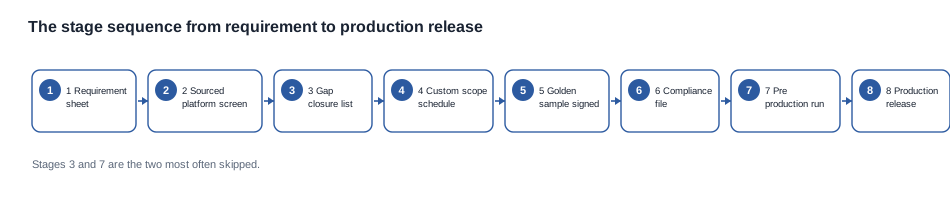
The sequence below runs from a written requirement to a production release. Every stage has one output. Where the output is a conversation rather than a document, the evidence for that stage does not exist, and you will reconstruct it later at the point where your leverage is weakest.
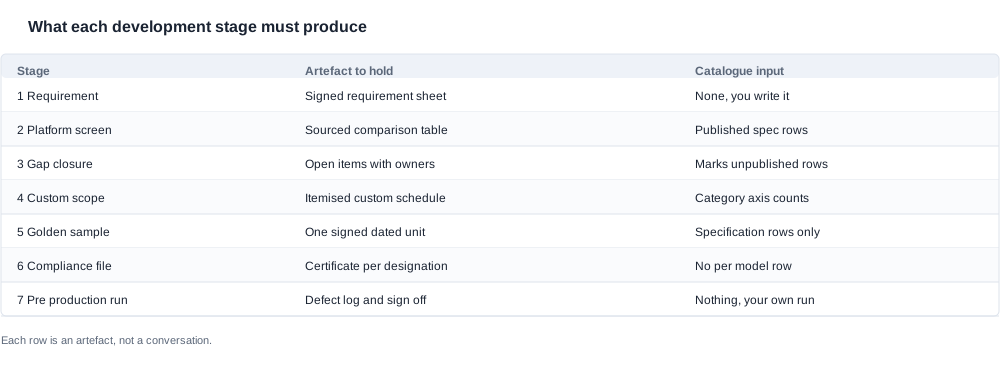
Development process checklist stages one to three: before you choose anything
The first three stages happen before anyone discusses volume, and they determine whether the later conversations are productive or impossible. Their output is a decision you can defend to a colleague, to a finance reviewer, or to an auditor: a requirement that names a failure, a screen built only from traceable rows, and a list of what nobody has yet published. Each stage produces one artefact, and each artefact has a named writer.
Stage one — the requirement sheet with the failure named
Start with the failure, not with the feature list. "We want smart glasses for our cycling brand" is a market position; it cannot be evaluated against any supplier. "A shop assistant who currently holds a phone while advising a customer needs both hands free to open display cases" is a requirement, because it names a person, a task, and the failure the product has to remove. The sheet should carry five things: the operating scenario, the failure that must be eliminated, the environment the unit will work in, the duration of continuous use, and the person or the standard that judges whether the failure is gone.
Two tests separate a usable requirement from a slogan. The first is measurability — if you cannot describe the observation that shows the failure has been removed, you cannot write an acceptance criterion, and you cannot evaluate a sample against anything. The second is independence — the requirement has to survive a supplier change. If a requirement can only be met by one supplier's private implementation, it is not a requirement, it is a description of that supplier, and it removes every negotiation you would otherwise have.
Write the requirement sheet before you write a specification, and keep the two documents apart. The requirement belongs to you and does not move when a supplier's catalogue does. The specification belongs to the programme and does move when an unpublished row is closed by a written answer. Merging them is the quiet mechanism by which an assumption becomes a commitment that nobody consciously decided to make.
The questions to ask before you leave stage one:
- Which failure does this requirement remove, and who observes that it is gone?
- How will the buyer evaluate the failure at sample stage, with what instrument and against what threshold?
- Does the requirement still hold if the supplier is replaced next year?
- Which parts of the requirement are a preference rather than a condition?
- Who signs the requirement sheet, and does procurement sign it as well as the business unit?
- What is the criterion for dropping a requirement that no supplier can close?
Stage two — a platform screen built only from published rows
Build the comparison table the way you would build a due-diligence file: every row traceable to a published source, or explicitly marked as unpublished. The columns of that table should be your requirement fields on one side and the published rows on the other, so that a gap shows up as a gap rather than being smoothed over with a plausible number. Where two supplier documents disagree, the row stays open until the disagreement is closed in writing by the supplier, because a table that quietly picks a winner is a table with an undocumented assumption in it.
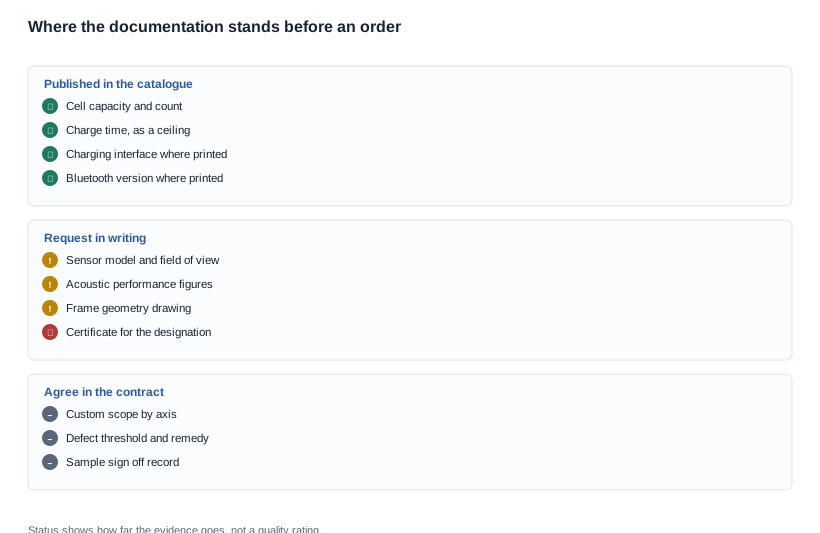
In our own catalogue the published rows are the cell capacity and cell count, the charge time, the charging interface on the rows where it is printed, the rated runtime, the Bluetooth version on the rows that carry it, the camera resolution class on the eleven camera models, the charging case capacity on the camera models that publish one, colour on the two models whose colour rows are printed, and the ingress marking on two sport models. What is not published is equally important to record: sensor models, field of view, frame rates, video formats, and acoustic measurements appear for no model in the range. A row marked "not published" is a legitimate row in this table, and a better row than an estimate dressed up as a specification.
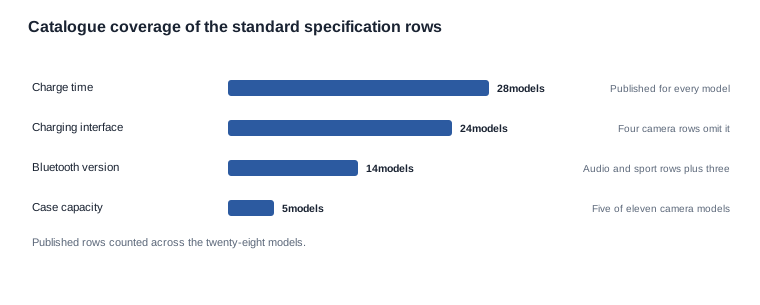
Note what the coverage chart is actually telling you. The published rows are the ones you can quote in a purchase order without a second conversation with the supplier. The unpublished rows are the ones that will consume programme time, and they are exactly what stage three exists to handle. A shortlist built on published rows alone is defensible; a shortlist built on a mix of published rows and assumed values is not, because you will not be able to tell later which parts of it were ever evidence.
The questions to ask when the screen is being built:
- Which row in this table is quoted from the catalogue, and which is quoted from a supplier answer?
- For every row marked as unpublished, who requests the written figure, and in what document will it arrive?
- Does the requirement need a row that no catalogue in this class publishes?
- Which published rows are ceiling values rather than exact measurements, and which require a stated measurement condition?
- How many of the rows the brief requires are missing for every model on the shortlist, rather than for one?
- Which row would the programme fail on first contact with a production unit, and is that row verified or assumed?
Stage three — the gap closure list
Convert every unpublished row into a question with an owner, a date, and a definition of what a closed answer looks like. The list is short to write and expensive to skip. An open question discovered in the first fortnight of a programme is a phone call; the same question discovered during a shipment review is a dispute.
Two kinds of answer have to be separated. A closing answer is a written figure, a measured sample, a test report, or a documented product specification that closes the row permanently. A relocating answer moves the problem downstream — "the factory will confirm this with the customer", "that depends on the firmware version", "we will assume the usual figure" — and it converts an open row into a hidden assumption. Assumptions are the most expensive item in this entire process, because an assumption becomes a specification the moment it appears on a purchase order, and from that moment no one can say it was never agreed.
Accept "not published" as a status only when it is paired with a written figure and a signature against it. A row marked "not published" on the order tells the reader that a figure exists somewhere and was deliberately withheld. A row marked "not published" with nothing behind it tells the reader nothing at all, and it will be read as an oversight the first time it is used.
The questions to ask at gap closure:
- What counts as a closed row for this programme: a figure, a report, a measurement, or a documented specification?
- Who owns each request, and by what date does it have to be back?
- Which assumptions are currently written into the brief without a source?
- Which requirements have to be dropped because nothing can close them?
- What is the written escalation path when a supplier declines to answer a question in writing?
- Which closed row will have to be re-opened after the first production batch, and who will notice?

Stages four to seven of the development process checklist
Stages one to three produce a decision you can defend. The next four produce the evidence that the decision was executed as written. The questions change character at this point: you stop asking what has been published and start asking for documents a catalogue does not carry — the custom scope, the reference unit, the certification file, and the evidence of a controlled build. The trade-offs here are no longer technical. They are about who carries risk, and when.
Stage four — the custom scope, itemised rather than summarised
The custom schedule is where most first programmes lose their footing, because it is usually handled as a capability conversation. Our internal product record carries a different number of recorded customisation axes for each category, and the recorded sets do not match one for one: the scope that applies to a camera programme is not the scope that applies to an audio programme, and for the children's category our own record marks the software customisation capability as pending verification rather than settled. A brochure sentence about customisation therefore tells you almost nothing about the order you are about to place.
The quotation has to carry the scope as an itemised list: which custom axes are in scope for this order, which are explicitly excluded, who owns artwork and content approval, what sample evidence is provided before production, and what happens to the schedule and to the commercial basis if an axis is added after the golden sample is signed. An order that points at a supplier's general customisation page instead of an itemised schedule is an order whose scope will be disputed at the point where it matters most, which is the point at which the goods have already shipped.
The questions to ask for the custom scope:
- Which custom axes are in scope for this quotation, and which are excluded from it?
- Is the scope in the quotation the same set as the scope recorded for the category, or a general capability list?
- Who approves artwork and content, by when, and how many rounds of revision are included?
- What sample evidence is provided before production starts, and against which written specification?
- What happens to the schedule and to the quoted basis if an axis is added after sample sign-off?
- Are the customisation obligations written into the purchase order, or only into correspondence?
Stage five — the golden sample
One unit, identified, dated, signed, photographed, and kept. Not "a sample" — a named reference unit with an identifier that appears in the purchase order. Everything shipped afterwards is compared against it. Without a reference unit, the phrase "not as ordered" has no agreed referent, and the argument moves from evidence to opinion, which is a bad place to be standing when a shipment is already in transit.
Agree what the reference unit covers before it is ordered, because the scope of a sample is negotiated at the moment it is requested and almost never afterwards: the custom axes in scope, the printed packaging and its label content, the accessories in the box, the software build identifier, and the labelling. A sample that demonstrates the glasses but not the packaging, the label, or the accessory kit has demonstrated the easiest part of the order, and the harder part will arrive in production.
One caution about the reference unit itself. It records the agreed state; it does not promise that every production unit will match it. Production units vary, which is exactly why you want a written tolerance, an acceptance procedure and a remedy agreed in advance rather than after the first rejection.
The questions to ask for the golden sample:
- What does the reference unit cover, and is that scope written down before the sample is made?
- How is the reference unit identified in the purchase order, in the shipment, and on the production batch?
- What tolerance applies between the reference unit and the production units?
- Who performs the acceptance procedure, and what happens to a shipment that fails it?
- How long is the reference unit kept, and who holds it?
Stage six — the compliance file, per model designation
Certification scope is a per-designation question, and it is the one most often answered too loosely. Our catalogue carries a company-level export certification page whose content is images rather than text; the catalogue text contains no reference to CE, FCC or RoHS, and there is no per-model certification row anywhere in it. We therefore do not state a certification scope we cannot cite. What a buyer can do is request the document itself for the exact model designation intended to be bought: the certificate, the test report behind it, the certificate holder, the issue date, and the list of covered variants. A certificate that names a family but not your variant is a different certificate for your purposes, and the difference is easy to miss because the family name looks familiar.
The same discipline applies to an ingress rating printed in a catalogue. The catalogue prints IP54 on two sport models, and our internal record notes that no third-party test report number is attached to that marking. A rating printed in a product catalogue is a claim to verify, not evidence to rely on, and the cost of treating it as evidence is paid at the moment a customer asks.
One published acoustic figure deserves particular care. The bone-conduction entry publishes an amplification gain of 35 dB, and a figure in that range can sit close to the boundary where medical-device rules begin to apply. How that entry is classified for each market you sell into, and what evidence supports the classification, is a question for the supplier in writing. It is not a question a buyer should resolve by reading a catalogue page.
The questions to ask for the compliance file:
- Which certificate covers the exact model designation intended for purchase, and does it name the variant?
- Who is the certificate holder, and when was the certificate issued?
- Which test report sits behind each claim, and is the report identified by number?
- How is the ingress marking printed in the catalogue supported by a report?
- How is the bone-conduction entry classified for the markets you sell into, and what evidence accompanies that classification?
Stage seven — the pre-production run
Not optional, and least optional on a first order. The defects a pre-production run catches are the defects your customers will not have to find, and the defects a pre-production run finds on a small batch are cheap to close while the artwork and the production setup are still open. The artefacts to agree in advance are simple: the size of the run, the defect log format, the written acceptance threshold, the sign-off, and the remedy for a batch that fails.
A supplier who resists a pre-production run on a first order has given you information about how the second order will be handled. Ask for the reason in writing. A production constraint — a shared assembly line, a component allocation, a seasonal window — is a legitimate reason, and it belongs in a contract where it can be planned around. "The tooling is settled" is not a reason, because settled tooling does not settle the assembly.
The pre-production run is also the stage at which packaging, labelling and the accessory kit get validated together with the product itself. A programme that validates each element separately and assembles them for the first time in a production shipment has moved the failure forward instead of resolving it, and the cost of that move is usually charged to the customer who receives the shipment.
The questions to ask for the pre-production run:
- How large is the pre-production run, and who decides its size?
- What is the written acceptance threshold, in which units, and against which test method?
- Who signs the batch off, and what is the remedy if it fails?
- Has the packaging, the label and the accessory kit been validated as a set with the product?
- What does the defect log look like, and who maintains it after the run?

The two stages buyers skip in a development process checklist
Two stages are skipped almost everywhere: stage three, the gap closure list, and stage seven, the pre-production run. The reasons are behavioural rather than technical, and they are predictable enough to plan against.
Buyers skip the gap closure because it is uncomfortable. It is the stage where you discover that the thing you wanted is not published anywhere, that it may not exist for the category you had in mind, or that your requirement was written against an assumption nobody made. The natural response to that discovery is to stop asking, because a closed question has the power to change the programme while an open one does not. So the gap stays open, and it reappears later as a rejection, a claim, or a silent substitution — at which point the supplier will treat it as a change request rather than as a question that was on the table from the beginning.
The pre-production run is skipped because it costs time and because the factory says the production setup is settled. Both arguments are strong enough to sound reasonable, and neither addresses the actual question, which is whether the first shipment should carry the discovery risk or whether a smaller batch should carry it first. A batch that fails before the main order costs a delay. The same batch failing as the main order costs a delay, a claim, an expedited replacement, and a damaged relationship with the customer who received it.
Both skips convert a solvable problem into an unsolvable one, and they do it quietly. The arithmetic is not about the unit price. It is about who holds the risk and when: in the first fortnight you still have alternative suppliers, a re-scope, and a budget line; in week thirty you hold a shipment, a deadline, and a customer relationship. None of that is visible on the purchase order, which is exactly why both stages need to be written into it.
Neither stage has to be large. The gap closure list costs one page and a scheduled review. The pre-production run can be a small batch against the same written acceptance threshold you will apply to production. What both require is a named owner and a date, because an unowned stage is a stage that gets skipped by default rather than by decision.
Further reading on what each stage produces is on the development process pillar, and the validation phase covered in ODM development deals with the evidence side of the same sequence. On the written-record side, development documentation and quality gates set out what each handover should contain.
Where CYNRIN stands on the OEM readiness checklist
The position we take on a development process is narrow and consistent: each stage should close with a document a buyer can hold, and a stage whose output is a conversation is a stage that will fail quietly. We will not fill an unpublished row with a typical value to make a comparison table look complete, and we would rather a buyer learns in stage three that a figure does not exist than discovers it in stage nine.
What can be put in writing today is the published specification set for every model in the range — the cell capacity and cell count, the charge time as a ceiling, the charging interface on the rows where the catalogue prints one, the rated runtime, the Bluetooth version on the rows that carry it, the camera resolution class on the eleven camera models, the charging case capacities that are published, the colour rows where the catalogue prints them, and the ingress markings on two sport models. What cannot be put in writing from the catalogue is a per-model certification scope, because the certification content in the catalogue is an image page and the catalogue text contains no CE, FCC or RoHS reference at all. That is not a shortcoming we can talk our way around; it is a document the buyer has to request.
Our internal product record also flags six items as unresolved, and a buyer should treat them as open questions in the brief rather than as details to discover late:
- The A05 and the A06 publish identical parameters, and the difference between them is marked as unconfirmed.
- The L2 Utral page carries two variant names and two charging case capacities without stating which capacity belongs to which name.
- The catalogue reference for the MT5 is flagged as anomalous, and so is its product category, so the category has to be confirmed before it enters a sport-specific requirement.
- The catalogue references for the V06 and the S7 are flagged as anomalous as well.
- Three catalogue entries — the colour-shifting, the bone-conduction and the AR models — carry no formal model designation, which means a document request for them has no designation to quote.
- Across the full range of twenty-eight models, product photography, video and test reports have not been provided internally, so the evidence has to be requested rather than assumed.
None of those six items is unusual for a range in active development, and none of them is a reason to stop. They are reasons to ask early, in writing, and to keep the answers attached to the programme rather than in somebody's inbox. That is the readiness we can offer: a published specification set, a clear statement of what the catalogue does not publish, and a written list of what our own records still flag. What we cannot offer is a number for a figure that does not exist, and we would rather the programme be built on what does exist.
Applying the development process checklist to your own programme
Take the requirement sheet from stage one and mark every row of your own comparison table as published or unpublished. Every unpublished row becomes a line in the gap closure list, with an owner and a date, and every question on that list is a question to ask before you order rather than a problem to solve afterwards. If you send this checklist back with the project filled in, we will tell you which stages we can support with a written output and which ones depend on information we have not been given.
The discipline is short enough to remember: a stage closes when a document exists, not when a conversation happens; an unpublished row is either a question with an owner and a date, or a specification you have chosen to accept without evidence. Keep the development process checklist open next to the purchase order, and the two documents will never contradict each other.
Related reading
- what the development process produces
- ODM development and the validation phase
- standard OEM sample process
- how development documentation is structured
- the quality gates between production stages
Send the checklist with your project filled in and we will say which stages we can document and which we cannot.


