

A buyer planning a smart-glasses launch usually asks this question with a number already attached to it: does certification add to lead time, and if it does, how many weeks should I add? The number is the least useful part of the question. The honest answer is that certification can add nothing to a launch schedule, or it can add a substantial part of it, and the spread between those two outcomes is not a question of how careful the supplier is. It is a question of which of four specific situations your product happens to be in when you sit down at the table.
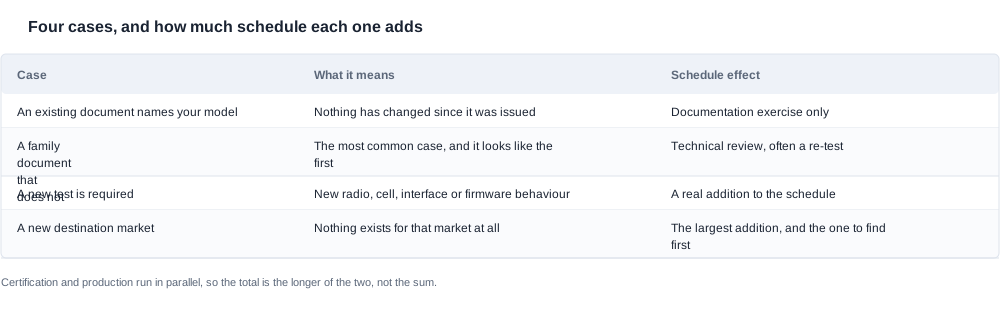
There is a second reason the question is asked badly. Certification work and production work normally run in parallel rather than in sequence, so the total schedule is the longer of the two, not the sum of the two. A buyer who plans ten weeks of production and then adds the certification time is planning a programme that is roughly twice as long as it needs to be, and is then shocked when the supplier says the total is still ten weeks. That miscalculation is not the supplier's fault, but it does damage the relationship, because the buyer arrives at the negotiation with a false premise about what they are buying.
This article is written by a Shenzhen smart-glasses manufacturer, and that position comes with one awkward obligation we would rather state at the top than bury at the bottom. Our own published catalogue does not name CE, FCC, RoHS, RED or EN 18031 anywhere in its body. Our export-certification page is a picture page carrying ten patent certificates, eight of them design patents and two utility models. There is no per-model certification row in the catalogue, and there is no published certification lead time for any model. So we cannot tell you that certification adds four weeks or nine weeks, and we are not going to invent a range that would feel more helpful.
What we can do is considerably more useful than a number. We can tell you the four cases, how to work out which one you are in, what evidence settles it, and how to write the result into a quotation so that it cannot be reinterpreted six weeks later when the first shipment is waiting on a laboratory slot. That is the method this article teaches. For the wider framework, our lead time page explains how the production schedule itself is built, and our certification checklist sets out the document types a supplier should be able to produce.
Does certification add to lead time: four cases and what each costs
The classification is not a matter of opinion. Each of the four cases has a different documentary answer, and in every case the first step is the same: read the model list on the document rather than the family name on the marketing page. Family names are how products are sold; model lists are what is actually tested.
Case one — an existing document names your exact model and configuration. Here the product sits on a document that already names it, the components have not changed, and the technical file matches what you are ordering. Certification adds effectively nothing to the schedule. What it adds is a week of administration: collecting the file, confirming the model list, checking that nothing has changed since issue, and confirming that the report is still valid for the standards in force in your destination market on the day of shipment. For a repeat order of an existing SKU in an existing market, this is close to a zero-day question.
Case two — the document exists at family level and your model is not named. This is the most common case in this category and it looks identical to case one until somebody reads the model list carefully. The work here is to extend coverage to your variant: a technical review of exactly what differs between the tested configuration and yours, and frequently a partial re-test of the characteristics that the difference touches. The schedule cost is real but bounded, and it is bounded because the scope of the difference is finite and knowable. This is the case that most often surprises buyers, because their prior was case one.
Case three — a new test is required. This happens when a radio module, a cell, a charging interface, or a firmware behaviour is different from anything previously tested. It also happens when a change affects the physical characteristics the report was based on. In our own catalogue you can see how many separate configurations a modern glasses programme touches: charging is magnetic on seventeen models, Type-C on seven, and for CY03 and L1 Pro, and CY05 and MT6 the charging method is not published at all. If a private-label variant changes the charging interface on a model whose method we publish as magnetic, that is a change of the kind that can move the certification scope. In the camera range, V03 Pro is the only model publishing photochromic lenses and three colour options, and V06 publishes four colours, so a colourway-driven variant on either of those is a configuration decision with documentation consequences. In case three the answer to the buyer's question is unambiguously yes, and the way to control it is to freeze the configuration before the test plan is written.
Case four — the destination market has no existing coverage at all. A first-time entry into a market is the full route: a test plan, a laboratory, a sample batch, a report, a technical file and a Declaration of Conformity. This is the largest schedule addition of the four, and it is the one that must be identified at the very beginning of the programme, not discovered when the first container is held at the border. Our market-selection guidance explains how the frameworks differ, and our EN 18031 and GPSR pages cover the two European requirements buyers most often conflate.
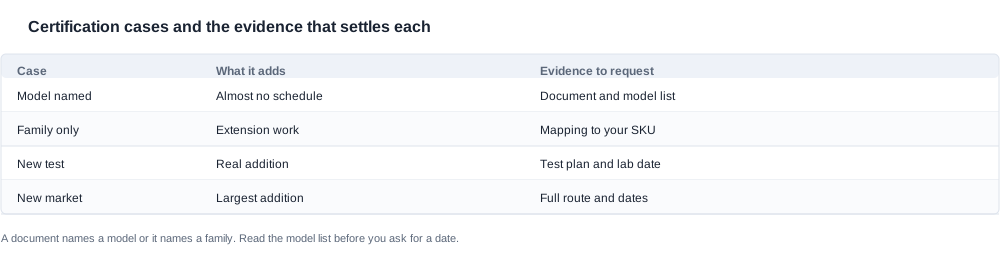
The triage that turns this into a decision takes three steps, and it is worth doing it in this order rather than the reverse:
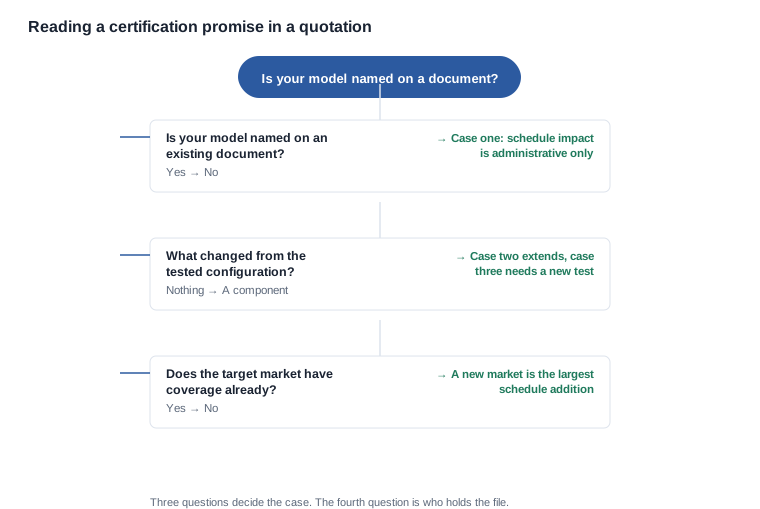
- Get the document set for the exact model, and read the model list. If the model is named, you are in case one and the schedule question is close to settled. If a family name is printed but your SKU is absent, you are in case two.
- List every difference between your configuration and the tested one. Components, charging interface, firmware behaviour, colour, packaging. Each difference is either outside the tested scope or inside it, and the answer decides whether you are in case two or case three.
- Establish the market position. If the target market has no coverage for this product type at all, you are in case four regardless of what the first two steps told you, and the market decision outranks the configuration decision.
Do these three steps before you ask anyone for a schedule. A supplier asked for a certification date before the configuration is frozen is being asked for a guess, and a professional one will refuse to guess in writing.

When does certification add to lead time stop being the constraint
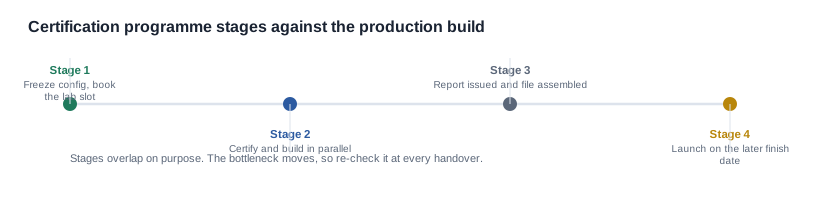
Once you know which case you are in, the schedule question becomes a scheduling problem rather than a certification problem. Two workstreams run: one produces certified goods, the other produces goods. The launch date is whichever of the two finishes last. In most programmes that sounds like a small administrative point, but it changes three things a buyer normally gets wrong.
The first is the arithmetic. If the certification path takes six weeks and production takes ten, the launch is in ten weeks, not sixteen. Buyers who add the two get a programme that is too slow, then try to claw the difference back through negotiation on unit price, which is a strange place to recover time you never needed to lose.
The second is where attention goes. If production is the longer path, certification is not the critical path and over-investing in it produces a better-documented product arriving late. If certification is the longer path, production capacity is irrelevant to the launch date and the only useful negotiation is on the certificate itself, the laboratory, the sample availability, and the date the extension starts.
The third is what a slip in one workstream does to the other. This is the part that is usually invisible until it bites. A laboratory cannot test a physical unit that has not been made, so a certification programme waiting for production samples is waiting on the entire production plan, not on the laboratory. And the reverse is equally true: a production run built on a configuration that is still in testing is a run that may have to be quarantined, reworked or thrown away if the report comes back with a finding. The configuration freeze is therefore the point where the two workstreams meet, and it should be a dated, signed event in the programme rather than a conversation.

Five variables decide which workstream binds, and all five are within reach of a buyer who asks early:
- Whether the product is certified at all for the target market. If no document exists for the product type in that market, the answer to the buyer's question is yes by definition, and the size of the addition is case four.
- How much has changed from the tested configuration. This is the variable that separates case two from case three, and it is the cheapest one to settle because it is a comparison of two bills of materials.
- The laboratory's queue. Test capacity is finite and external to both you and the supplier. An unbooked slot can cost more calendar time than the test itself. If a supplier cannot tell you the earliest date a test could start, the certification date is not committed, and a date that is not committed should not appear in a quotation.
- Sample availability. Who provides the units, from which batch, and when are they reserved. If the supplier must wait for the production batch to build the certification samples, the launch date is tied to a build that has not started.
- Who holds the document. If the supplier is the applicant and holds the file, extension depends on their willingness and their commercial terms. If your company is the applicant, you control the schedule directly but you also own the obligation. This is worth deciding consciously rather than inheriting by default, and it is a legitimate negotiation point in an OEM arrangement.
The mistake worth naming is assuming the two workstreams are sequential. Buyers plan the production date, add the certification time, and arrive with a total that is too long — and then learn that the supplier's confidence rested on a family-level document that never named their model. The cost of that mistake is not only the inflated date. It is that the buyer's planning assumptions are wrong in a way that makes every subsequent conversation about dates feel unreliable.

Reading does certification add to lead time inside a supplier quotation
A quotation that answers the certification question properly does not contain a single number for certification. It contains a named scope, a named owner, a starting condition, and a date that depends on a thing you both know about. Here are the six questions to put to any supplier, in this order, and what a good answer sounds like.
- Is there an existing document for this model, and does it name it? A good answer produces the document, or states clearly that none exists for the model and identifies the nearest family coverage. An answer that speaks about "our smart glasses family" without producing a model list is an answer to a different question.
- What is the technical difference between the tested configuration and mine? A good answer is a short list, itemised by component. This answer determines whether you are in case two or case three, and it is finite in a way that a schedule is not.
- Who is the applicant and who owns the file? A good answer names the legal applicant and the holder of the technical file, and says what happens to both if the relationship ends. For a distributor or a channel partner this matters commercially: the file is part of what you are buying.
- What is the laboratory's earliest available start date, and is a slot held? A good answer names a date and a queue position. A vague answer about "normal laboratory timing" is a way of saying the date is not controlled.
- What happens to the programme if the configuration changes after testing? A good answer describes a re-test or a scope extension and says who bears the cost. This is the clause that decides whether a late change to a colourway or a packaging spec becomes a schedule event.
- Is certification cost separated from unit price? A good answer quotes it as its own line, with a unit cost where it is per-SKU and an amortised figure where it is per-programme. A supplier who cannot separate the two is telling you something about how they price programmes of this size.
Ask for the certification cost to be a separate line. That single request does more than improve the transparency of the quotation. It converts certification from a vague risk sitting inside the unit price into a named, negotiable, comparable item, which is exactly what a shortlisting exercise needs. If two suppliers quote the same unit price and one has priced the certification work explicitly, their quotes are not comparable, and the lower unit price may be the quote with the larger unpriced assumption in it.
Write the answer into the purchase order or the development agreement rather than leaving it in an email thread. The clauses that matter are short: the configuration that the documents cover, the date by which the supplier confirms coverage or starts a test, the party who bears the cost of a scope change, and what happens to the schedule if that change occurs. A due diligence file that includes the certificate, the model list, the technical file index and the correspondence is what turns a certification promise into something a bank, a distributor or an insurer will accept. For the wider decision, our lead time guidance covers how the production side of the same programme should be scheduled and what a supplier should be able to state about it.

Why does certification add to lead time differ across our four product ranges
Not because the suppliers differ — they are the same factory — but because the configurations differ in ways that change what has to be tested. Our catalogue is organised into an audio range of eight models (LC-105-2 and G07, K02 and YK12, K01 and LC-105-1, and D11 and D12), a sport range of three (YKC02, D17, ZH12), a camera range of eleven (MT6 and V03, MT5 and CY03, V03 Pro and S7, L1 Pro and L2 Utral, KY06 and V06, and CY05), and a kids range of three (A05, A06, A07), plus AR glasses, electrochromic and bone conduction lines that carry no model string in the catalogue at all.
Four configuration facts from that list bear directly on the certification question.
Radio coverage is unevenly published. A Bluetooth version is published for fourteen of the twenty-eight models. It is not published for the eleven camera models, for A05 and A06, or for bone conduction. That is not a minor gap in a spec table; it is the exact point at which the scope of a radio test is undetermined. For those models, the first question in the certification conversation is not which documents exist but what radio configuration is even in scope.
The charging method is a real configuration variable. Magnetic on seventeen models, Type-C on seven, not published for MT6 and L1 Pro, and CY05 and CY03. Where we publish a charging method, changing it on a private-label variant is a change to a characteristic that previous testing may have covered, and it should be treated as case three until a supplier confirms otherwise.
Only two models in the entire catalogue carry an IP marking. V06 and S7 publish IP54. Nothing else does, and that includes every sport model — YKC02, D17 and ZH12 carry no IP rating. A buyer whose programme depends on a water-resistance claim for a sport SKU cannot lean on an existing rating, because there is not one to lean on. That does not mean the product cannot be tested; it means the starting position for the test plan is empty rather than inherited.
The kids range is a separate regulatory track. A05, A06 and A07 are children's products with their own requirements around mechanical safety, small parts and materials in contact with the skin. Only A07 publishes a Bluetooth version. A certification programme that treats a kids SKU as an adult SKU with a different logo is a programme that discovers its scope late.
There is a fifth, more awkward case. AR glasses, electrochromic and bone conduction products appear in our catalogue without a model string, which means there is no published configuration to scope a certification case against yet. For those lines, certification timing cannot be estimated at all, and any supplier figure offered before the model and configuration exist is a figure about nothing. Treat it as a due diligence item on the supplier, not as a schedule line.
What we publish about does certification add to lead time, and what we do not
Being explicit about the boundary is worth more than a confident estimate, because the estimate would be wrong for most of the configurations above and you would have no way to know.
What our published catalogue carries is a hardware record: the model, the range it belongs to, the Bluetooth version where it is published, the charging method where it is published, the charging case and its capacity where it is published, charge time where it is published, the camera resolution where it is published, the IP rating for the two models that publish one, and the weight for the single model that publishes one. What it does not carry is any certification row per model, any certificate number, any laboratory, any test date, any test condition, and any certification duration.
So here is what we will do when you ask about the schedule, and what we will not.
- We will confirm which documents exist for a named model and configuration, and tell you plainly whether a document names the model or only a family. That single distinction is the one that most often changes a programme's calendar, and it costs us nothing to state.
- We will describe the certification work as a separate line in the quotation, with the scope and the starting condition written down, so it can be negotiated and compared rather than buried in the unit price.
- We will identify the binding constraint for your programme, which is the only useful form of the schedule answer.
- We will not publish a certification lead time on this website, because it depends on the model, the configuration, the destination market, the laboratory queue and the current state of the product, and none of those is visible in a catalogue. Any single number we printed would be wrong for someone.
What we need from you to give a case rather than a caveat is the model, the configuration including colour and charging interface, the destination markets, and whether the programme is a private-label variant or an existing SKU. With those four things we can tell you which of the four cases applies and what the certification work actually consists of.
If you are still choosing between suppliers rather than already in a programme, the certification checklist is the better starting point, because it is written to be used as a comparison document across a shortlist. If you are thinking about European market entry rather than a specific model, read EN 18031 alongside GPSR first, because those two requirements attach to different parts of the programme and are frequently assumed to be the same work.
Related reading
- Lead time and delivery
- Certification checklist and model coverage
- EN 18031 cybersecurity compliance
- GPSR compliance
Send the model, the configuration and the destination markets and we will tell you which case you are in.


