

A customisation programme is not reviewed. It is carried across six gates, and at each gate somebody looks at a specific set of evidence and either lets the programme move forward or stops it. The difference between those two descriptions matters more than it sounds. A programme that is "reviewed" invites opinions, and opinions accumulate until the buyer is negotiating against a list of mild reservations nobody ever wrote down. A programme that is carried across gates produces, at every stage, a small set of documents with names and signatures on them, and the reservations are either closed or explicitly carried forward with an owner attached.
What follows is the structure of that review. It is a method, not a story about a particular customer. There are no customer names here, no volumes, no dates and no factory figures, because none of those are published and none of them are needed to describe how a review actually works. What is needed is the mechanism: what the review points are, what evidence is put in front of each one, who signs, what a finding looks like when it appears, what a rejected change actually costs, how an unresolved item survives the handover from one gate to the next, and what a buyer should insist on keeping in the file.
The framework underneath is the CYNRIN development framework, which runs in a fixed order: requirements frozen, feasibility reviewed, engineering and tooling, samples built and verified, compliance file closed, and a pilot run before mass production. A stage is finished when it produces a document, not when a date arrives. Every statement in this article hangs on that one rule, because it is the rule that makes a review auditable. If a stage could be declared complete by the passage of time, there would be nothing to review at the next gate — there would only be a schedule that had been met.
This method is one part of a wider engineering customisation approach, and it sits under the engineering customisation pillar alongside the requirement-writing discipline, the compliance file and the pilot-run rules described elsewhere in the pillar.
Engineering customization case review: the review points
The six gates are the review points. Each one asks the same underlying question in a different register: has the thing the next stage depends on actually been produced, and is it signed by the people who can carry it? What follows is what each gate is given, and what it produces when the answer is yes.
Requirements frozen. The evidence here is a signed written requirement document. It states the target market, the models in scope, the configuration, the packaging, the delivery documentation, and which claims the product is allowed to make. The last of those is the one most often under-specified, and the one that pays for itself, because a claim that was never agreed cannot be defended later when a channel partner or a competitor asks where it came from. The signatory set at this gate is the brand side, because a requirement the brand has not signed is not a requirement; the supplier's role is to state clearly, at this point, what can and cannot be built, and that statement belongs in the feasibility review that follows. A usable template for the document itself is covered in smart glasses OEM requirements checklist, and the wider question of what a brand is entitled to specify is discussed in customization options overview.
Feasibility reviewed. The evidence is a written answer on whether the request can be built and what it costs in engineering and tooling. The important word in that sentence is written, because the failure mode of this gate is a verbal reassurance in a meeting that nobody can point to later. The output is a boundary, not a yes or no: a range of achievable configurations, a statement of what each configuration requires in tooling, and a clear account of what falls outside the envelope. A feasibility review that answers "yes we can do that" without stating the boundary has not been performed.
Engineering and tooling. The evidence is completed and verified tooling, plus a firmware build that matches the frozen requirement. Two things make this gate different from the ones before it. The first is that tooling is the least reversible step in the whole programme, so it is also the point at which the commercial conversation about what happens if the project stops has to be settled in writing — specifically, what happens to the tooling cost. The second is that a firmware build is only evidence if it can be compared against a document, and the document is the frozen requirement. "The build exists" is not a match; "the build implements every line of the frozen requirement, and here is the line-by-line comparison" is.
Samples built and verified. The evidence is a signed golden sample plus a verification record covering pairing, audio, charging, any camera function and control behaviour. The golden sample is a physical object that the parties agree represents the product, and the verification record is the evidence that the sample behaves as required. Both matter, and they do different jobs. The sample is what a factory line is inspected against later. The record is what a buyer points at when a field return contradicts a claim.
Compliance file closed. The evidence is a declaration of conformity covering the exact model string that will ship, the underlying reports, and market-specific requirements. A declaration covering a product family rather than a model is not a declaration for your SKU, and the review at this gate is where that distinction has to be tested rather than assumed. The gate also has to establish that the closure is real: the reports are present, they are the reports for that model string, and the market-specific requirements for the target market are covered rather than assumed to be covered by a family statement. Certification evidence is the artefact under scrutiny here, and a review should treat an unverified family-level statement as an open item rather than as closure.
Pilot run before mass production. The evidence is a production run on production tooling at production volume, inspected against the golden sample. This is the gate that catches the difference between a sample that works and a line that works, and it is the gate where a buyer most needs to be present with a checklist rather than a tour. The pilot run is also the last point at which a systemic issue is cheap to fix, which is why it is a gate and not a formality. The relationship between the pilot run and the move into mass production is set out in development process and mass production.
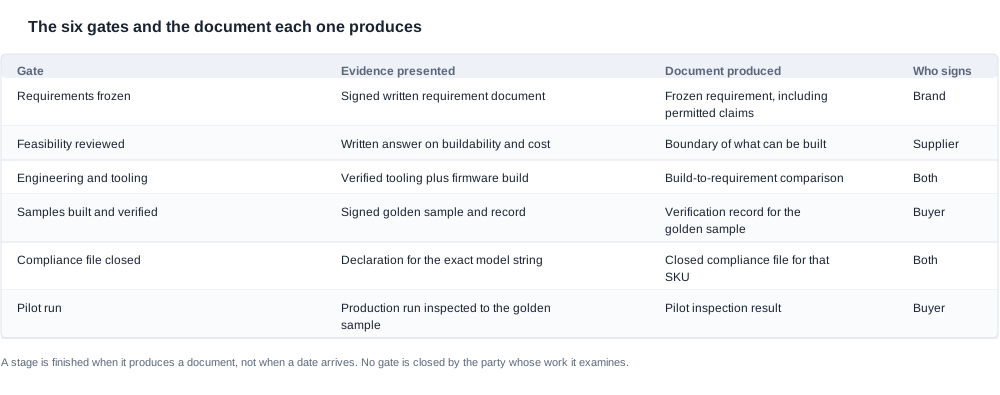
The table is the review points condensed into one working sheet. Read down the second column and you can see what each gate is actually given; read across and you can see who has to be present for it. A programme that cannot fill this table in is missing something, and the empty cell tells you where.

Who signs, and when a gate is actually closed
The signatory set changes from gate to gate, and that is not a formality — it is what stops a gate being closed by the party whose work it examines.
At the requirements gate the brand signs, because the brand owns what it wants. At the feasibility gate the supplier signs, because the boundary is a statement about what the supplier's engineering can and cannot do, and it is not evidence if the brand signs it. At the engineering and tooling gate both parties sign, because the artefacts are shared and the comparison against the frozen requirement is a two-sided exercise. At the samples-built-and-verified gate the buyer signs against the golden sample, because the golden sample is a commitment about what the buyer will accept as representative; the supplier's own acceptance of its own sample proves nothing about whether the buyer will accept it. At the compliance file gate both parties sign, and the buyer's signature is specifically on the model string. At the pilot run gate the buyer signs the inspection result against the golden sample.
A gate is closed when the document exists, the signatures are on it, and any findings raised at that gate are either closed or formally carried forward. It is not closed because the next stage has started, and it is not closed because a quote was accepted, a purchase order was issued, or a lead time was quoted.
In practice, we will insist on the distinction between a gate that is closed and a stage that is under way, because most programme disputes are actually disagreements about which of the two has happened. A buyer who believes a gate is closed and a supplier who believes it is still open will produce a very expensive misunderstanding, because one side will have stopped checking and the other will assume the checks are still running. The closure record is what prevents that, and it should exist for every gate, including the ones that closed with nothing outstanding.

What a finding looks like
Findings are the output of a review, and a review that produces no findings is not evidence of a good programme; it is evidence that nobody looked. A finding is a specific, bounded statement about a gap between what was required and what exists.
A finding carries five things, and a finding missing any of them is not yet a finding.
- A reference. The requirement line, the document section, the golden-sample check or the packaging element it is about. A finding without a reference is an opinion, and opinions cannot be closed.
- A statement of the gap. What is required, what exists, and how they differ. Not a judgement — a difference.
- A classification. Whether it blocks the gate, or is carried forward with a known consequence.
- An owner. One named party, on one side, responsible for closing it.
- The evidence that closes it. The document, the object, the record or the report that proves the gap is closed, named in advance so that closure is a matter of fact rather than of opinion.
The most useful discipline here is that a finding describes a difference and not a solution. A finding that says the packaging artwork does not show the model string that appears on the declaration of conformity is actionable. A finding that says the packaging artwork must be reprinted with the correct model string is a decision, and decisions belong to the party that owns the requirement, not to the reviewer. This distinction is not pedantic. It is what allows a supplier to disagree with a finding without disputing the review, and it is what keeps a review from turning into a negotiation conducted in the language of defects. A reviewer who is also invited to negotiate the remedy inside the same session is no longer reviewing; they are deciding, and a decision with no independent owner is a decision that gets reopened at the next gate.
Findings also need a severity that is honest rather than dramatic. A blocking finding is one where the next stage cannot proceed correctly without closure — a model string on the declaration that does not match what will ship is blocking, because everything after it inherits the error. A carried finding is one where the programme can proceed with the gap documented and the consequence understood — a minor packaging wording difference is carried, provided the shipping decision accounts for it. The temptation in every review is to inflate severities so that the review feels consequential. We will resist that, because inflated severities destroy the signal: when everything is blocking, nothing is, and the gate loses its ability to stop anything.
What a finding must never be is a restatement of the requirement in the supplier's words. A finding that says "the requirement states that the device name must be consistent with the model string" adds nothing; the requirement already says it. The finding names the instance where they are not consistent.
We will also record the findings that were raised and closed within the same gate, separately from the ones that travelled. A review that only shows what is still open hides the most useful signal in the whole process, which is where the programme keeps finding the same class of problem. If three findings in two different gates are all about the same requirement not being specific enough, that is not three findings; that is one requirement that needs rewriting, and the programme will keep paying for it until somebody rewrites it.
What a rejected change costs
Not every difference between what was required and what exists gets closed. Sometimes the requirement is right, the programme knows it, and the change is still refused — because the cost of the change exceeds what the requirement is worth, or because the change lands in the least reversible part of the programme, or because the requirement was simply wrong.
The cost of a rejected change is worth writing down, because it is the number that turns a disagreement into a decision. In a tooling context it is the tooling cost plus the engineering effort, plus whatever has to be re-verified afterwards, plus the effect on the next shipment. In a packaging context it is the artwork cost and the risk of cartons in transit that carry artwork nobody can change. In a firmware context it is the re-verification of samples and the re-issue of the verification record. In all three cases there is a second-order cost that is easy to forget: the effect on the people downstream. A packaging change after cartons are printed means the warehouse, the freight forwarder and the retailer all have to be told; a firmware change means the support team has to be given new instructions, and the spares already in the field may or may not receive it.
The review does not decide these on its own. What the review does is put the cost in front of the party who can decide, and record the decision. A rejected change with a written rationale — this requirement is not worth the tooling cost, this requirement was incorrect, this change cannot be made without re-opening the compliance file — is a closed item. A rejected change with no rationale becomes an open item that reappears at every subsequent gate, because nobody closed it; it was merely deferred.
That is the practical difference between a trade-off and a postponement. A trade-off is decided, recorded and owned. A postponement is an open item with a nicer name.
We will treat a rejection as a legitimate outcome of a review and not as a failure of the supplier, and we will hold the same standard on our own side. A brand that raises the same requirement at three gates in a row, after the feasibility review already explained what it would cost, has not made a review; it has restarted a negotiation at a point where the answers are already on file.

How an open item travels between gates
An open item is a finding that has been classified as carried forward rather than blocking. It has not been closed, and it is not going to be closed before the current gate can close, but it does not stop the programme either — provided it is properly packaged for the journey.
A carried item carries five fields, and the same five the finding had, plus a destination:
- The reference and the gap, unchanged from the finding, so that the item is still traceable to the requirement it came from.
- The classification, restated, so that the next reviewer does not have to re-derive whether it is blocking.
- The owner, who stays the same. Ownership does not transfer at a gate boundary. A carried item with a new owner at each gate is an abandoned item wearing a different label.
- The evidence that closes it, unchanged, because the standard for closure does not move either.
- The destination gate — the gate by which it must be closed, and what happens if it is not. This last field is the one that is usually missing, and its absence is why carried items live forever.
The mechanism works because the next gate cannot close cleanly while a carried item against it is unresolved. In practice that means the gate closure record lists every item carried into it, and each one is either closed during the gate or carried again with a fresh destination and a stated consequence.
Carried items are not a failure of the programme. They are the programme working. The alternative — holding a gate open indefinitely over an item that will not change anything — costs more and resolves less. The alternative of closing a gate and forgetting the item is worse still, because the forgotten item is discovered at the worst possible moment, usually when the model string has already shipped on packaging.
Two disciplines keep this from becoming a graveyard. The first is that the carried list is short. A gate carrying a dozen open items is a gate that did not do its job, and the honest response is to stop and fix the requirement rather than to keep moving. The second is that an item carried across three gates is escalated, not carried again. Escalation means it goes back to the requirement, because the pattern of an item not closing usually sits in a requirement that was written ambiguously.
We will keep the carried list in the programme file, visible at every gate, and we will read it at the start of each gate rather than at the end. Reading it at the end produces a closure document that lists what is still open; reading it at the start produces a closure document that shows what the gate was actually asked to deal with.
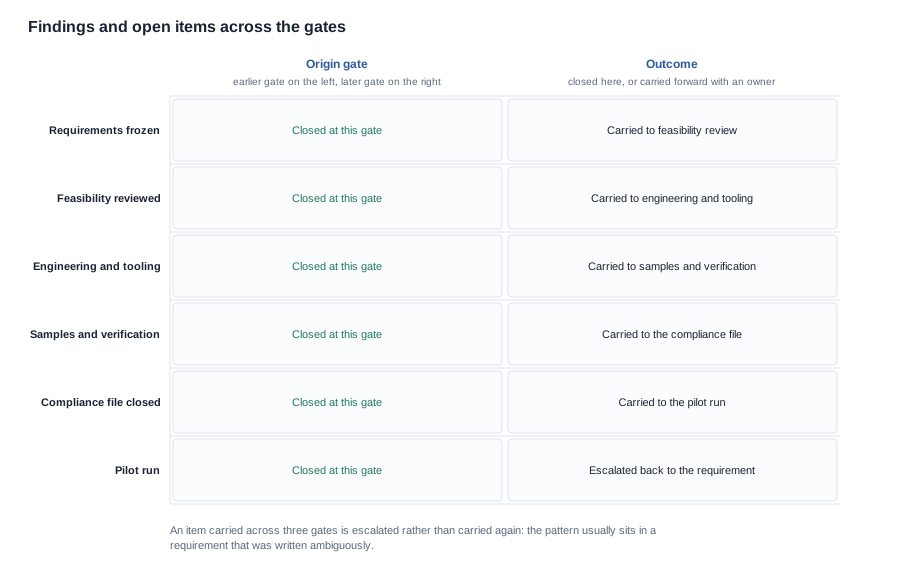
The matrix is the working view a buyer keeps: the gates down one axis, the states an item can be in across the other. An item starts as raised, becomes either closed at this gate or carried, and a carried item either closes later or comes back to the requirement. The point of drawing it as a matrix rather than a list is that the matrix makes it obvious when a row is being used for tracking and when it is being used for avoidance.

Questions to ask about a customisation review
These are the questions we ask, or that we expect to be able to ask, at any point in a customisation programme. They are grouped by the stage they belong to, because the value of a question depends entirely on when it is asked.
At the requirements gate:
- Which document is the requirement, who has signed it, and does it state the target market, the models in scope, the configuration, the packaging, the delivery documentation and the permitted claims?
- Which claims is the product allowed to make, and which are explicitly excluded?
- What is not published in the programme — MOQ, lead time, warranty terms, price — and when will each of those be stated?
At the feasibility review:
- What is the boundary of what can be built, written down, and what falls outside it?
- What does each configuration inside the boundary require in tooling, and what does the tooling cost look like?
- If the programme stops after this point, what is recoverable and what is not?
At the engineering and tooling gate:
- Has the tooling been verified against what it is for, and who confirmed that?
- Does the firmware build match the frozen requirement line by line, and where is that comparison recorded?
- What has to change, and what does it cost, if the requirement moves now rather than after the samples?
At the samples-built-and-verified gate:
- Which physical object is the golden sample, and how is it stored and marked so that it is still the reference in a year?
- What does the verification record cover, and against which requirement lines was it run?
- Which failures were found, which were fixed, and which were accepted as differences?
At the compliance file gate:
- Which exact model string does the declaration of conformity cover, and does it match the model string that will ship and the one on the packaging?
- Which certification evidence is in the file, and which market-specific requirements does it cover?
At the pilot run:
- Was the run on production tooling, at production volume, and inspected against the golden sample?
- What did the inspection find, and what was the disposition of each finding?
Across all gates:
- Which items are open right now, who owns each of them, and by which gate must each be closed?
- What is in the file that a buyer, a channel partner or a regulator could reasonably need to see, and is it all there?
The last question is the one that most often exposes a gap. A programme that has produced six gate documents and one golden sample is in good shape; a programme that has produced a verbal history and a set of files scattered across inboxes is not, and the second kind usually discovers the problem at the compliance file rather than before it.
It is also worth putting on the record the ordinary commercial questions we will ask directly rather than assuming: what is the incoterms basis for the purchase order, what does the spares commitment look like for the field, and what does a warranty claim require from the buyer's side. These are ordinary commercial questions that belong in the file at the same time as the engineering ones, because a programme that cannot answer a channel partner's warranty question has a commercial gap even when every engineering gate is closed.
None of these questions require disclosure of anything that is not published. They ask about process, artefacts and rules, all of which are things a supplier either has or does not have. A programme file that can answer them is a programme that can be reviewed by a third party — a new procurement manager, a channel partner's quality team, or the brand's own operations lead — without needing anyone to explain what happened. That is the real test of a review method: not whether it produced a clean report, but whether the file survives a change of personnel.
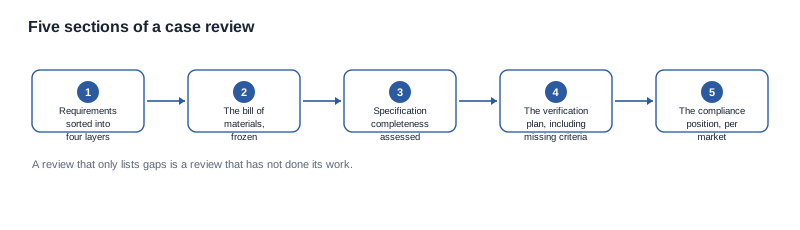
The last point is the one worth repeating. The value of this structure is not the meeting. It is the file. A programme that has been carried across six gates with named documents, signed closures, classified findings and an explicit open-item list does not depend on the memory of any individual, and that is what makes a customisation programme transferable — from one buyer to the next, from one revision of the product to the next, and from a quotation through a purchase order and a pilot order into a production relationship that is meant to last.


