

A buyer sends a requirement list. Most of the lines on it are cosmetic, one or two are structural, and the difference between those two kinds of line decides whether the programme is a printing exercise or an engineering programme. This guide is an orientation to the customization options we publish and, more usefully, to the four layers they sit in, because the layer a requirement lands in determines its tooling, its schedule and its cost long before a quotation exists.
Our catalogue records customisation routes category by category rather than as a single set for the whole range. It does not price them, because a price without a scope is a number nobody can plan a launch against. What the catalogue does publish is the underlying range: twenty-five named models across four tiers, plus three entries — AR glasses, an electrochromic entry and a bone conduction entry — that carry no model string.
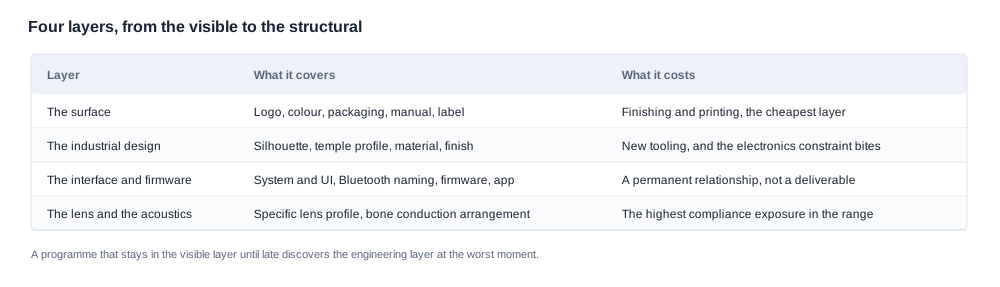
Customization options start where the requirement lands, not where it looks
A requirement list arrives as a flat document. Logo here, colour there, a Bluetooth name, a packaging line, and — usually buried near the bottom — a request to change the temple profile. Read linearly, that list is one project. Read by layer, it is three or four projects with three different engineering consequences and three different cost structures.
The sorting exercise is short, and it is worth doing before anything else, because the questions that drive it are the same in every programme:
- Does the requirement change how the product looks, or how it works? Appearance moves the programme into finishing, printing and assembly. Behaviour moves it into firmware, optics, acoustics and the supply chain behind them.
- Does it change the bill of materials? A different cell, a different board, a different charging interface or a different sensor changes what the shipment is made of, and every downstream document — packing list, transport paperwork, conformity assessment — has to be re-read against the new configuration.
- Does it need new tooling? A new mould, a new lens tool, a new case tool and a new fixture are capital items. They do not appear in a unit price, and they are governed by the ownership rules on the standard OEM tooling page.
- Is it permanent or one-off? A printed logo on a temple is a consumable. A branded app, a renamed Bluetooth stack, a modified firmware build and a custom interface are a maintenance relationship that continues long after the shipment has been paid for.
- Who signs it off? A requirement that only a designer can approve moves slowly. A requirement a procurement manager can approve moves quickly, because the evidence attached to it is a fact rather than an opinion.
Buyers who answer these five questions before requesting a quotation tend to get a faster and a more accurate quotation than buyers who send a long list and ask for a price. The reason is not supplier behaviour. It is that a flat requirement list has no unit of comparison, so it can only be priced as a whole — and a whole is exactly the number that cannot be planned against.
The practical instruction to a supplier, then, is short: sort the requirements by layer before quoting, and state the layer for each line. If a quotation arrives without that structure, it is a guess with a total on it.
The screening criteria are worth writing down before the first request goes out, because they decide which requirements you even put in front of a supplier. Three criteria filter most lists:
- Does it change the bill of materials? If not, it belongs in a printing and finishing instruction, and it should be costed as such rather than as engineering.
- Does it survive contact with your other requirements? A colour reference that has to match a lens tint, and a temple profile that has to carry the cell, pull against each other. Lists that are filtered one line at a time produce programmes that have to be redone.
- Is it written in a form the supplier can quote against? "Brand blue" is not quotable. A Pantone or RAL reference against a named material is. A logo file in a named vector format at a named size is. A requirement expressed as a preference is a negotiation, and it should be identified as one before the quotation rather than discovered after it.
This filtering is ordinary due diligence. It is also the fastest way to find out whether a programme is a product project or a packaging project, because the answers separate the two immediately.

Customization options by layer: surface, industrial design, interface, optics
Layer one — the surface. The printed items themselves — the marks applied to the frame, the printed manual, and the per-market label. This is a finishing and printing exercise: pigment, screen or pad printing, and artwork files prepared to the printer's tolerance. It is the fastest layer to change, the cheapest layer to change, and the layer where the artwork freeze matters most. Nothing here alters the bill of materials.
Layer two — the industrial design. Frame silhouette, temple profile, material, finish, nose bridge. This is where the electronics constraint bites: a temple that has to carry a cell, a protection circuit, a board and, on the camera tier, a sensor needs a different cross-section from an optical temple, and that cross-section is rarely a designer's first choice. The published customisation list includes temple shape for exactly this reason. For eyewear brands, the depth question is whether your existing frame geometry can be preserved — the customisation depth discussion for eyewear brands sets out which parts of a heritage silhouette usually survive contact with a battery.
Layer three — the interface and the firmware. System and UI customisation, Bluetooth naming, the firmware build, and the app. The published list names these routes, but the detail that decides the commercial outcome is not in the list: a branded app is a permanent relationship, not a deliverable. The app branding article sets out the levels and what each one commits the supplier to, and it is the one to read before the app appears on a purchase order rather than after.
Layer four — the lens and the acoustics. A specific lens profile, a specific temple geometry, a bone conduction arrangement with its own amplification. This is the layer where published data shows the trade-offs most sharply. The V03 Pro pairs photochromic lenses with three published colour options, and no other camera model in the range offers photochromic lenses; the V06 publishes four colours; the catalogue carries an electrochromic entry with no model string. Everything else in the colour and lens space is written as not published and has to be asked for.
The catalogue facts that actually constrain layer two and layer four are worth holding in view while you read the requirement list:
- Charging method is published for twenty-four of the twenty-five named models — magnetic on seventeen, Type-C on seven — and is not published for CY05 and the CY03, and MT6 and L1 Pro.
- Charging case capacity is published for five models: the L1 Pro and the CY05, and the CY03 — each at 1400 mAh, the L2 Utral at 900 or 1400 mAh, and the MT6 at 1200 mAh in a foldable case. A case is listed for the KY06 and the MT5, though neither has a capacity published. There is no case row at all for S7 and V06, and the V03 Pro and the V03 is explicitly published as having no case.
- Charge time is published as "2 hours or less" for twenty-six models. Only the D17 and the ZH12 publish approximately one hour, and the D17 and ZH12 are the two sport-tier models among the twenty-five.
- Camera batteries fall in the 220–290 mAh band, and the rated runtime published for them is roughly five to eight hours, with no test condition given.
- IP rating is published for exactly two models in the whole catalogue: IP54 on the V06 and IP54 on the S7. No other model carries an ingress row.
- Weight is published for exactly one model: 158 g for the MT6 glasses, explicitly excluding its 1200 mAh foldable case.
- Camera resolution comes in two published values: 8 MP on eight models, and 13 MP on three — the L1 Pro and the S7, and the L2 Utral.
Read those as constraints, not as selling points. A buyer planning a sport range knows that the only two models with a published ingress rating are the V06 and the S7, and that if a programme needs a different rating, it has to be established against a test condition we have not published.
Customization options the catalogue publishes, and the ones it does not
The published customisation list is a list of routes, not of scopes. It tells you that each category records a set of customisation routes, without naming a single set that covers the range. It does not tell you how deep any of them go, because depth is a decision, and a decision taken at quotation stage is a decision taken without engineering input.
The rows a buyer would use to evaluate a customisation are largely the rows that are missing. Here is the honest inventory.
Published, and usable for planning:
- The seven customisation routes listed above.
- Colour options for two models only — three for the V03 Pro, four for the V06.
- Photochromic lenses on the V03 Pro, and an electrochromic entry with no model string.
- The configuration grid: how each device charges, whether it has a case, how long charging takes, camera resolution, Bluetooth version where published, and the battery and runtime figures for the camera tier.
- Bluetooth version, published on fourteen of the twenty-eight catalogue entries, and left out entirely for the eleven camera models, the A05, the A06 and the bone conduction entry.
- Surround audio, published for the D11; the D17 publishes "Surround Sound" and the ZH12 publishes 立体环绕音.
- Ten patent certificate images on the export certification page — eight design patents and two utility models — with no per-model certification row anywhere in the catalogue.
Not published, and therefore a question rather than a number:
- Minimum order quantity, unit price, production lead time, sample fee and warranty terms.
- Any per-model conformity claim. The catalogue body mentions CE, FCC, RoHS, RED and EN 18031 zero times; the export certification page is a picture page of patent certificates, not a conformity table. Certification status for a specific model is a question for the supplier.
- Touch input. The catalogue carries no capacitive-touch row for any model, so no model in this range may be described as having it.
- Translation. The catalogue has no translation row for any model, so multi-language packaging and inserts are a programme, not a stock feature.
- Test conditions behind the runtime and charge-time figures.
- Tooling cost, NRE, artwork tolerances and colour-matching tolerances.
- Field of view, video specification, sensor model and microphone specification for the camera tier.
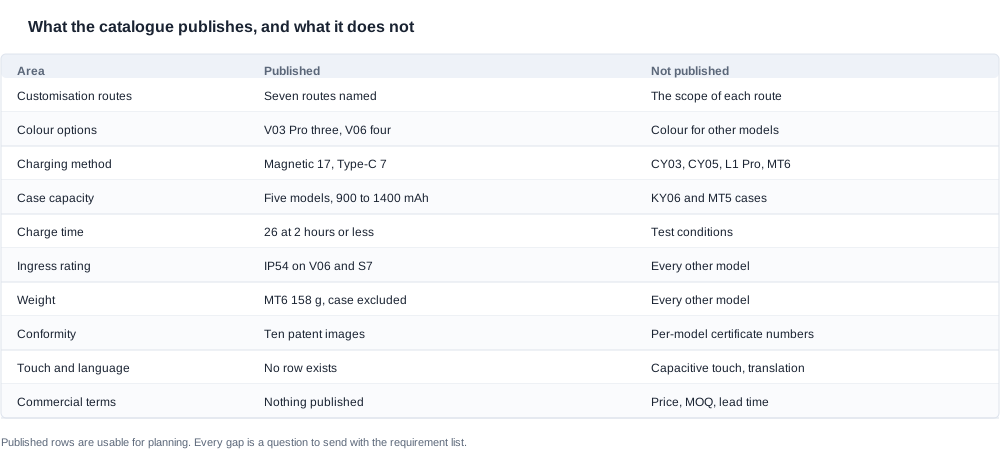
That last table is the one to keep. A quotation you can plan a launch against is a quotation whose configuration rows are all published. Where a row is missing, the missing row has to become an explicit deliverable in the contract — a datasheet, a test report, a certificate number, a measured tolerance — rather than an assumption in a spreadsheet.
The acceptance criteria for a customised build should therefore be written as a list of documents, not as a description of the product. A product description leaves the supplier to decide what good means. A document list does not. The list usually runs to eight or ten items: a configuration sheet naming the charging method and the case, a charge-time figure with its test condition, a runtime figure with its test condition, an ingress figure with its test method, a weight figure with what it excludes, a lens or colour reference with the tolerance written against it, a manual, an insert, a packing list, and a set of conformity documents for the destination market. Each item either exists, does not exist, or has to be created — and the third case is a development item with a cost and a schedule, not an omission.

Customization options that need new tooling
Tooling is where a cosmetic programme quietly becomes a capital programme. The rule of thumb is simple: if the change alters the shape of a moulded or machined part, it needs a tool; if the change alters only what is printed on a part, it does not.
By that test, the requirements that carry tooling are the temple profile, the frame silhouette, the nose bridge, the case shell, and any lens geometry change that moves the edge thickness. The requirements that do not are the logo, the pad or screen print colour, the packaging print, the printed manual, the carton artwork, and the label content.
Three consequences follow, and each one belongs in a purchase order rather than in a conversation:
- Tooling ownership and location. Who holds the tool, where it sits, and whether the buyer can move it if the relationship ends. The tooling requirements page sets out the options in full, including the amortisation question, which is the one that determines whether a second order from the same tool carries the cost.
- NRE and the artwork freeze. Non-recurring engineering cost is not published by us, because it is a function of the specific tool and the specific development path. The freeze point matters as much as the number: artwork that changes after the tool is cut is a second cut, and a second cut is a schedule event, not a design decision.
- Sample handling. A pre-production sample and a golden sample are different objects with different purposes. The pre-production sample proves the configuration works; the golden sample is the reference against which production units are accepted. Neither the sample fee nor the number of samples is published, and both belong in the order.
A fourth item sits alongside tooling and is often forgotten: where the tooling sits in the schedule. A tool that is cut after the first purchase order lands can hold the entire programme, because a tool that is not ready cannot be started. This is the reason lead time appears in our own programme documentation as a function of customisation depth rather than as a single figure — see the customisation and lead time discussion for how each requirement type adds time.

The flow above is deliberately simple, because most of the delay in a customised programme is not in the middle. It is at the first box, where a requirement is accepted without being written down, and at the last, where production is accepted without a frozen artwork file and a golden sample.

Customization options, ownership and change control
Customisation creates assets that outlive the shipment. A logo file, an app build, a modified firmware image, a UI string set, a tooling set and a document set are all assets, and the question of who owns them is not answered by default in most supply relationships.
Three ownership questions deserve explicit answers:
- The design and tooling. If your team draws the frame and the supplier cuts the tool, ownership of the design file and the tool is a contract term. If the supplier draws it, you need to know what rights you hold over a design that carries your name. The OEM confidentiality discussion covers the commercial framework for this, and the intellectual property discussion covers how design files, firmware and app code are typically separated.
- The software. A branded app, a renamed Bluetooth identifier and a custom interface are three different levels of involvement, and each has a different maintenance tail. A custom interface is a quarterly obligation. A renamed Bluetooth stack is a firmware obligation that reappears on every security or connectivity update. The app levels in the app branding article make the difference concrete.
- The documentation. Manuals, inserts, warranty statements and conformity text are usually the fastest way for a brand's legal exposure to enter a product it did not design. The export documentation discussion covers what a market set usually has to contain.
Change control is the fourth item, and it is the one that protects a schedule. A written change procedure should state:
- what constitutes a change, and who is allowed to raise one;
- the evidence required before a change is accepted;
- who approves it, and how long approval may take;
- what happens to the schedule and to the open balance when a change lands after the artwork freeze.
A programme without change control does not avoid changes. It discovers them, one at a time, at the worst moment.
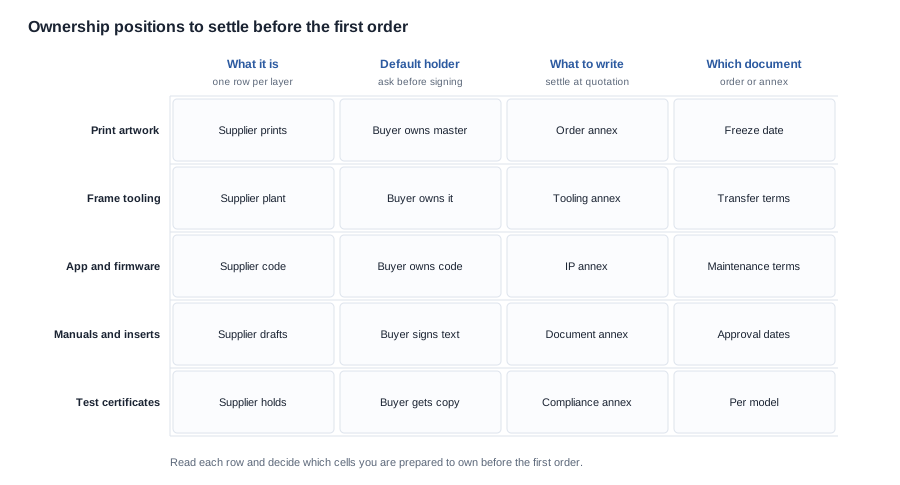
The matrix is a negotiating aid rather than a legal template. Its use is simple: read it down each column, decide which cells you are prepared to own, and put those cells into the agreement before the first purchase order is issued.
Customization options in a range plan
Most programmes are not a single product. They are a range — a hero model, a mid model, a sport or travel variant, a kids model — sharing an app, a packaging language and a supply base. In a range plan, customisation decisions do not repeat per model. They repeat per layer, and the layer decisions are made once.
A workable sequence for a range plan:
- Decide the layer-level strategy first. One colour system across the range, one packaging structure, one app, one firmware baseline. This is where cost and time are actually saved, because the alternative is four independent decisions that each carry their own engineering tail.
- Then place each model in a slot. If two models share a temple profile, they share the tool. If they do not, they carry two tools, two NREs and two schedules.
- Then check the published rows for each slot. Charge method, case presence, capacity, charge time, resolution, IP rating, weight. Where a row is missing for a model you have placed in a slot, that missing row becomes an explicit question before the slot is confirmed.
- Then freeze. Artwork, colour references, packaging copy, manual text and insert text, all in one freeze, so that production units can be judged against one reference rather than against a moving document.
- Then place the order with the commercial terms settled. Unit price, minimum order quantity, lead time, warranty and certification status are not published and have to be settled in the quotation and the order rather than assumed from a catalogue page. Incoterms and the ship-to split, DDP or FOB, belong in the same document, because the cost of a customisation programme sits as often in the freight and duty line as in the unit price.
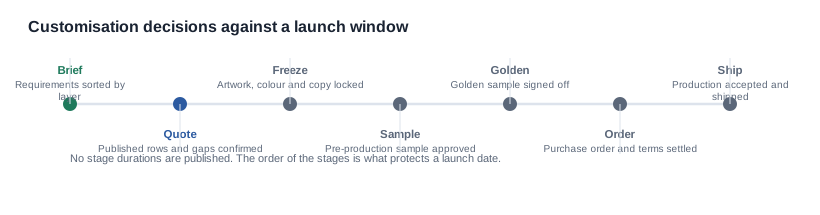
The timeline above is a planning frame rather than a schedule: no dates are published for any stage, because none of the durations involved are fixed. What is fixed is the order of the stages, and the order is what protects a launch date.
The questions to ask before you order are worth having in writing, because they are the questions that separate a programme from a dispute later:
- Which published rows apply to the exact configuration you are ordering, and which are not published for it?
- Which of your requirements are catalogue options, and which are development items with a cost and a schedule?
- Which requirements change the bill of materials, and what documentation is re-issued as a result?
- Which requirements need new tooling, who owns that tooling after the first order, and what happens to it if the programme ends?
- What is the artwork freeze date, and what is the change procedure after it?
- What is the sample sequence — how many, at what cost, and which one becomes the golden sample?
- What is the warranty, expressed in a term and a period, and who handles a claim in your market?
- What conformity documents will accompany the shipment, for which destination markets, and under whose name?
- What are the unit price, minimum order quantity and lead time for your configuration, and what are the negotiation levers on volume and on tooling amortisation?
- What is the total cost of ownership for the first year, including packaging MOQ, spare parts and any software maintenance?
That last question is the one that separates a buyer from a purchaser. The unit price is a line; the total cost of ownership is the number that decides whether the programme works.
The negotiation levers, for a buyer who intends to negotiate rather than simply accept:
- Volume. Break points in unit price are normal, and a supplier will tell you where they are if you ask for a price ladder rather than a single number.
- Tooling amortisation. Whether the tool is paid for once and amortised, or charged per unit, changes the second order's price more than any first-order discount does.
- Packaging MOQ. Packaging frequently carries its own minimum, and a print run that must be bought in full is a cash exposure that does not appear on the product line.
- Change fees. A stated fee for artwork changes after the freeze is cheaper than an open-ended re-quote.
- Delivery terms. DDP and FOB put the freight, duty and insurance risk in different places, and on a customised programme that difference is often larger than the unit price discount.
- Payment terms. On a programme with tooling, the tooling instalment, the sample payment and the balance terms should be separate lines with separate triggers.
Two red flags are worth naming. The first is a quotation that bundles a customisation into the product price without naming its scope; the scope is where the cost lives, and an unnamed scope cannot be compared between suppliers. The second is a specification written in adjectives rather than references — "premium", "slim", "high-end" — because adjectives cannot be inspected at incoming goods, and a finished unit that fails an unmeasurable specification is not a defect.
The common pitfalls in a first programme are unglamorous: artwork that changes after the tool is cut, a colour reference approved on a screen and rejected on the part, a manual written in a language the product cannot display, and an inspection checklist written against the catalogue rather than against the configuration that was actually built. Each of those is a document problem, and each is solved by a document rather than by a complaint.
One last point, because it is the one that is most often misunderstood. We publish the options we hold and mark the rest as not published. We will not describe an option's scope without stating it, and we will not fill a colour list, a dimension row or a performance figure with a value taken from a comparable product. If a requirement is new to us, we will say so and treat it as a development item rather than pretend it is a configuration switch.
Send the requirement list sorted by layer, and we will come back with the layer for each line, the published rows that apply to it, and the questions that the published catalogue does not answer.
Related reading


