

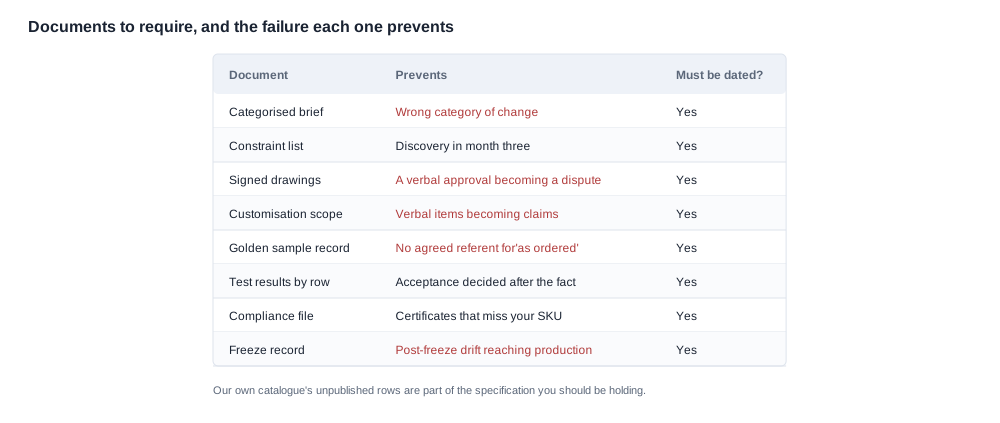
An engineering customization programme is, mechanically, a series of decisions. Some of those decisions are technical: which housing, which firmware branch, which test fixture. Most of them are commercial: who pays for the tool, what the unit price is, when the goods land, which incoterms apply, what MOQ the brand commits to, what the warranty covers. What connects the two sets is a third set, which is far smaller than either and far more decisive: the documents.
The documents are not paperwork added on top of the work. They are the work product in its durable form. A programme can run for a long time on goodwill, phone calls and shared assumptions, and it will still produce something shippable — but it will produce a product nobody can defend to a customs officer, a distributor, a retailer compliance team, or an internal auditor six months later. The buyer who requires documentation at each gate is not being difficult. The buyer is buying the ability to answer a question in a month instead of guessing.
This article lists the document set an engineering customization programme should produce, gate by gate, explains what each document has to settle so that it can be argued with, and covers how to organise the file so that an audit or a new colleague can follow it without a meeting. It is written for brand-side buyers and channel procurement managers who will be asked to sign.
The framework is the one we apply: requirements frozen, feasibility reviewed, engineering and tooling, samples built and verified, compliance file closed, and a pilot run before mass production. Six gates, six sets of documents, and one rule underneath them all — a stage is finished when it produces a document, not when a date arrives on a plan.
Engineering customization documentation: the documents to require
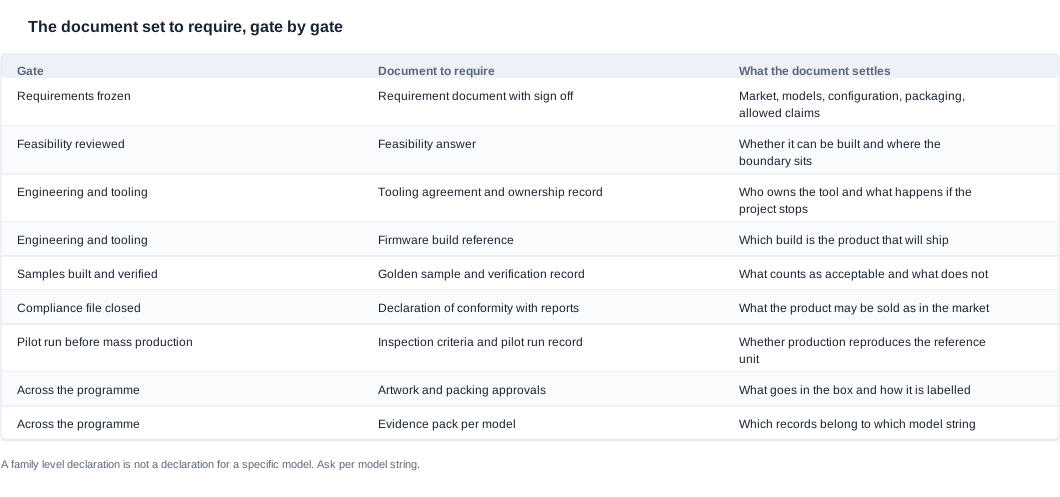
The list below is the minimum set. A programme that produces all of these has an auditable trail from a written request to inspected production output. Anything a supplier is unwilling to produce in writing is, functionally, not part of the programme.
- The requirement document, signed. States the target market, the models in scope, the configuration, the packaging, the delivery documentation, and which claims the product is allowed to make. This is the document every later document points back to. Without it, "matches the sample" has no reference, and the verification record becomes an opinion.
- The feasibility answer. A written answer on whether the request can be built and what it costs in engineering and tooling. The output is a boundary, not a yes or no — what is inside the achievable envelope, what sits outside it, what would have to change to bring the outside part in, and what that change costs.
- The tooling agreement and ownership record. Who owns the tool, where it lives, what happens to tooling cost if the project stops, and how the amortisation or recovery of that cost is handled. Tooling is the least reversible step in the programme, which makes this the most important document to have settled before anyone signs.
- The firmware build reference. A build identifier that matches the frozen requirement, reproducible by the supplier, quotable by the buyer in a purchase order, and traceable to the verification record. A version string nobody can reproduce is a label, not a reference.
- The golden sample and its verification record. A signed reference unit plus a record covering pairing, audio, charging, any camera function and control behaviour. The golden sample defines acceptable and not acceptable; the record explains how.
- The declaration of conformity and the reports behind it. Covering the exact model string that will ship, the underlying reports, and market-specific requirements, with the reports attached rather than referenced in passing.
- The inspection criteria and the pilot run record. The criteria the units are inspected against, and the record of the production run on production tooling at production volume, inspected against the golden sample.
- The artwork and packing approvals. Approved artwork files, approved packaging print files, and the approved packing specification — master carton, inner tray, protection, labelling — with the approval date and the approver named.
- The evidence pack per model. The set of records for each specific model string that will ship, so that nothing has to be reconstructed when a question arrives about one model rather than the family.
Number nine is the one most often skipped, and it is the one that saves the launch. Our own catalogue shows why the discipline matters: the range covers twenty-eight models — eight audio, three sport, eleven camera, three for children, and three carrying no model number. Bluetooth version is published for fourteen of them and is not published for the eleven camera models plus three others. Remote control shutter appears only on two specific sport models. An ingress rating of IP54 appears only on two specific models. Facts of that kind cannot be inferred from the family; they have to be looked up per model, and looking them up is a filing exercise, not a memory exercise.
So we will ask for the evidence pack to be delivered per model rather than as one consolidated file, because the consolidated file is the one that hides gaps. A consolidated bundle looks complete and is impossible to check. We will also ask for the file to name the model string on the cover of each pack, so that nobody has to infer which records belong to which SKU.

What each required document has to settle
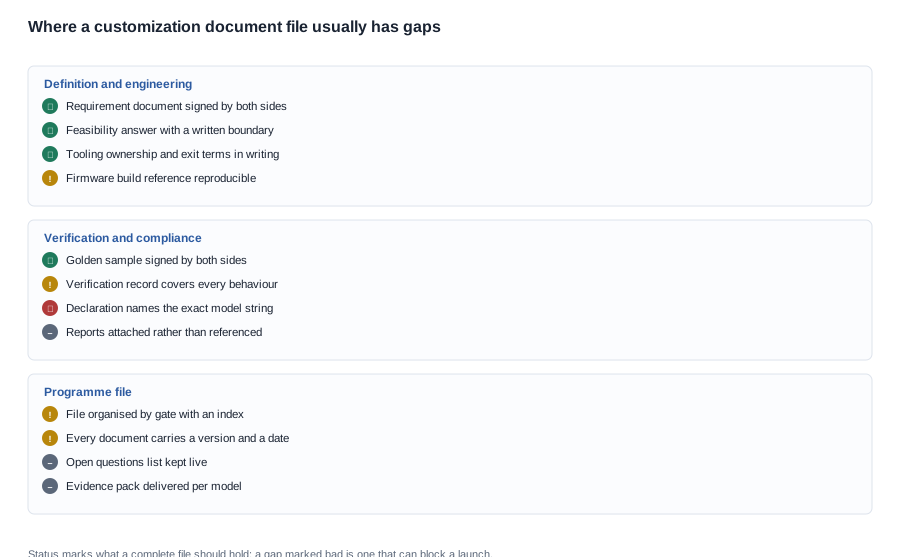
A document is useful in proportion to the number of arguments it ends. The test for each one is simple: after it is signed, is there still a question that two reasonable people could answer differently? If yes, the document is not finished.
The requirement document settles what the product is and what it is allowed to say. The clause that carries the most weight is the one about claims. The requirement document states which claims the product is allowed to make, and that list is the single source of truth for the packaging, the listing, the brochure, the sales deck and the manual. A claim discussed in a meeting but not written down returns during compliance review — not as a minor documentation gap, but as an unapproved claim that has to be withdrawn, re-approved, or re-evidenced, and the marketing material built on it has to be redone. This is not a theoretical risk; it is the most common way that a launch date slips for a reason nobody can explain at the time.
The feasibility answer settles what is possible and where the boundary sits. It should contain the list of things the supplier will not do, and the reason for each. It should also record what is known to be excluded and on what basis. Numbers do not belong here in the sense of published specifications, because capacity figures, stage lead times, indicative schedules, price, MOQ, lead time, sample fees, warranty terms, certificate numbers, certification status per model, factory size, employee count, annual output, customer names, order volumes and cost percentages are not published by us. Those belong in a quotation against a frozen requirement, and then they are negotiable. The boundary is not a number and it does not move in a negotiation; it is a statement about what the engineering can do.
The tooling agreement settles ownership and the exit. Three questions have to appear in writing: who owns the tool; what happens to tooling cost if the project stops; and what happens to the tool if the project stops — does it stay with the supplier and become available for a later run of the same project, is it transferred, or is it written off. A programme that reaches tooling without a written answer to those three questions has already accepted a transfer of risk it did not price.
The firmware build reference settles which build is the product. It should carry enough identity to be quoted in a purchase order, reproduced by a second engineer, and matched against the verification record. When a firmware change is made after the golden sample is signed, the reference moves and the verification record moves with it.
The golden sample and its verification record settle what acceptable means. The golden sample is a physical reference unit, signed by both parties, and the verification record describes the checks that were run against it — pairing, audio, charging, any camera function, and control behaviour — with the results. The record is what makes the golden sample usable: without the record, the sample is an artefact with an opinion attached, and every later comparison becomes a matter of taste. The sample defines acceptable versus not acceptable, which is why it is signed rather than merely delivered.
One rule follows from the golden sample and should be written into the inspection criteria: a component substitution triggers re-verification against the golden sample and a check of whether the declaration still covers the product as changed. A substitution that changes nothing the verification covered can be treated as like-for-like. A substitution that touches anything the verification covered means the golden sample is reissued and the declaration is reviewed before further units ship. Here we will not accept a substitution into a pilot order on the basis that it looks equivalent, because "looks equivalent" is precisely the judgement the verification record exists to replace.
The declaration of conformity settles what the product may be sold as. It must cover the exact model string that will ship, the underlying reports, and the market-specific requirements. A declaration covering a product family rather than a model is not a declaration for your SKU — it is evidence about other products, and it does not transfer to yours by proximity. This is the retention point that decides whether a launch holds or slips, and it is worth repeating because the failure is common: the brand receives a family-level document, believes the file is closed, and discovers at customs, at a distributor onboarding check, or during a market surveillance enquiry that the model it is shipping was never named.
The reports behind the declaration are part of the same document set, and certification evidence should be requested by model string rather than by product line. Our catalogue body lists CE, FCC, RoHS, RED and EN 18031 nowhere at all, and per-model certification status is not published. The one catalogue export page we have is an image page showing ten patent certificates — eight design patents and two utility models — with no per-model certification rows. A patent certificate is not a market access document, and the two should never be treated as substitutes in a file. The right question to put to any supplier is which report, naming which model string, covering which market, and resting on which configuration — and the right thing to receive in return is the report itself, not a summary of it.
The inspection criteria and the pilot run record settle whether production reproduces the reference. The inspection criteria define what is checked, how many units are checked, and what constitutes a defect in each of the behaviours the verification record covered. The pilot run record is the evidence that a production run on production tooling at production volume was inspected against the golden sample, and it should carry the inspection data rather than a pass statement. A pilot order is not a development run and the distinction is a documentary one as much as a physical one: if a unit was hand-assembled, hand-flashed or adjusted, it is an engineering sample no matter how many were produced, and it cannot be the evidence for the production system.
The artwork and packing approvals settle what goes in the box. Approved artwork files, approved packaging print files, and the approved packing specification, each with an approval date and a named approver, close a surprisingly large number of otherwise avoidable arguments — most of which surface at the moment goods are being prepared for shipment rather than during development. Artwork is also usually needed earlier than buyers expect, because it travels on the product and on the packaging and both sit downstream of the tooling decision. A late artwork approval compresses packaging approval into the same window as everything else, and the trade-off between an extra review cycle and a compressed one should be made deliberately rather than by accident.

How to hold the file
A document set that exists but cannot be navigated has a shelf-life. Programmes move people: the engineer who ran the verification leaves, the channel buyer is replaced, the brand reorganises its sourcing team. Six months later somebody asks which firmware build corresponded to the units that are on a shelf, and the answer lives in an inbox folder that no longer exists.
So the file needs structure, and the structure needs to be simple enough that it survives contact with a new person.
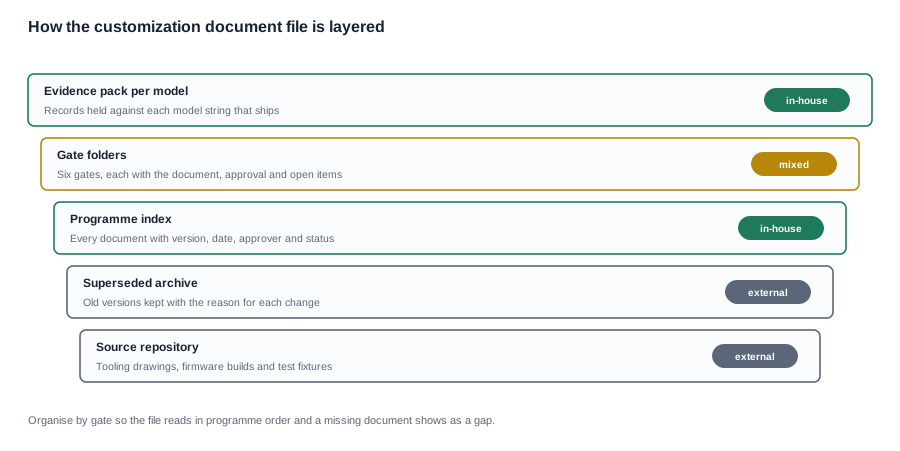
Organise by gate, not by document type. A file structure that separates "test reports" from "agreements" from "approvals" forces every future reader to do the reconstruction work themselves, and reconstruction is exactly the work the documents were meant to prevent. A structure that mirrors the sequence of the programme — requirements, feasibility, tooling and engineering, samples and verification, compliance, pilot — tells the reader the story of the project in order, and lets a missing document be identified by its absence in a sequence rather than by an argument.
Within each gate, keep three things and nothing else: the document itself, its approval record, and the list of open questions that were raised against it. That third item is what most files omit and what auditors most often ask for. A gate with no open questions recorded is either a gate where nothing was questioned, which is rare, or a gate where the questions were discussed in meetings and never written down. We will keep the open-questions list live, mark each item as open, answered or carried to the next gate, and carry unresolved items forward explicitly rather than letting them disappear.
Give every document a version and a date, and never overwrite one. The current version belongs at the top of the gate folder; superseded versions stay in a subfolder marked superseded, with the reason recorded. The reason matters more than the version number. A superseded requirement document is normal — requirements move, and the document set should show the movement rather than hide it. A superseded golden sample is a different signal entirely, because it means the definition of acceptable changed, and everything downstream of it has to be checked again.
Name files so that a stranger can find them. A file called req_v3_final_signed.pdf tells you nothing about which model it covers; a file called K01_requirement_v3_signed.pdf tells a new person exactly where to start. Model string first, document type second, version third. It sounds pedantic and it is the difference between a file that answers a question and a file that creates one.
Keep one index per programme that lists every document, its gate, its version, its approval date, and its approver, and keep it updated at the point a document is approved rather than at the end. An index reconstructed at the end is an index reconstructed from memory, which means it will be wrong exactly where it matters.
The practical test is whether we will still be able to answer four questions from the file alone, at any point in the programme and without a meeting: which build is the product, what is the reference unit, what is the product allowed to be sold as in this market, and who signed each of those answers. If the file cannot answer all four, the missing part is the next document to be written.

Questions to ask about the document file
These are the questions that expose the shape of a supplier's documentation practice early, when it is still cheap to change. They are also the questions worth carrying into any what to ask the supplier list you keep for evaluation.
- Which document closes each gate, and who signs it? Ask for the named gate list and the named signatory for each. A supplier who describes gates in terms of activities and dates rather than documents is describing a different programme from the one you are buying.
- Will the requirement document list the claims the product is allowed to make, and will it be the only authority for those claims? The answer should be yes, and the answer should survive being asked twice.
- What happens to tooling cost and to the tool itself if the project stops? Ask the question as written, in a meeting, and get the answer in writing, before the tooling invoice exists.
- Does the declaration of conformity name the exact model string, or the family? If the answer is the family, ask which documents would be needed to extend coverage to the specific model string that will ship.
- Which reports sit behind the declaration, and what do they name? The reports should be provided, not described. For each model string in scope, ask what evidence exists and what to ask the supplier about it.
- Is the golden sample signed, and what does its verification record cover? The expected scope is pairing, audio, charging, any camera function and control behaviour.
- What is the inspection criteria for the pilot run, and who signs the pilot run record? Ask for the criteria before the run, not the summary after it.
- How is the file organised, and can you walk a new colleague through it without a meeting? A supplier who can do that has a real document set; a supplier who has to narrate it has a set of files.
Two commercial questions belong alongside these. The first is what the quotation covers — price, MOQ, lead time, incoterms, packaging, samples, spares, warranty, the terms of the pilot order — and whether it is quoted against a frozen requirement, because a quotation against a moving requirement is not a quotation. Those terms are the ones you can negotiate freely; what you cannot negotiate is the evidence behind them. The second is how any change to the requirement is handled after it is signed: who raises it, who approves it, which documents are reissued, and whether the change is priced as an engineering item or absorbed. We will treat a change to a signed requirement as a document event, with the affected documents named and reissued, because a change absorbed quietly is a change that eventually surfaces as an inconsistency between the goods and the file.
The underlying principle is simple enough to state in one line: the document set is the product's other half, and a buyer who accepts half a programme has accepted half a product. Engineering customization work, the programme structure behind these documents, and the wider development documentation approach are covered in more depth on the engineering customization pillar, alongside development process documentation for the full record set, engineering customization and what can be customized for the scope of change itself, and the procurement certification checklist for assembling the evidence you need before a purchase order is signed.


