

Engineering customization what can be customized is the question every programme asks in its first week and very few answer well, usually because the answer comes back as a list of nouns. A list of nouns tells a buyer what to ask for. It does not tell a buyer whether the request will be accepted, what it will cost, how long it will take, or whether the same request would be accepted on a different model. Those four answers are the ones a sourcing team needs, and in our own documentation they are not written as a menu at all.
What we hold internally is a record of customisation routes indexed by product category. It is a record of what has been set up, arranged and discussed — not a promise, not a published capability list, and not organised model by model. This page is written around that record: what it says, what it deliberately does not say, how to turn a requirement into an itemised scope, and which questions decide whether a change is feasible.
It contains no list of customisable items. That is not an omission of convenience; the reason is set out in the second section, and the reason is stronger than it looks.
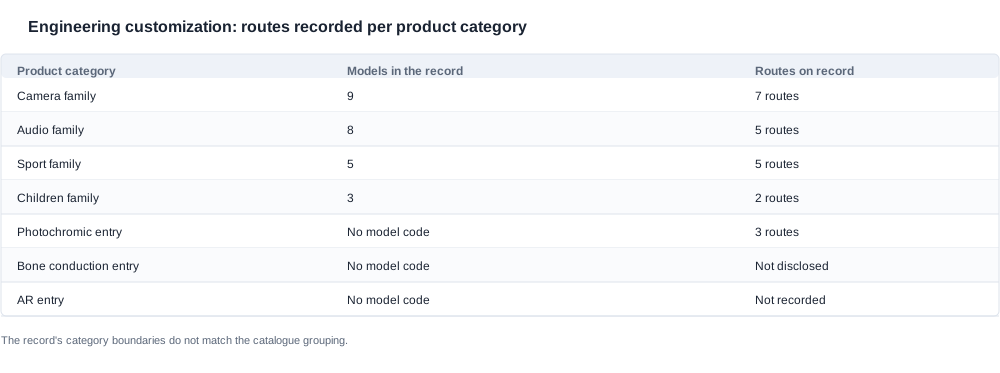
That table is the whole of the published-facing evidence for this question. Three families have routes recorded against them, one has fewer, one has a capability that our own record marks as unconfirmed, and two entries with no model code sit at the far end of the scale — one with nothing disclosed and one with nothing recorded.
What the internal record supports as a starting point
Our internal product record indexes customisation routes by category rather than by model, and the category boundaries in that record do not line up exactly with the grouping the published catalogue uses. That distinction matters, because a buyer who moves a model between the two sources will find the counts do not reconcile, and a discrepancy that looks like an error is in fact two different classifications of the same range.
What the record shows is this. The camera family has nine models against it and seven recorded routes. The audio family has eight models and five routes. The sport family has five models and five routes. The children's family has three models and two routes. The photochromic entry, which carries no model code at all, has three routes recorded against it. The bone-conduction entry, also without a model code, has nothing disclosed. The AR entry, the third of the three entries published without a model code, is simply not recorded.
Two features of that table do more work than the counts.
The first is that the three families' route sets are not versions of one another. They are different sets. Nothing about the audio family's routes can be assumed to exist on the camera family, and nothing about the sport family's routes can be carried over either. A buyer who arrives with a global list in mind, built from one family and projected across the range, will be wrong on every model that is not in that family — and the projection fails silently, because the request is expressed in words that sound as though they apply everywhere.
The second is that the counts are not capability statements. Seven routes recorded against a family means seven routes have been set up for that family at some point. It does not say that any two of them can be combined, that all seven can be combined, that any of them is available at a particular volume, or that the combination the buyer wants is one of them. It says nothing at all about cost or schedule. Treating the count as a menu is the error this page exists to prevent.
The certification position travels alongside the routes and has to be read as carefully. Three states appear in the record and no others: a framework named with nothing identifying it, a framework recorded alongside a note that no report is on file, and no certification information at all. The camera and audio families sit in the first state. The sport family sits in the first state as well, with the additional note that the ingress marking published on the V06 and the S7 appears on the catalogue page with nothing published beside it in the way of a third-party report number. The photochromic entry sits in the first state. The children's family sits in the third, and the bone-conduction entry with it. For the AR entry there is no recorded position at all.
And in the children's family, one of the two recorded capabilities is marked in our own record as still to be verified, which means it cannot be presented as available until somebody checks it. That is an honest statement about our own documentation, and it is worth more to a buyer than a confident sentence would be.
Why the available set is not published as a capability menu
There are four reasons, and they are reasons of accuracy rather than of caution.
The first is that publishing the names of the recorded routes would publish a capability claim. A list of routes is read as a promise, and a promise made in a catalogue is one a buyer will rely on when the alternative supplier's list is shorter. We would rather be judged on the answers we give against a named configuration than on the length of a list we published once.
The second is that the routes are family-specific and the list would mislead across families. A published global list would have to be annotated with the family it belongs to, and a buyer in a hurry reads the list, not the annotations. The record itself does not suffer from this, because it is indexed by family and the index is the point.
The third is that the record is a record of what has been arranged, and what has been arranged is not what can be arranged for a new programme. A route that exists in the record may have been set up for a model, a volume and a market that have nothing to do with the one in front of you. A published list would convert a historical arrangement into an apparent entitlement, and the gap between the two is exactly where a budget goes missing.
The fourth is the one nobody expects. Our published catalogue carries no per-model customisation row at all. Across the twenty-eight entries, there is no row that says what may be changed. So a published list of routes would not sit alongside a published record of what is standard — it would stand alone, describing the customisable part of a product whose standard part is undocumented. That is a strange document to publish, and a strange one to rely on.
There is also a fifth consideration that is not about accuracy at all. Customisation routes are not neutral. Some of them are trivial in one family and structurally serious in another, and a single flat list cannot carry that distinction without a lot of annotation, at which point it is no longer a list but a specification — and a specification has to be written against a configuration. The conversations that work are the ones where the requirement is already written down and the answer is given item by item.

The flow is the replacement for a menu. A requirement arrives as a list of nouns. Each noun becomes an item, and each item carries the family it belongs to, what the record holds for that family, what would have to be established before it can be answered, and who answers it. By the end of the exercise, the buyer has a scope rather than a wish list, and the supplier has a set of questions it can actually answer.

Turning a request into an itemised written scope
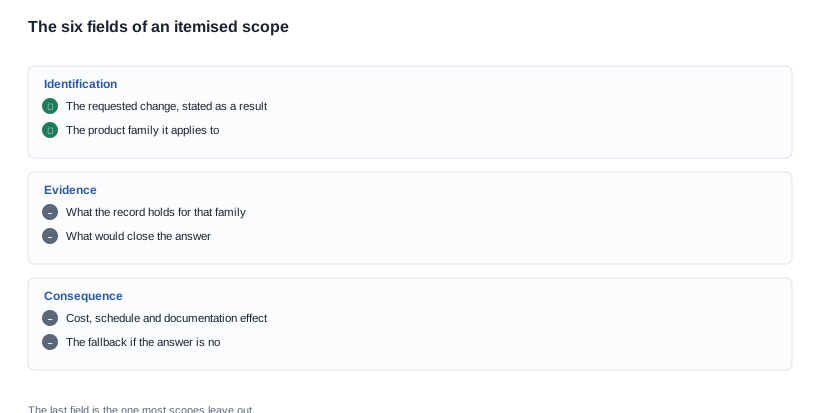
An itemised scope has six fields, and the reason for each one is short.
The first field is the requested change itself, written as a single sentence that describes the result rather than the mechanism. "The unit carries a different colourway" describes a result. "The front is re-moulded in a different polymer" describes a mechanism, which presumes the answer.
The second field is the family the change applies to. This is the field that prevents the most expensive error in this category, which is a request written for one family and read against another. Every family has its own recorded set, and a request that does not name its family is a request against the whole range, which is a much larger and much slower thing than the buyer usually intends.
The third field is what the record currently holds for that family, expressed as a count and a state rather than as a yes or a no. Seven recorded routes on a family of nine models says something specific and bounded. It does not say the change is available, and it does not say it is impossible.
The fourth field is what has to be established before the item can be answered, and it has four possible answers. Feasibility: whether the change can be made on this family at all. Cost: what the change adds, and whether it is per unit or one-off. Schedule: what the change does to the route to a first production batch. And documentation: whether the change alters anything that has to accompany the unit for its destination. Those four are what a buyer is actually asking for when they ask whether something can be customised.
The fifth field is the evidence the answer would rest on. Some items can be answered from the record. Some need a document — a drawing, a specification, a report. Some can only be answered by a physical unit, and the cheapest one to answer them is a sample built for the purpose. Some need a conversation, because the answer depends on how the buyer intends to use the product. Naming the evidence is what stops a question from being answered on the basis of confidence.
The sixth field is the fallback position if the answer is no. This is the field most often left out and the one that saves programmes. A scope that records only the yes answers leaves the buyer with nothing to plan around; a scope that records the no path as well can be priced against the weaker assumption, which is usually a workable programme.
Once those six fields exist for every item, two things become visible that a list of nouns hides.
The order in which the items are answered matters as much as the fields themselves, because the answers arrive at different speeds. An item whose answer depends on the family record can be closed in a single exchange. An item that depends on geometry cannot be closed until a drawing exists. An item that depends on a physical unit cannot be closed until a sample round has run. An item that depends on how the buyer intends to use the product can only be closed by the buyer. Writing the closing route beside each item is what tells a sourcing team what to ask first, and the checklist it produces has three columns: the item, the closing route, and who owns it. First, the items that are not independent of one another: some pairs of changes interact, and an item that is fine on its own can become a different question when it sits beside another. Second, the items that need to be answered first, because other answers depend on them. A scope that shows the dependencies is a schedule; a scope without them is a wish.

The questions that decide feasibility
Feasibility is decided by a small set of questions, and they can be asked in this order because each one either answers the next or removes it.
The first question is which family the request sits in, because the answer sets the working assumption for everything after it. The second is whether the record shows any recorded route for that family at all, and if it does not, whether the conversation is still worth having, which is a different question from whether the answer will be yes.
The third is whether the change touches a published specification row. If it does, it is a variation on a documented product, and the variation can be checked against the row. If it does not, it is an engineering request, and it belongs to a conversation with an engineering owner rather than to a catalogue lookup.
The fourth is whether the change alters geometry. A geometry change is what separates a modification from an engineering project, because it brings a tool into the programme, and a tool brings an ownership question and a cost and a schedule that nothing else does. This is the single most useful question a buyer can ask early, because the answer reframes the whole programme.
The fifth is whether the change alters the documentation scope. A change that touches the radio path, the charging path or the ingress structure has to be assessed against a technical file for the exact model designation and the exact destination, and our range carries no certification line to assess it against. That assessment can produce a change to the part itself, which is why it belongs in the early conversation rather than at the end of it.
The sixth is whether the answer depends on volume, and in what way. A change that only pays for itself at scale is a different commercial proposition from one that carries a fixed cost, and the buyer needs to know which before deciding whether to pursue it.
The seventh is what evidence would settle it. If the answer is "it depends on the drawing", then the drawing is the next task, not the answer. If it depends on a unit, then the sample round is the next task. If it depends on the intended use, then a conversation is the next task. Buyers who ask this question tend to get answers they can plan around, because the answer is a task rather than an opinion.
There is a further criterion that decides whether a change is worth pursuing at all: whether its answer would change the rest of the programme if it arrived tomorrow. A change whose answer leaves everything else untouched can be pursued cheaply, with the answer gathered in parallel. A change whose answer rewrites the configuration, the tool position and the documentation scope has to be settled before anything else starts. The trade-offs between the two are commercial, and the criteria for choosing between them belong to the buyer — which model, which family, which destination, which volume. Naming those four in advance is what stops a feasibility conversation from reopening the whole programme.
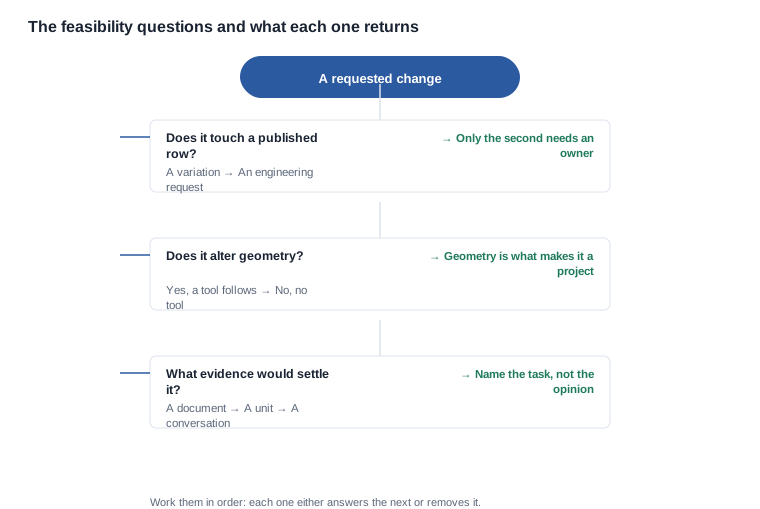
The last question in that diagram is the one that decides whether the programme continues, and it is the one that separates a scope from a shopping list. An item that has no feasibility answer, no evidence path and no fallback is not a request; it is a hope, and it should be priced as one until it is resolved.
Where CYNRIN stands on engineering customization capability
We hold a record of customisation routes by product category, that the record is not a published capability list, and we will answer item by item against a written requirement rather than in general terms. We will say how many routes are recorded against the family in question, which state each of them is in, and what would have to be established for the specific change.
We will not publish the names of the recorded routes as a menu, and we will not state that a change is available before somebody has answered the feasibility question for it. The families differ from one another, the routes within a family do not necessarily combine, and a recorded route says nothing about cost, schedule or the volume at which it makes sense. Those are the reasons, and they are reasons about accuracy rather than about disclosure.
Two further limits belong in the same answer. Our published catalogue carries no certification line for any model and names none of CE, FCC or RoHS in its text; the export certification page is company artwork, and the ten patent certificates it holds are not a conformity record for any model. And the ingress marking on the V06 and the S7 has no third-party report number published anywhere behind it, so it cannot be restated externally without a report. Where a requested change touches either of those, the answer names the document that has to be obtained.
For a buyer, the method is short. Name the family, itemise the request with the six fields, work the feasibility questions in order, and hold every open answer against the weaker assumption until it closes. A programme that does that ends up with a scope it can cost and a set of questions that are actually answerable — which is a better position than a published list that would have to be re-derived from scratch for every model. It can also say, at any point, which items are closed, which are pending, and what each pending item is waiting on. The questions to ask a supplier then become a list rather than a briefing, and a shortlist gets built without three separate conversations.
Related reading
- the questions that cannot be answered before a configuration exists
- the scope items an engagement leaves undefined by default
- what a signed reference unit settles before a volume order
- the quantity questions a volume order has to answer
- the catalogue rows a specification can rest on
What can be customised is answered item by item against a written requirement and a named family — a published list of nouns would answer the question in a way nobody could build against.


