

FCC compliance what it is, is a question that gets answered with a phrase like "US radio approval", which is accurate and nearly useless to a buyer. What a buyer needs is a precise picture of what the regime covers, what it deliberately leaves to other regimes, and which of the two authorisation routes applies to the device in the order. Those three things determine whether the shipment can move, and they also determine whether the buyer has anything in hand that a customs broker or a market surveillance officer can actually check.
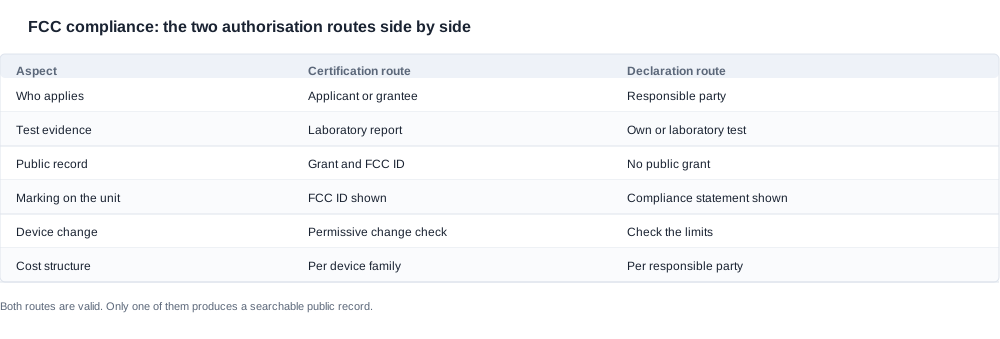
The single most useful thing to know about this regime is that one of its two routes produces a public, searchable record. A buyer holding an FCC identifier can confirm it alone, without the supplier's involvement, in a few minutes. A buyer holding a supplier's declaration has a document and no public record, which means the check becomes a matter of trust plus an inspection. That difference should drive how much effort goes into the supplier questionnaire.
FCC compliance: what an authorisation identifier does and does not settle
What a radio buyer should settle before anything is quoted
Three conclusions will make the rest of this subject straightforward. First, the regime regulates radio frequency emissions and, for digital devices, unintentional radiation, and it does not regulate battery safety, chemical content, ingress protection, product traceability or the physical durability of a hinge. An FCC identifier is therefore necessary for a connected product and completely insufficient on its own. Second, the identifier is a property of a device, not of a product name, so the file has to be matched to the configuration in the order rather than to the model family. Third, the cheapest and most decisive check in the entire category is a search of the public equipment authorisation database using the identifier, and it is the check most often skipped because the buyer assumes the supplier has already done it.
Before you order anything, the red flags worth naming are an identifier quoted from a brochure, a grant that covers a sibling variant, and a power setting raised after the grant was issued. The instruction that follows is short. Before anything is quoted, establish what the product transmits, in which band, at what power, and under whose name the authorisation will sit — because the answer decides the route, the cost and the evidence you will hold.
The buyer holding the radio file, and the exposure in it
The reader is a brand-side compliance lead, a procurement manager or an importer who is putting a wireless product on the United States market, either directly or through a channel customer who will run a file check before listing. Some of them are opening a new programme and need to know what to put into the specification so that the quotation reflects the authorisation cost. Others have a product already in the channel and have been asked by the customer for the identifier, and cannot find one.
What such a reader is managing is not a fine and not a test fee. It is a customs hold, a delisting, and the cost of a channel relationship that depends on a file being complete on a date the customer set. There is also a second cost that is easier to miss: the cost of discovering after production that the identifier on the units does not correspond to the grant the supplier quoted, because the supplier was describing a different variant of the same housing.
The reason this subject attracts more confusion than its complexity deserves is that the vocabulary is imprecise. A grant, an identifier, a declaration, a certification and an authorisation are used interchangeably in the trade, and a buyer who treats them as synonyms will end up holding the wrong document. The remainder of this article separates them.
What the identifier looks like and what it resolves to
The identifier issued under the certification route is unique to a granted device and is constructed from the grantee's code and a product code assigned to that device. The important property for a buyer is not its shape but its behaviour: it resolves to a public record, and that record names the grantee, the applicant, the equipment class, the frequency bands authorised and the test reports or exhibits the authorisation rests on. A buyer who has the identifier has, in effect, the outline of the file without having requested it.
The alternative route, the supplier's declaration of conformity, exists for a defined set of lower-power devices and has three characteristics that change what a buyer must do. There is no grant and no identifier to search. The declaration must be held by a responsible party located in the United States. And the device must carry a compliance statement, with the user manual carrying its own set of required statements. A buyer in the declaration route is not worse off than a buyer in the certification route, but the buyer is carrying the verification work themselves, because there is nothing public to check.
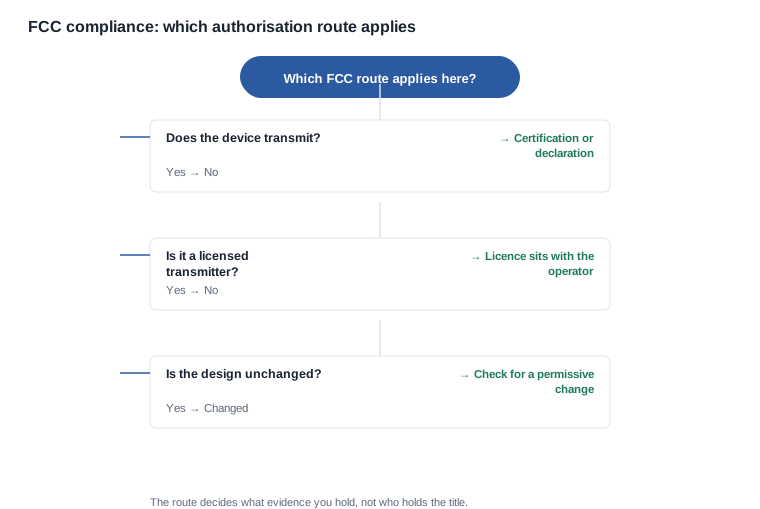
The routing question is short enough to answer on a phone call, provided it is asked properly. The three questions that settle it are whether the device transmits, whether it is a licensed transmitter whose authorisation sits with the operator rather than the manufacturer, and whether the design has changed since any earlier grant. A supplier who cannot answer the third question has not managed its own change process, and that is worth knowing before the order rather than after it.

Two records that cannot be compared between suppliers
The lines that decide whether the delivered unit matches the file
A radio file is easy to produce and hard to verify, which is why the table below is built around the check rather than around the document. Each line carries how it is measured, the line it has to meet and the shape a weak answer takes, and the last column matters more here than in most categories: an identifier that looks right and resolves to a different device is the failure that reaches the customer.
| Line to test | How it is measured | The line it has to meet | How a weak answer shows up |
|---|---|---|---|
| Route identification | Establish whether the device is authorised by certification or by supplier declaration. | The route is stated and the evidence matches that route. | A single answer of "certified" offered for both. |
| Identifier on the unit | Read the identifier printed on the device and on the packaging. | The identifier is legible and corresponds to the grant. | An identifier for a variant that is not the shipped variant. |
| Grantee against supplier | Read the grantee code and compare it with the party invoicing. | The grantee is the supplier or is disclosed and contractually bound. | A grant held by a design house unknown to the buyer. |
| Public record | Search the equipment authorisation database with the identifier. | The record is public, current and names the applicant. | An identifier that does not resolve to anything. |
| Equipment class | Read the class named on the grant against the device. | The class matches the device's actual function. | A grant for an unintentional radiator used for a transmitting one. |
| Frequency band | Compare the band authorised with the band the product uses. | The product operates inside the authorised band. | A product shipped in a band the grant does not cover. |
| Transmit power | Compare the authorised power with the configured power. | The configured power sits inside the authorised limit. | A power setting raised after the grant was issued. |
| Antenna | Ask what antenna is fitted and where it sits. | The antenna matches the one in the authorised design. | A different antenna fitted for a channel or a market. |
| Responsible party location | Check that the responsible party in the declaration route is in the United States. | A reachable domestic party is named. | A foreign entity named on a document that requires a domestic one. |
| Marking on the device | Inspect the compliance statement or identifier on a production unit. | The marking is present, legible and complete. | A marking present on the carton and absent on the unit. |
| Manual statements | Read the required statements in the user manual. | The statements required for the route are present. | A manual written for a different route. |
| Change control | Ask what happens if the chipset, antenna or power setting changes. | A written process identifies when a new authorisation is needed. | An assurance that changes are immaterial, made without assessment. |
| Evidence retention | Ask who holds the grant documents and test reports. | A named owner and a retention period are recorded. | A file that exists only as an attachment in one inbox. |
Two rows in that list cannot be compared between suppliers without care, and comparing them anyway is what manufactures a false specification gap. A supplier holding a certification route file and a supplier holding a declaration route file are not in a competition on quality; they are under different regimes with different public visibility, and a declaration route file can be entirely valid while having nothing to search. And a grant for a device that has since had its antenna changed is not a grant for the device on the pallet, so a statement that a grant "covers the model" is not evidence of anything until the antenna and the band are checked.
The check a buyer can complete alone
There is one check in this category that requires nothing from the supplier beyond an identifier, and it should be done on every device rather than once per programme. Search the equipment authorisation database, read the record, and compare four things: the applicant and grantee, the equipment class, the frequency band, and the authorised power. Then read the identifier printed on the physical unit and confirm that it is the one on the record.

That check catches the failures that matter, because it tests the device rather than the description. It catches a supplier quoting a grant for a sibling variant, because the identifier on the pallet resolves to a different record. It catches a band or power change made for a channel, because the record shows what was authorised. And it catches the case where the supplier's paperwork is fine but the units came from a different production run, because the identifier printed on the unit does not match the paperwork they sent.
The sequence matters as well as the check, and it is worth writing into the questionnaire rather than leaving to judgement:
-
Identify what the device does first, because the route and the equipment class both follow from it.
-
Establish who will hold the authorisation second, because that decides whose name appears on the file and who has to be reachable when a question arrives.
-
Request the identifier or the declaration third, naming the antenna and the band in the same request.
-
Verify it against the public record fourth, before a deposit rather than after.
A buyer who wants to know how to compare two suppliers on this point should start from the public record, because that is the only place where two files can be compared on equal terms. The checklist for the delivered unit is the second gate, and the pitfalls to avoid are comparing a certification route against a declaration route as though one of them were a lesser file.
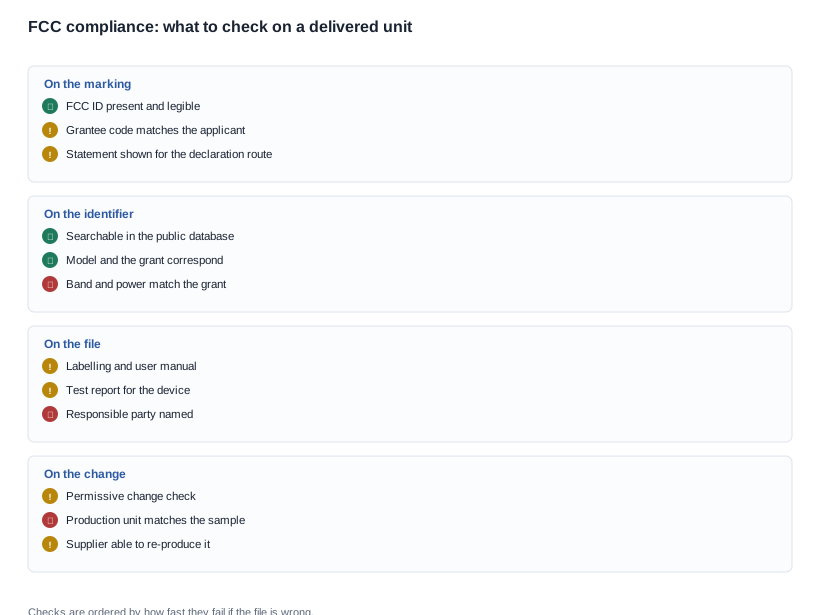
The checklist is ordered by how quickly each item fails when the file is wrong. The marking items fail in seconds, the identifier items fail in minutes, the file items fail in days. A buyer who only has time for one of them should have the time for the first.

Where radio approval is mistaken for product approval
Four ways the radio file is assumed and never checked
The identifier quoted from a brochure. A supplier includes an identifier on a quotation because it is on the datasheet, and the datasheet describes a reference design rather than the shipping configuration. The symptom is a mismatch between the identifier on the units and the one on the paperwork. The cause is a quotation assembled from marketing material rather than from the authorisation file. The prevention is to require the identifier on the purchase order as a controlled item, matched to the antenna and the band in the same line.
The grant for a variant, not for the product. The housing is shared across a family and the grant covers the earliest variant. The symptom is a query about whether the product complies with the grant. The cause is a grant treated as covering a product family rather than a device. The prevention is to check the equipment class and the band on the public record against the device in the order.
The power setting raised after the grant. A product is configured for longer range in a particular market, and the change is made in the firmware rather than in the hardware. The symptom is an authorisation whose record no longer describes the shipped behaviour. The cause is a configuration change that nobody thought of as a regulatory change. The prevention is a written change trigger in the specification that names the antenna, the band and the power as controlled items.
The domestic party that does not exist. In the declaration route, a responsible party is named that turns out to be a forwarding service with no knowledge of the product. The symptom is a request for documentation that nobody can answer. The cause is a contractual requirement that was met on paper and not in substance. The prevention is to ask what evidence the party holds, because a party that cannot answer that question is not a responsible party in any useful sense.
Parties of that kind are names on a form until someone answers for them. They are reasons to check the identifier against the public record rather than against the quotation.
What a supplier can and cannot change after the grant
The commercial conversation in this category divides fairly cleanly. What can be negotiated is everything that happens before the authorisation is filed: the chipset, the antenna, the power configuration, the band, the enclosure, and the model name that appears on the application. All of these are design decisions with a regulatory consequence, and a buyer who changes one of them after filing pays for the consequence.
What cannot be negotiated is the test laboratory's schedule, the authority's processing time, and the requirement that the device be tested as it ships. A supplier who offers to accelerate the laboratory booking by changing the test scope is offering something that does not exist.
The scope question is where the buyer has leverage. A supplier who has already filed for a chipset and an antenna will quote the incremental cost of a regional variant far more cheaply than a first filing, because the expensive part — the characterisation of the radio — has been done. A buyer who says early which variants it needs gets that quotation; a buyer who decides variant by variant gets the full cost every time, and pays for the characterisation repeatedly.
The total cost of this category is driven by the number of radio variants a buyer creates, not by the size of any one authorisation. That makes the variant list a specification decision, and it should be made before the quotation rather than after it.

A United States market entry worked through, and the limit of our catalogue
A hypothetical United States market entry, step by step
The example that follows is a hypothetical sourcing decision. The model, the quantity and the channel are assumed, no client is described, and no figures are claimed; what is demonstrated is the sequence of checks and the reason they come in that order.
The scenario. A buyer is placing a wireless model on the United States market through a channel customer who will run a file check before listing. The model has been specified from the catalogue, and the buyer is choosing between two radio variants, one for a single market and one for a wider set.
Step one, the device. The buyer establishes what the product transmits and in which band. This is the question that produces the route, and the route produces the evidence set.
Step two, the identity. The buyer establishes the antenna and the configured power from the specification, because both are controlled items that the grant will name. A variant that changes either is a different device for this regime, and the buyer treats it as one.
Step three, the request. The request goes out asking for the route, the identifier or the declaration, the evidence behind it and the name of the party holding it. A supplier who answers with a brochure is asked again in a form that requires a document.
Step four, the verification. Before the deposit, the buyer searches the identifier, compares the class, the band and the power against the specification, and confirms the applicant. For the variant that does not have its own authorisation, the request goes back to the supplier as a question about scope rather than as a second order.
Step five, the unit. On the first delivered units, the buyer reads the identifier printed on the device and on the packaging, and compares it with the file. This is the check that closes the loop between the specification and the carton.
The radio facts we publish, and the authorisation we do not
A buyer who needs the radio position of a model should be able to get it from the specification sheet, and where the sheet carries it, it does. Our published rows are the cell capacity, the charging time, the rated runtime and the charging method for each model, the Bluetooth version for the fourteen models that carry one, the pixel class for the camera models, the IP54 marking on the V06 and the S7, and the 158 g weight of the MT6 glasses body with its 1200 mAh folding charging case. What sits outside the sheet is the radio authorisation: no identifier, no grant, no test report and no radio parameter of any kind, because none of that is ours to publish. What we can do instead is confirm the radio configuration and the protocol features a specific model uses, so that you can establish what a file would have to cover.
We publish no FCC identifier, no grant reference, no test report and no radio parameter of any kind, because we hold none of them to publish. The catalogue text contains no reference to FCC, to CE, to RoHS, to REACH or to the Radio Equipment Directive, and it carries a company-level export certification page whose content is images rather than text — ten patent certificates, eight appearance-design patents and two utility-model patents. There is no per-model certification row anywhere in it, and a company-level page cannot be read across to a per-model conclusion about radio authorisation.
What we can do for a specific model is confirm the radio configuration and the protocol features the product uses, so that a buyer can establish what an authorisation would have to cover. Eleven of our camera models publish no Bluetooth version row at all, which means even the protocol level is an open question for those models and has to be requested rather than read off the sheet. Where we do not know, we will say so rather than produce a plausible identifier.
The identifier check to run this week
If you are working on this now, the next step is short and specific. Send the model, the configuration, the band, the antenna and the target markets, and ask for the authorisation evidence against that configuration rather than for the range. We will tell you which published rows exist for that model, what the radio configuration is, and where the authorisation file has to come from.
The FCC compliance applicability check article works through the scope question, FCC compliance and how it interacts with other rules shows where this file meets the chemical and transport regimes, and who needs FCC compliance and when it applies to them separates the routes. The FCC compliance pillar holds the requirement set.
Send the model and the radio configuration, and we will tell you what our catalogue settles and what your file has to contain.


