
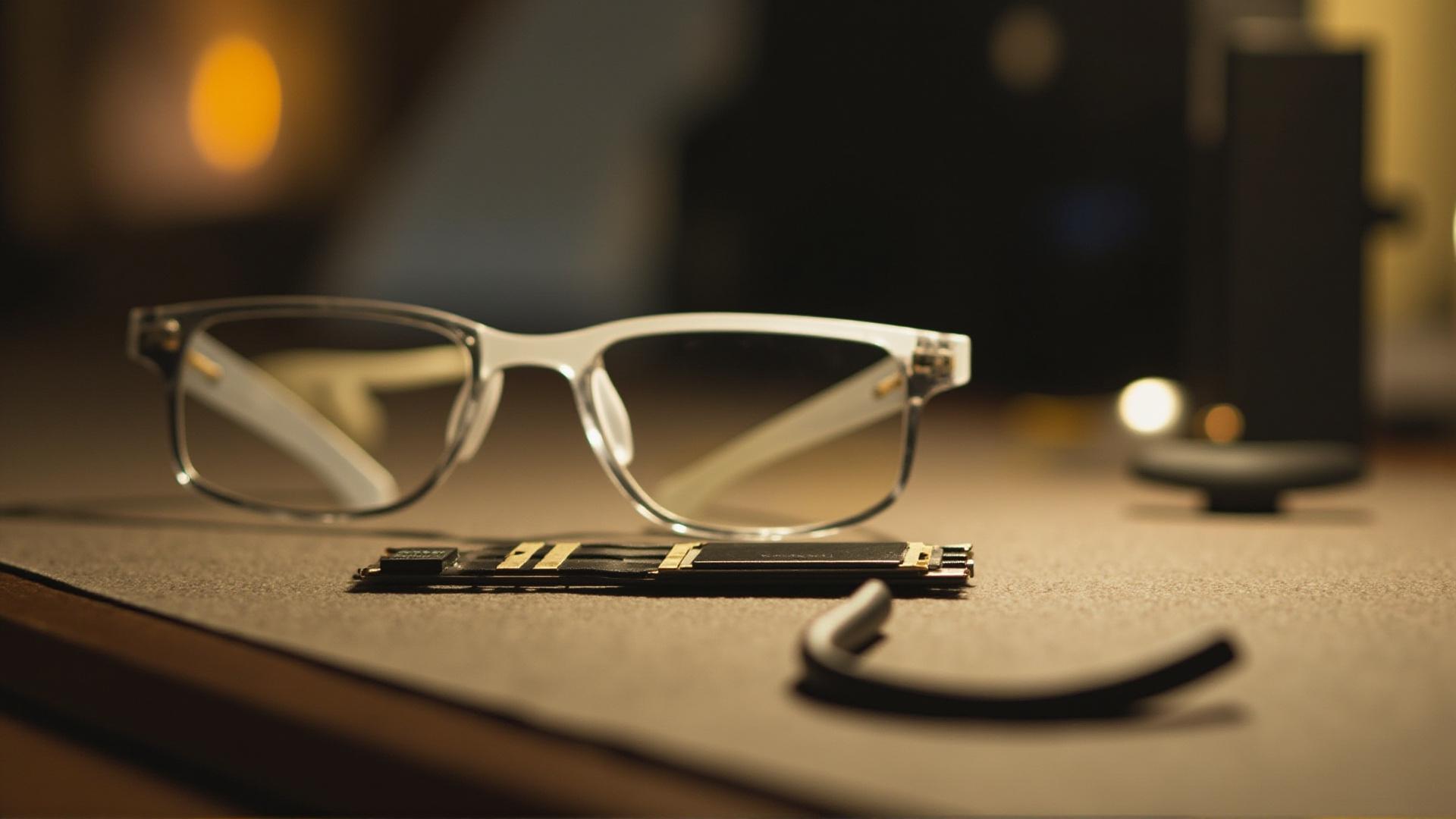
Comparing the G07 against the K01 produces a clean table with two rows that matter and one that is routinely over-read. Both use paired cells and magnetic charging. The K01 holds 70 mAh more across its two cells; the G07 rates 6 hours against the K01's 8. Those runtime figures are untested and should not decide the comparison. The rows that should are the published cell capacity and the G07's ultra-thin detachable temple.
This page is written for the buyer who has to put one of these two on a purchase order, and it separates the rows that decide the choice from the ones most comparison tables quote and mean least. It also states plainly what neither model publishes, because the absence of a row is the part of this comparison most often written around.
The buying task behind the comparison
What each of the three roles needs from this comparison
A brand owner is deciding what the proposition rests on — control and capacity, or design and replaceability — and the published rows point to two different models for those two propositions.
A procurement manager is comparing two quotes and needs to know which difference survives scrutiny, because the runtime row is the one most tables lead with and it is the one that does not survive.
A channel buyer is writing the listing and needs to know which claims are publishable, which of the two models has a weight nobody has published, and what the AI translation claim rests on.
The decision in one line
If your proposition is capacity, take the K01 — it publishes 70 mAh more across the pair of cells. If it is design and replaceability, take the G07, which is the only model in the comparison with a published feature line. If it is a control method or an AI capability, neither model can be listed on it, because the catalogue publishes no touch-control row and no AI row for either. In every case, sample both and decide on the measured row, because neither publishes a weight and fit is what determines your return rate.
The rows that genuinely separate the G07 from the K01
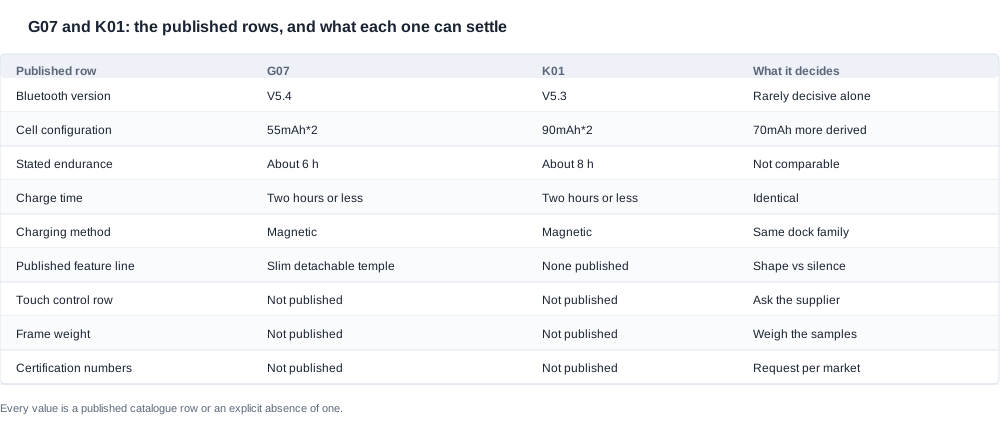
| Row | G07 | K01 | What it decides | The threshold or question to write |
|---|---|---|---|---|
| Capacity | 55 mAh per temple | 90 mAh per temple | A real 70 mAh difference across the pair, and the only hardware row that points clearly in one direction | The cell for the configuration ordered, and the runtime condition behind any endurance claim |
| Touch control | Not published | Not published | Whether the product brief can include a control method you can demonstrate | The control method, the surface it uses, and whether it works with gloves |
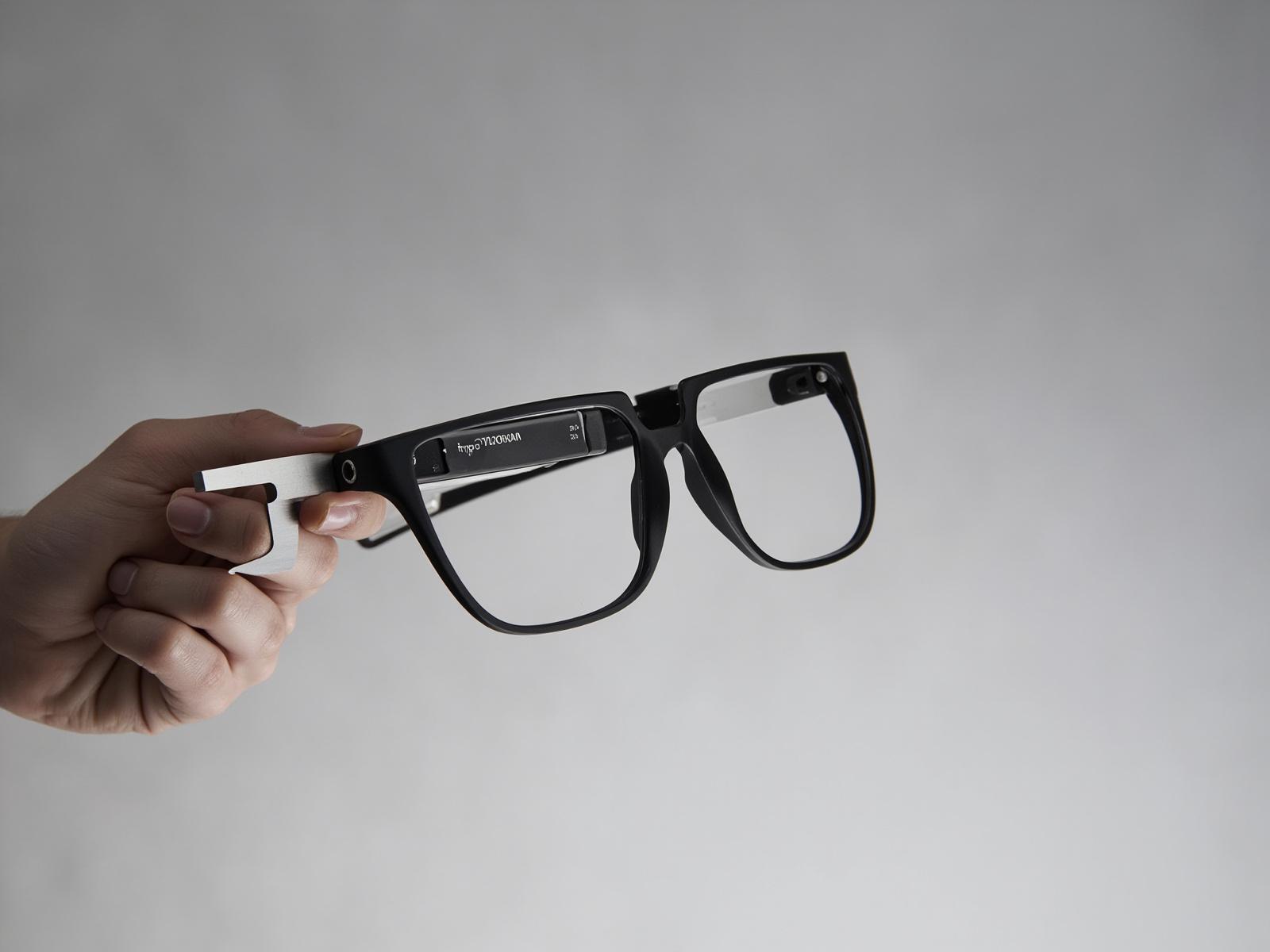
| Temple design | Ultra-thin temple, detachable | Neither published | The strongest published argument in the comparison for a channel selling on design, repairability or a differentiated silhouette | Whether the temple is user-replaceable or factory-only, and the adjustment range |
| AI translation | Not published | Not published | Nothing either model can be listed on, and therefore nothing to substantiate | On-device or cloud, subscription or not, offline capable or not, data stored where |
| Bluetooth | V5.4 | V5.3 | One generation apart and rarely decisive | Whether the customer's platform is on the version you are quoting — see bluetooth connectivity |
| Charging interface | Magnetic | Magnetic | Identical, and it rules out half the range on other models | Whether a spare dock is available at your quantity |
| Rated runtime | About 6 hours | About 8 hours | Not comparable, and it should not decide the comparison | The test condition, in identical words, on both |
| Acoustic detail, microphone pickup, frame weight, ingress rating, certification numbers | Not published | Not published | The rows that decide fit, call quality and market entry | Each one, or an explicit statement that it is not published |
The published cell configuration is the one row that points clearly
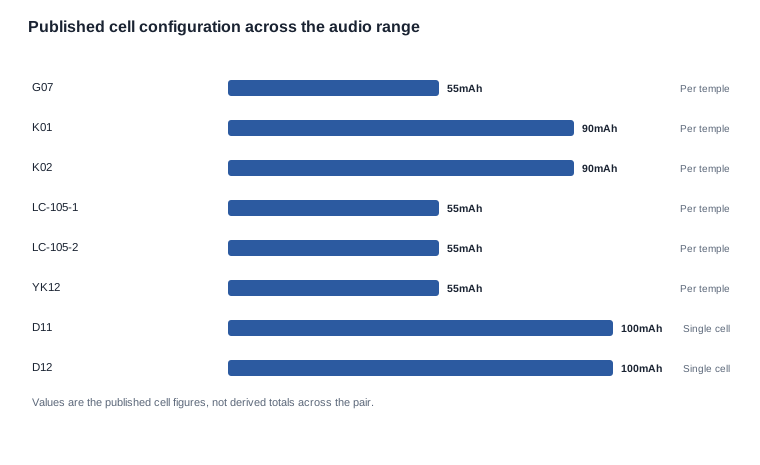
The K01 publishes 90mAh2 where the G07 publishes 55mAh2, which is 70 mAh more across the pair of cells — the largest hardware difference in this comparison. It is worth being precise about what that figure is and is not. The catalogue publishes the cell value and the cell count, not a combined total; 180 mAh and 110 mAh are derived sums, and any comparison using them has to say so.
What the difference legitimately supports is a statement about energy in the frame. What it does not support is a statement about time, because the endurance figures attached to these two models do not behave the way a capacity argument would predict — and the next section explains why.
What the catalogue publishes for these two models, row by row
The comparison table above is the summary. This is the reasoning behind it, and it is worth walking through because the structure of the range explains itself once the rows are set side by side.
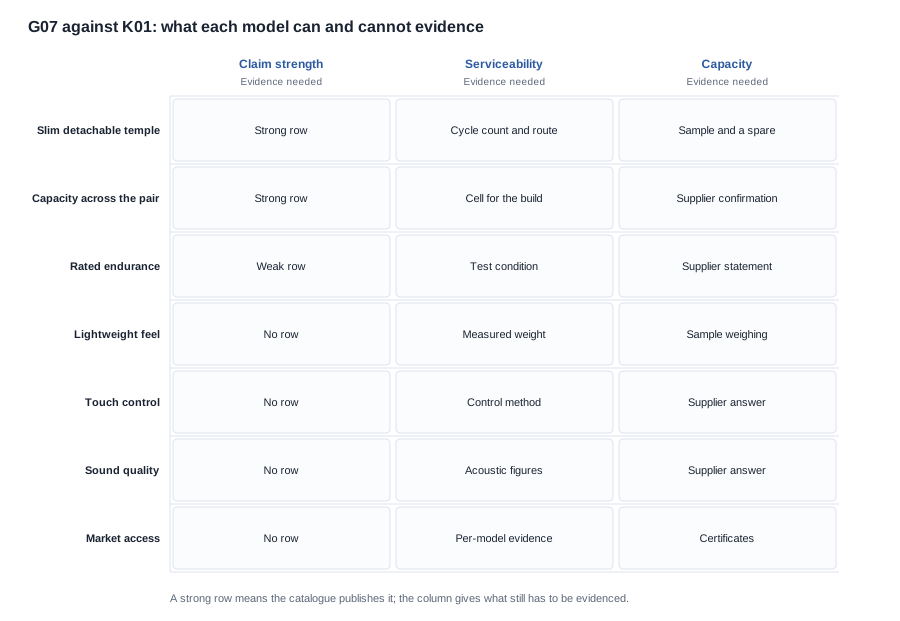
The two models share the charging method, so the parcel consequence is identical and cannot be used to separate them. They differ by one Bluetooth generation, which is rarely decisive on its own and becomes decisive only when a customer's platform is known. They differ substantially on published cell configuration. And only one of them carries a published feature line at all — the G07, with its slim detachable temple, where the K01 publishes none.
That last point has a consequence that is easy to miss: there is no control-method row to compare, no acoustic row to compare, and no AI row to compare. Neither model can be listed on any of those, and a comparison table that carries them as differentiators is manufacturing a distinction the documentation does not support.
The weight row deserves a note of its own
The absence of frame weight is worth dwelling on, because the G07's ultra-thin temple invites the inference that it is light. That inference is unsupported. The same applies to the K01: a larger cell is not a lighter frame. See materials and ergonomics for the measurements worth taking once you have units, and weigh both samples before you write a comfort claim.
Why the runtime row should not decide it
The G07 rates about 6 hours and the K01 about 8, on paired cells of 55 mAh and 90 mAh respectively. The intuitive reading is that the bigger cell produces the longer runtime.
The catalogue contradicts that intuition elsewhere in this range. The LC-105 series uses the same 55 mAh paired configuration as the G07 and rates 8 hours — a two-hour spread on an apparently identical cell size. So capacity alone does not explain the outcome, and no test condition is published for any of these models.
Treat both figures as untested numbers of similar magnitude and exclude them from the decision. The smart glasses battery life treatment covers why this is unresolved category-wide. If battery life is central to your proposition, request a stated test condition from the supplier before making any claim.
How to verify the comparison before the order
Ask for the runtime condition on both models, in identical words, and in the same message as the other questions. A condition asked on one model and not the other produces a comparison that cannot be defended, and the whole point of asking is to be able to chart the two against each other.
Ask how each model is controlled before a control method appears in any listing. The catalogue publishes no touch-control row for any model, including these two, so a comparison that lists capacitive touch on the K01 is asserting something our documentation does not contain. Ask what the control surface is on each, what it does, and whether it is usable in the environment the product will be used in. A buyer who gets that answer can list the method; a buyer who does not, cannot.
Ask whether the G07's temple is user-replaceable and what the adjustment range is. A detachable temple is a service and sizing story, and it only becomes a retail asset if the replacement path exists.
Ask how the K01 and the G07 are controlled. Neither model publishes a touch-control row, so the control method has to come from the supplier before it can be described. The operating environment decides whether the method is usable.
Weigh and measure both samples. Weight, temple length, lens width, bridge width. This is the row that predicts the return rate, and it is missing on both sides.
Ask for the certification position per model per market, and the ingress position for each. Neither model publishes a certification number.
Six ways this comparison goes wrong
The runtime row decided the order. Symptom: the model with the longer quoted figure was chosen, and the real endurance does not match. Root cause: a figure with no condition was treated as comparable. Prevention: set the runtime row aside until the conditions are documented, and if endurance is central, require the condition before quoting.
The ultra-thin temple was read as a light frame. Symptom: the product is uncomfortable over a working day and the listing promised otherwise. Root cause: a design word was read as a weight claim. Prevention: weigh the samples, and quote the weight you measured.
A control method was listed without asking for it. Symptom: a product page names capacitive touch on the K01, and the model in the customer's hand does not respond the way the page implies. Root cause: a control row was assumed into the specification table. Prevention: the catalogue publishes no touch-control row for any model, so ask the supplier and list only what the answer supports.
A detachable temple was sold as a serviceability promise. Symptom: a broken temple cannot be replaced and the channel absorbs the cost. Root cause: user-replaceable versus factory-only was never established. Prevention: ask the question, and price the answer.
A Bluetooth generation gap was treated as a compatibility risk. Symptom: a purchase order is delayed over a version that was never a problem. Root cause: a version number was read as a compatibility decision. Prevention: ask the customer's platform and check it against the version you are quoting.
Neither model's acoustic gap was checked. Symptom: a call-quality or sound claim appears in the copy and nothing supports it. Root cause: the comparison table did not include the rows that are missing. Prevention: run the missing-rows check as a checklist before the copy is written, and treat the absence as the absence. The trade-offs here are not close.

Evidence needed before a G07 or K01 order is placed
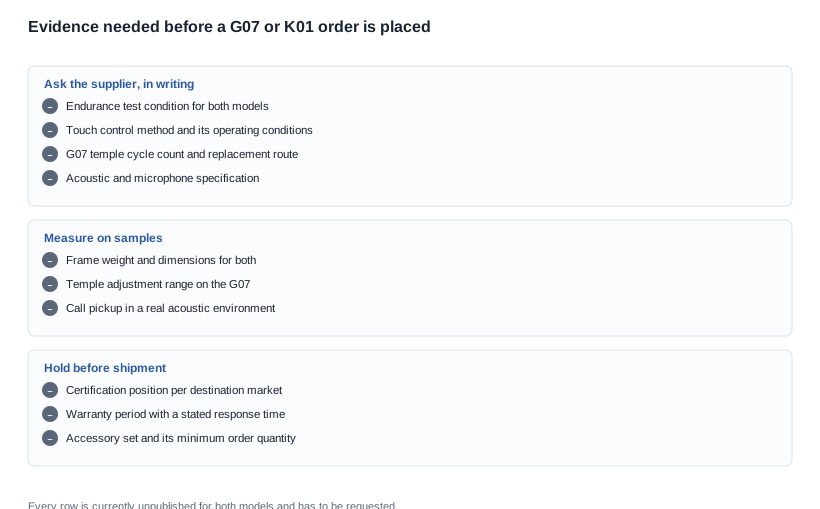
Nothing in this comparison is decidable on the catalogue alone, and the reason is structural rather than unfortunate. Both models publish five standard specification rows and, between them, one feature line. Every row that a buyer would want to build a proposition on beyond capacity and frame treatment — weight, control method, acoustic performance, ingress protection, certification — is absent for both.
That is not a reason to avoid the comparison. It is a reason to know which four documents will close it, because four documents close a great deal.
The four documents that do the work
The endurance condition, for both models, in identical wording. One request, one reply each, and the runtime row either becomes usable or is formally retired from the comparison. Ask what was measured, whether the Bluetooth link was active, what the volume was set to, and whether the measured sample was the production configuration. Without these, the six-hour and eight-hour figures sit side by side in every comparison table and nobody can act on them.
The weight and dimension sheet, measured on samples of each model. Frame weight, temple length, lens width, bridge width, and the adjustment range on the G07's detachable temple. Weight is the number most likely to change a decision and least likely to be volunteered, because it is the number a manufacturer would rather leave unstated.
The control and acoustic answers. How each model is controlled, what the control surface is, whether it operates with gloves on, plus the acoustic specification and microphone pickup. None of this is published for either model, so it is a request rather than a comparison.
**The per-model certification position for the destination markets in scope.The catalogue shows a company-level export certification page the content on it being images rather than text, and the catalogue text leaves CE, FCC and RoHS unmentioned. There is no per-model certification row for either model. That means certification is a document you request for each model in each market, and the request should go out in parallel with the order rather than after it.
The order of work, and why it matters
Run the certification request first, because it has the longest lead time and it can stop a shipment at the border. Run the endurance and control questions in the same message, because they are documentation rather than sample work. Then weigh and measure the samples, then cycle the G07's temple joint, and only then fix the order.
Doing it the other way round means discovering a certification problem after the artwork is approved, which is the most expensive order this evaluation can run in.
Two claims that have to be dropped from the draft copy
Before this comparison is finished, two lines need removing from any draft marketing copy attached to either model.
The touch-control line has to go. The catalogue publishes no touch-control row for any model, so a page that names capacitive touch on the K01 is asserting something our documentation does not contain — and if the hardware behaves differently from the page, the channel carries the correction. Ask the supplier, then write the method they confirm.
The AI-translation line has to go as well. Neither the G07 nor the K01 publishes an AI feature row, and the four questions that would make such a claim defensible — on-device or cloud, subscription or not, offline capable or not, data stored where — have to be answered in writing before any version of it appears on a product page. A buyer's compliance team will ask all four, and a page that cannot answer them is a liability rather than a selling point.
The one question that separates the two models fastest
If the buyer's proposition is energy in the frame, the K01's published cell configuration settles it and no further work is needed on that point. If the buyer's proposition is a frame that can be repaired at the channel's own bench rather than returned to the supplier, the G07's published detachable temple is the only row in the catalogue that supports it — and the spares route has to be established before the advantage is real.
Everything else in this comparison — the endurance figure, the Bluetooth generation, the charging method — either ties or carries a row too weak to decide anything. That is the whole of it, and it is a short answer, which is what a two-model comparison should look like when the documentation is thin.
What a G07 and K01 comparison is worth commercially
The two arguments are worth different amounts in different channels, and the unit price gap is usually the smallest of the three variables. A channel selling on repairability and silhouette gets a lower return rate and a spare-parts line from the G07, provided the temple is user-replaceable. A channel selling on energy in the frame and a longer published figure gets the K01. Price is the third variable, and it should be scored last.
The terms worth spending negotiation time on. Unit price and volume tiers, the accessory set and its minimum order quantities, packaging specification, delivery splitting, payment nodes against inspection, the warranty period with a stated response, the spare-parts position for a broken temple, and the terms of a pilot order.
The terms fixed by the process. Certification cost and lead time, which follow the testing body. Tooling, which is frequently amortised across a first order while certification cost sits per product family — ask which of the two you are being quoted, because the two are often bundled into a single line that hides which is which.
What to write into the agreement
The published rows for the configuration ordered; the endurance figure with its condition once established; the temple description and whether it is user-replaceable; the control method and its operating conditions; the frame weight and dimensions as measured and agreed; the certification position per market; and the warranty period with a stated response.
What to leave out
Any endurance claim without a condition, any weight or dimension that was not measured, any control method not confirmed in writing, and any AI feature claim not supported by written answers.
Where CYNRIN stands on the G07 and K01 comparison
A spec comparison between these two is misleading unless the endurance row is set aside and the unpublished rows are named as unpublished. The published data supports a capacity argument and a design argument — and the endurance argument, which is the one most tables lead with, does not survive contact with the rest of the catalogue.
We will not fill a weight, a dimension or an acoustic figure with a typical value, we will not publish a touch-control method the catalogue does not record, and we will not carry an AI capability into a listing as though it were a documented specification. Tell us what your proposition rests on, and we will narrow this to one model and name the rows you would still need evidence for.
The audio range both models belong to is set out on the Bluetooth audio glasses page, and the questions to ask before trusting an AI feature are in AI features in smart glasses.
Related reading
- The audio range both models belong to — Bluetooth audio glasses
- Why runtime figures are not comparable — smart glasses battery life
- Questions to ask before trusting an AI feature — AI features in smart glasses
Give us the target market, the quantity and the required configuration, and we will reply with what is available and what is not.


