
Smart glasses for cycling are charged at the wall, and that single fact decides the whole plan. A rider cannot top up on a climb, cannot charge at a roundabout, and cannot charge in the group. Everything that matters therefore happens before the ride or after it, and the number that governs the purchase is not how fast the unit charges in a laboratory — it is how long the unit has to sit still at the wall, and how long the longest ride can be before the unit is a liability rather than a tool.
This page is written for the buyer specifying a cycling channel, for the procurement manager choosing between the sport platforms, and for the channel buyer writing the routine that goes in the box.
Smart glasses for cycling: the wall-side charge beats the on-road one
Why the ride is a wall-side problem
Three properties of cycling make the charging question a wall-side problem, and each of them changes what a buyer should ask for.
There is no mid-ride recharge. The available opportunities are the wall before the ride, a café or a pub stop, and the wall afterwards. A plan that assumes a charge somewhere in the middle of the route is a plan with a hole in it.
The ride length is unpredictable and the failure is public. A rider in a group is the worst possible place to discover that the camera stopped, that the navigation prompt went quiet, or that the unit is about to shut down. This is why the charging plan for a cycling channel is a safety plan before it is a convenience plan.
The unit comes back wet. A rider's head and the air movement over the frame put sweat and road spray onto the charging contact, and that contact is the thing that has to make a solid connection at the wall that evening. The catalogue publishes the interface for most models and publishes nothing at all about the contact's behaviour when it is damp, which makes it an open question rather than an assumption.
The three sport platforms and what each one commits you to
The catalogue names three sport models, and each has a different charging commitment that suits a different riding pattern.
- The YKC02 publishes a 70 milliamp-hour doubled cell, a magnetic charging contact, a charge time of two hours or less, and a rated runtime of about eight hours. It is the longest-runtime platform in the sport group and the slowest to turn around, because two hours or less is a ceiling rather than a figure.
- The D17 publishes a 115 milliamp-hour cell, a Type-C port, a charge time of about one hour, and a rated runtime of about seven hours. It also publishes a remote capture control.
- The ZH12 publishes a 100 milliamp-hour cell, a Type-C port, a charge time of about one hour, and a rated runtime of about eight hours. It publishes a remote capture control as well.
Two more models carry the sport positioning without carrying the word in the name. The V06 publishes a 260 milliamp-hour cell, a magnetic charging contact, a charge time of two hours or less, a rated runtime of five to eight hours, eight megapixels, a removable inner frame and an IP54 marking. The S7 publishes the same cell capacity, the same magnetic contact, the same charge time and the same runtime range, with thirteen megapixels, a removable inner frame and the same IP54 marking.
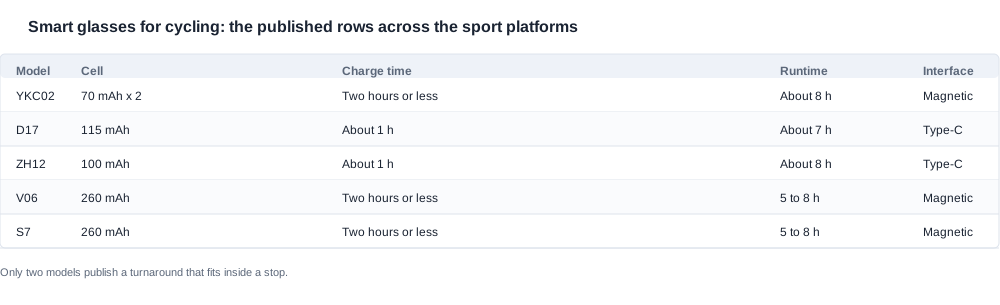
The line that decides a lot of rider behaviour is at the top of that table. Across the twenty-eight models in the catalogue, twenty-six publish a charge time of two hours or less and two publish about one hour — the D17 and the ZH12. Only two, and both are sport models with a Type-C port, publish a turnaround figure that fits inside a café stop.
What a buyer should take from the table
Two hours or less is a ceiling, and a ceiling has to be planned as an overnight job. The catalogue publishes no state of charge at which the charging clock starts and no criterion at which charging is judged complete, so "two hours or less" describes the top of a curve whose two ends are not published. A buyer planning a wall-side routine against that figure is planning against the worst case, which is correct, and should say so in the instructions rather than implying a typical duration.
About one hour is a different operational fact. The D17 and the ZH12 publish a turnaround that fits inside a stop, which is what makes them the only two models in the catalogue whose published charge time can be reconciled with a mid-ride top-up.
The runtime figures carry no condition. The about seven hours on the D17, the about eight on the ZH12 and the YKC02, the five to eight on the V06 and the S7 — none of them publishes the workload that produced the figure, and the operating temperature range is not published for any model. A winter channel cannot derive a ride length from a row, and a channel that promises a ride length from a row is making a claim the catalogue cannot support.
Model the ride, not the day: why the longest ride decides
The ride profile is the only design input that matters
The single most common failure in a cycling charging plan is that somebody took an average day and treated it as the specification. A rider who does forty kilometres on a Tuesday and a hundred and sixty on a Saturday has no average; the Saturday is the design case, and the plan has to survive the Saturday in the coldest month the channel sells into.
The profile a buyer needs from the channel is short and specific:
- The longest ride in the distance profile, in hours, at the pace the target rider actually rides rather than at the pace of a trained cyclist.
- The proportion of that ride with the unit capturing. A unit that records continuously and a unit that is switched on at junctions do not draw the same current, and no published runtime says which workload it was measured under.
- The stops, and their length. This is the number that decides whether the about-one-hour platforms earn their place.
- The lowest ambient temperature the channel sells into. The catalogue publishes no operating temperature range, so nothing about cold behaviour can be derived from a specification, and a cold cell is slower to charge.

What the profile tells you about the model
If the longest ride is four hours and the platform is rated at about seven, the unit survives the ride with margin on paper and the margin is not evidence, because no test condition is published behind the rating. If the longest ride is nine hours, then no model in the catalogue has a published rating that covers it, and the honest commercial answer is that the product is being specified for a use its published rows do not reach. That is a conversation to have before the purchase order rather than after the first winter.
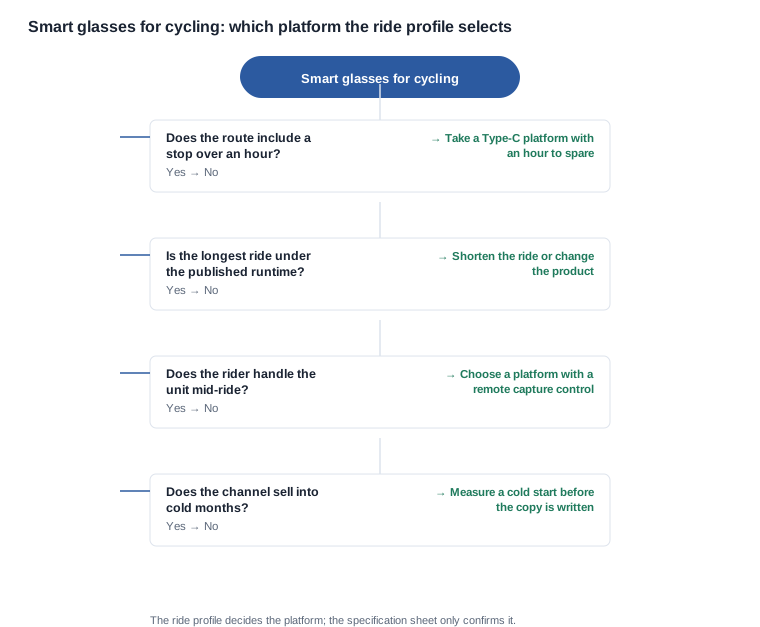
If the ride profile includes a stop long enough for a top-up, the interface starts to matter in a specific way. The D17 and the ZH12 publish a Type-C port, which means the rider can charge from a power bank or a café socket with a cable that costs very little and is easy to replace. A magnetic platform needs its own contact to be carried, and that contact is a second object in the kit bag with its own minimum order quantity and its own replacement cycle.
The remote capture control is a safety row, not a convenience row
Both the D17 and the ZH12 publish a remote capture control. On a cycling product this is worth more than on almost any other product in the range, because the action it removes is reaching for the device mid-ride — a movement that destabilises the bike and ruins the framing at the same time.
For a buyer this converts a feature into a safety argument that a channel can make honestly, and it does so on the strength of a published row rather than a claim. It also has a commercial consequence: a product where the rider is instructed not to handle the device has a different quick-start card from one where the rider is told to tap the temple.
Kit and safety: the interface, the contact and the part that gets replaced
The kit a cycling channel should specify
| Item | What it prevents | Commercial treatment |
|---|---|---|
| The correct interface cable or contact | A rider at a stop with no way to charge | Per-unit consumable, or included at the volume tier |
| A spare contact or dock | A failed contact at the end of a wet ride | Spare-parts line with its own minimum order quantity |
| A power bank | A café with no socket, on a long day | Sold as an accessory, not assumed in the box |
| A moisture pouch or a spare contact cover | A contact that will not seat after a wet ride | Low-cost insert item |
| The quick-start card with the wall-side routine | A rider who charges from empty and waits two hours | Printing cost, and it belongs in the artwork |
The kit argument has a commercial half that is easy to miss. A spare contact or dock is a repeat-purchase line, and in this category it is frequently the line most often forgotten, because it is small, cheap and obviously replaceable until a rider is standing at a café with a dead unit and no way to charge it. Whether it ships in the box, sells as an accessory, or is stocked as a spare is a decision with a margin attached to it, and it should be taken before the artwork is drawn.
Why the contact is a cycling-specific service item
A magnetic charging contact is a metal surface that has to make a solid connection, and in the environment where these models are used the contact is repeatedly exposed to sweat and to road spray. The catalogue publishes the interface for these models and publishes nothing about the number of insertion cycles the contact is rated for, nothing about its behaviour when it is damp, and nothing about the position of the contact on the frame relative to a helmet strap or a handlebar mount.
That last point is specific and worth raising with a supplier: a contact routed under a strap or next to a mount does not seat reliably, and a misaligned contact frequently appears seated. The position of the interface on the frame is not published for any model, so it is a request, and for a handlebar-mounted product it belongs in the mount instructions rather than only in the quick-start card.
The ingress marking, and what it does not cover
The IP54 marking appears on the V06 and the S7 and on no other model, and no test report is published behind it. IP54 covers splashing water and a dust protection level; it does not cover immersion, it does not cover a sustained downpour, and it says nothing about a charging contact that has been wet and then plugged in.
The commercially correct handling is to describe the marking as a catalogue attribute and not to extend it into a general protection claim, and to state plainly that the marking does not cover the charging interface. The IP ratings page sets out what the digits mean; the charging solutions page page carries the published charging rows and the battery life page covers the runtime condition and what a published rating does and does not include.

The four rows nobody publishes, and the measurements that close them
Everything above is a published row. Four things that a cycling channel needs are not published for any model, and they are the whole of what a measurement programme has to cover.
- The charging input. No model publishes the input voltage or the current. This is not academic for a wall-side plan: the about-one-hour figures on the D17 and the ZH12 were produced against some input, and a rider charging from a low-output port or from a power bank that has switched itself off will not reproduce them.
- The state of charge at which the charging clock starts and the criterion at which it is judged complete. Without both, the published charge time is a ceiling and cannot be compared between models or between samples.
- The behaviour of a cold cell. The operating temperature range is not published for any model, so nothing about cold charging can be derived from a specification. A cold channel has to measure it.
- The contact's position and its damp behaviour. Not published, and both are the difference between a rider who charges at the wall in ninety seconds and a rider who spends ten minutes at a café trying to seat a wet contact.
How to verify the plan before the channel is launched
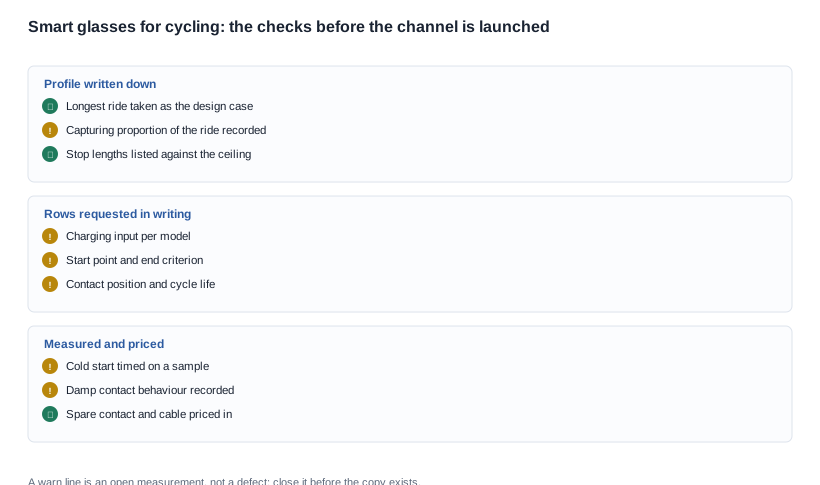
- Write the ride profile down — longest ride, capturing proportion, stop lengths, lowest ambient — and check the published runtime against the design case before any copy is written.
- Request the four rows per model in one document, and ask for the charging input and the two charge-time endpoints rather than accepting the catalogue ceiling.
- Time a charge from a stated start point on a sample, and write the start point and the end state into the record. Without them, the measurement cannot be compared with the published figure or with the next unit.
- Measure a cold start on a sample, and record the temperature alongside the result, because the operating temperature range is not published and a laboratory figure cannot be carried into a January channel.
- Test the contact with a damp or dusty hand, and record whether a misaligned contact appears seated, because that is the failure a rider will not notice.
- Decide the listing boundary before the copy exists. Charge times, interfaces, cell configurations, runtimes and the IP54 catalogue marking are published rows. Charging inputs, start points, indicator behaviours, contact positions, contact cycle lives, cold behaviour and case positions are not.
- Price the accessory chain with the device — cable or contact, spare contact, and the case where the configuration has one — rather than treating them as customer-funded problems.

What a cycling channel costs to run, and where the money moves
The wall-side charging plan is also a set of commercial lines, and a cycling channel has two of them that most product categories do not.
The accessory chain. A cycling product specified around the wall has a contact or a cable in every box, and possibly a power bank in the accessory line. Each of those is a per-unit cost with its own minimum order quantity, and the power bank is a second lithium cell per unit that a buyer has to declare, ship and insure. Ask for the accessory prices at each volume tier rather than accepting a device price with the accessories bundled in, because the tier gaps on small accessories are wider than the gaps on the device, and that is where a margin quietly disappears.
The contact as a repeat-purchase line. The contact is the part most likely to be replaced, and a channel that carries it as a stocked spare converts a support conversation into a sale. Whether it ships in the box, sells as an accessory, or is reserved against the returns rate is a decision with a margin attached to it, and the right moment to take it is after the first season of returns data rather than before it.
The packaging. Cycling packaging has to survive a bike bag and a boot, and a retail box for this category is a design and a tooling cost amortised across the first order. Ask how the packaging is quoted, and whether the accessory adds a print area that has to be paid for twice.
The freight class. A configuration with a charging case adds a second cell to the package, which changes the battery transport documentation and the freight class at the same time. For a channel shipping into several markets that is a per-market cost line rather than a one-off.
The terms worth negotiating. Unit price and volume tiers; the accessory set and its minimum order quantities; the spare contact and whether it is stocked or shipped; packaging specification and whether the artwork is ours to supply; delivery splitting against a staged payment; the warranty period with a stated response time; and the return terms for a channel whose products meet weather.
The terms that are better budgeted than argued. The cost and the lead time of a conformity document for a new market; the cost and the lead time of a battery transport file for a new cell configuration; and tooling, which is amortised across the first order and quoted as a separate line rather than buried in the unit price.
The decision this section exists to support is a shortlist criterion, and it is a total-cost criterion rather than a unit-price one: the total cost of a cycling channel is the device, the accessory chain, the freight class the accessory creates, the packaging the accessory changes, and the returns reserve a wet-weather channel carries. A supplier whose quotation covers only the first of those five is quoting a device rather than a product. The questions to ask before you order are the five that produce the other four, and the red flags worth watching for are a quotation with no accessory line and an agreement with no returns clause.
Where the cycling charging plan stops, and what we will put in writing
Concretely, a cycling charging plan is a wall-side routine, and the published rows in this catalogue describe the charger rather than the ride. We will not publish a charging input, a charge-time starting point, an indicator behaviour, a contact cycle life, a cold charge rate or a case charge time for a model where we have not been given one, and we will not present a rated runtime as a promise of a completed ride or the IP54 marking as a tested rating.
We will also not fill a gap with an industry average. On a cycling channel that means saying plainly that the sport platforms publish no unit weight at all, that the only weight published anywhere in the catalogue is the 158 gram MT6 eyewear body — a figure that covers the eyewear body including the battery and the camera and excludes the folding case — and that a rider-facing weight claim cannot be written from the catalogue for any sport model.
What we will do is take the ride profile, the climate, the channels and the models you are shortlisting, and tell you which published rows apply, which of the four unpublished rows you need to measure, and what a wall-side routine can honestly claim. The cycling application page covers the channel positioning, the charging solutions page carries the published charging rows, and the battery life page covers what a published rating includes.
What to do next, in order:
- Write the ride profile, and take the longest ride as the design case.
- Decide the stop policy, because it decides whether the Type-C sport platforms earn their place.
- Request the four unpublished rows per model.
- Measure the cold start and the damp contact on a sample.
- Price the accessory chain and the spare contact with the device, and put the wall-side routine in the quick-start card.


