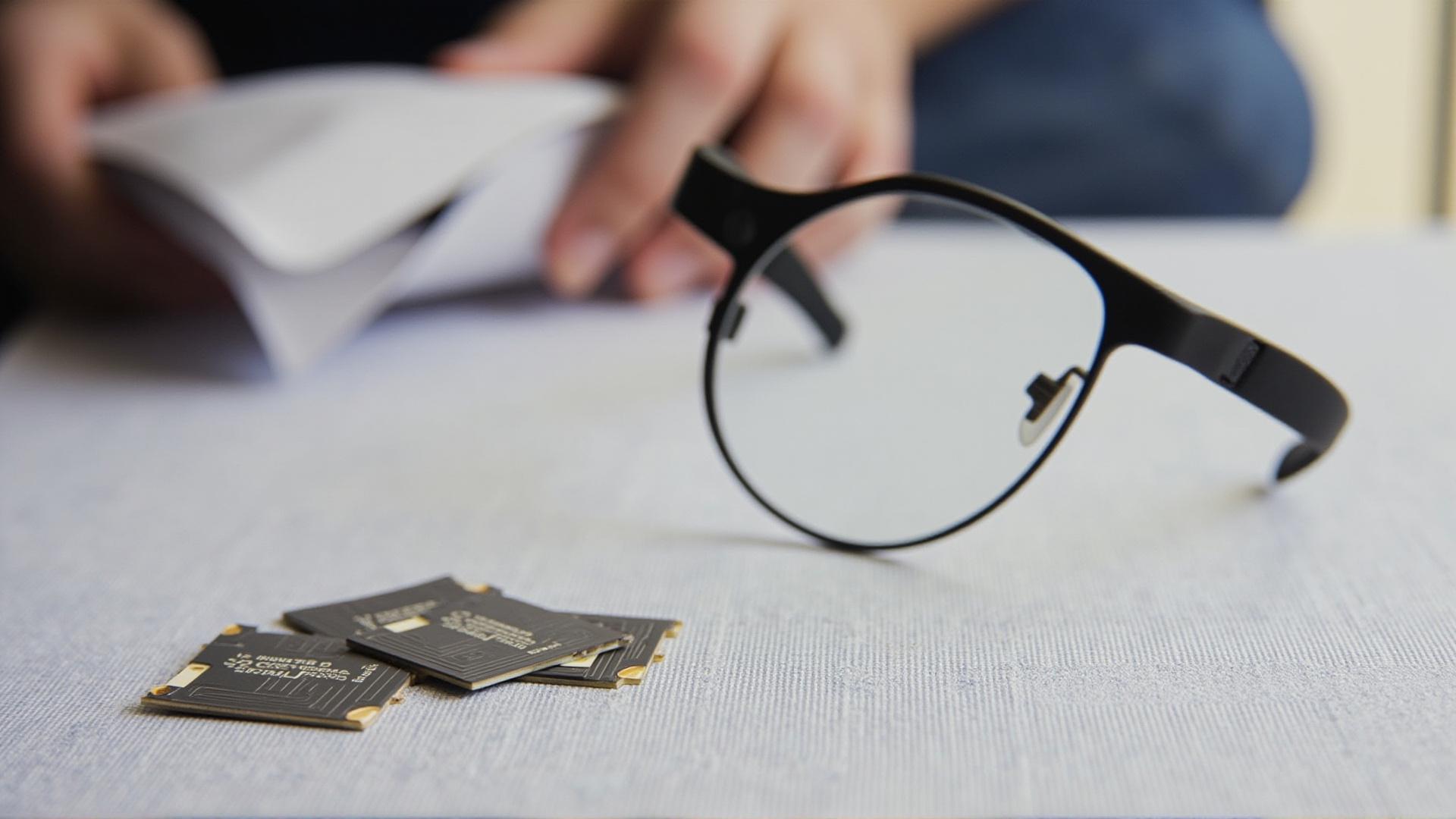
Smart glasses for ecommerce are sold by photographs, judged by reviews and refunded by a policy, which means the lens condition is a conversion-rate variable and not merely a return variable. A listing whose hero image shows a hazed lens does not lose one sale; it depresses the conversion rate of every subsequent impression until the listing is re-shot. That asymmetry is why the lens position has to be settled by the seller before the first fulfilment order, not after the first one-star review: the unit that comes back is a few cents of margin, while the review that lands on the listing is a permanent tax on every future click. The practical sequence is short enough to write on a purchase order. Settle the surface statement and the prohibited-agents list in writing for the exact model in the quotation, shoot the listing imagery from a unit that has been through the same routine the customer will be told to follow, and hold a return condition standard with a reference photograph that the refund desk can apply without judgement. The catalogue publishes the lens material, the coating and the surface treatment for no model in the range, so each of those three steps is a document request rather than a comparison — and that is exactly why it has to happen before the artwork is locked.
Smart glasses for ecommerce: the lens, not the unit, in early reviews
The seller, the listing, and the desk that owns the claim
The reader is a marketplace seller, a direct-to-consumer brand owner or an e-commerce category manager who has selected the model and the price tier and now has to decide what the customer receives, what the listing claims, and what the refund desk does when a customer says the lens was not clean on arrival. That last question is the one that is usually left open, and it is the one that costs the most, because the refund desk does not own the product, the listing or the factory — it owns a queue. A desk with no reference photograph decides each case from the customer's photographs alone, which means the outcome is decided by the quality of the customer's photograph rather than by the quality of the unit.
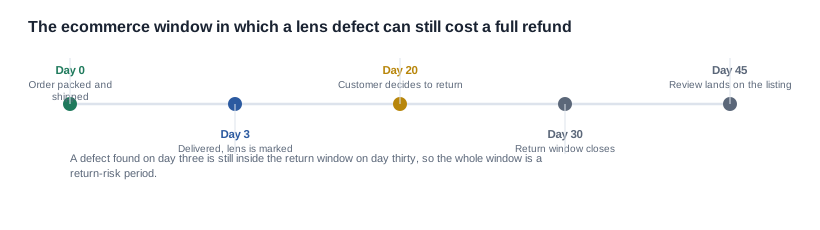
The commercial exposure is also different from a retail channel in a way that changes the arithmetic. In a shop, a scratched lens is a return of one unit at the point of sale. On a marketplace, the same scratch becomes a review, and the review sits on the listing for as long as the listing exists. The review does not merely describe the unit that was returned; it is read by every subsequent visitor, and a mention of a cloudy or scratched lens in the first ten reviews is usually enough to slow a listing's conversion for weeks. Sellers who have run this category tend to treat the first ten reviews as a production milestone rather than as a marketing artefact, because the cost of a review cluster is measured in traffic rather than in refunds.
There is a second dimension specific to e-commerce, and it is the contents of the box. The listing has a "what's included" section, and the customer compares it against what arrives. The catalogue does not publish one uniform configuration for this range, which means the contents section cannot be written generically: the V03 Pro and the V03, and the S7 and the V06 publish no charging-case row at all, and the supplier has to confirm the box contents in writing for each of them, the KY06 and the MT5 are published with a case whose capacity is not stated, and the CY05 and the CY03, and the L1 Pro publish a 1400 mAh case. A listing that promises a case across the range is promising something the range does not publish, and the first order that arrives without one is the first dispute of the "not as described" type.
Why a marketplace prices a clean lens differently from a retail counter
Two sellers can order the same model at the same unit price from the same factory and end up with completely different returns, because the marketplace route adds two costs that a shop does not carry. The first is the handling chain: a unit sold on a marketplace passes through a warehouse pick, a pack station, a carrier network and a parcel sort before it reaches a customer, and every one of those stages puts a hand on the temple where the lens sits. The second is the visibility of the dispute: a customer who is unhappy can spend eleven seconds and one photograph to open a case, and the case is judged by a policy rather than by a person who handled the unit.
The way to see why this matters commercially is to price the handling chain rather than the product. A fingerprint on a lens costs nothing in material. It costs a replacement unit, a return label, a refund, a handling fee and — the term that dominates on a marketplace — a review. The review term is not a cost the seller books anywhere, which is exactly why it gets ignored. Yet it is the only term that scales with the size of the listing rather than with the number of returns, and it is the reason a seller who treats lens condition as a fulfilment detail ends up losing the listing rather than the order.
The other marketplace-specific factor is the review window itself. The defect almost always appears in the first days after delivery, because that is when the customer uses the product, and the return window is still open when the customer decides to return. That means the operational response has to be ready before the first batch ships rather than after the first complaint, and the only artefact that makes that possible is a written reference: a photograph of an acceptable lens, a photograph of a lens that does not meet the standard, and a rule that says which one applies. Everything else in the lens position is an improvement; that artefact is the one that converts a dispute into a decision.

What happens to a lens between the warehouse and the parcel
Four handling exposures and the claim each one produces
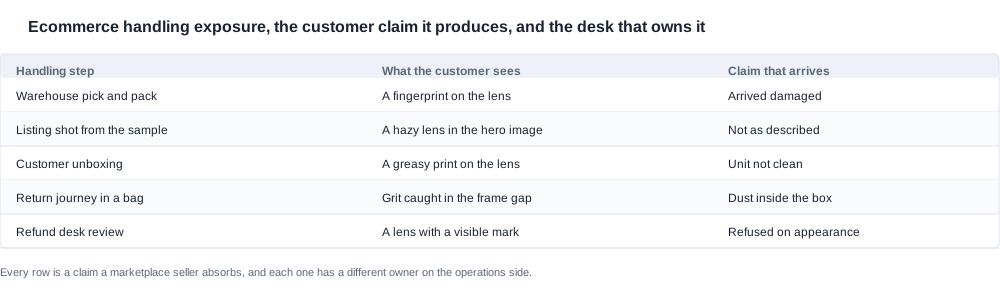
Four exposures occur on the way to the customer, and each one arrives at the refund desk as a different claim. A fingerprint is transferred at the warehouse pick and pack, where a unit is lifted from a shelf and placed in a carton by bare or gloved hands; the customer receives a lens with a print near the lower corner and opens a case for damage on arrival. A haze in the listing photograph is created earlier, when the hero image is shot from a unit that has been handled during a demonstration; the customer receives a product that does not match the picture and opens a case for a description mismatch. Grit in the frame gap is created during the return journey, when a unit is bagged and posted in a soft envelope alongside other soft items, and it arrives as a contamination complaint. A contact mark on the lens face is created by a protective film that was applied at the packing station and peeled off in the wrong order, and it arrives as a manufacturing defect claim.
The pattern in that list is worth noticing, because it explains where the money goes. Only the last of the four is genuinely a supplier defect. The first is a handling decision, the second is a photography decision, and the third is a packaging decision — and all three are decisions the seller or the fulfilment partner controls. Sellers who route all four to the factory as a quality claim end up with a supplier argument they cannot win, because the evidence in the claim does not point at the factory.
The thresholds that decide whether a listing survives a review cycle
Six thresholds decide this, and they are worth writing down in the order that makes them cheapest to fix.
Threshold one: the surface statement, per model, in writing. How it is measured: a document naming the lens substrate and the coating treatment for the exact model, with the model designation on it. Pass line: the designation on the document matches the designation on the unit that ships. What a soft answer looks like: a single statement covering "our smart glasses", which cannot be used to defend one SKU and leaves every other SKU undefended. The lens and frame material background is at materials and ergonomics.
Threshold two: the prohibited-agents list, and a single channel that owns it. How it is measured: a list the seller, the marketplace listing and every support reply use. Pass line: one list, one version, one owner. What a soft answer looks like: three different answers across the product page, the instruction insert and the automated reply. On a marketplace the difference between one answer and three is the difference between one macro and three tickets per thousand orders.
Threshold three: the listing image protocol. How it is measured: a stated procedure for how the unit is prepared before the hero shot and the detail shots. Pass line: the unit is wiped with the same cloth the customer receives, photographed under the same lighting rig used for the rest of the catalogue, and the reference frame is retained. What a soft answer looks like: images shot once, at launch, on a unit that has been in the demonstration loop for two weeks.
Threshold four: the contents statement per configuration. How it is measured: the "what's included" list, checked against the published configuration rather than against a generic description. Pass line: the list distinguishes the models that publish a case capacity from the models whose case capacity is not published, and names the models for which the catalogue publishes no case row at all. What a soft answer looks like: "charging case included" written across a range that does not publish it for every model.
Threshold five: the contact and film procedure at the packing station. How it is measured: the packing instruction that the fulfilment partner follows, including the order in which a protective film is applied and removed, and the instruction that the charging contacts are not touched with a wet or oily hand. Pass line: the procedure is on the packing list, not in the training. What a soft answer looks like: a good film instruction that says nothing about the contacts, which are the part the customer will touch.
Threshold six: the refund desk reference. How it is measured: two photographs and a written rule. Pass line: the rule states what constitutes an acceptable lens, what constitutes a lens that does not meet the standard, and what the desk does in each case, including the case where the customer unit was used. What a soft answer looks like: a policy document that refers to "damage" without defining it, which is the same as no policy.
Verifying the lens position before the first fulfilment order
A sample check built around the listing photograph
The verification for this channel has one thing in common with every other verification in this category: the artefact the desk needs is the artefact the factory can produce. The difference is that in e-commerce the artefact is a photograph, which makes the sample check simpler than it looks.
- Order or request one unit of the exact model and configuration, in the configuration the listing will actually sell, including the case option if the listing offers one. Completion test: the unit in hand matches the configuration code on the quotation, not only the model name.
- Run the routine that the proposed instruction names, using the cloth that the proposed configuration includes, and photograph the lens before and after under one fixed light at a fixed angle. Completion test: a retained before-and-after pair, same light, same angle.
- Shoot the listing images from the treated unit, not from a separate demonstration unit, and retain the reference frame for the hero shot. Completion test: the retained reference frame is the unit that shipped in the sample, and the two match.
- Simulate the handling chain, which means a warehouse pick, a pack and a transit in a soft bag, then inspect the lens and the charging contacts separately. Completion test: a log line for the lens and a log line for the contacts.
- Hand the two photographs to the refund desk and ask them to write the rule against them. Completion test: a signed rule, written by the desk that will apply it, using the same two images.
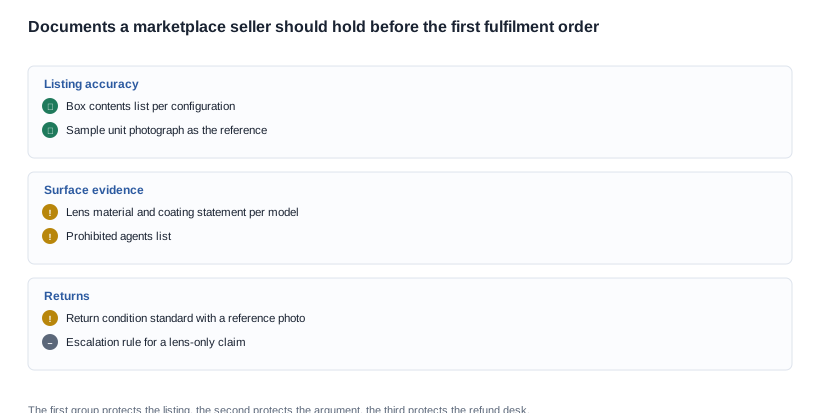
The supporting documents are the surface statement, the prohibited-agents list, the packing instruction, the contents list per configuration, the return condition standard with its reference photographs, the model designation table, and the certificate register that accompanies the designation. The certification register procedure is at certification checklist, the clause language is at contract terms, the commercial structure of a first order is at pricing, and the transport file that a configuration with a case requires is at battery transport. The product families are at AI camera glasses, Bluetooth audio glasses and sport smart glasses.
The questions to ask before you order are shorter than they look, because the answers are mostly one-line documents:
- What is the lens substrate and the coating treatment for the exact model in the quotation?
- Which agents must not touch the surface, and can the list be supplied as a single version?
- Does the configuration I am ordering ship with a case, and what is the published capacity for it?
- Is a protective film applied before packing, and does the film instruction specify the order of steps?
- Are the charging contacts reached dry, and is that stated for the interface my model publishes?
- What does the ingress marking cover for this model, and is there a test report behind it?
- What is the box contents list per configuration, in the format my listing needs?
- Will the supplier review the insert artwork and the packing instruction before they are printed?
The last question is the cheapest one to ask and the easiest for a supplier to decline, which makes it a useful signal about the supplier itself. A factory that will read the insert has tested the routine the insert describes; a factory that treats artwork as the buyer's problem is asking the buyer to carry a risk that belongs in the packing instruction. When to ask the questions matters as much as asking them: all eight are cheap before the purchase order and expensive after the first complaint.

Where an ecommerce lens position fails commercially
Six failure signatures and the operations desk that owns each one
The hero image shot from a demonstration unit. Symptom: a review cluster mentioning a cloudy picture, and a conversion rate that never recovers. Root cause: the photography session used a unit that had been handled rather than a unit prepared to the protocol. Prevention: the image protocol, with the retained reference frame. Owner: the content team.
A generic contents list across a range that does not publish one. Symptom: "not as described" cases, each one low value individually and expensive collectively because they are a documented pattern rather than a one-off. Root cause: the listing was written for the family, not for the SKU. Prevention: the contents statement per configuration, written from the published rows. Owner: the listing editor.
A refund desk without a reference. Symptom: a refund rate that rises with volume while the return rate stays flat — the classic signature of a desk that is refusing on appearance rather than accepting on appearance. Root cause: no visual reference, so each case is judged from the customer's photograph. Prevention: the two photographs and the written rule, agreed with the desk before launch. Owner: customer service.
A protective film applied in the wrong order. Symptom: a print on the lens face that arrives on a batch and is attributed to the coating. Root cause: the packing instruction did not specify the order. Prevention: the packing list, with the film step written explicitly. Owner: the fulfilment partner.
A solvent in a marketplace listing copy. Symptom: haze on a batch of units, in a pattern that points at a shared source rather than at random handling. Root cause: an agent was named on the product page without a surface statement behind it. Prevention: one prohibited-agents list, with change control on it, and a page review before it goes live. Owner: the content team, with the factory as the source of the list.
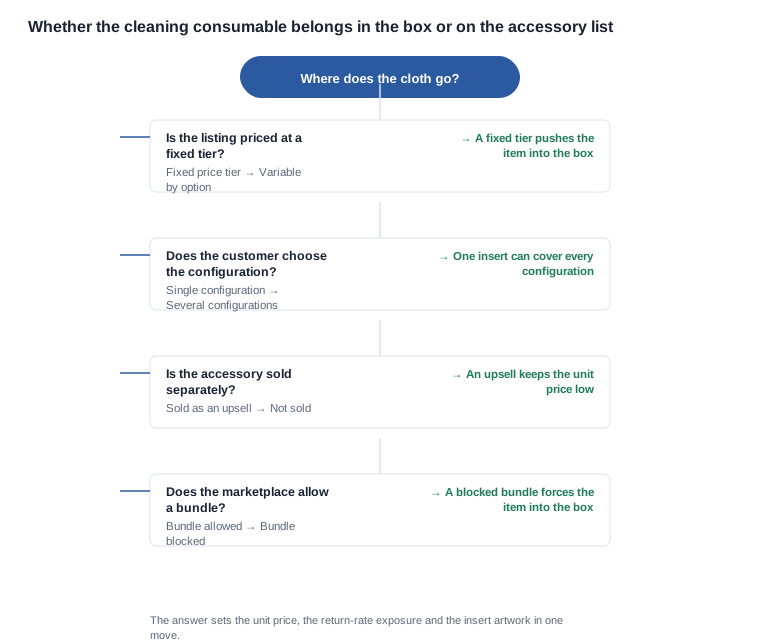
The accessory sold as an upsell that nobody buys. Symptom: no change in the return rate after the upsell was added, because the customer who would have returned was never going to buy a cloth at the checkout. Root cause: the accessory was priced as an add-on rather than as a protective consumable included at a negligible cost. Prevention: price the consumable against the cost of the return it prevents, not against the accessory category average. Owner: the commercial team.

The clauses an ecommerce seller can move
A worked scenario for a two-SKU marketplace listing
Take a direct-to-consumer brand selling on a large marketplace, with one camera model and one audio model under a single brand, a fixed price tier, and a hybrid fulfilment arrangement in which most orders ship from the brand's own warehouse. The first decision is the consumable, and it is settled on the refund-desk arithmetic: because the price tier is fixed and the marketplace bundle rules do not offer a third option, the cloth ships in the box for both SKUs, at a per-unit cost of a few cents, because the alternative is a refund path that the desk has to argue rather than a return the desk can process. The second decision is the contents list, and it is settled per SKU rather than per family: the camera SKU is listed with the case configuration it actually ships with, including the capacity the catalogue publishes for that model, and the audio SKU is listed without a case. The third decision is the photography, and it is settled by protocol: the hero images are shot from the same unit that went through the sample check, and the reference frame is retained and attached to the listing documentation.
The fourth decision is the refund desk, and it is the one that is settled before launch rather than after the first case. The desk is given two photographs and writes the rule against them — the acceptable lens and the lens that does not meet the standard — and the rule states what happens when the unit has been used. The fifth decision is the film step, which is written into the packing list rather than left to the fulfilment partner's judgement, together with the instruction that the charging contacts are handled dry. The sixth decision is the documentation, which runs in parallel: the surface statement and the prohibited-agents list from the factory, and the return condition standard from the desk, both required before the listing goes live rather than before the first complaint. The commercial outcome is a listing whose claims match what arrives, a refund desk that can settle a lens case in one decision, and a review profile that does not carry a lens cluster in its first ten reviews.
What can actually be negotiated
The surface treatment and the lens material are fixed for a given model revision, and the certification cost and lead time behind them are a cost of market access rather than a price item; tooling is a separate line amortised across the first order, and a seller who folds it into the unit price loses the ability to see a one-off charge. What can be moved is everything around the lens position: whether the cloth ships, whether it is an insert rather than a loose item, whether a protective film ships and whether it is applied at the factory or at the fulfilment partner, whether the accessory is priced into the box or offered as an upsell, the wording of the return condition standard, and the escalation rule for a lens-only claim. The share of units taken at a pilot tier rather than the run tier is where most of the commercial room sits, because it is the factory's own risk exposure rather than the seller's. Minimum order quantity tiers, the split of a first run into two deliveries against a staged payment, and the number of configurations per purchase order are negotiable and all of them matter more to the margin than the unit price does.
What we publish about lens condition, and what we will not claim
We publish the rows a buyer can order from, and we publish the absence of the other rows with the same prominence. For this range that means the resolution class, the cell capacities from 40 mAh to 290 mAh, the charge times, the rated runtimes between five and eight hours, the charging interface per model, the colour counts, the case capacities where they are published, and the structural features the catalogue states — the detachable temples on the G07 and the YK12, the removable inner frame on the V06 and the S7.
What we do not publish, and will not estimate: the lens material, the coating, the surface treatment, the hinge specification, the field of view, the video specification, the runtime test condition, the standby draw, the cycle-life rating and the operating temperature range. We publish one weight figure in the whole catalogue — 158 g for the MT6, a camera model, which is the whole unit including its 265 mAh cell and its camera and excluding the folding charging case — and we will not present it as a frame weight. We will not state that any product is tested to IP54, because the marking appears on the V06 and the S7 with no test report published behind it and no marking is published for the other models. The catalogue carries no per-model certification row and no CE, FCC or RoHS text anywhere in it, so we will not present those as ours to have; they are what a buyer will ask for, and they are documents to be requested from whoever holds them.
What we will do: take the model, the configuration, the channel and the volume, and tell you which published rows apply to each SKU, which documents have to be settled before the listing goes live, what the reference photographs for the refund desk should be based on, and which claims the listing can honestly make on the evidence available. The scenario entry point is smart glasses for ecommerce, the product families are at AI camera glasses and Bluetooth audio glasses, and the selection logic upstream of the lens position is at how to choose smart glasses for ecommerce.
What to send us next. Send the SKUs, the price tier, the fulfilment arrangement and the volume, and we will return the published rows that cover each configuration, the contents statement each listing should carry, the documents to settle before the listing goes live, and the claims the evidence supports.
Related reading
- The scenario's opening — smart glasses for ecommerce
- The families on offer — AI camera glasses and Bluetooth audio glasses
- The lens and frame background — materials and ergonomics
- The published entries — battery life
Send us the SKUs, the price tier and the fulfilment arrangement, and we will return the contents statement each listing should carry.