Field work accessories for smart glasses are not a shopping list, and treating them as one is how a kit ends up full of items that solve nothing. Each accessory in a field deployment exists because a specific published specification creates a specific problem, and an accessory bought without that link is a cost with no function. The published data for the range gives you those problems directly. The V06 and the S7 both carry a catalogue IP54 marking and a detachable inner frame. The D17 and the ZH12 publish roughly one hour of charging on a Type-C interface and both carry a remote capture control. The YKC02 publishes Bluetooth V5.4, two 70 mAh cells and about eight hours of rated use, and it carries no camera. None of these models has a published unit weight, and the only weight anywhere in our catalogue is the MT6's 158 g, which is not a field-work model at all. So the list below is derived from the specifications rather than from what a shop happens to stock.
Smart glasses for field work: the handover that makes each accessory traceable
The derivation rule
The rule is short: an accessory belongs in the kit when a published row creates a problem the device cannot solve on its own. That is a stricter test than it sounds, and it excludes more than it includes. A pouch that protects a unit during transit solves a problem that no published row describes, so it is a packaging item rather than a field accessory. A spare case solves a problem the published endurance figures create, so it is a field accessory. A lens cloth exists because the lens material and coating are not published for any model, which means nobody can specify a method for the lens and the operator has to be given a conservative instruction. That is a published absence creating a real need, and it puts the cloth in the kit.
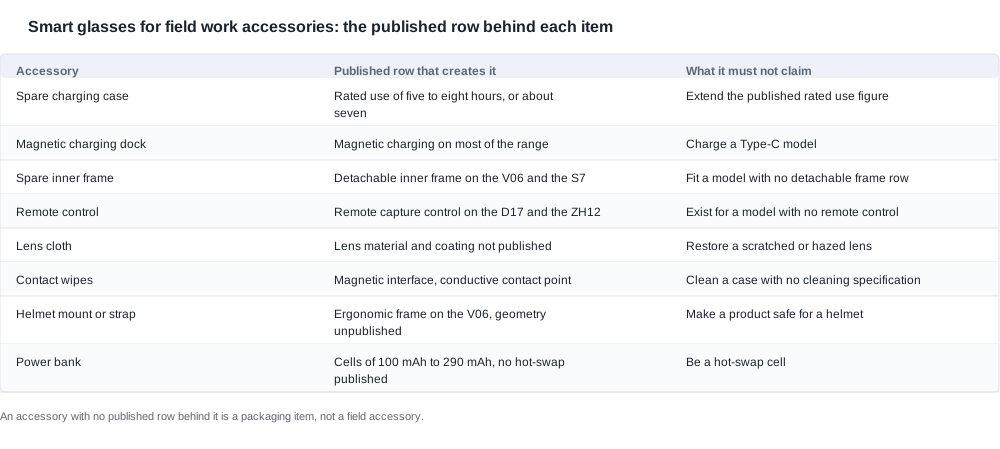
| Accessory | The published row that creates it | Models affected | What it must not be claimed to do |
|---|---|---|---|
| Spare charging case | Rated use of five to eight hours on the 260 mAh models, about seven on the 290 mAh models | MT6 and V06, S7 and L1 Pro, and L2 Utral and CY03, and CY05 | Extend the rated use figure beyond the published value |
| Magnetic charging dock | Magnetic charging published across most of the range | V06, S7, YKC02, K01, K02, LC-105 pair, G07, YK12 | Charge a Type-C model, and the D17 and the ZH12 use Type-C |
| Spare inner frame | Detachable inner frame published on the V06 and the S7 | V06, S7 | Be a spare for a model whose inner frame is not published as detachable |
| Remote control | Remote capture control published on the D17 and the ZH12 | D17, ZH12 | Exist for a model without remote capture control |
| Lens cloth | Lens material and coating not published for any model | all | Restore a scratched or hazed lens |
| Contact wipes | Magnetic charging interface, contact is a conductive point | magnetic-charging models | Wipe a case that carries no wipe specification |
| Helmet mount or retention strap | Ergonomic frame design published on the V06, temple geometry not published | site dependent | Make a product safe for a helmet, which needs a trial and a site assessment |
| Power bank | Cell capacities of 100 mAh to 290 mAh, no hot-swap arrangement published | all | Be a hot-swap cell, because none is published |
Who owns the accessory, and who reorders it
The second half of the derivation is ownership, and it is the half that decides whether the kit still exists in six months. Accessories divide into three groups by who carries them and who replenishes them, and an item in the wrong group is an item that runs out.
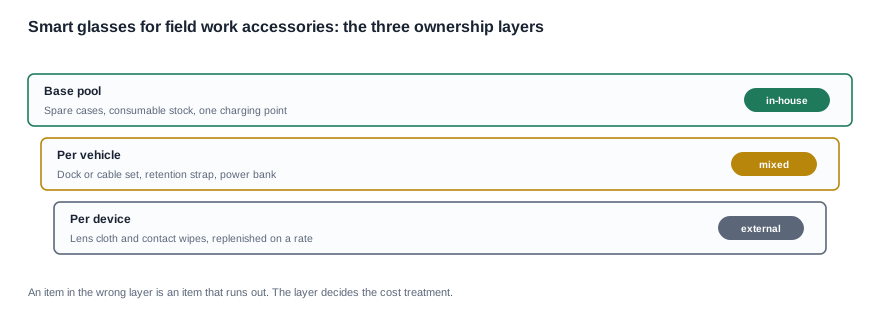
The per-device group is the consumable group: the lens cloth, the contact wipes, and anything a site uses up at a steady rate. Its cost per unit is small and its replacement rate is predictable, which makes it the easiest line in the kit to justify and the easiest to forget. The per-vehicle group is the installed group: the dock or the cable set, the retention strap, the power bank. These are placed once, at a location, and they are physically tied to a vehicle or a crew. The base group is the pool: spare cases, spare units, the consumable stock and the charging point. The pool is where resilience lives, and the pool is also where an unused case ends up sitting in a box for a year because nobody wrote a restock rule for it.
The three cost treatments, and why they are not interchangeable
A consumable is priced per unit and replenished on a rate. An installed asset is capitalised and placed. A pooled spare is neither: it is stock held against a failure rate, and the quantity comes from the deployment size and the escalation ratio rather than from the device count. Buyers who mix these three treatments end up with either a case shortage or a case surplus, and the surplus case is worse because it is a second lithium cell that has to be declared, stored, charged and eventually retired.
Which published rows create which accessory
The case situation, model by model
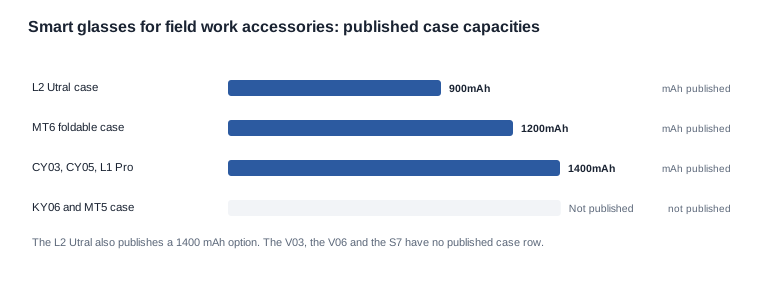
The charging case is where published data is most uneven, and the unevenness is the most useful part of it. Three camera models publish a 1400 mAh case: the L1 Pro and the CY05, and the CY03. The L2 Utral publishes two options, 900 mAh and 1400 mAh. The MT6 publishes a 1200 mAh foldable case. The KY06 and the MT5 have a case in the published specification with no capacity stated. And the catalogue publishes no charging-case row at all for the V03 Pro and the V03, and the V06 or the S7, so the box contents for those four are an item to confirm rather than assume.
Those are three different states, and a kit built from a single assumption about cases will be wrong for some models. No published case row is not the same as no case, and the difference matters because the spare case is a logistics decision: a case issued per device is a second object to issue, count, charge and declare, and a case held at the base is a resumption tool. For a fleet, the base-held case is usually the better answer, and for a single remote technician working away from a vehicle, it is the opposite. The published rows cannot make that decision; the deployment shape makes it.
The interface decides the charging accessory
Magnetic charging and Type-C are not two preferences, they are two different asset classes. A magnetic model needs the correct dock at every charging point, and that dock is a fixed asset the buyer has to place, power, service and insure. A Type-C model needs a cable, which is a consumable replaced at the base rather than an installed item, and it carries a much lower replacement cost because a cable is a cable.
The range publishes Type-C on the V03 Pro, the L2 Utral, the D11, the D12, the D17, the ZH12 and the bone-conduction model, and magnetic charging on the AR model, the A07 and the V06, the S7 and the A06, the A05 and the MT5, and the V03, and the KY06, the K01, the K02, the LC-105 pair, the G07, the YK12, the YKC02 and the photochromic model. Four camera models publish no charging method row at all: the MT6 and the CY05, and the CY03 and the L1 Pro. Those four do publish a case capacity, and the interface is simply not a published row for them — so a buyer specifying a dock for them is specifying something the catalogue does not support, and the question has to be put to the supplier in writing.
The two structural accessories
The detachable inner frame on the V06 and the S7 is the clearest example in the catalogue of an accessory that exists because a structural part is published as replaceable. The claim it can carry is narrow: it is a spare for a frame whose inner frame is published as detachable. It is not a spare for a model where no such row exists, and it is not a general frame replacement.
The remote capture control on the D17 and the ZH12 is the other one. Both publish it, and it exists for a specific reason — the capture happens without reaching to the frame, which matters when the unit is on a head and the operator's hands are occupied. For any other model, a remote control accessory is a generic add-on with no published row behind it.
Three items worth thinking twice about
The spare case
The spare case is the highest-value accessory in the list and also the one where the temptation to shortcut is strongest. A 1400 mAh case is a substantial object, and a crew carrying spares carries weight. Decide the quantity from the published endurance band and the shift length rather than from habit, and remember that a case with an unknown history is the one most likely to fail intermittently.
The published case capacities are the right basis for the decision, and they are uneven in a way that matters: 1400 mAh on the CY05 and the CY03, and the L1 Pro, 900 mAh and 1400 mAh on the L2 Utral, 1200 mAh on the MT6's foldable case, and a case with no published capacity on the KY06 and the MT5. Where the capacity is not published, the quantity decision has to be made on the device's rated use rather than on the case, and the case specification has to be requested in writing.
The helmet mount
Whether these products can be used with a helmet is asked constantly, and the published material does not answer it, because the answer depends on the frame geometry, the temple shape and the helmet. The helmet compatibility answer and the interference question are the honest starting point, and the real answer is an on-site trial with the actual helmet, used by the actual crew, on a site where the actual work happens. The V06 publishes an ergonomic frame design, and the S7 publishes the same, but neither publishes a mounting specification, so a retention accessory for either is a trial item rather than a catalogue item.
The lens cloth
It is the cheapest item on the list and the one most often missing. A lens wiped with grit against it is a lens with a coating mark, and the lens material and coating are not published for any model in the range, which means there is no specification to wipe against. A coating mark on a product sold as rugged is a warranty conversation nobody planned for. The instruction has to be conservative and specific — a stated item, a stated prohibition list, one motion — and the prohibition list matters more than the cloth.
What the kit costs, and what it saves
Accessories are hard to justify in a quotation, and the honest way to present them is against the two costs they reduce: the replacement cost of a unit taken out of service, and the return rate of a product that arrives marked. Both are real, and neither appears in a unit price.
The first is a downtime cost. A unit that will not charge on a morning it is needed is a unit out of a crew's work, and the cost of that is the shift, not the device. The accessories that reduce it are the consumables and the pooled spares, because they exist to keep a unit in service rather than to protect it. The second is a claims cost, and the accessories that reduce it are the wipe items and the protective ones, because a product that arrives marked is a product a customer returns, and a return is a negotiation.
A third benefit is harder to quantify and easy to state. A crew that has a complete kit stops improvising. Improvised charging and improvised lens wiping are how a device that was specified at 260 mAh and a five to eight hour rated use ends up being reported as faulty, and the resulting ticket costs more to investigate than the accessory costs to supply.

How to present accessories in a quotation
Kit tiers, and the reorder rule attached to each
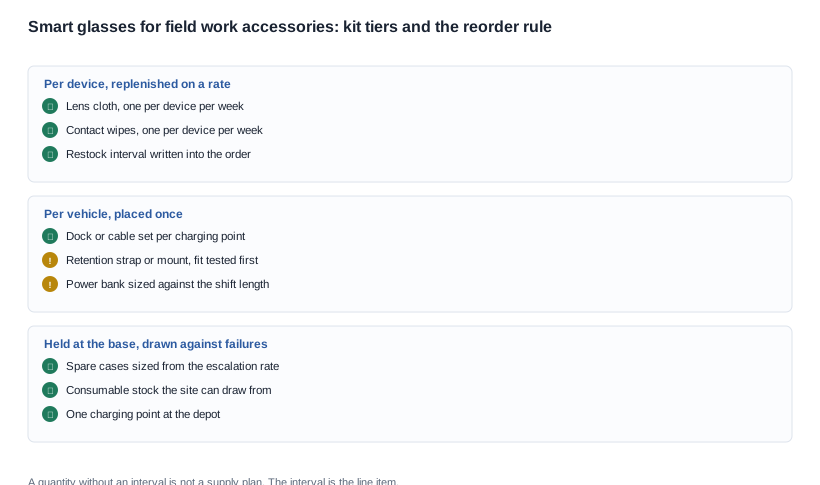
A kit should be quoted in three tiers with a named owner and a restock rule for each, because an accessory line without a reorder rule is a line that runs out silently. The per-device consumables are quoted per unit with a per-unit-per-week rate, which is the number that lets a site draw stock without raising a purchase order. The installed items are quoted per location, with the quantity tied to the number of vehicles or charging points rather than to the device count. The pooled spares are quoted against the deployment size and the escalation rate, and the escalation rate is a number the buyer should be measuring from the pilot rather than assuming.
The restock rule is the part that gets left out, and it is the part that decides whether the consumables stay in the bill of materials for the second year. A quantity without an interval is not a supply plan, and the interval is the number that turns a line item into a managed supply.
Where the accessory cost belongs
Accessories are usually quoted as an add-on, which is a mistake, because it invites the buyer to treat them as optional and to cut them first. The stronger position is to price the kit as a single deployment package with the device line and the accessory line separate inside it, so that a buyer comparing two quotations compares a whole deployment rather than a unit against a unit. The two-line structure also makes the negotiation productive, because the accessory line is small enough to be conceded and large enough in aggregate to matter.
The one number worth negotiating hardest is the consumable per-unit cost, because it is the highest-return line available and the easiest to discount in exchange for a run tier. What a supplier should not discount is the pooled spare quantity, because that is the supplier's own risk exposure being reduced at the buyer's expense, and a buyer who cuts it will get a very cheap first order and an expensive second one.
Where the accessory specification belongs in the order
The accessory list is a document, and it belongs in the purchase order rather than in a separate quotation line that nobody signs. A buyer who quotes devices and accessories as two unrelated lines ends up with two price tiers, two delivery dates and no way to say which accessory ships with which device. The bill of materials per configuration, with the accessory tier stated, is the form that lets a supplier quote against it, and it is the form a factory can actually build to.
Three items in that bill of materials carry contractual weight that goes beyond their price. The packaging standard has to be written down, because a damaged transit box produces a damage claim that lands on the buyer rather than on the factory, and because the packaging determines the freight weight, which determines the landed cost, which determines the margin on the delivered unit. The transit documentation for the case has to be requested for the exact configuration, because a charging case is a second lithium cell and the battery transport requirements are a shipping gate rather than a preference; the requirements are at battery transport. And the accessory warranty has to name the items, the coverage period and the replacement route, because a case replaced under a consumer policy template and a case replaced under a fleet contract are different commercial objects.
The audit trail matters as much. A procurement team that receives an accessory list without a serial or part number has received a catalogue, and it cannot tell a replacement from a spare part at the point of claim. A part number per accessory line, tied to a model designation and to the case capacity where one is published, is what makes the quality control record, the defect claim and the replenishment order reference the same object. Certificates and declarations for the accessories themselves are a further document request, and on our published position the conformity file for this range is not published, so a buyer who needs CE, FCC, RoHS or UN38.3 documentation for the accessories in the box has to ask for it in writing before the order.
The commercial consequence of getting this right is a supplier who can quote a deployment rather than a box, and a buyer who can compare two suppliers on the same scope. Tooling and setup costs for a custom dock or a custom package are quoted as separate lines from the unit price, and a sample order is the cheapest way to settle the packaging standard before it is printed.
Traceable to a specification, or not at all
The short answer: an accessory list should be traceable to a published specification, and anything not traceable to one is either a personal preference or an unproven claim. We publish the charging interfaces, the rated use figures, the remote capture features, the charge times and the cell capacities, the detachable inner frames and the catalogue IP54 marking on the V06 and the S7. We do not publish frame weights, lens materials or mounting specifications for this range, and we will not present an accessory as solving a problem that no published row creates.
Two items stay off the list on principle. A helmet mount is a trial item and a site-assessment item, and we will not describe it as making a product safe for a helmet. A hot-swap battery arrangement is not published for any model, and a power bank is not a hot-swap cell.
If you describe the shift, the environment, the helmets and the number of vehicles, we will say which of these items the published data actually supports, which ones need a test first, and which model the accessory attaches to. The field-work buying checklist is the selection counterpart, the terminology is at the field-work glossary, and the scenario entry point is at smart glasses for field work.
Related reading
- How the scenario opens — smart glasses for field work
- The selection counterpart — the field-work buying checklist
- The terminology — the field-work glossary
- What the catalogue publishes — battery life
Send the shift length, the environment, the helmet type and the vehicle count, and we will say which accessories the published rows support.