Smart glasses for kids parenting is a category where a first order is a fair test, and where six mistakes are reliably made by a channel that is entering it for the first time. None of the six surfaces at the quotation stage, where the price looks good and the specification sheet looks complete. All six show up afterwards — in the return rate, in the review copy, in the customer service queue, or in the compliance file — and each one has a known correction that costs far less in the first quarter than in the second year. They are set out here as symptom, cost and the question that prevents the mistake.
Smart glasses for kids parenting: six mistakes that surface after the first order
The first characteristic of these six is that they are all errors of assumption rather than errors of fact. In each case the buyer had a correct published row available and used something else instead — a translation of the product name, a reading of a ceiling as a measurement, a general impression of a family, a supplier's restatement of a catalogue. That is why they are so common: nothing in the process flags them, because at the moment of the mistake the document reads as finished.
The second characteristic is that they are expensive in a specific way. None of them makes the device worse. They make the channel's statements about the device wrong, and a channel's statements are the part of the business a parent acts on and a market authority examines. The cost therefore lands on the returns desk, on the listing's performance, and on the paperwork, and it lands there as something the supplier cannot fix.
The third characteristic is that the corrections are almost all editorial rather than commercial. Six of them can be fixed by rewriting a listing, revising an insert, or consolidating three SKUs into two. Only one requires a new order from the supplier. A channel that discovers these six in the first quarter pays for text; a channel that discovers them in the second year pays for stock it cannot sell.
The order below is roughly the order in which they appear. The age grade and the claim surface first, because they are visible in the listing review. The cell and the charge surface next, because they surface in the first support tickets. The supplier and the specification surface later, because they surface when the channel tries to scale the range or enter a second market.
One structural point explains why a buyer who has read the catalogue carefully still makes mistake three. The catalogue is written in the language of its own tables, where a cell capacity, a charge ceiling and a rated use sit side by side as equal entries. A listing has to be written in the language of a promise, where those same entries become an expectation with a consequence attached. The translation between the two is where the errors occur, and it happens in the copy, in the artwork and in the conversation with the supplier rather than in the document the buyer read. Which is also why the correction for most of these six is to go back to the published form rather than to write around it.
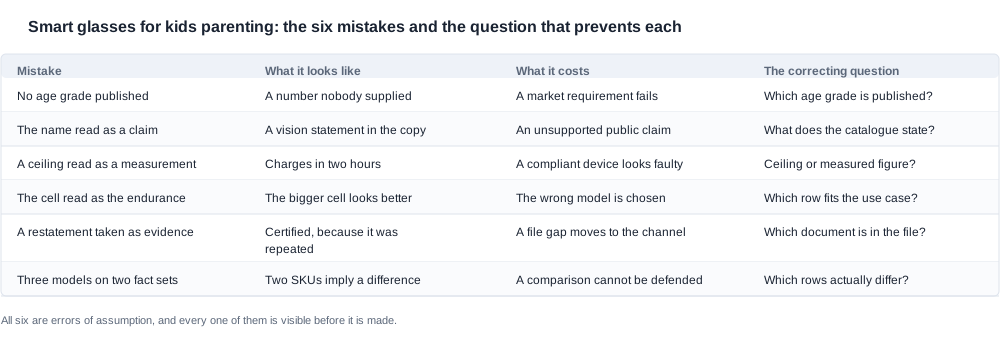
| Mistake | What it reads like | What it costs | The correcting question |
|---|---|---|---|
| Listing without an age grade | The listing shows a number nobody supplied | A market or platform requirement fails after publication | Which age grade is published for this model? |
| Reading the name as a claim | A vision or strain statement appears in the copy | An unsupported claim in a listing that is now public | What does the catalogue actually state? |
| Treating a ceiling as a measurement | "Charges in two hours" appears in the copy | A device meeting the published figure reads as defective | Is this a ceiling or a measured figure? |
| Reading the cell as the endurance | The larger cell is treated as the better product | The wrong model is chosen for the use case | Which row describes the use case? |
| Accepting a restatement as evidence | "Certified" appears because the supplier repeated it | A documentation gap moves from the supplier to the channel | Which document, for which model, is in the file? |
| Listing three models on two sets of facts | Two SKUs imply a difference that is not published | A comparison the channel cannot defend | Which published rows differ between them? |
Mistakes one and two: the age grade and the claim
Mistake one: publishing an age grade that nobody supplied. The catalogue publishes no age grade for the A05, the A06 or the A07, and a parents channel nonetheless needs one because a platform listing, a market authority or a parent will ask for it. The mistake is not leaving the field empty — that would be defensible — it is filling it with a number from a competitor, a similar product or a general assumption. A published age grade is a regulatory statement about a product's design, so it has to come from the manufacturer for the model, in writing.
The cost of the mistake is asymmetric. If the age grade stated is too low for the product, the channel has sold a product into a market that requires more of it. If it is too high, the channel has sold a product into a market that prohibits it, and the consequence is a product recall rather than a listing correction. Either way the number was never the channel's to choose, and the correction is to remove the number and request the statement.
Mistake two: reading the catalogue's product name as a performance claim. The A05 and the A06 are published in the catalogue as children's smart protective glasses, and the A07 as children's smart audio glasses. Those are designations, and a listing has to use them because they identify the goods. The mistake is expanding a designation into a promise — that a protective glasses product protects the eyes, relieves strain, or affects how a child's eyesight develops. The published feature is a lens-type electronic fogging arrangement together with posture and distance detection, illustrated in the catalogue as a clear lens under correct posture and distance and a fogged lens under incorrect posture and distance. There is no medical reference and no refractive reference anywhere in the published text.
The cost here is the reason the mistake is on this list. A vision claim in a listing is not a copy problem that ends when the copy is fixed. It is a statement that has been made publicly, to parents, in a category where the subject is a child, and in many jurisdictions a claim of that shape is treated as a regulated claim whether or not it was intended as one. Removing it before publication is cheap; removing it after publication is a matter of record.
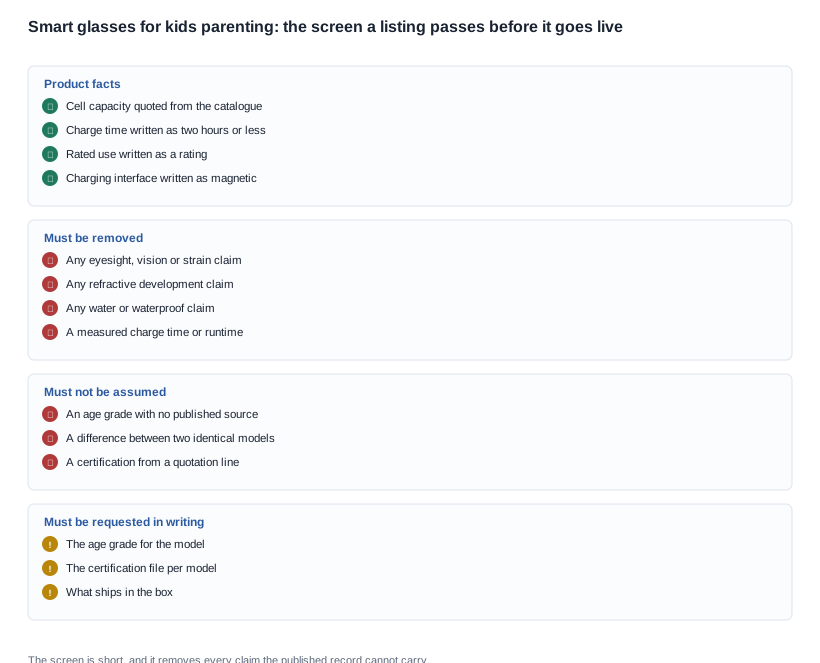
The practical screen is short. Any statement about eyesight, vision, strain, myopia, refractive development or eye health is removed, because no published row supports one. Any statement about water is removed, because no ingress marking is published for these three models. Any statement that depends on the A05 or the A06's fogging arrangement is removed from the A07's copy, because the A07 publishes no such arrangement. What remains is the electrical rows, the published feature set for that specific model, and the instructions — and that is enough to sell a product honestly.

Mistakes three and four: the cell and the charge
Mistake three: turning a published ceiling into a measured figure. All three models publish a charge time of two hours or less. A listing that says the product "charges in two hours" has converted a ceiling into a promise that is stronger than the published fact, and the gap between the two is precisely the case the published record cannot cover: the catalogue states no starting state for the charge and no end point for it. A device that takes exactly two hours from empty has met the published figure and will read as defective against the copy. This is the most common complaint the charge ceiling generates in this category, and it is entirely self-inflicted.
The correction is wording rather than numbers. The published form is that the charge time is two hours or less, and a channel that writes it that way has written something it can defend in a customer service reply and in a market file. The same correction applies to the endurance figure: roughly twenty hours is a rated use figure with no published test condition behind it, and a copy that treats it as a measured continuous-use result makes a promise the supplier never made.
Mistake four: choosing between models on the cell capacity. The A05 and the A06 publish a 40 mAh cell and the A07 publishes 70 mAh, and all three publish a charge time of two hours or less and a rated use of about twenty hours. The natural inference is that the larger cell makes the A07 the better product, and that inference is wrong because the published rows do not connect the two. The A07's larger cell sits alongside a published radio version and a published absence of the fogging and detection feature. The two feature sets serve different jobs, and the published record is what tells a buyer which is which.
The way to make the choice is to name the use case before the model, and then read the rows that bear on it. A parent whose reason for the purchase is the posture and distance prompt is buying the A05 and the A06, and the A07's larger cell is irrelevant to that decision. A parent whose reason is audio has no published fogging or detection feature to benefit from, and the A07 is the only one of the three with a published radio. A channel that chooses first and justifies afterwards will end up with a listing that sells the wrong thing to the wrong buyer, and the review copy will show it.
The related mistake sits beside this one and is worth naming, because it costs the same and is harder to see. The published rated use of about twenty hours is identical across all three models, so it cannot be the reason to prefer one. The published charge ceiling is identical across all three as well. If a channel's shortlist for this range was built on endurance or on charge speed, it was built on rows that do not differ, and the real differentiators — the published feature set and the radio version — are the two rows that were left unexamined. The general rule is worth keeping: when the electrical rows are identical, the decision has to be made on the feature rows, and when the feature rows are identical too, the two models are one model with two names on it.
Mistakes five and six: the supplier and the specification
Mistake five: accepting a supplier's restatement of the catalogue as evidence. This is the mistake with the longest tail, because it reads like diligence. A supplier's quotation states that the products are certified, or comes with a catalogue page showing an export certification section, and the channel treats the quotation as the document. In this range the catalogue text contains no reference to CE, FCC or RoHS, there is no per-model certification row anywhere, and the company-level export certification page is an image page whose content is not text. So a restatement confirms nothing, and a channel that has relied on one has a documentation gap it has mistaken for a closed file.
The correction is to ask for documents rather than statements, and to ask per model. Which certificate, for which model, in which configuration, issued by which body, with which number, and where the buyer can verify it in the issuing body's public register. A document with a number can be checked; a sentence in a quotation cannot. The request list is at the certification checklist and the market routes are at child product compliance and the EU route.
Mistake six: listing three models on two sets of published facts. The A05 and the A06 publish identical parameters, and the difference between them is not confirmed. Listing both as distinct variants implies a distinction the channel cannot evidence, and it sets up the comparison a parent will make — the A05 versus the A06 — on grounds the published record does not support. A channel that cannot explain the difference between two SKUs has a returns problem waiting, because one of the two will be reviewed as the disappointing one.
The correction is a decision about the range rather than about the copy. Either consolidate to a single model and use the other as an internal alternate, or keep both and state explicitly that the published parameters are identical and the difference is a variant the channel has confirmed in writing. The second option is legitimate; what is not legitimate is implying a difference that exists only in the listing. Consolidation has a second benefit that a channel should price in: one model means one insert, one conformity file and one set of support copy, and in a category with this little published detail that is most of the work.
The correction sequence for a channel already in market
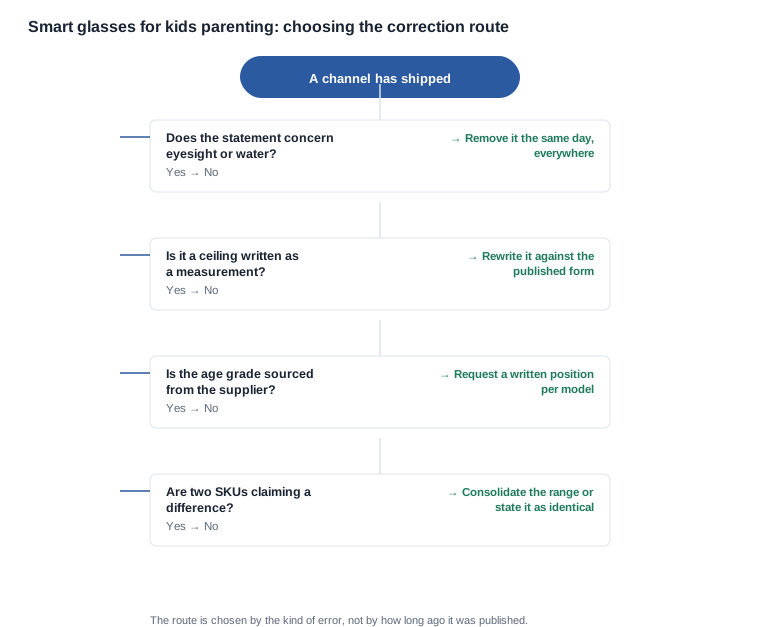
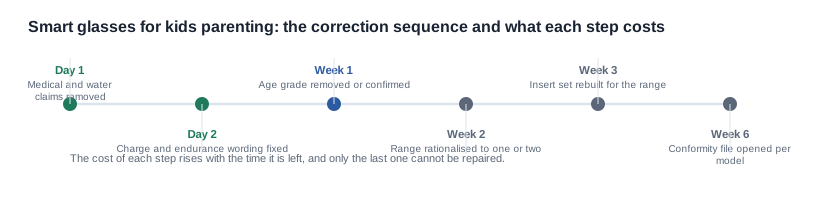
A channel that has already shipped has a finite set of things to do, and the order matters because some of them are cheap now and expensive later.
First, take the medical and water claims out. This is a copy edit, it can be done the same day, and it is the one step whose cost grows with time. Any statement about eyesight, strain, refractive development or water is removed from every listing, every insert, every product description and every advertisement, not just the ones the channel remembers. This step takes priority over everything else because it is the only one whose exposure is cumulative.
Second, correct the charge-time and endurance wording. Replace every measured-sounding statement with the published form: a ceiling rather than a duration, a rating rather than a result. This is a search-and-replace pass across listings and insert artwork, and it is best done before the insert is reprinted rather than after.
Third, remove the age grade, or replace it with a written position. If a grade has been published without a source, it comes out immediately and a written request goes to the supplier. If the supplier confirms a grade in writing, it goes back in with the confirmation attached to the file.
Fourth, rationalise the range. One model or two, with the decision recorded. If two, the published parameters are stated as identical and the confirmed difference is stated separately. The insert set is then rebuilt for whichever combination was chosen.
Fifth, open the conformity file properly. A document request list per model and per destination market, with a place to record the answer, the date and the verification. This step does not block the channel's sales, which is why it keeps getting deferred, and it is the step that cannot be repaired retrospectively if a market authority asks.
Sixth, and separately, put a review routine in place. The six mistakes are not one-off errors; they are what happens when nobody owns the wording. A channel that has corrected them once will produce them again at the next range extension, at the next market entry, or at the next redesign of the listing. The routine is unglamorous: a named owner, a fixed interval, and a check that each published statement still matches a current published row or a written supplier position, with any claim that has no source behind it removed rather than reworded. The check takes an afternoon per model, and it is the difference between a channel that corrects this category's mistakes once and one that never has to correct them twice. The same routine, applied to the accessory set and the insert artwork, closes the two places where the remaining errors usually reappear.
What the corrected channel looks like from the outside. Nothing about the product changes, and that is the point worth ending on. The device is the same device, the cell capacity is the same published capacity, the charge ceiling is the same ceiling, and the feature behaviour on the A05 and the A06 is the same published behaviour. What changes is that every statement about it now has a source a third party can check, which is what turns a listing that merely sells into one that can be defended to a parent, to a market authority and to a returns desk at the same time. That is the whole return on the work of going through the six mistakes carefully: not a better product and not a cheaper one, but a channel whose claims about the product are the same claims the supplier would make, and no broader.

What we will and will not tell a channel. We publish the rows that exist — the cell capacity, the charge time as a ceiling, the rated use, the magnetic charging interface, the published feature set and, for the A07, the Bluetooth version. We will confirm, in writing, which of those rows applies to which model, and we will say plainly which models are published with identical parameters. We do not publish an age grade, an ingress position, a weight, a frame or lens material, a coating, a charging case for these three models, or any certification reference, and we will not supply one that the published record does not carry. Send us your current listings and insert artwork and we will return the specific lines that need to change, the ones that need a written supplier position before they can stay, and the ones that have to go regardless of what a competitor's listing says.
Related reading
- The entry point for this scenario — smart glasses for parenting
- The family in question — kids smart glasses
- The gate before the order — a buying checklist for a parents channel
- The accessory set — accessories for a parents channel
Send us the listing and the insert artwork, and we will mark every line that a published row can carry, every line that needs a written supplier position, and every line that has to come out.