
The category name is the problem, and it is a problem for the buyer rather than for the consumer. A product called kids eye protection glasses invites a claim that a catalogue cannot support, and the distance between what the name promises and what the evidence allows is where both the regulatory exposure and the return rate come from. So the way to select in this category is not to compare models on features. It is to write the listing first, mark every claim in it, and let the claims tell you which model you need and which measurement you have to buy.
Here is the selection logic in five steps.
Write the draft listing before you shortlist a model. The claims in that draft are the specification. A model is then selected against the claims, and a claim that has no evidence behind it either becomes a measurement you order or becomes a sentence you delete.
Start from the published features and work outwards. Our range publishes posture and distance detection on the A05 and the A06. That is the honest centre of this category, and a proposition built on it is defensible, sellable and repeatable.
Treat the fit row as a blocking item, not a detail. A reminder the child cannot see because the frame does not sit correctly is a feature that does not exist. We publish no frame dimensions, no weight and no fitting range for any of the three children's models, so this row has to come from the tooling programme before the first order.
Separate the two compliance questions. The safety of the product as a children's article and the health claims you may make about it are entirely different matters. One is a product assessment with a named framework. The other is a line that does not exist, and no certificate brings it back.
Do not let the supplier's literature set the claim. A written confirmation that no vision or health claim is made in the supplied material protects the buyer as much as the supplier, and it is worth asking for in writing before the artwork is approved.
Kids eye protection glasses technology: what we publish
The category holds three models in our range, and the published rows are narrow.
The A05 and the A06 publish a lens-type electronic atomiser, a charge time of two hours or less, magnetic charging, a 40 mAh cell, a rated runtime of about twenty hours, and posture and distance detection. The catalogue also carries functional illustrations for those two models contrasting correct and incorrect sitting posture. That illustration set is the most useful marketing asset we hold in this category and the one buyers ask about least often, because it demonstrates a behaviour rather than describing a specification, and behaviour is what a parent is actually buying.
The A07 publishes Bluetooth V5.4, a 70 mAh cell, a charge time of two hours or less, a rated runtime of about twenty hours and magnetic charging. It is an audio platform with no camera in the published specification.
The twenty-hour figure needs the clarification it has always needed, because it is the number most likely to be misread. The A05 and the A06 publish 40 mAh, the A07 publishes 70 mAh, and all three are rated at about twenty hours. Two very different cell sizes producing one identical runtime means the number describes a light duty cycle with a long standby, not twenty hours of continuous use. Read it as continuous wear and the A05 specification is simply wrong; read it as a duty cycle and it is coherent. The commercial consequence is straightforward: a buyer who takes the twenty-hour figure at face value and positions the product for a full school day is positioning it on a number the cell cannot support.
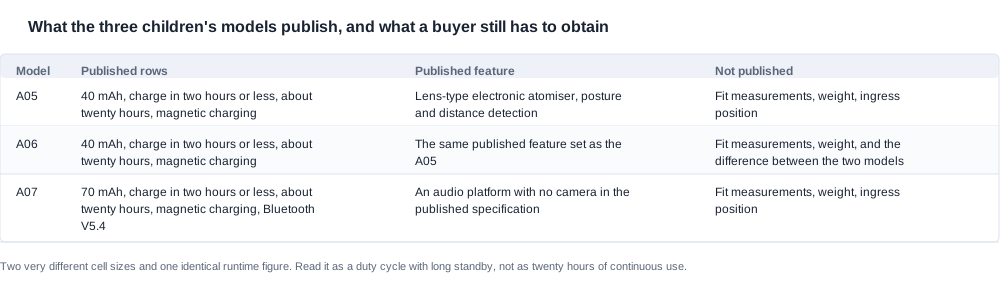
What is not published for any of the three: frame dimensions, weight, the fitting range, the materials, the lens specification beyond the published feature, any measured visual or optical performance, the ingress position, and any model-level certificate numbers. There is also an internal difference between the A05 and the A06 that our own documentation has not confirmed, so a buyer who is building two separate product pages on those two models is building them on a difference nobody has confirmed. That is a page-level and a programme-level decision, and it is cheaper to resolve before the artwork than after it.
Two further structural facts matter for a private-label programme. First, the category carries the highest documentation burden in our range, because a product aimed at children attracts a safety assessment that a product aimed at adults does not, and the frameworks are named and specific — EN 71 in the European market, ASTM F963 in the United States, and the consumer product safety requirements that sit alongside them. Second, the marketing requirement sits alongside the safety requirement rather than behind it: the General Product Safety Regulation (EU) 2023/988 applies to the product as placed on the market, and the technical file behind a product aimed at children has to withstand more scrutiny than one aimed at adults, not less.
The A05 and the A06 deserve a paragraph of their own, because the way a buyer handles that pair has commercial consequences beyond the catalogue. Their published rows are identical, down to the cell, the charge time, the runtime and the feature set, and the difference between them has not been confirmed to us. Three options exist and each one costs something. Treat them as one product with two colourways and the risk is a buyer who discovers a genuine difference after the tooling is committed, with a certification scope that may not cover the second unit. Treat them as two products and the risk is two product pages describing the same specification, which is a content and a search-visibility problem rather than a technical one, and which is cheaper to resolve than most buyers assume. The third option, which is the one we would recommend, is to buy the answer: put the difference in writing to the company as a question with a deadline attached to the sample order, and let the answer decide how many pages the programme has. It is one email, and it is cheaper than either of the two mistakes.
There is a fourth point on the published rows that a buyer should not skip. The A07 has no camera in its published specification, which makes it a different proposition in a different channel rather than a variant of the same product. A parent buying a reminder device is buying a camera-less product, and a buyer who lists all three models on one page creates a comparison the catalogue cannot support and a decision the customer cannot make. Three published rows on one page is a catalogue; three use cases on one page is a choice the buyer has made on the customer's behalf.
The fit row, which decides whether any of it is used
Ask any buyer what they wish they had asked earlier about a children's wearable and the answer is almost always the same: the dimensions. Not the feature set, not the battery, not the price — the dimensions, because they decide whether the product is used at all.
A posture and distance reminder is a behaviour prompt. Its value is entirely a function of the child wearing it correctly and for long enough to be reminded. The rows that determine that are specific and measurable, and none of them is published for our three models:
- Frame width, temple length and bridge, in millimetres. Not a size label — measurements, because a size label is what a supplier uses to avoid giving measurements.
- The weight of the complete unit, in grams. Weight determines whether a child complains about the product by the end of the first afternoon, and it is the row most likely to change a parent's decision at the point of purchase.
- The adjustment range of the temples. If the temples are fixed, the fitting range is a single point and the product fits one head shape. That is a return driver, not a preference.
- The age band the measurements support. A product aimed at a stated age band needs the measurements to justify that band, and the band is what the packaging, the listing and the marketplace category all key off.
- The material of the frame and of every contact material. For a product that rests against the skin for hours, the material declarations are part of the safety file rather than an optional extra.
- Whether the geometry suits the posture the product detects. A reminder that fires when the child is sitting correctly is worse than no reminder, and this can only be confirmed on a sample with the detection in operation.
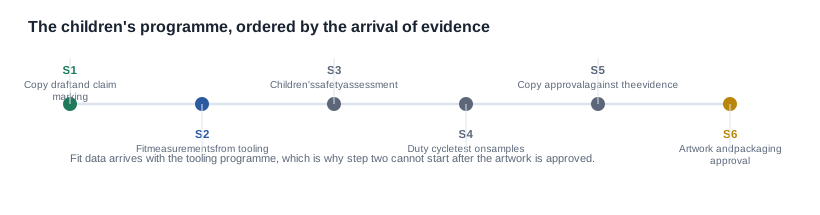
The commercial point is that the fit row is a tooling row, not a quotation row. The measurements come out of the tooling programme, which means the moment you start the tooling is the moment the fit row becomes knowable. Any programme plan that puts the listing approval before the tooling start is planning to approve artwork without the data that the artwork depends on.
That is also why the fit row has to be requested rather than assumed. A buyer who asks for six measurements in the first email gets them; a buyer who asks for "sizing for a 7 to 10 year old" gets a size label back and a second round of email. The difference is whether the request is expressed as something that can be measured.

Turning a draft listing into an evidence file
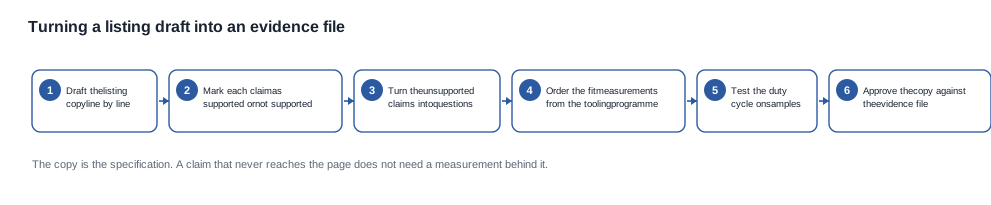
The procedure below is the one we would use with a customer, and it works because the copy is the deliverable. A claim that never reaches the page does not need a measurement behind it, and a claim that reaches the page without one is the thing that comes back.
Step one: draft the listing copy line by line. Every sentence in the listing is a claim, including the ones that describe the box contents, the battery and the pairing process. Write them as sentences, not as bullets, because a bullet hides the claim that is being made.
Step two: mark each claim. Three marks, no more, or the exercise becomes a negotiation. Supported means our documentation already answers it. Needs a measurement means it can be answered, but only by a test or a factory measurement that has to be commissioned. Must come out means the claim cannot be evidenced in any way for this category, and it is deleted rather than softened. Softening is where the trouble starts, because a hedged clinical claim is still a clinical claim.
Step three: turn the "needs a measurement" claims into purchase orders. Each one becomes a line in a request list with a named owner and a date, and each one is either delivered or removes the sentence from the listing. That last half is the discipline: a measurement that does not arrive removes its sentence.
Step four: request the fit measurements from the tooling programme. Six rows, in millimetres and grams, with the adjustment range and the age band the measurements support.
Step five: test the duty cycle on samples. Ask what happens if the unit is worn continuously rather than intermittently, and confirm whether the posture detection can be adjusted or disabled. A reminder that cannot be turned off is a complaint waiting for a parent, and a parent complaint in this category becomes a marketplace review rather than a support ticket.
Step six: approve the copy against the evidence file, not against the brief. The approval is a line-by-line exercise with the evidence open beside it, and it is the last chance to remove a sentence before the artwork goes to print.
The documents to request before a deposit, in this order:
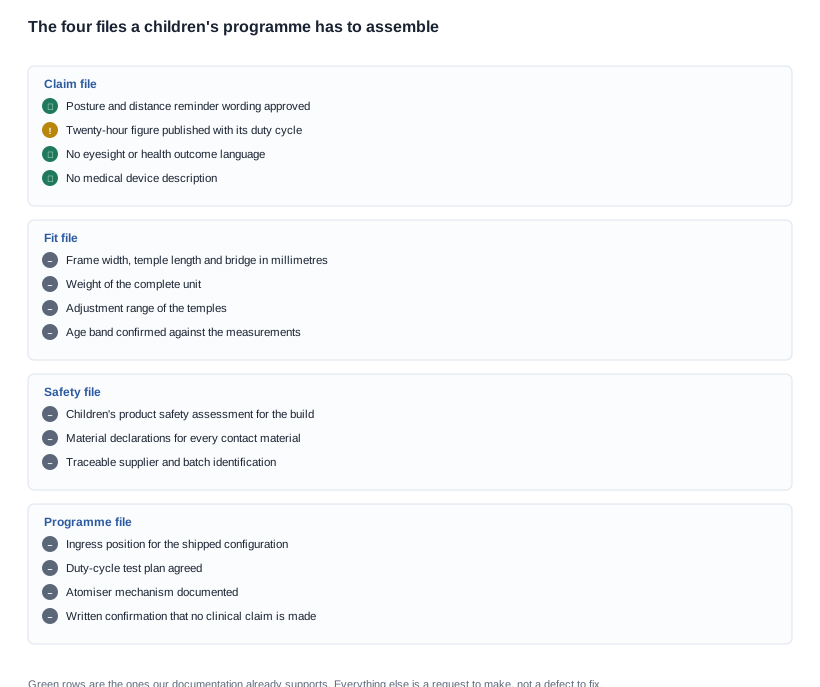
- The fit measurement sheet, with the six rows above, in millimetres and grams.
- The materials declarations for the frame and for every contact material.
- The children's product safety assessment for the build that will ship, with the document numbers, the issuing body and the validity dates.
- Traceable supplier and batch identification for the unit and for the battery.
- The ingress position for the shipped configuration, including the port or contact.
- A duty-cycle test plan, with the pass condition written down.
- The written description of the lens-type electronic atomiser, what it does and whether it interacts with the wearer's vision.
- A written confirmation that no vision, health or medical claim is made in the supplied literature.

Four claims that a certificate cannot rescue
This is the part of the category where being direct is more useful than being diplomatic, so it is worth being unambiguous about the boundary.
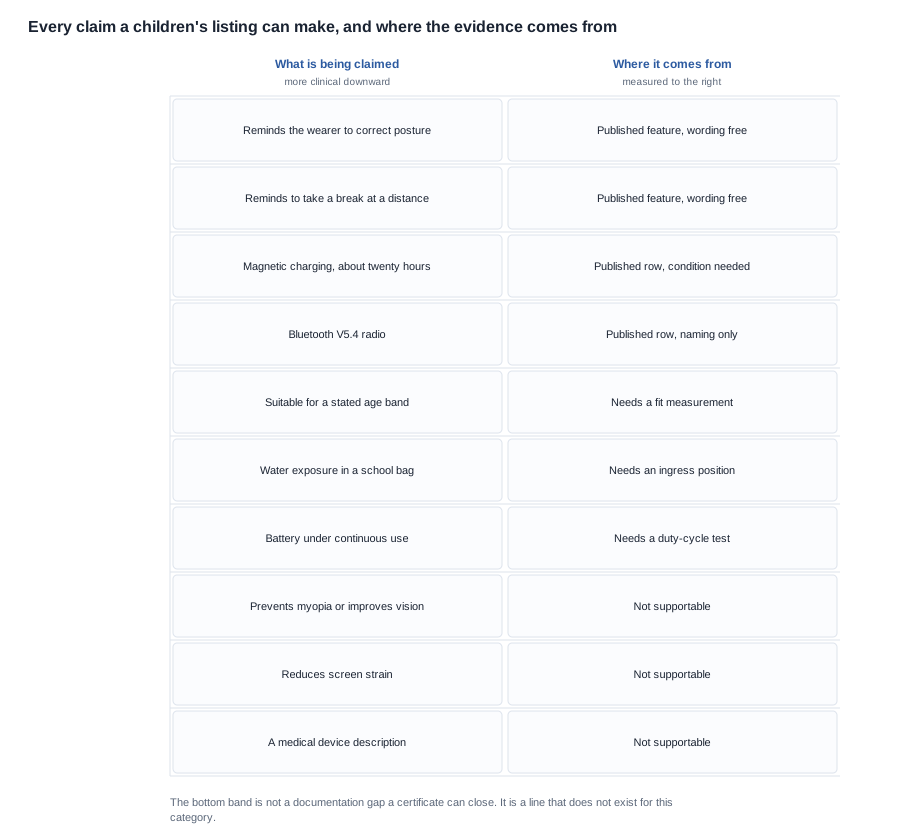
A posture and distance reminder is a claim we can support. The A05 and the A06 publish posture and distance detection. A listing can say the product reminds the wearer to correct their posture and to take a break at a distance. It should describe the behaviour accurately and not imply an outcome.
A standby runtime is a claim we can support, with a condition. About twenty hours on a light duty cycle, with the condition stated on the page rather than in the specification sheet.
A product made for children is a claim we can support, once the size is confirmed for the age band — and that is a measurement we do not publish, so it comes from the tooling programme.
Anything about protecting the eyes, preventing myopia, improving vision or reducing screen strain is not a claim we can support. These are clinical claims. They need clinical evidence, they carry regulatory consequences in most markets, and a product catalogue cannot supply either. A device that reminds a child to sit well and look at a distance is a behaviour prompt. It is not a treatment, and describing it as one is the fastest route to having a product withdrawn from a market.
A medical device description is also unavailable. These are not medical devices and they should not be presented as anything of the kind.
The reason this is worth being strict about is commercial rather than moral. A claim you cannot evidence produces a refund, a regulator enquiry and a retailer delisting, and it produces all three at once, in the same quarter, on the same product. A claim you can evidence is a selling point you can keep for the life of the programme.
There is a second reason that is specific to private label. In a children's category, the claim language on your listing is the thing a marketplace reviewer reads first and the thing a retailer's own compliance team reads second. A listing that leads on a posture reminder and a standby runtime can be approved by both without escalation. A listing that leads on eyesight protection cannot, because the reviewer has to escalate it, and an escalation that goes unanswered becomes a delisting rather than a query.
What we will put in writing for a children's programme
The short answer: we publish the capabilities our documentation supports, and the published posture and distance detection on the A05 and the A06 is the honest centre of this category. We will not make, or help a buyer make, a claim about protecting eyesight, preventing myopia or improving vision, and we will not describe any of our products as a medical device. We will not publish a children's product safety assessment, a certificate number or an ingress marking for any of the three models, because none has been confirmed to us, and we will not estimate the fit measurements or the weight from typical children's frames.
That boundary is more useful to a buyer than it may look. It means the specification you can plan against is small and knowable, and it means that every additional claim is something you either buy evidence for or delete. In this category, the discipline that protects a programme is not finding a cleverer wording for the claim you cannot evidence. It is deciding early which claims you are going to own, and funding the measurement for those.
On the commercial side, the structure follows the documentation burden. Negotiable: the number of configurations you commit to, the artwork round count, the per-market label scope, the delivery split against a sample-approval milestone, the minimum order quantity tiers for the product and for the accessories that ship with it, the payment structure including a retention against the documentation package, and the pilot tier share of the first run. Not negotiable: the children's product safety assessment itself, its cost and its lead time, which follow the assessment process and the testing body rather than your order size, and the tooling cost, which is usually amortised across the first order — the useful question there is over what volume it is amortised and what happens to it if the programme is discontinued.
One commercial item in this category is worth planning separately, because it is not a product cost at all. A children's product generates a different support pattern from an adult one: the end user is not the buyer, the buyer is often not the user, and the person who decides whether the product is kept is a third party again. That produces a returns and warranty conversation which has to be written before the first order rather than improvised against the first complaint, because the question "does the posture reminder work for a child of this size" is a question about measurements, and a support team without the measurements has no answer. The commercial consequence is that a warranty period agreed against a calendar assumption is a warranty period you will pay for in a category where the real failure driver is a product that does not fit. Setting the warranty against a stated failure criterion, and giving the support script the measurement sheet, is cheaper than the alternative.
Three things to do this week.
- Send us your draft listing. We will mark every claim in it as supported, testable or unsupported, and the marking takes one pass.
- Send the fit request as six measurements. Millimetres, grams, adjustment range, age band. A supplier who answers all six has a tooling programme you can plan around.
- Send the eight document requests as a list. A supplier who answers all eight has a documentation habit. A supplier who answers two is telling you something you need to know before the deposit.
The models are on the kids smart glasses range page, the fit questions are set out in more detail under kids sizing for children, the runtime conditions are under battery life specifications, and the document set a children's product needs is in the certification checklist.
Related reading
- The models in the category — kids smart glasses
- The fit questions in detail — kids sizing for children
- The runtime figures and their conditions — battery life specifications
- The document set a children's product needs — certification checklist
Send us your draft listing and we will mark every claim in it as supported, testable or unsupported.


