

A Bluetooth version number in a procurement conversation is a proxy, and it is being asked for because it is easy to write in a spreadsheet. It stands in for three things that matter far more: the radio approval you already hold, the update path you will depend on, and the energy budget the product runs on. It is a decent proxy for the third, a weak proxy for the first, and almost no proxy at all for the second. A buyer who opens with the version number will spend the meeting on the row that decides the least, and will leave without the three rows that decide the most.
So the conclusion first.
If the radio approval for your market is already held on a given generation, choose that generation and stop arguing. The approval was paid for once and it covers what it covers. Choosing a newer generation to be current is a decision to pay again.
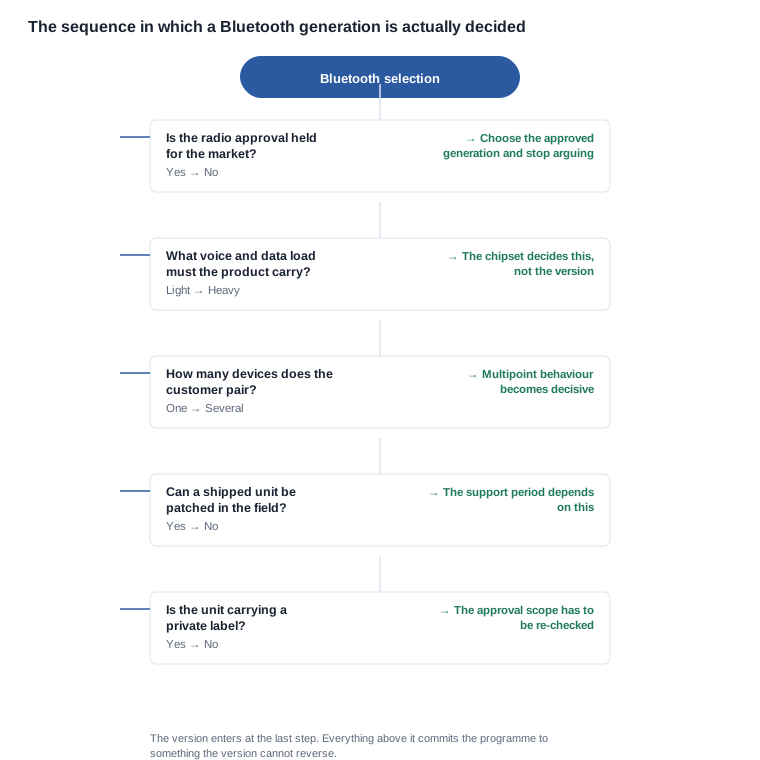
If the approval is not held, the version is close to irrelevant. What decides the programme is the market list, the approval scope, the voice and data load, the pairing count, the field update path and the certification scope, in that order. The version enters last.
Ask for the chipset part number instead of the version. The part number, not the generation, determines the profiles, the codecs, the multipoint behaviour, the range and the current draw. It is a catalogue reference that any supplier who has specified the build can give, and it is the row that lets you compare two suppliers who publish different version numbers for products that behave identically.
Do not read a newer generation as a support commitment. A radio that can be patched in the field outlives a radio that cannot, regardless of generation. The update mechanism decides the support period.
Smart glasses Bluetooth version: what published generations do not tell you
Our catalogue publishes the Bluetooth generation for part of the range and not for the rest, and the shape of that gap is itself a finding.
Bluetooth V5.3 is published for the K01 and the K02. Bluetooth V5.4 is published for the LC-105-2 and the ZH12, the YK12 and the D12, the YKC02 and the A07, the D17 and the D11, and the G07 and the LC-105-1, and for the electrochromic and AR entries. Nothing is published for the camera glasses family, for the bone conduction entry, or for the A05 and the A06.
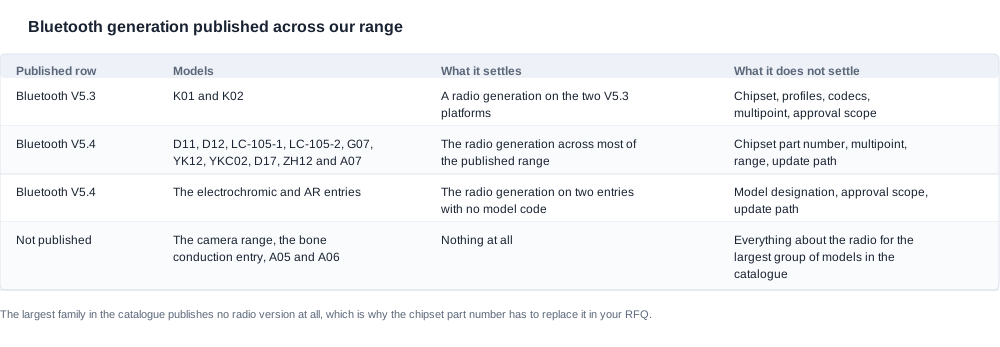
Count the columns and the procurement implication is immediate: the largest single group of models in the catalogue publishes no radio version at all. That is a documentation gap rather than a statement about the radio inside them, and it has a direct consequence for how the selection is run. A version-based comparison cannot be performed on the camera range from our documentation, so on the largest and most commercially important part of the range, the version question is not answerable and has to be replaced by the request that is answerable. Which is the chipset part number.
The other thing the published generations tell you is where the commercial weight sits. V5.4 appears on the audio platforms, the sport platforms with remote capture, and the one children's audio model. That is a coherent story: the same generation across the platforms where a radio actually does work, which is a voice and data radio, a paired audio platform and a call platform. Where a generation is published, it tends to be the current one for that kind of product, and the practical reading is that a supplier in this category is generally specifying a current-generation radio rather than a legacy one. That is useful background and it is not a selection method.
What the published generations do not settle is the following, and this is the full list of what you need to decide anything:
- The chipset part number, and therefore the profiles, the codecs and the multipoint behaviour.
- The approval scope: which model codes the approval names, and in which markets.
- The field update mechanism, and therefore the support period.
- The measured current draw, and therefore the real energy budget behind the runtime rating.
- The radio band coverage, and the antenna configuration.
- The encryption support, and where it is implemented.
That last pair deserves a note, because it is where the version has a legitimate claim to relevance. Bluetooth 5.4 added support for AES-CCM encryption, and that sits closer to what the EN 18031 series of harmonised standards asks for. The European framework is the Radio Equipment Directive (EU) 2014/53/EU, and the cybersecurity provisions within the harmonised standards cited into it are now part of what a CE marking has to demonstrate. A newer generation is therefore a weak signal that some of that paperwork is already done. It is weak because the generation says nothing about the update path, the consent mechanism or the secure storage, which are the other three things that series covers. Take the signal and ask the other three questions.

The chipset part number is the row that replaces the version question
This is the most important practical point in the article, so it is worth stating without hedging. A generation number is a label for a baseline. The part number is a description of the part. Four things follow from asking for the part number instead.
You get the behaviour, not the label. A specific part number carries a specific set of supported profiles, codec support, multipoint behaviour, link behaviour and current draw. Two suppliers quoting different version numbers for products that behave identically is a common outcome, and the only way to find out is to compare the parts.
You get a row that can be checked later. A part number is a catalogue reference. It can be looked up, compared against a second sample, and used in a purchase order as a line item with a value attached. "Latest Bluetooth" cannot be put in a purchase order, and a version described as a description rather than a value is not binding if a shipment arrives with a different radio.
You get a defensible change-control clause. A clause requiring notice before any change of chipset, module or radio board is only meaningful if the contract names the part. This is the classic way a certified product becomes an uncertified one: a substitution for cost or lead time reasons, discovered at a customs inspection rather than in a factory.
You get a signal about who controls the product. A supplier who gives the part number without being asked twice is specifying the build. A supplier who answers with a family name or a marketing phrase is managing a supply chain rather than owning it, and that is a materially different relationship for a private-label programme. It is not disqualifying — many factories are genuine integrators rather than designers — but it changes where you put your diligence.
The same logic applies to the second row, the update path, which is more often neglected than the part number. A product that can be updated in the field can be patched when a requirement changes or a defect is found. A product that cannot will accumulate defects that cannot be corrected, and the warranty cost of that is borne by the brand. The question is concrete and it has a concrete follow-up: what mechanism updates a unit that is already in a customer's hand, and what happens for a customer who never pairs the application? "Updates over the app" is a soft answer, because the customer who never pairs the app is precisely the customer whose defect you cannot fix.

The sequence, from a market list to a line item
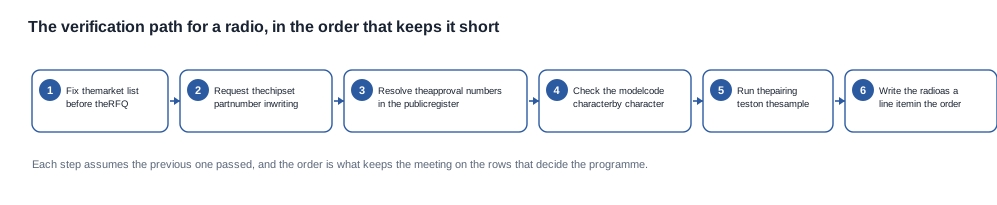
The order below is the one we use when a customer asks us to shortlist. Each step assumes the previous one passed, and the whole sequence is designed so that the expensive questions are asked while they are still cheap.
Step one: fix the market list before the request for quotation goes out. This is the cheapest of the seven questions to answer and the most expensive to answer late, because the market list determines how many approval routes you need, whether a local representative is required, how many label sets you print, and how many document sets you assemble. A programme specified for two markets with one approval in hand is a launch date problem, not a product problem.
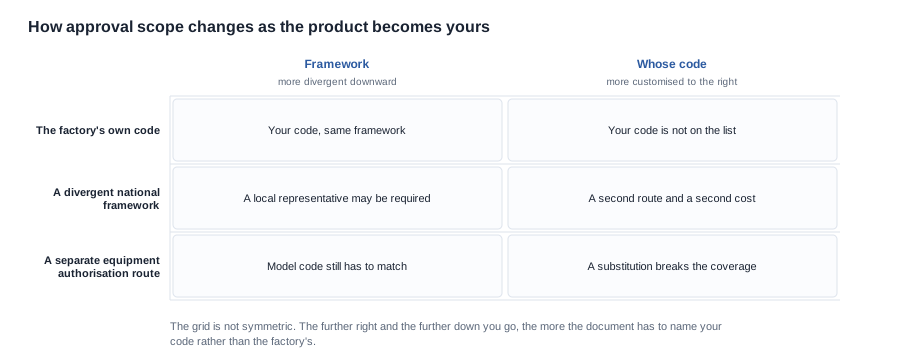
Step two: establish the radio approval position per market, in writing. For the European Union this is the Radio Equipment Directive framework; in the United Kingdom the UKCA framework applies with a diverging route; in the United States the FCC equipment authorisation route covers the radio; and several South East Asian markets require a local representative, which is a cost line and a lead time line. A product compliant in one of these is not automatically compliant in the others, and the practical consequence is that the market list is a negotiation as much as a decision.
Step three: request the chipset part number, in writing, in the body of the quotation. Not as an attachment, and not as a description. One line, one value, and the answer tells you what kind of technical relationship you are buying into.
Step four: resolve the approval numbers in the issuing body's public register. Confirm three things on each entry: that the model designation on the document matches the model you are ordering, that the document covers the radio band and the functions you are shipping, and that the validity date has not passed. Compare the model string character by character. Where a family holds several models with similar designations, this is the check that catches a substitution.
Step five: check the Bluetooth SIG qualification position for the chipset. A qualified chipset has a public listing. A chipset that is not listed, or that is listed under a different module than the one in the product, is a finding worth raising before the deposit rather than after.
Step six: run a pairing test on the sample with the number of devices your customer actually pairs. If your customer holds two phones, a product that pairs one at a time is a different product, and this is a decision made by a customer in about four seconds, in a shop, having already decided to buy.
Step seven: write the radio as a line item in the purchase order. The Bluetooth generation and the chipset part number, with the approval numbers and the model list attached to the order, and a clause requiring notice before any change of chipset, module or radio board.
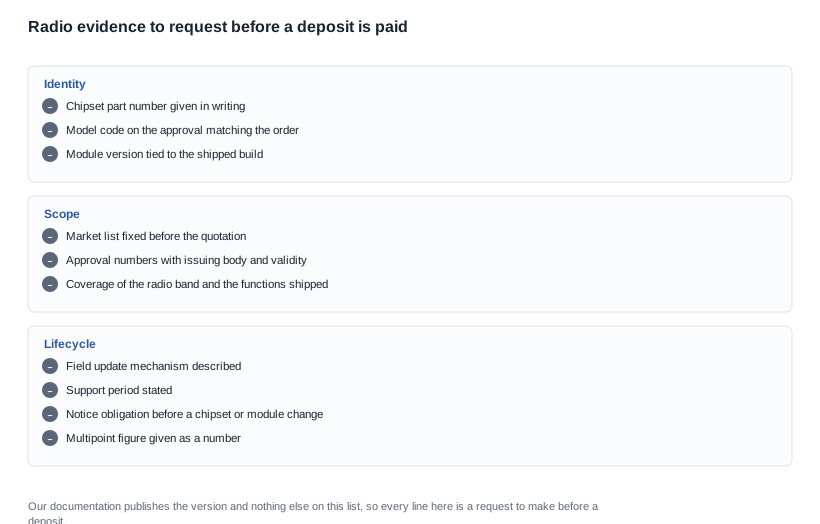
The documents to request before a deposit are: the approval numbers with the issuing body and the validity dates; the list of model designations each approval covers; the chipset part number, in writing; the field update mechanism; the multipoint figure, given as a number; the supported profile and codec lists; and the radio band coverage. The clauses to write into the contract are: the generation and the part number as line items; the approval numbers and the model list attached to the order; the sample acceptance criteria including the pairing count; a delivery schedule tied to the documentation milestone rather than to a date the factory controls; and the change-control notice obligation.

Where a radio programme breaks, and what it costs to fix afterwards
Five failure patterns, each written as symptom, root cause and prevention. The common thread is that all five are decided by a question that was never asked, and all five are cheap to prevent at the quotation stage.
A product is quoted with a Bluetooth version but the approval is held on a sibling model. The symptom is a customs query, a marketplace rejection, or a warranty claim that cannot be settled. The root cause is that the version was read as a proxy for certification, when certification is per model code. The prevention is to treat the model list on the document as the controlling document and the version as a description of what is inside.
A private-label programme assumes the factory's approval covers the rebranded unit. The symptom is the same set of failures, arriving later and more expensively. The root cause is that equivalence was assumed from similarity. The prevention is to make the exact model designation on the certificate a condition of the purchase order, and to verify it against the register before the deposit rather than after the artwork is approved.
The radio works, but the product cannot be patched after launch. The symptom is a defect rate that cannot be corrected, and a support cost that rises for every unit already in the field. The root cause is that the update path was never asked about, because the decision was made on the version number. The prevention is the written question about the mechanism, plus the follow-up about the customer who never pairs the application.
A product is specified for two markets and only one approval exists. The symptom is a launch in one market and a hold in the other, and a product page that has to be edited in two directions. The root cause is that the market list was settled after the supplier was chosen. The prevention is to fix the market list before the request for quotation goes out.
A V5.4 product is chosen for the encryption benefit and the support commitment is ignored. The symptom is a product that meets its radio requirements and still fails an operational requirement three years later. The root cause is that a protocol generation was read as a support commitment. The prevention is to ask for the support period and the update mechanism in writing, and to treat the encryption direction as a secondary benefit.
On commercial terms, the structure is ordinary but the priorities are not. Negotiable: the minimum order quantity, and more so on a repeat order once the approval cost has been absorbed; the delivery split against a certification milestone, which is often worth more to a supplier than a price concession because it moves the risk of the approval onto the schedule where it belongs; the packaging and insert design including the printed regulatory and market labels, which is a low-cost negotiation with no tooling implication for an electronic product; and the payment schedule, with a deposit on the purchase order, a balance on the pass before the shipment is released, and a retention against the paperwork. Not negotiable: certification cost and certification time. The cost is per product family and largely fixed, and the elapsed time is set by the test laboratory and the review queue rather than by your order size. Asking a supplier to absorb the radio approval cost as a discount usually produces a longer schedule, not a shorter one, and it is worth knowing that before the negotiation rather than after it.
What we publish about Bluetooth, and what we will not estimate
We publish the version where the catalogue states it and mark it as not published where it does not, and we will not present a protocol generation as a proxy for what a buyer actually needs from a radio. A newer version is not a better product on our own evidence, and a buyer who shortlists on it is optimising for a column rather than for a requirement.
Concretely: Bluetooth V5.3 is published for the K01 and the K02, Bluetooth V5.4 for the D11; the D12; the LC-105-1; the LC-105-2; the G07; the YK12; the YKC02; the D17; the ZH12 and the A07; and for the electrochromic and the AR entries No version is published for the camera glasses family, for the bone conduction entry, or for the A05 and the A06. We publish no chipset, no profile list, no codec list, no multipoint figure, no range, no update method and no qualification position for any model, and we will not estimate them.
That last point is the one a buyer planning a camera programme should hold on to. The largest group of models in our catalogue publishes no radio version at all, which means a decision made on the version cannot be made from our documentation for that range. It is a documentation gap rather than a statement about the radio inside those products, and it is the reason we ask suppliers for the chipset part number instead.
Three things to do this week.
- Fix the market list in writing and send it with the request for quotation. It is the cheapest question in the sequence and the one that costs the most when it is answered late.
- Add four rows to the request list: the chipset part number, the update mechanism, the multipoint figure, and the model list each approval covers. A supplier who answers all four has a documentation habit.
- Send us the model, the markets and the customer profile. We will work the sequence with you and tell you at each step what our documentation answers and what has to come from a supplier, a register or a test.
The connectivity rows are in detail under Bluetooth connectivity, the market differences that follow are in selecting by market, and the regulatory stack around the radio is in Bluetooth SIG and radio compliance.
Related reading
- The connectivity rows in detail — Bluetooth connectivity
- The market differences that follow — selecting by market
- The regulatory stack around the radio — Bluetooth SIG and radio compliance
Send the model, the markets and the customer profile, and we will work the sequence with you.


