

IP rating: a channel gate, not a quality score
Comparing two ingress ratings is easy, and comparing two ingress claims is where it goes wrong, because the two are not the same kind of statement. One is a measured result with a protocol behind it; the other is a phrase. A fair comparison has to be built on the codes and the evidence, and it has to discount the surrounding language entirely.
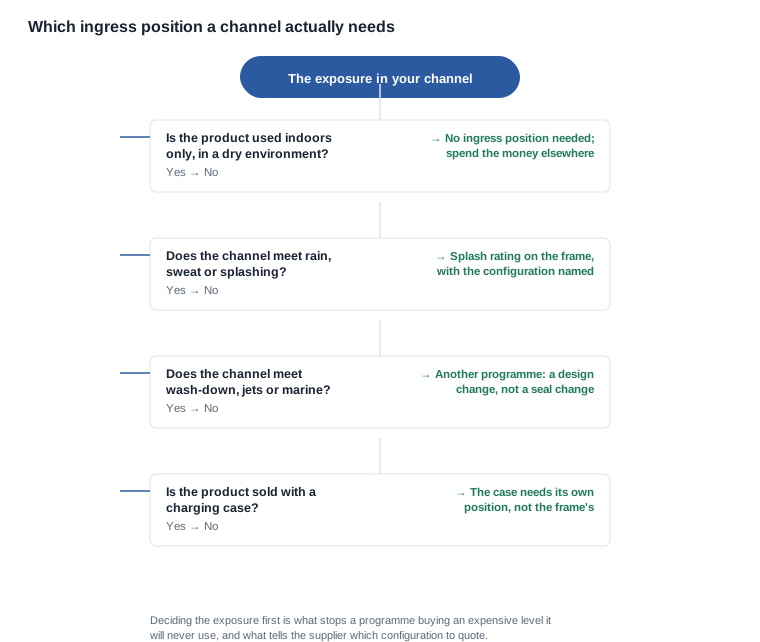
But there is a step before the codes, and a buyer who skips it buys an expensive level it will never use. The step is the exposure. An ingress code is a statement about one enclosure against one hazard, and the only question that matters commercially is whether that hazard exists in the channel the product is being sold into. A product that is sold into a splash-and-sweat environment and a product that is sold into a wash-down environment need different answers, and a buyer who decides the requirement after reading the code has already decided it wrongly.
So the order is: exposure, then code, then configuration, then report, then claim. This page sets out seven checks in the order they should be applied, explains why the order matters, and gives the request format that keeps the comparison fair. It is written for the buyer comparing two candidates for a channel where the claim will be tested by a customer in the first week.

The buyer comparing two ingress positions, and the exposure behind them
The three roles comparing ingress positions
A brand owner is choosing between two products for an outdoor or sport channel, and the ingress position is the row that decides whether the channel is open to them at all. Their exposure is usually sweat and rain, which is a splash case, and the mistake they make is paying for a level designed for something they will never encounter.
A procurement manager is signing off two quotations and needs to know whether the ingress positions are comparable at all. Their question is not which is better; it is whether the comparison has a valid basis, and the answer is usually no until the configurations are checked.
A channel buyer is writing the packaging and needs to know how far the wording can go for each product. This role inherits the whole problem, because a claim that is one step wider than the evidence becomes their returns data.
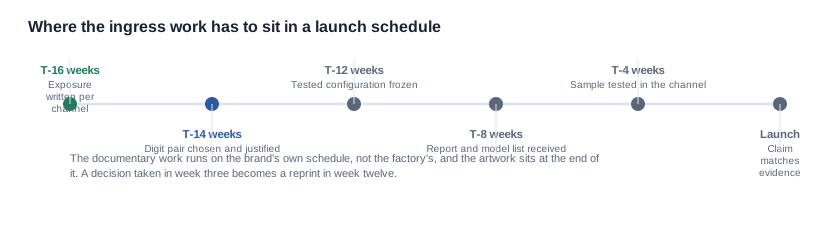
What all three are defending against is the same: a listing that makes a claim the evidence does not support, discovered by a customer in the rain, or by a marketplace reviewer, or by a customs inspection. That is an expensive discovery, and it is expensive because the documentary work runs on the brand's own schedule rather than the factory's.
Why the same code can be a strength and a liability
The code is defined by IEC 60529 as degrees of protection provided by enclosures, and it has two independent parts. The first digit rates protection against solid foreign objects on a scale from 0 to 6. The second rates protection against water on a scale from 0 to 9. A letter X in either position means that part was not evaluated at all, which is an absence rather than a poor score.
Because the two digits are independent, they trade off. A product with a 6 and a 4 is better against solids and worse against water than one with a 5 and a 7. Neither is better overall, and a comparison written as a single ranking is wrong. Most comparisons in this category still make exactly that error, and the error is invisible because the codes are printed in the same format on both products.
The second reason a code can be a liability is the marketing gap between the code and the phrase. A 4 in the water position covers splashing water from any direction. It does not cover immersion, a shower, a hose, or a sustained downpour. A catalogue that says IP54 and a product page that says waterproof are making two different claims, and the second one is not supported by the first. In a channel where the customer will test the product outdoors, that difference is a return.
The third reason is the configuration, and it is the one that most often invalidates a comparison without anybody noticing. A rating attaches to a configuration, not to a product name. A unit with a different case, a different cell, a different port arrangement or a different interface is a different assembly, and the rating on the report does not cover it.
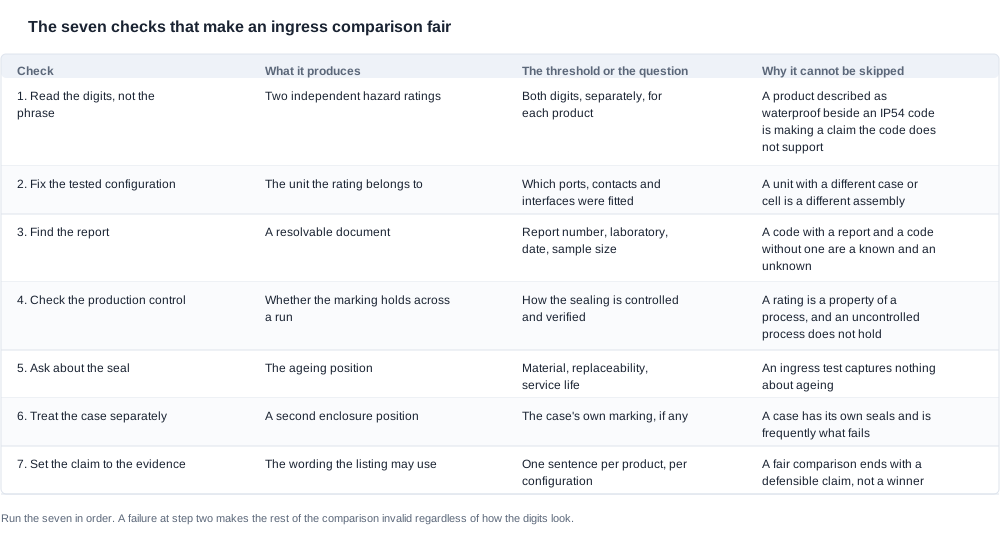
Seven checks that make an ingress comparison fair
Steps one to three: the digits, the configuration and the report
Check one, read the digits and discard the phrase. Take both digits separately for each product and write them down. The pass line is a pair of digits per product, with the marketing phrase excluded from the table entirely rather than listed in a separate column that somebody will read later.
Check two, confirm the tested configuration. Ask which ports, contacts and interfaces were fitted on the tested sample, and compare that list against the unit that would ship. Where a charging contact or a port is exposed on the shipped unit and was capped on the tested sample, the marking does not cover the product in the packaging. This is the check that most often invalidates a comparison, and it is the one that gets skipped because it requires a question rather than a document.
Check three, find the report. A code with a report behind it and a code without one are not comparable in a meaningful way, and the difference is not the difference between a good and a bad product. It is the difference between a known and an unknown. The pass line is the report number, the issuing body, the standard and edition, the date, and the sample size.
A report naming an accredited laboratory and a recent date tells you the result is real and current. A code with no report behind it tells you the manufacturer is making a claim. The claim may well be true, and it is still unverified, and a fair comparison has to treat it as unverified rather than as equal.
Steps four to seven: production control, the seal, the case and the claim
Check four, check the production control. Ask whether the marking is a property of the product or of a sample, and how the sealing is controlled and verified across a production run. A rating is a property of a process, and a process that is not controlled does not hold across volumes. This is the check that separates a programme that will be fine at first article from one that will be fine at first article and drifting by the third thousand units.
Check five, ask about the seal and its service life. The rating is only as good as the seal it was measured with, and every seal ages. The pass line is the seal material, whether it is replaceable, and its expected service life. An ingress test does not capture ageing at all, so a rating describes the product as it left the factory rather than the product in year three.
Check six, treat the charging case separately. A case is a second enclosure with its own seals, and it is frequently the one that fails. Ask for the case's own marking. No charging case in our range carries a published ingress marking, and a brand that ships a case alongside a rated frame has to decide what it claims about the case, separately, in writing.
Check seven, set the claim to the evidence. The pass line is one sentence per product, per configuration, written before the artwork exists. A fair comparison ends with a defensible claim for each product rather than with a winner, because in most real comparisons the exposure and the channel do not permit a winner to exist.
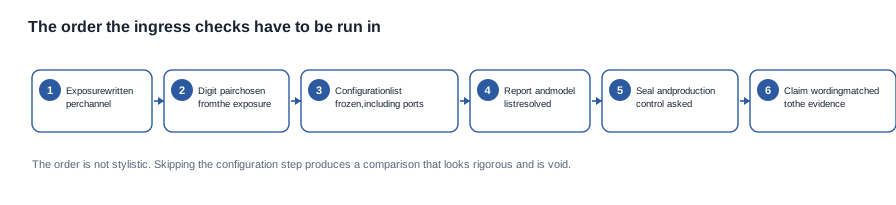
Set the thresholds before the first article, not after. A tolerance or a configuration agreed afterwards is one that has already been missed, and tightening an enclosure after tooling is orders of magnitude more expensive than specifying it before.

How to gather the evidence, and what to do when it is missing
The request format to send to both suppliers
Send the same request to both candidates, in the same message, with the same wording. A comparison built on a different request format for each product is not a comparison, and the difference in what each supplier returns is itself a finding about documentation discipline.
The request has four items per candidate: the report number with the issuing body, the standard and the edition, and the date; the model list the report names; the tested configuration, with the ports, contacts and interfaces fitted; and the seal material with its replaceability and expected service life. Add two more items if the product ships with a case: the case marking, and the production control position.
Then resolve the numbers. The resolution itself is four steps:
- The model designation on the document matches the model you are ordering, character by character.
- The document covers the radio band and the functions you are shipping.
- The validity date has not passed.
- The model list on the document includes the configuration you intend to ship. Where a range holds several models with similar names, this is the check that catches a substitution, and a mismatch is a stop condition rather than a query.
Running your own test on a sample
If the decision is real, the documentary route is not enough on its own. Run a test on a sample, on a fixed protocol, and record it as your own measurement. The protocol should be narrow: the specific failure mode the channel actually has — sweat and dust for a sport product, saltwater and sand for a beach product, repeated handling for a family product — with the duration, the environment and the pass condition written down before the first reading. A generic spray test is not any of these, and a test with no written pass condition produces a number rather than a result.
Two details decide whether the test is worth anything. Start from a genuinely used unit rather than a fresh one, because the failure mode that matters in year three is the ageing one, and a fresh unit will pass. And repeat the exposure rather than performing it once, because a seal that fails on the third cycle has told you something a single pass never will.

The breakdowns that void an ingress comparison
Five breakdowns and the claims they leave behind
The phrase was compared instead of the digits. Symptom: a product is shortlisted on a waterproof claim the code does not support. Root cause: the marketing language was read as the specification. Prevention: discard the phrase at the first check, not at the end.
Two different configurations were compared. Symptom: the shipped product does not match the rated one, and the discovery is made by a customer rather than by the inspection. Root cause: the case, the cell or the port arrangement differed. Prevention: check the configuration identifiers on the report against the unit in the box.
A marking with no report was treated as equal to one with. Symptom: a product with a catalogue marking and a product with a tested rating are presented as equivalent to a channel partner who then asks which one to promote. Root cause: the difference between a known and an unknown was collapsed into a single column. Prevention: keep the unknown labelled as unknown, and plan the copy for it.
The case was assumed to inherit the frame rating. Symptom: water in the case, and a claim against the brand, on a product whose frame was correctly rated. Root cause: a separate enclosure was assumed to inherit a rating. Prevention: check six, every time, and publish the case position next to the frame position.
The production control was never checked. Symptom: the first production batch does not hold the rating, and the return rate is attributed to the channel rather than to the process. Root cause: the sample was rated and the process was not. Prevention: check four, before the first order, in writing.
A sixth failure belongs to the schedule rather than the evidence. The claim is written after the artwork is printed. The documentary work runs on the brand's own timeline, not the factory's, and the artwork sits at the end of it. A marketing decision taken in week three becomes a reprint in week twelve, and the reprint is the expensive part.
The cost of an ingress position, and the file that supports it
Which terms can move, which cannot, and the ingress documentation
The commercial lines worth negotiating time on in an ingress programme are the familiar ones — unit price and volume tiers, the accessory and charging set with its own minimum order quantities, packaging specification including the market labels, delivery splitting against a sample-approval milestone, payment nodes against inspection with a retention held against the documentation package, the warranty period with a stated response, the return terms for an outdoor or sport channel where the marking is the promise, and the terms of a pilot order.
Two commercial items are negotiated more often than they should be, because they are usually treated as fixed. The number of configurations the brand commits to, and the per-market label scope, both of which scale the documentary work rather than the unit cost. A channel served only from markets where approvals already exist is worth a materially better price than one that requires new testing, and that is a decision to make before the quotation rather than after it.
Two costs in an ingress programme can be quoted but not negotiated, and the distinction matters when a supplier bundles them into one line. Certification cost and lead time are decided by the schedule and by the body that runs the test; for an ingress claim the test cost is usually a one-off per configuration rather than per order, so it is worth asking which one you are being quoted. Tooling is often amortised across the first order. Ask which one you are being quoted, because the two are frequently bundled into a single line that hides which is which. Below both sits the enclosure design itself, which is not a commercial variable at all: a supplier who will not change the seal material, the seal geometry or the port design is telling you the ingress performance is fixed, and the programme should be built around that fact.
The agreement is where an ingress marking becomes enforceable, so write into it the marking with its standard, its report number and its tested configuration, the seal material and its service life, the production control position, the case position, the certification position per market, the warranty period with a stated response, the acceptance criteria from the buyer-run protocol, and the return terms.
The agreement should equally bound what may be claimed: no waterproof, immersion or rain-capable claim beyond what the digit and the report support, and no ingress claim for an accessory with no marking of its own.
A worked example: an outdoor brand comparing two sport lines
The sequence below is a teaching example. It exists to show how the checks stack up, and it does not describe a shipment that was made.
Assume a mid-size European outdoor brand with two candidate sport products, two colourways each, three destination markets, and a marketplace listing that was suspended six months ago for a claim it could not evidence. The brand does not want to repeat that.
Step one, the exposure. The brand's customers run in rain and sweat heavily on the temples. That is a splash-and-sweat exposure. Its channel does not include swimming, wash-down or marine use, so the higher water levels are not in scope. Writing that down at the start is what stops the programme buying an expensive level it will not use, and it is also the sentence that will be reused in the copy.
Step two, the configurations. Before asking for reports, the brand asks both suppliers for the tested configuration and compares it against the shipping unit. On the first candidate the charging contacts are exposed on the shipped unit and were capped on the tested sample. The marking therefore does not cover the unit as it would ship, and the decision becomes one of three: a capped build, a re-test, or a narrower claim.
Step three, the reports. The brand resolves the report numbers in the issuing body's register and checks the model designation character by character. One candidate's report names a model designation that differs from the quoted model by a single character, which is the kind of mismatch that a family-level document conceals. That candidate's position is downgraded to an unverified marking and its copy is written accordingly.
Step four, the claim. Rather than re-testing in the first programme, the brand takes the narrower-claim option on the second candidate. The copy says the product is protected against splashing water from any direction and does not say waterproof, and the exclusions are published on the listing rather than left to the reader's imagination. The listing reviewer accepts it, because the claim is now narrower than the evidence.
Step five, the production control. The brand asks how the sealing is controlled and verified across a run, and writes a check of that control into the incoming inspection. The margin for the first production batch is tightened, because the first article is a sample and the process is the product.
Step six, the commercial structure. The brand negotiates the per-configuration minimum against a committed combination count rather than a unit count, because two colours on one frame are two configurations, not one. It moves artwork approval earlier than usual, because a capped build is a visible difference the packaging has to reflect. It splits the first run against the first-article sign-off.
The result is a programme with one named precondition and a claim the brand can defend, rather than a programme with four unowned risks and a listing suspension waiting to happen. Every decisive decision was made before the sample order, and none of them was about the digits.
Where our own ingress markings stand
Stated plainly: comparing two ingress claims is not a comparison, and a fair one has to be built on the codes, the reports and the configurations, and has to say at the end what each product's evidence actually supports.
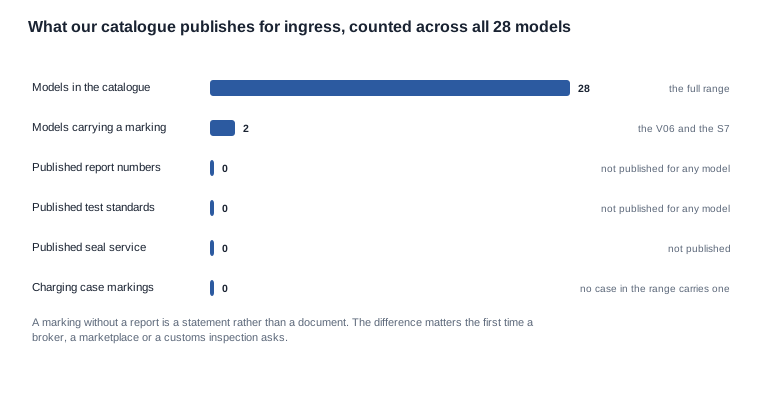
In our catalogue, an IP54 marking appears on two models: the V06 and the S7. It appears as an annotation. We publish no third-party test report number, no standard, no test condition, no sample size and no laboratory behind it, because the company has not confirmed them to us. No other model in the range carries a published ingress marking, and no charging case in the range carries one either. The general background is at IP ratings explained, the compliance side is at certification requirements, and the models with their published rows are at sport smart glasses.
A comparison of ingress claims has two limits, and this page states both of them. No marking on a model is not a statement that the model cannot handle the environment; it is the absence of a claim. And a marking without a report number is a statement rather than a document, and the difference matters the first time somebody asks — a broker, a marketplace, a retailer's technical team or a customs inspection. We will not extend one model's marking to another, and we will not describe a splash-protected product as waterproof, rain-capable or immersible.
The request that opens an ingress comparison
Send us the two candidates, the exposure in each channel, the destination markets and the configurations, and we will say which ingress positions are published, which of the seven checks can be answered from our documentation today, and which have to come from a report or a test on your own units. We will also tell you where our own position is weak, because a buyer who checks a claim should be able to check ours first.


