

The YKC02 is a sport model. Two 70 mAh cells, Bluetooth 5.4, magnetic charging, a charge time of two hours or less, about eight hours of rated use, and two descriptors on the catalogue page: Surround Sound and Long Battery Life. That is the whole published row, and it is a shorter row than most buyers expect for a platform that looks, on a shelf, like a straightforward Bluetooth audio product.
Customising ykc02 smart glasses therefore starts from an unusually narrow base. There is no colour line to choose from, no published weight, no ingress marking, no per-model certification entry and no camera row to work around. Every one of those is a decision you either inherit from the factory or have to create from nothing, and the difference decides whether the customisation costs a week or a quarter.
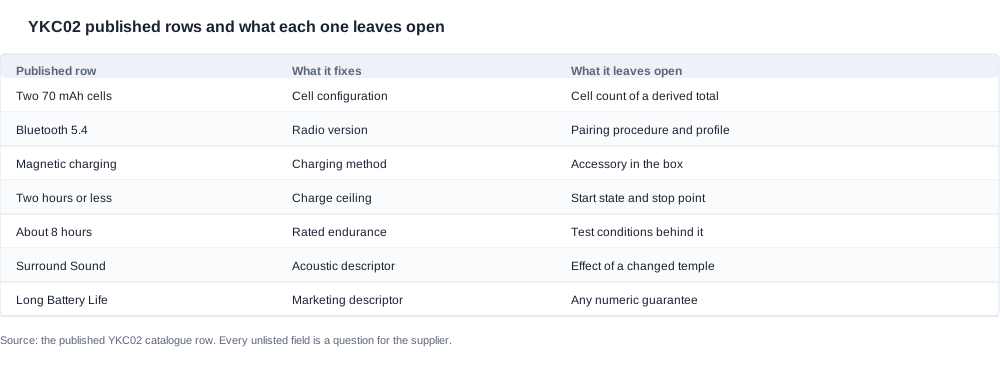
YKC02 customisation starts with the sport group, not the audio group
The first mistake a buyer can make with this model is a classification mistake, and it is easy to make because the YKC02 behaves like an audio product in the hand. It is not in the audio group.
The catalogue splits into three published groups, and they are not interchangeable. The audio group holds eight models: the K01 and the D12, and the D11 and the K02, the LC-105 pair and the G07, plus the YK12. The sport group holds three: the YKC02, the D17 and the ZH12. The camera group holds eleven. Anyone assembling a Bluetooth audio product line for a channel will find the YKC02 attractive on endurance and on the two-cell configuration, and if it is dropped into an audio line without a decision, it arrives at the customer with the wrong category expectations and the wrong supporting documentation.
What the sport classification changes in practice is the comparison set. The D17 and the ZH12 publish roughly one hour of charging on a Type-C interface; the YKC02 publishes a ceiling of two hours or less on magnetic charging. The D17 and the ZH12 also publish a remote shutter row; the YKC02 does not. Two of the three sport models publish a camera-adjacent remote, and one does not, and that asymmetry is a good example of why the group label matters: within a single group the published rows can diverge more than they do across groups.
It also changes the endurance framing. The YKC02's page carries Long Battery Life as a descriptor alongside the numeric rating of about eight hours, and the number behind the descriptor is a rated figure under unspecified conditions rather than a measured worst case. A buyer who writes "long battery life" onto a product page without the rating behind it is making a promise the catalogue does not support, and one who writes "up to eight hours" is making a different promise that the rated figure also does not support. The defensible form is the rated figure itself, stated as rated, with the test conditions asked for in writing.
Two cells of 70 mAh is a genuine distinguishing point and it is worth stating precisely, because a single number is the source of most of the confusion in this range. A buyer who sees "70 mAh" in a specification and stops there will assume the same configuration as the A07, whose page publishes a single 70 mAh cell. The YKC02 publishes two, which totals 140 mAh — a derived figure, not a published one, and one that should be labelled as derived whenever it is used in a comparison, because a table that prints a bare total reads as if the factory published it.
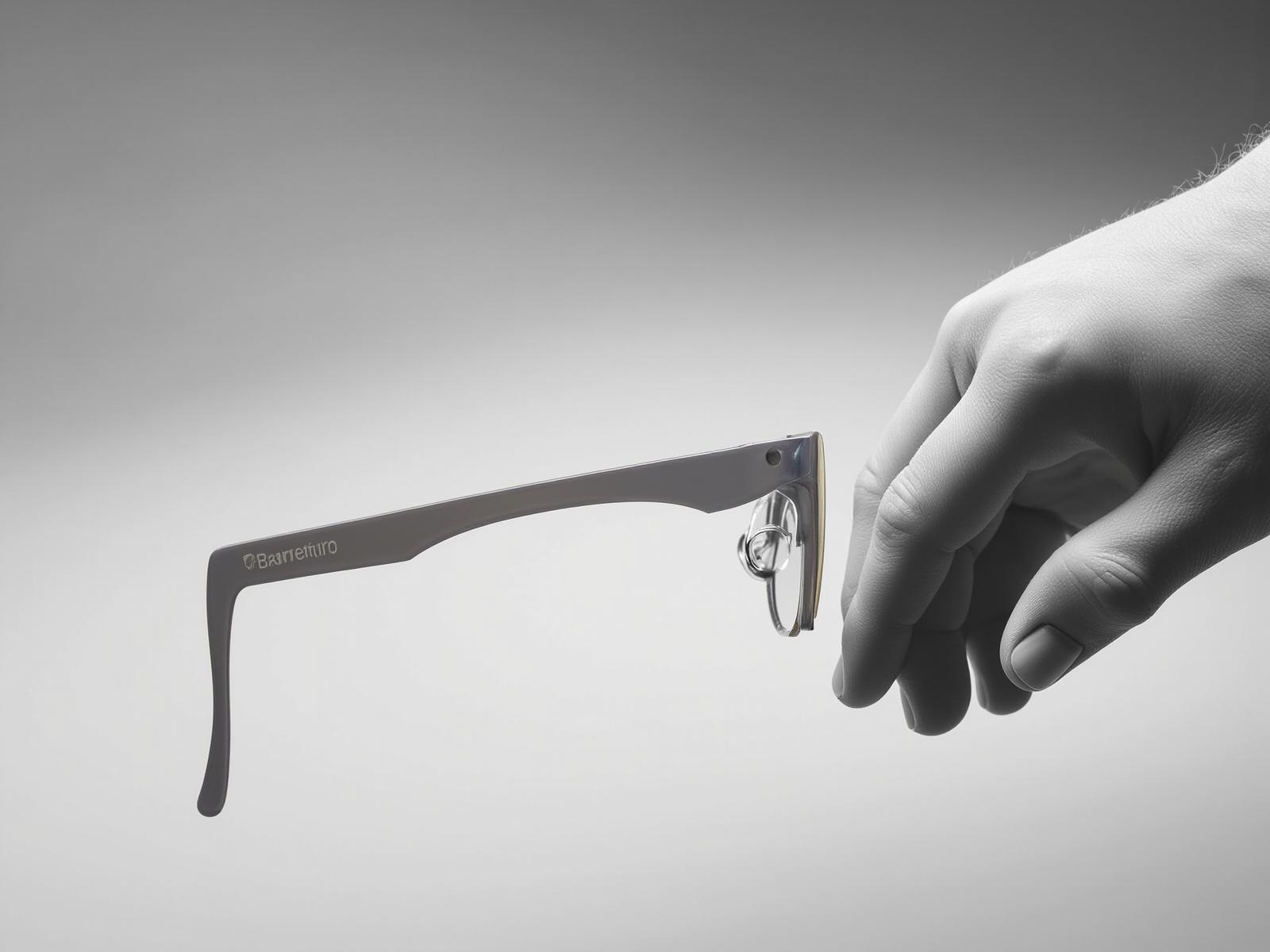
The YKC02 published row and the customisation levers it leaves open
A published row fixes a configuration. It does not forbid the next configuration, but it stops describing it, and that is the boundary a customisation exercise has to be built around. Four levers carry most of the interest on a sport model with a row this thin.
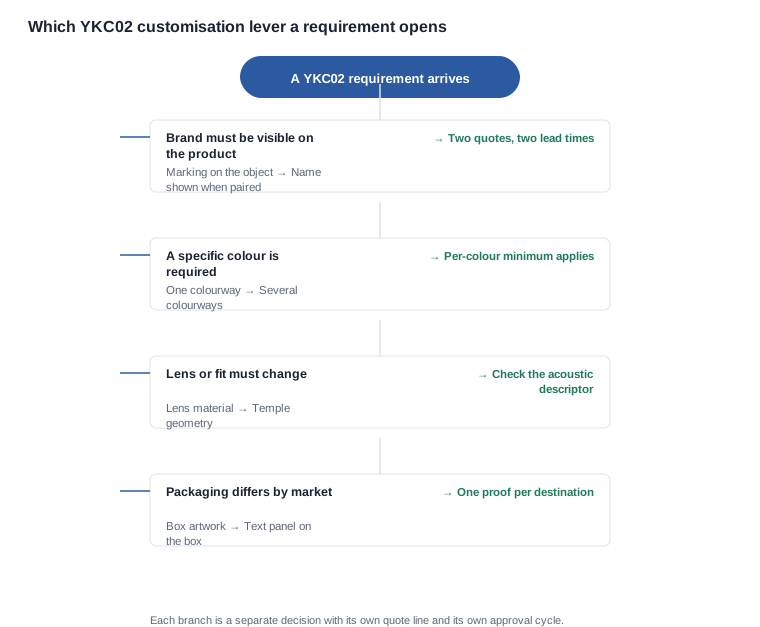
Marking. Your brand on the product is the most common customisation and the one most often confused with the least. A logo method is a change to the object, and it is the lever most likely to open tooling. A change to the printed name in a device listing, or the software name reported over Bluetooth, is a change to the interface. Both are on the table for the YKC02, but they have different consequences: one is visible and physical, the other is invisible and lands in a pairing screen that a customer sees during the first five minutes of ownership. Treat them as two decisions with two different quotes.
Colour and finish. The catalogue lists colour rows for some models in this range and not for others. For the YKC12 it does not, which means the colour you ship is a colour you have to specify and have confirmed, not a colour you have selected. The question to ask is not "what colours are available" but "how many colourways are being run for this order, and is a colour-specific minimum order quantity applied to each of them". A supplier who answers with a single colour for a single run is telling you that the other colours exist but are not yours; a supplier who answers with a count and a per-colour minimum is telling you something you can plan around.
Lens and fit configuration. The row publishes no lens material, no lens tint and no frame dimension. For a sport model this is not a detail, because lens choice and fit determine whether the product is used as intended, and because a change in lens specification interacts with the two descriptors the page does publish. The Surround Sound descriptor describes an acoustic characteristic; if the lens or temple configuration changes, the acoustic path may change with it. The question is whether the descriptor still holds for the build you receive, and the answer belongs to the factory because only the factory knows what the configuration change touches.
Packaging and documentation. Retail packaging, the printed box, the leaflet inside, the language set, the regulatory text panel and the model name on the box are all decisions with a lead time attached and no tooling implication in the usual sense. They are also the levers most likely to be underestimated, because they carry artwork approval cycles rather than factory engineering cycles, and the cycle belongs to your team, not to the supplier's.
The charging interface sits underneath all four and rarely gets treated as a lever. The YKC02 charges magnetically, and magnetic charging is part of the published row that a customer or a channel partner may rely on when they describe the product. Any change to the charging method — and several suppliers will offer it — is not a cosmetic option. It changes the row, it changes the accessory in the box, it changes what the instruction leaflet says, and it changes the documentation set. If a magnetic-to-Type-C change is on the table, treat it as a new base build with a new documentation obligation rather than as a preference.

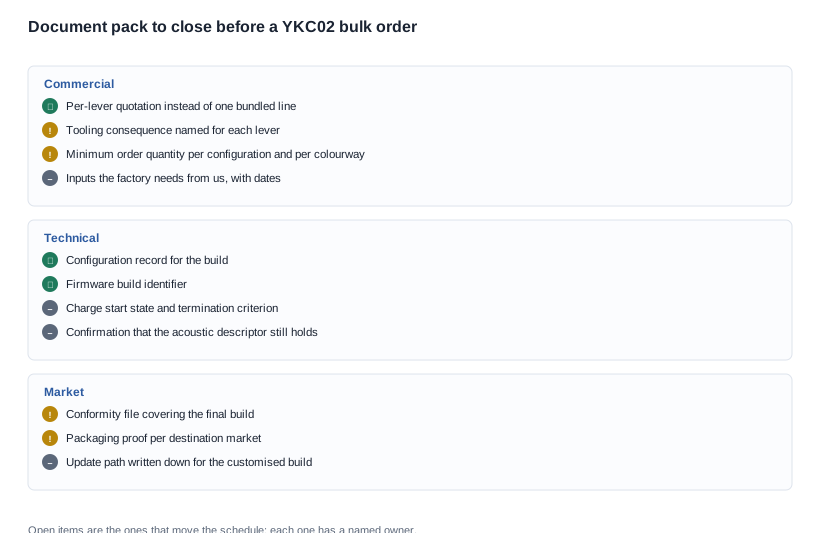
YKC02 evidence to collect before the sample is approved
The purpose of a sample is to settle the questions that a specification cannot. On a row as thin as this one, that means the sample has to be instrumented by a written checklist, because the alternative is a sample that arrives, looks right, and settles nothing.

The order matters, because each commitment narrows the next one. Start with the build, not the artwork: confirm the base configuration, the charging method, the acoustic configuration and the cell count in writing before any visual design work begins, because artwork is expensive to redo and cheap to defer. Then confirm the interface elements, then the physical markings, then the packaging, and only then the market-specific documentation.
What you should be holding at the end of that sequence is a set of records rather than a product. A configuration record that names the base build and every deviation from it. A firmware build identifier for anything that runs on the product, so that the second order can reproduce the first. An artwork approval set with a signed date on each item. A packaging proof per destination market, because the regulatory text panel differs and the box artwork does not always follow it. A conformity file that covers the configuration as it will actually ship, and not the stock model the catalogue describes. And a written statement of what happens to the build when the platform software moves.
None of these are exotic, and none of them are optional if the customisation is real. What makes them procurement items rather than administrative ones is that each of them has a lead time, and each of them sits upstream of something you cannot easily change later.
A good way to structure the request is as a numbered list attached to the sample order, with a column for the answer and a column for the document. That structure is worth more than it sounds, because it converts a conversation about features into a document set that can be attached to the purchase agreement and referenced at goods-in. It also makes the missing answers visible. On this platform, a supplier can answer most of a well-formed list in a single reply, and the two or three they cannot answer are exactly the ones that decide the project.
The questions that belong in the purchase agreement
- Which customisation levers does this quotation cover, priced separately rather than as a single bundled line?
- Does the build keep the Surround Sound descriptor, and does the change to the lens or temple configuration affect it?
- Does the build keep the Long Battery Life descriptor, and what rated endurance applies to it?
- What is the configuration record for this build, and what identifier does the factory use on the production order?
- Which colourways are included, and is a per-colour minimum order quantity applied?
- From what cell state does the charge start, and at what point is it treated as finished?
- Is the charging interface magnetic in this build, and is the magnetic charging accessory included in the box?
- Which conformity document covers this build for my destination market, and who signs it?
- When a unit arrives faulty, who pays for it and who replaces it?
- How is a repeat order configured to reproduce this build, and what record is used to do it?
- What is the warranty position on this build, and does it differ from the standard build?
- Which platform software updates reach a customised build, and what is the notice period before one is withheld?
Questions 2, 3 and 6 are the ones that quietly go unanswered. They are not commercial terms; they are the published row, restated for the build you are buying, and a supplier who treats them as trivial is telling you how the rest of the list will be handled.

YKC02 commercial checks that decide whether a bulk order is signed
The commercial conversation on a customisation like this has four moving parts, and each of them has a question that determines whether the numbers in the quotation mean anything.
Tooling. The question is not whether tooling is charged for. On any branded product it almost always is. The question is which levers open tooling, because a marking method does and a firmware name usually does not, and a bundle that treats them the same hides the expensive one inside a number you cannot decompose. Ask for the tooling consequence to be stated per lever, with the artwork lead time attached to the lever that actually needs it. If the supplier cannot separate them, the quotation is not a quotation you can re-run; it is a number you will have to re-negotiate from scratch on the second order.
Minimum order quantities. There is a published structural fact here that a buyer can use: the factory runs colourways and configurations as separate production lines, so a split order is a split line, and a split line has its own minimum. Ask what the minimum is per configuration, whether it is per colourway or per order, and whether the minimum changes between the first order and a repeat. The last part is the one that matters commercially — a supplier who holds a lower minimum for repeat business has a reason to hold it, and that reason is worth knowing before the first order is placed rather than after.
Lead time and its dependencies. The number on a quotation is the least informative part of it. The dependencies are what make it real: artwork files, a signed specification, a firmware branch, a packaging proof, a market compliance decision. Ask the factory to name what it needs from you and when, and check the dates against your own plan. A lead time that assumes four supplier-side inputs arrive on the same day is not a lead time, and if your team has to produce artwork revisions, a proof sign-off and a market decision in parallel, the order will sit behind the slowest of them.
Ownership and reproducibility. Ask who owns the tooling and the artwork files after the first payment, and whether the files are handed over in an editable format. Then ask how a repeat order is produced. A supplier who answers the second question with "the same as last time" and no record is describing a memory, not a process, and a memory is what fails when the person who held it leaves. A configuration record and a build identifier are what make the second order resemble the first, and they cost almost nothing if they are requested on order one.
There is one more check that belongs in this section rather than the technical one, and it is the question that most often decides the project: does the factory's own documentation match the build. The catalogue page for the YKC02 is a product description, and a product description is a marketing artefact. What the channel receives is a package, a leaflet, a device name and a conformity file, and a mismatch between any of them and the product in the customer's hand is a support ticket, a return, or in some markets a listing correction. Ask for the four documents as they will appear in the box, not as summaries of them.
How to choose between a stock build and a customised one is a decision with a clear set of criteria, and the criteria are not about how much the product can be made to do. A stock YKC02 arrives as the configuration the catalogue already describes and needs no re-documentation at all, which makes it the right route for a single market with a standard device name and no branding requirement. Customisation is worth the extra work when one of three conditions is true: the brand has to be visible at the point of sale, the packaging or the device name has to differ by market, or the channel requires an interface the catalogue build does not provide. Everything beyond those three is cost without a corresponding return.
The trade-off is asymmetric, and that is the most useful thing to carry into a negotiation. Adding a lever after the first order costs more than the same lever added before it, because the build record, the artwork set and the version identifier all have to be put back together from nothing and the lead time already consumed does not come back. A lever dropped early costs almost nothing beyond a conversation. That asymmetry is the strongest argument for writing the complete lever list into the brief on the first order even when only two of them are live, so that the levers you park are parked on purpose rather than by accident.
The red flags in a quotation produced under time pressure are worth listing, because they are the same three every time and all of them are visible before you sign. A single bundled customisation line covering every lever hides the expensive one and removes your ability to drop a lever later. A conformity statement that names the catalogue model rather than the final build describes a product you are not buying. A firmware commitment with no build identifier attached means the second order cannot be reproduced from any record. And a lead time presented as one number, with no list of the inputs the factory needs from your side, assumes your team is not part of the schedule.
Because of that last point, the total cost of a customised YKC02 is not the unit price plus tooling. It is the unit price plus tooling plus the artwork cycles plus the documentation effort plus the cost of a second order that does not reproduce the first. A due diligence pass that stops at the unit price will get this wrong, and the questions to ask before you commit are aimed at exactly the parts of the cost that the unit price does not contain.
What the YKC02 catalogue cannot tell you
The boundary of what we will state is worth drawing in plain terms, because a thin catalogue page invites a reader to assume that the silence means the feature is absent, or that the supplier is withholding something bad.
What the YKC02 publishes: two 70 mAh cells, Bluetooth 5.4, magnetic charging, a charge time of two hours or less, about eight hours of rated use, and the Surround Sound and Long Battery Life descriptors. That is the complete published specification, and it is the baseline any quotation should be compared against.
What we do not publish for this model: a frame weight, a lens material, a colour line, the ingress position, what the microphone does, the control row, the case capacity, the cell state at the start of a charge and the point at which a charge counts as done. Export certification appears once in the catalogue, at company level rather than per model, and the page carrying it is graphical rather than textual. A patent is not a conformity document, and no per-model certification entry exists for this model or for any other in the range. Nothing in the catalogue text refers to the market-access marks a buyer will ask about by name, so the answer to a certification question has to be a document request, and the document request has to name the destination market and the final build.
We also will not fill those gaps with plausible numbers. A weight that has not been published has not been published, and an invented one is worse than a blank because it will be quoted back to you as though it came from us. Where the catalogue is silent we would rather hand you the question than the guess.
For the model-level entry, the sport smart glasses category page groups the three sport models together, which is the right place to see how the YKC02 compares with the D17 and the ZH12 on charging interface and on which descriptors each of them publishes. If you want the customisation route laid out end to end, including the specification-confirmation step that happens before anything enters production, the OEM and ODM customisation process page describes it.
Send the destination market, the target order quantity and the specific changes you are considering, and we will tell you which of them open tooling, which ones create a build you will have to version, and in what order they have to be committed.


