

Most buyers who look up zh12 smart glasses how to customize are actually asking four separate questions: what can be changed, what cannot, in what order to ask for it, and what each change costs in schedule. The ZH12 as published is a Bluetooth V5.4 platform with a 100 mAh battery, roughly one hour of charging time, about 8 hours of rated use, Type-C charging, remote shutter control and stereo surround sound. Everything above that line is negotiable. Everything below it is fixed, and no amount of customisation will move it.
That published row is shorter than it looks, and the reason is that this page carries two descriptors and a very small set of numbers. There is no colour line, no weight, no lens material, no ingress marking, no charging case and no per-model certification entry. Each of those is a decision you either inherit or have to create, and the ones you have to create are the expensive ones.
ZH12 customisation has to start from the one-hour Type-C row
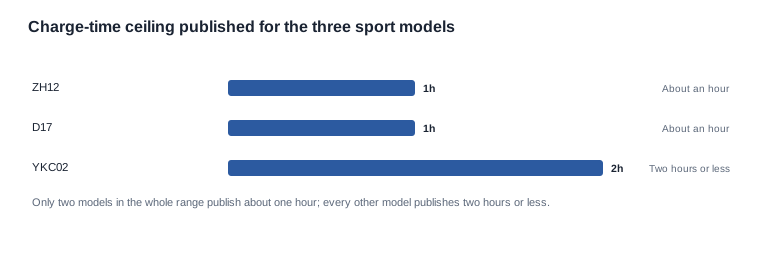
Two models in this range publish a charge time of about an hour, and this is one of them. The other is the D17. Every remaining model in the catalogue publishes a ceiling of two hours or less. The distinction is not cosmetic, and it changes the shape of any customisation discussion about the ZH12 in a specific way: the charging interface is part of the published advantage.
Type-C charging is what the ZH12 row specifies. A buyer customising this model for a channel will eventually be offered a magnetic charging variant, because magnetic is the most common interface in the range — seventeen of the twenty-eight models publish magnetic charging, and the buyer may be working with a channel that has already standardised on a magnetic dock for other products. Making that change is straightforward operationally and expensive in documentation terms. It converts the one published fast-charge row into the standard two-hour row, it changes the cable and the accessory in the box, and it changes every piece of printed and written material that mentions the charging time.
The point to hold on to is that a change of charging method is not a preference within the published configuration. It is a new base build, and the reason a buyer sometimes misses this is that the factory treats a charging-interface change as a small engineering variant while the documentation side of it — the leaflet, the box panel, the specification sheet, the listing copy, the market technical file — has to be reworked to match. The engineering is one line in a quotation. The documentation is a chain.
The second thing the one-hour row does is set the tone for the endurance question. The ZH12 publishes about eight hours of rated use from a single 100 mAh cell, and the catalogue expresses the charge time as a figure of about an hour. A buyer who wants to claim a full working shift from one charge will find that the numbers do not obviously support it, because the rating is a rated figure under conditions the catalogue does not describe, and the relationship between the rating and the charge cycle is not published. The right response is not to publish a shift claim. The right response is to ask for the test conditions behind the eight-hour figure, and to write a duty cycle of your own into the acceptance criteria for the first production batch.
There is a second reason the charge interface matters for a customisation project that has nothing to do with speed: the accessory. A product that ships with a cable ships with a component that has to be in the box, has to be counted on the packing list, and has to be described in the leaflet. A product that ships with a magnetic dock ships with a different component, and the dock is usually a separate line in a purchase order rather than a loose item in a polybag. That difference shows up in the unit cost, in the packing list and in the returns process, and it is invisible in the catalogue because the catalogue publishes a charging method and not a box contents list.
What the ZH12 catalogue publishes and what a buyer still has to specify
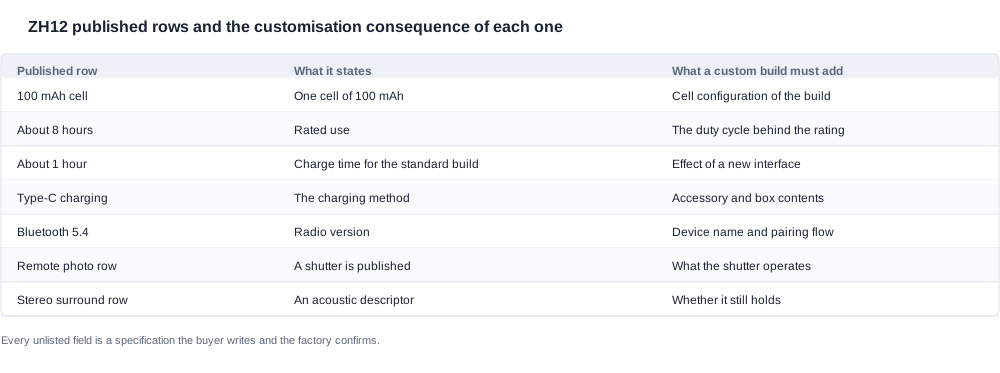
Taking the published items in the order they appear on the page: a 100 mAh battery, about eight hours of rated use, roughly one hour of charging, Type-C as the charging interface, Bluetooth V5.4, a remote photo row, and a stereo surround sound row published in Chinese on the page. That is the complete specification for this model.
The first two of those — the 100 mAh cell and the eight-hour rating — are unusually close to each other compared with the rest of the range, where several models pair a small cell with a much longer rating. What the catalogue does not publish alongside them is the operating mode that produces the rating, the volume level, the codec, the ambient noise condition, or whether the rating holds while the remote function is in use. All of those are test conditions, and all of them belong in the acceptance criteria you write for the first production batch rather than in the catalogue.
The remote photo row needs careful handling, because it is the item most likely to be misread. The catalogue lists a remote shutter control as a feature of this model, and it also lists no camera row for the ZH12 at all. The model publishes no camera specification, no resolution class and no video format, which is consistent with its position in the sport group: of the eleven models in the camera group, the ZH12 is not one of them, and the "no camera row" description applies to it correctly. The consequence for a buyer is precise and useful: the shutter is published, the imaging device is not, and what the shutter operates therefore has to be confirmed in writing before the feature is described on a listing or in a channel brief.
The stereo surround sound row is the other descriptor, and it is published in Chinese on the catalogue page while the rest of the page uses English. That is a presentation detail rather than a substantive difference, but it has a practical consequence for a channel that localises its own copy: the English wording a buyer wants to use is not the wording the factory used, so the descriptor has to be agreed as text rather than assumed from the page.
Three areas remain entirely unspecified. There is no colour line, so the colour of a ZH12 is a specification you write and the factory confirms. There is no lens material, no lens tint and no frame dimension, so the optical configuration is likewise yours to specify — and because the surround sound descriptor describes an acoustic characteristic, a change to the lens or the temple interacts with it, which is a question to put to the engineering side rather than a matter of preference. And there is no frame weight, which matters for a product that a customer will wear for eight hours at a time, and which the catalogue publishes for only one model in the entire range.
ZH12 levers: the remote shutter, the acoustic descriptor, and the documents
Taking the three descriptors of this model and turning them into decisions gives four levers that matter for a customised ZH12, and they are worth separating because they sit at different levels of the project.
The remote shutter. The published feature is the remote. What it does, what it pairs to, what it controls and what happens when the paired device is out of range are all unstated. For a customisation project this lever has an unusual property: the remote is the part of the product most likely to be re-branded, re-packaged or replaced, because it is a separate object in the box with its own surface, its own artwork and its own regulatory text. Each of those is a small job on its own and a combined documentation exercise in practice. The question to ask is what the remote is paired to, what the pairing procedure is, and whether the remote carries any marking of its own that has to be declared in the destination market.
The stereo surround sound descriptor. This one appears on a channel listing and in a channel script, which makes it expensive to change later. If the acoustic configuration of the product is altered — and the levers that can alter it are the temple geometry, the lens configuration and the internal speaker arrangement — the descriptor has to be re-established for the new configuration rather than carried over. The question is a yes-or-no one: does the descriptor as published still hold for the build we are buying, and if not, what replaces it. A supplier who answers with a general assurance rather than a configuration reference has not answered it, because the whole point of the question is that a general assurance travels with a catalogue page and not with a build.
The interface and the box. The device name as it appears over Bluetooth, the pairing flow, the packaging artwork, the leaflet, the language set and the per-market text panel. This lever carries no tooling in the usual sense, and it carries the longest lead time, because the approval cycles belong to your own team and the market decisions belong to your compliance function. The useful practice here is to freeze the build and the interface before the artwork is produced, so that the artwork cycle starts against a settled specification rather than a provisional one.
The market documents. The conformity position of the final build, the radio documentation for the destination market, the general product safety framework that applies in the European Union under (EU) 2023/988, and the transport paperwork for the cell. The catalogue treats export certification as a company-level item and shows it graphically rather than in text, so it does not settle what applies to a build. The radio and the EMC frameworks are separate instruments, the Radio Equipment Directive (EU) 2014/53/EU and the EMC Directive (EU) 2014/32/EU, and the harmonised standards EN 300 328 and EN 301 489 are the standards a conformity route is built on rather than certificates in their own right.


Documents to close before a customised ZH12 order is released
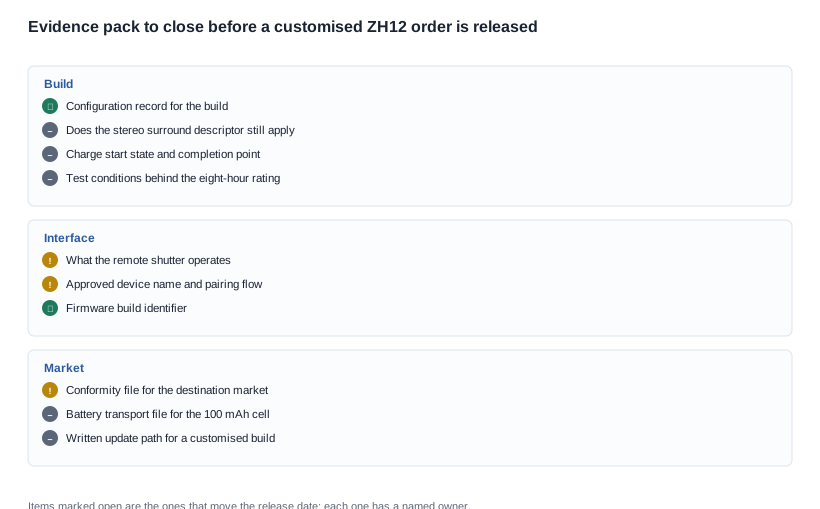
The output of a well-run customisation is a set of records, not a product. This is the list we expect to exist before a customised ZH12 order is released for production, and it is written in the order in which each item becomes necessary.
- A configuration record naming the base build and every deviation from the published row.
- A written statement of whether the stereo surround sound descriptor still applies to the build.
- A written statement of what the remote shutter controls and what the pairing procedure is.
- A firmware build identifier for the interface, and a device name approved for the channel.
- The artwork approval set for the product and, if it is re-branded, for the remote.
- A packaging proof and a text panel per destination market.
- The charge time definition: the starting cell state and the point at which the charge is considered complete.
- The test conditions behind the eight-hour rating, and the duty cycle the rating was taken under.
- The conformity file for the final build in the destination market, and the party that signs it.
- The battery transport documentation for the 100 mAh cell.
- A written update path stating which platform software changes reach a customised build.
- How a defect is handled between the factory and the distributor on a customised build.
The two that most often come back with a vague answer are the second and the seventh. Both are the published row restated for a specific build, which makes them easy to treat as housekeeping when they are in fact the only evidence that the product you receive is the product that was described.
What is worth adding to that list is the repeat-order question. If the first order is a customised build, the second order has to point at the configuration record and the build identifier of the first, and the factory has to be able to produce it from that record rather than from a memory of the previous run. A supplier who cannot describe the record that reproduces a previous custom build is describing a one-off, and the numbers on a one-off do not behave like the numbers on a line.
Choosing between a stock ZH12 and a customised build
This is not a question about which option is better, because in most cases the customised option is simply more expensive and slightly more fragile. It is a question about which of the four levers is genuinely open for you, and the criteria for deciding are the same in every case: does the lever change something a customer or a regulator will see, and can you reproduce it on the second order.
A stock ZH12 is what the catalogue already describes, and it needs no re-documentation at all. For a channel selling into a single market under its own existing device name, with the factory packaging and no change to the acoustic configuration, that route carries almost no risk and should be the default. The four conditions that justify customisation are narrow and worth naming exactly: the brand has to be visible on the product or the remote, the packaging or the device name has to differ between markets, the audio configuration has to change, or the interface has to behave differently from the standard build. If none of those four is true, the trade-off has already been decided against customisation.
The trade-off itself is asymmetric in a way that rewards early decisions. A lever added later costs more than the same lever added first, because the build record, the artwork set, the version identifier and the market documents all have to be put back together from nothing, and the lead time already consumed does not come back to you. A lever dropped early costs a conversation. That is the argument for writing the complete lever list into the first brief even when only one of them is live, so that the ones you hold back are held back on purpose rather than by oversight.
Total cost is where buyers most often get this wrong. The quoted unit price and the tooling line are only the visible part. The invisible part includes the artwork cycles your own team has to run, the market compliance decisions, the documentation effort, and what a repeat order costs when it fails to match the delivery before it. When a due diligence pass stops at the unit price, the total cost of the programme is understated, and the decision to customise is taken on a number that is not the number that matters.
Three red flags appear repeatedly in quotations for this kind of sport platform, and each one is visible before you sign anything. The first is a single bundled customisation line covering every lever, which conceals the costly one and takes away the option of dropping a lever later. The second is a conformity statement tied to the catalogue model instead of to the build you are buying, which describes a product you will not receive. The third is a lead time given as a single number that does not list what the factory needs from your side, which quietly assumes that your team is not part of the schedule at all.
The shortlist of questions to ask before you commit is therefore short and specific, and it is worth sending it as a written list attached to the quotation rather than raising it in a call, because the answers are what you will attach to the purchase agreement later. Which lever opens tooling. What the stereo surround sound descriptor becomes if the acoustic configuration changes. What the remote shutter controls. What the start state and completion point of the charge are. Which document covers the final build in the destination market. And how the second order is reproduced from a record rather than from memory. A supplier who answers all six specifically is telling you something useful about the factory itself, not only about the quotation.
Where the ZH12 catalogue stops and the factory has to answer
The published specification for this model, restated in one place, is: Bluetooth V5.4, a 100 mAh cell, a charge time of about an hour, roughly eight hours of rated use, Type-C charging, a remote photo row, and a stereo surround sound row.
We do not publish a weight for it, a colour line, a lens material, an ingress rating, a touch row, a charging case capacity or a per-model certification entry, and we are not going to supply numbers for any of them that the factory has not confirmed. The catalogue itself is explicit that only the V06 and the S7 carry an ingress marking, which means the ZH12 has none. Where a specification is silent, the honest answer is a question addressed to the factory, and the value of a supplier is measured by how quickly a well-formed question gets a specific answer.
Two things we will state plainly. First, the charge time published for this model is about an hour, and it is a figure for the standard configuration; a change of charging interface changes it, and we would rather say that than quote the fast-charge figure for a build that no longer has it. Second, we will not attach a market-access claim to this model that the documentation does not support, and we will not describe the remote shutter as operating a camera the catalogue does not publish for it.
For the wider platform, the sport smart glasses page collects the three sport models so that the D17, the YKC02 and the ZH12 can be compared on the published rows that actually differ between them, which is the only comparison that carries any weight before a sample is on the table.
Tell us which lens or temple configuration you are planning to change on the ZH12, and we will come back with what the acoustic descriptor and the charge-time row do when that change is made.


