

Buying more than the minimum is usually presented as a discount question, and it is largely not one. What a larger quantity actually changes is a set of eight lines, of which three improve, three cost you money, and two are consequences that arrive whether or not anybody negotiated them. The ratio of benefit to cost is not what a supplier's quotation implies, and the reason is structural: a bigger order changes the factory's economics in several directions at once, and only one of those directions is the price.
The working version is below, and it is the same set of eight lines we use when a buyer asks whether to take the next tier.
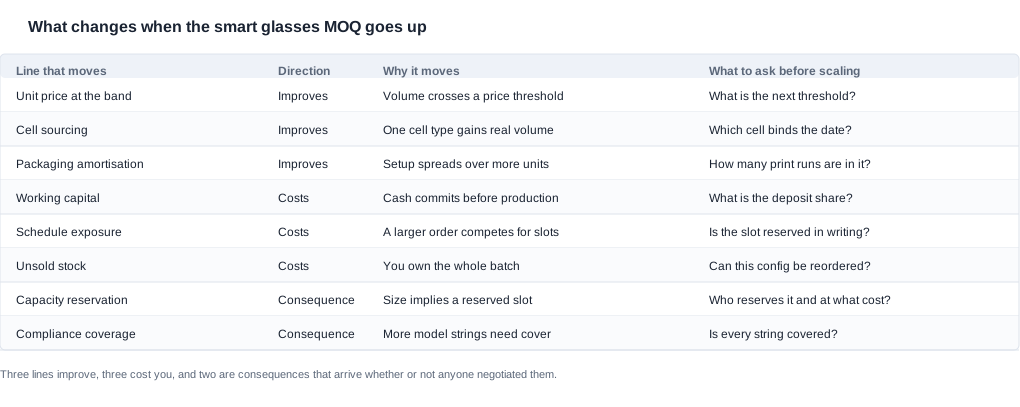
What raising a smart glasses MOQ actually changes, and what it leaves alone
The short answer on smart glasses MOQ
If you increase a smart glasses MOQ and your demand has been tested, you get three things: a lower unit price if your new quantity crosses a published threshold, better cell sourcing if you commit volume to one cell type rather than spreading it, and packaging amortisation if you keep the packaging identical. If your demand has not been tested, you get the first and lose the second, because a larger order spread across more configurations does not improve sourcing at all. And if your order is bigger than the factory can re-make in the same configuration, you have added a fourth cost that no price band covers: stock you cannot move and cannot cheaply re-order.
The practical conclusion is that the useful question is not "what do I get for a bigger order". It is "what am I buying with the extra volume" — a price band, a cell position, a reserved production slot, or nothing at all. A quantity chosen to reach a band and a quantity chosen to reach a date are two different decisions, and they carry different risks.
The buyer behind a smart glasses MOQ decision and the exposure they are managing
The reader is someone buying on the brand side, a channel buyer or an importer who has a demand forecast and a minimum order quantity in front of them and has to decide whether to take the next tier or split the order. Often they are doing it under pressure: a supplier has offered a better unit price at a quantity the buyer can justify commercially but not operationally, and the question is whether the working capital and the stock risk are worth the difference.
What they are managing is not the unit price. It is the exposure that arrives with it. A larger order of a configuration that moves slowly leaves the buyer holding finished goods — and in this category, finished goods in a non-standard colourway are considerably harder to re-order or to discount than the general run. A larger order also commits cash earlier, because the deposit structure in this category takes money before anything is produced, and the cash is committed at exactly the point where the buyer has the least information about how the programme will sell.
The fear underneath the enquiry is rarely "the price is wrong". It is "we committed to volume we cannot move, and the reason we committed to it was a discount". That is a commercial failure rather than a supply failure, and it is entirely avoidable by asking a different set of questions before the order rather than after it.

The commercial background behind a smart glasses MOQ threshold
Why the same product carries two minimum order quantities
Every factory in this category operates two thresholds and neither of them is the one written in the catalogue. The first is the commercial minimum — the smallest quantity the factory will accept for a given configuration, because below it the material set, the setup and the artwork are not worth opening. The second is the price band threshold — the quantity at which the unit price changes. These two numbers are frequently far apart, and the gap between them is where the most expensive orders in this category live: buyers who order at the commercial minimum, pay the higher band price, and wonder why doubling the order did not help.
A third number sits on top of the two, and it is the one that decides whether a scale-up is real. Setup cost is a per-variation cost. If a buyer doubles the quantity but splits it across three colourways or two box types, the setup count goes up by three or two while the volume goes up by two. The amortisation improves by less than nothing and the material purchase is now spread across three sets rather than one. This is the single most common reason a buyer's volume commitment fails to deliver the price that was quoted for it.
Where the volume actually goes once the order is larger
The second thing that changes with volume is the supply position, and this is the line most buyers do not know they can negotiate. The catalogue publishes the cell capacities used across the range, and they are not clustered: the children's A05 and A06 are listed at 40 mAh, the A07 at 70 mAh, the D11 and D12 at 100 mAh, the D17 at 115 mAh, the bone-conduction model at 200 mAh, the V03 and V03 Pro, and MT5 — each at 220 mAh, the KY06 and S7, and V06 — each at 260 mAh, the MT6 at 265 mAh, and the CY03 and CY05, and L2 Utral and L1 Pro — each at 290 mAh. A specific capacity on a specific model has its own supply position, and volume concentrated on one cell type moves that position in a way that the same volume spread across six models does not.
What is easy to overlook is that cell capacity does not determine endurance. The published figure makes the point on its own: the 40 mAh children's models publish about twenty hours of rated use, while the 290 mAh camera models publish about seven. The energy store is not what sets the runtime; the electronics load is. A volume commitment on a cell type therefore improves sourcing and does nothing for the product, and a buyer who expects a larger order to produce a better-rated unit has misunderstood the specification.
Two further published facts matter for a quantity decision. The charging case is a separate supply line with its own published options — 900 mAh and 1400 mAh on the L2 Utral, 1400 mAh on CY05 and L1 Pro, and the CY03, and a 1200 mAh folding case on the MT6 — and the KY06 and MT5 have a case whose capacity is not published. And the configuration options themselves multiply the setup count: three colourways on the V03 Pro, four on the V06, and two case sizes on the L2 Utral. Each of those is a decision that multiplies material sets, and each is a decision that gets made once and then lives inside the quantity for as long as the programme runs.
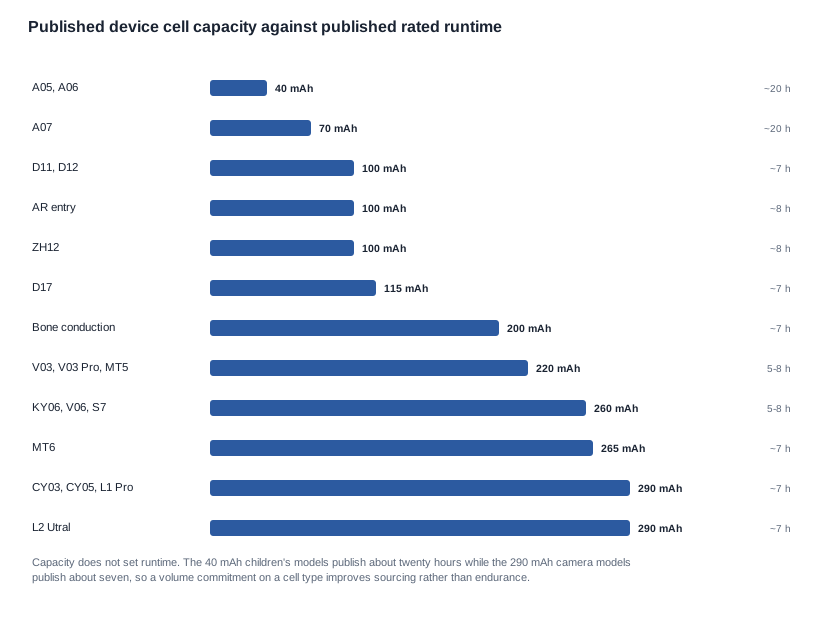
The thresholds that decide whether a smart glasses MOQ is worth crossing
How each line of a quantity increase is measured
The table below is the working criteria set for a scale-up decision. Each row states how the line is measured, the threshold it has to meet, and what an inflated version of the same line looks like when a buyer is being sold a bigger order.
| Line in the decision | How it is measured | The threshold it has to meet | How an inflated version shows up |
|---|---|---|---|
| Next price band threshold | Ask for the quantity at which the unit price changes | The threshold is a stated quantity, not a range | "Around a thousand units" as the answer |
| Configuration count in the order | Count the distinct model, colour and case lines | Each line is a separate setup and material set | One order described as a single configuration |
| Cell capacity concentration | Compare the cell in each line against the others | The order concentrates on one or two cell types | Volume spread evenly across six models |
| Packaging print runs | Ask how many print runs the quantity contains | One run, or a stated number of runs | An amortised setup that was never a single setup |
| Deposit share and timing | Read the payment schedule against the production start | The cash commitment is stated in the order | A deposit described as standard |
| Reorder cost of the configuration | Ask whether the same configuration can be built again later | Repeatability is confirmed before the quantity is set | A non-standard colourway presented as standard |
| Slot reservation | Ask who reserves capacity for a large order | The reservation is named, with a cost or a condition | "We will prioritise it" with no mechanism |
| Document coverage per string | List the model strings in the order against the file held | Every string in the order has coverage | Coverage assumed from the family name |
The row that decides most scale-up decisions is the third one, because it is the one nobody asks about. Buyers ask for the price band and they ask for the lead time, and both of those are quoted back to them. The concentration question is not quoted back, because it depends on the bill of materials of the specific configuration, so it has to be asked as a question: which cell is in this model, and how much of it are we buying.
The published figures a quantity decision can be tested against
The catalogue gives a buyer four things that make a quantity conversation concrete rather than rhetorical.
- Cell capacity per model, which is what makes the sourcing question answerable. A commitment on one 265 mAh line is a different commitment from a commitment spread across 220, 260, 265 and 290 mAh.
- Charging case options, which decide whether the case is one supply line or two. The L2 Utral at 900 mAh or 1400 mAh is a choice with a cost difference and a schedule difference; the MT6's folding case at 1200 mAh is a different assembly again.
- Configuration availability, which sets the ceiling on how much setup a single order can avoid. Three colours on the V03 Pro, four on the V06, and the two case sizes on the L2 Utral are the published options.
- Nothing about the commercial thresholds themselves. Price bands, minimum order quantities, production lead times and daily output are not published for our operation. A buyer who wants to know where the next band sits has to ask for it, and the answer has to be a quantity.
A warning belongs with these figures. Capacity, runtime and case size are not comparable between suppliers without care: a runtime quoted without its volume, source, ambient condition and starting charge state is a different measurement from one quoted with them, and a cell capacity quoted for a pack rather than for the cell in the unit is a different unit of measure. The published condition is what makes the number usable.
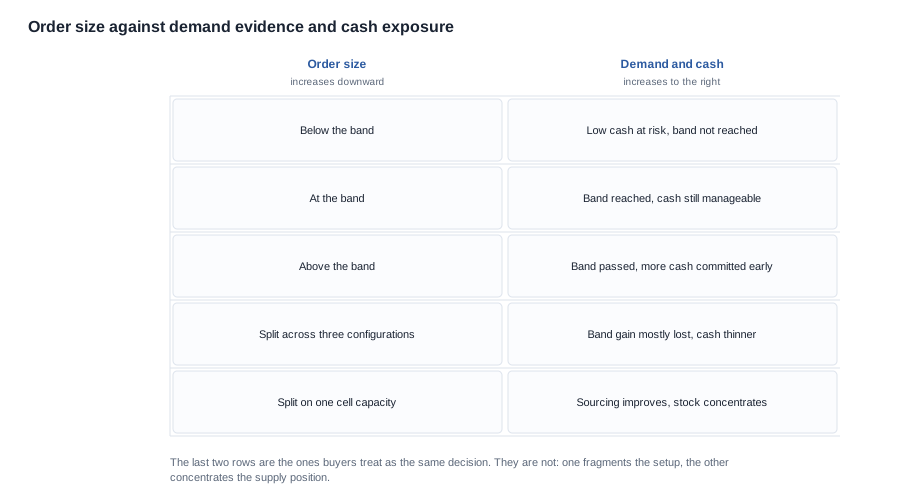

Verifying the assumptions behind a smart glasses MOQ before you scale
Working through the quantity evidence in sequence
A scale-up decision is verified in the order below, because each step tells you whether the next step is worth taking.
- List the configuration lines in the order, with the cell capacity of each. If the lines carry two or more different capacities, the sourcing argument does not apply and you need a different reason for the extra volume.
- Ask for the next price band threshold and for the ladder of thresholds below it. A single threshold is a number you can plan around; a ladder is a negotiation, and you want to know which one you are in before you order.
- Count the packaging print runs inside the quantity. One run amortises across everything. Three runs means three setups, and the saving you were quoted has already been spent.
- Ask what the deposit is, when it is due, and against what. The cash commitment at this stage is the risk you are taking, and it is worth pricing as a cost rather than as a timing detail.
- Ask whether the configuration can be built again later, and at what minimum. This is the reorderability question, and the answer determines how much of the volume has to sell through before the rest is committed.
- Ask who reserves the production slot for a large order and what that costs. If the answer is a mechanism, the order is a different kind of order. If the answer is "we will prioritise it", the reservation has to be written down or it is not a reservation.
The questions to ask about a smart glasses MOQ, and what completes each answer
Each of these has a completion test, because the value of asking is that it ends in something you can put in the order.
- What is the exact quantity at which the unit price changes? Completion: a number. A range is not a threshold.
- How many separate configurations does my order contain? Completion: a count, written out, with the colour and case lines.
- Which cell capacity does each line use? Completion: a capacity per line, so the concentration is visible.
- How many print runs are inside this quantity? Completion: a number, and an agreement that a second run is priced separately.
- What is the deposit, and what happens to it if the configuration changes? Completion: a schedule with amounts and a condition.
- Can this exact configuration be re-ordered later, and at what volume? Completion: a confirmation, because it decides how much has to sell through.
- What does a larger order do to my production slot? Completion: a named reservation mechanism or an honest "no difference".
Seven questions, asked in this order, are enough to tell whether the extra volume is buying a price band, a cell position, a reserved slot, or nothing at all. If the answer is "nothing at all", the smaller order was the better order, and you now know that before the money moves rather than after.
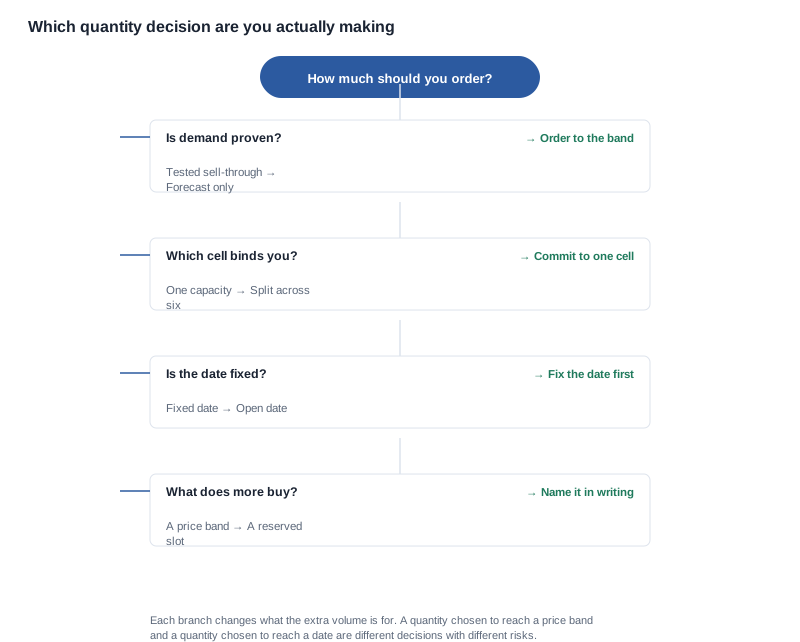

Where a smart glasses MOQ scale-up goes wrong
Four smart glasses MOQ failures that arrive as a surprise, and the control for each
The volume that bought the wrong thing. The symptom is a first order that arrives at a price the buyer expected, followed by a second order at the same price. The root cause is that the order was split across configurations and never concentrated on a cell type, so the sourcing position never moved. The control is to decide in advance which single capacity the volume commits to, and to treat the spread order as a deliberate choice with a different justification.
The colourway that cannot be re-ordered. The symptom is finished stock of a colour that will not move, in a configuration that the factory will not build again at a useful quantity. The root cause is that the volume was chosen to reach a price band and the band was reached with a non-standard finish. The control is to confirm reorderability before the quantity is set, and to keep the band-relevant volume on standard configurations, with the differentiated volume treated as a separate and smaller decision.
The cash that went out before the information did. The symptom is a deposit paid against a configuration that was still open, with the artwork and the firmware acceptance still outstanding. The root cause is that the deposit schedule was agreed before the configuration freeze. The control is to tie the deposit to a dated, frozen configuration and to nothing else, so that the buyer's money and the buyer's information move together.
The slot that was never reserved. The symptom is a large order that was placed in a peak period and treated as a queue position rather than a commitment. The root cause is that nobody asked who reserves capacity. The control is a named reservation mechanism with a cost or a condition, written into the order.
An MOQ discussion is ordinary commercial ground, and none of these items is a reason to change supplier. Each is a line to write down, and each is cheaper than the version where the buyer discovers it after the stock has arrived.
The negotiation on quantity, item by item
The negotiation that has movement is not over the minimum itself. It is over what sits around it.
What moves: the price band ladder, because a supplier who shows you where the thresholds are lets you choose which one to stop at rather than being pushed past it; the setup count, because consolidating colourways and case options inside one order is usually worth more to a factory than the volume itself; the cell concentration, because committing to one capacity is a real commercial concession; the packaging amortisation, provided the print run count stays at one; the slot reservation, and what it costs to hold it; and the release pattern, because a split delivery spreads the working capital cost as well as the volume.
What does not move: the commercial minimum itself, which exists because the material set and the setup are not worth opening below it; the cost and cycle of the regulatory route for the destination market, which is a fixed cost per model and per market; the component supply position, which is a fact rather than a position; and the case configuration, which is a specification decision rather than a commercial one.
The clauses worth having in the order are the configuration string with its cell capacity per line, the price band the order is priced at, the print run count, the deposit schedule with the freeze date attached to it, the reorderability confirmation, the slot reservation, and the acceptance rule with a sample size and a limit. A buyer who secures those has a scale-up that is a decision. A buyer who secures only the unit price has a scale-up that is a bet.
One smart glasses MOQ decision, argued through to a decision
A volume scenario, argued through to a quantity decision
What follows is an invented case assembled to show how a quantity question is decided. The brand, the model line, the channel and the two quantities are all assumptions, and no order that has been placed and no account we work with is described. The part worth following is the order of the questions, and where the extra volume ends up buying something.
The scenario: a brand is opening an open-ear audio programme for a channel buyer, with a first order that the factory will quote at its commercial minimum. The factory has offered a materially lower unit price at roughly three times that quantity, and the brand has a demand forecast that covers the smaller number comfortably and the larger one only optimistically.
Step one is to write out the configuration lines. The brand has two colourways and one case decision, so the order contains two model strings and one case option. That immediately tells the buyer that setup is not being amortised across a single run and that the "one print run" assumption is false.
Step two is the cell question. The brand's two colourways sit on the same model, so the order concentrates on one cell capacity. The sourcing argument therefore applies, and it is the strongest argument available, because it is a real commitment rather than a discount request.
Step three is the demand question. The forecast covers the minimum but not the larger quantity, and no sell-through history exists yet because the product is new. On the demand side of the decision, the extra quantity is inventory, and in this category inventory in a colourway is a slow asset.
Step four is to look for a middle position, which is where the band ladder becomes useful. If the price ladder has a threshold between the two quantities, the buyer may be able to stop at that threshold rather than at the top one, and take a smaller price benefit for a smaller exposure. That option only exists if the supplier publishes the ladder, which is why the first question in the sequence is the ladder question.
Step five is the cash. The deposit at the larger quantity is larger, and it falls due earlier relative to the information the buyer holds. The buyer therefore ties the deposit to a dated configuration freeze, so that the money and the information move together.
Step six is the decision. The reasoning goes: concentrate on one cell capacity, take the middle threshold rather than the largest one, keep the colourways to two, tie the deposit to the freeze, and put the reorderability question in writing before the order. The result is a scale-up that is deliberate, with a known downside if the forecast is wrong.
Where Cynrin stands on minimum order quantities, and the next action
We will say plainly that we would rather show you where the boundaries are than encourage you to order more than you can sell. We do not publish price bands or a minimum order quantity, because three internal sources at our operation currently disagree on the minimum and we have not reconciled them. Publishing a number that two of our own people would contradict would be worse than publishing nothing, and a buyer who plans against a figure we cannot stand behind is planning against our uncertainty rather than against our capacity.
What we will do is tell you what breaks the next band up, which cell capacity constrains a given date, and what a doubled order would and would not change for your configuration. What we will not do is quote a tier ladder we have not reconciled, or describe a configuration as reorderable without checking the bill of materials behind it.
Send us your target quantity, your configuration lines and the date you need to hit, and we will answer all three questions before we send a price. The commercial structure around a band is set out in pricing and cost structure, the schedule interaction is covered in lead time and production schedule, the document side of a multi-configuration order is in certification verification, and the model coverage is on the Bluetooth audio glasses page.
Send your configuration, your quantity and your date, and we will tell you which capacity binds it and what a larger order would actually change.


