

The gap between a sample that impressed somebody and a production order that ships on time contains seven gates, and most of them are skipped rather than failed. Requesting smart glasses samples how to proceed to bulk is usually asked by someone who has handled a unit, liked it, and wants to know the next step; the answer is that the next step is a specification, not a purchase order.
That distinction is the whole of this article. A purchase order is a commitment to a quantity at a price; a specification is a document that defines what will be made. One can follow the other, and in practice the order usually has to follow the specification, because the specification is what makes the order enforceable and what makes the goods inspectable.

The reason most programmes skip gates rather than fail them is that each gate looks like paperwork when the sample is sitting on the desk in front of you. Gate one requires a written protocol before the unit arrives, which feels pointless until the unit arrives and there is nothing to judge it against. Gate two requires a frozen specification, which feels like delay until the configuration has to change and the tooling has to be reopened.
The seven gates, and what each one is for
1. The sample passes your written protocol. Not a demonstration and not an impression — the protocol you fixed before the unit arrived. If you did not write one, this gate cannot be passed, because there is nothing to pass it against.
2. The specification is frozen. Model, build revision, variant list, and the agreed published figures. This is the control document for everything that follows, and it is the gate that most cheaply prevents the six others.
3. Tooling terms are agreed. Ownership, modification cost, and what happens to the tooling if the project ends. All three in writing. This is the most common single source of expensive disputes in this industry.
4. The compliance position is established for your destination. Which obligations apply, which evidence you need, and which parts of it you must obtain yourself rather than inherit from a supplier.
5. The quotation carries terms, not just a price. Scope, defect definition, inspection scope, and remedies. A price without those four is not a quotation you can act on.
6. The pilot run reproduces the sample. A different question from whether the sample was good. A factory can hand-build an excellent sample that the line cannot repeat, and the pilot run is the only stage that tests reproduction.
7. The change process is agreed before release. Who may request a change, what it costs, how long it takes, and what happens to the compliance position when the configuration changes.
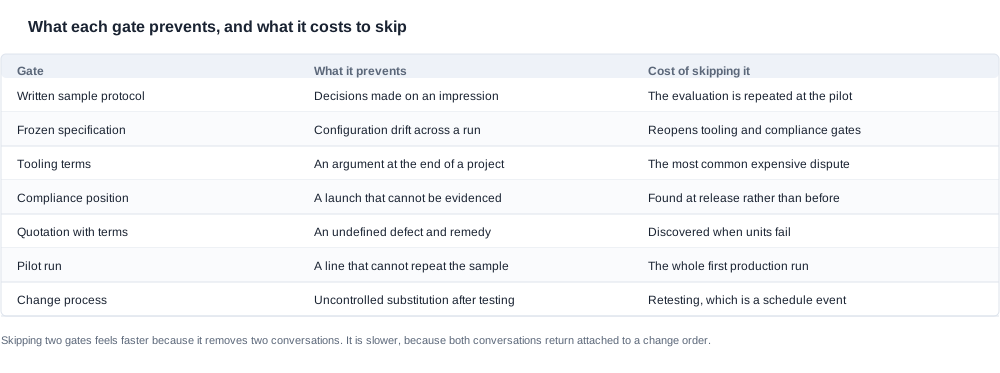
Each gate has a different failure mode, and it is worth being precise about them because they fail in different ways. Gates one and two fail by omission — nobody notices they were skipped until something cannot be judged. Gate three fails by disagreement, usually discovered when the relationship has already soured. Gate four fails by surprise, usually discovered at release. Gate five fails by ambiguity, usually discovered when units fail inspection. Gate six fails by repetition, discovered when the production run does not match the approved sample. Gate seven fails by drift, discovered when the goods that ship are not the goods that were tested.
Because they fail differently, they can also be closed in a different order, and the order is worth thinking about rather than assuming. Gates one and two must close first, because everything after them depends on knowing what is being made. Gate three can close in parallel once the configuration is known, because tooling terms do not depend on the protocol. Gate four can start in parallel with almost everything, because the compliance work has the longest lead time of any gate and is the one most improved by starting early. Gate five is a commercial document and is fastest once one, two and three are settled. Gate six is a schedule item and depends on the line. Gate seven can be drafted early but only becomes meaningful once there is a frozen specification for changes to be measured against.
The mistake this avoids is the sequential programme, where each gate waits for the previous one to close. A sequential programme treats gate four as something that happens after the product is decided, which is precisely when it is most expensive — because a compliance route that forces a hardware change at that point reopens tooling and testing, and the whole chain has to run again.
A second structural point is worth making about the gates themselves. They are not all the same kind of control. Gate one is an evidence control: it establishes what is known. Gate two is a change control: it establishes what is fixed. Gate three is a commercial control: it establishes who owns what. Gate four is a regulatory control: it establishes what is lawful. Gate five is a commercial control again, establishing what remedies apply. Gate six is a capability control: it establishes whether the process can repeat. Gate seven is a change control again, governing what happens after the freeze.
Mixing these up is common and costly. A buyer who treats gate two as an evidence control asks for a better document instead of a frozen decision, and gets a document. A buyer who treats gate six as an evidence control accepts a report saying the pilot passed, without asking whether the pilot was run under production conditions.

Gate one: the requesting protocol, written before the unit arrives
Gate one is the one buyers skip most often, and it is the one that determines whether the rest of the programme has any evidence to stand on. A protocol is a short document that says what will be measured, how, and against what threshold — and crucially it is written before the unit arrives, because writing it afterwards produces a protocol that fits whatever the unit happens to do.
The reason the ordering matters is subtle but decisive. A protocol written in advance is a commitment, and it protects the buyer: when the supplier argues that a figure is within expectation, the protocol already says what expectation means. A protocol written afterwards is a description, and it protects nobody: both parties can read it differently and both are being reasonable.
In practice a protocol for this category has four parts. The measurements, with the method stated for each, because a runtime without a stated charge method and a stated load is not a measurement. The environment, because acoustic and radio behaviour depend on where a unit is being tested. The pass thresholds, agreed in advance rather than inferred afterwards. The record format, so that the results are comparable with a later pilot run rather than being a set of notes.
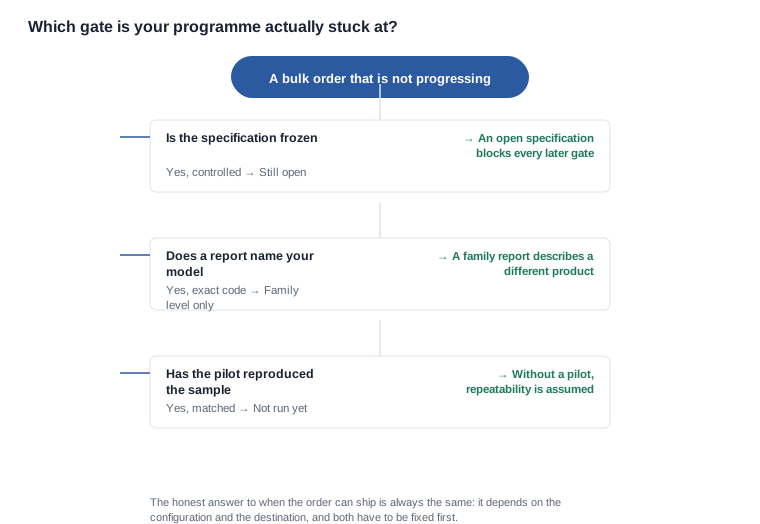
There is a second reason to write the protocol early, which is that it is the document that makes the sample request itself precise. A request that names the model, the configuration, the market, the quantity and the purpose produces a unit prepared for a purpose. A request that says "a sample please" produces whatever is nearest the shelf, and the shelf unit is rarely the production configuration.
The most common failure at this gate is not that the sample is bad but that it is a different unit from the one that will be produced. A cell configuration difference, a firmware build difference and a colour difference are all invisible in the box and all invalidate the evaluation. Any protocol worth writing therefore begins with a configuration sheet for the exact unit, and a request that arrives without one should be returned for completion rather than treated as a minor omission.
What to ask for alongside the hardware follows from the same logic. Ask for the test method behind each published figure — which cell, which charge method, and what the runtime was measured under — because every published runtime in our range arrives without a stated condition. Ask for the items that are not published, listed as not published, because a supplier who answers "the frame weight is not published" has told you something you can plan around, while a supplier who produces a number has told you something you will eventually have to defend. And ask for the documentation set for the destination market, because a sample that arrives with its conformity documents saves a round trip that otherwise happens after the evaluation is complete.
There is a fourth item that is frequently requested and rarely supplied, and it is the most useful of the set: a unit serial or batch reference that ties the sample to a specific build. In a category where several published rows are blank, the ability to tie a result to a specific unit is what makes the result reusable rather than anecdotal. A protocol that records the reference and a supplier that supplies it is the difference between a test and an impression.
Finally, a word on how much a sample can prove, because this is where expectations are most often mis-set. A sample can establish whether a product is within tolerance on the criteria you chose, on one unit, in one environment, at one point in time. It cannot establish repeatability, which is gate six. It cannot establish what happens at the end of a battery's service life, because a new unit has not been cycled. It cannot establish regulatory standing for a market, because a report on a sample is not a report on a product placed on that market. Setting those limits in writing at gate one is what prevents gate six from becoming a surprise.
Gate four is where our documentation constrains us
Gates one, two, three, five, six and seven we can support properly, because they are project-specific agreements that depend on published product data rather than on evidence we do not hold.
Gate four is different, and it is worth confronting early rather than at release. Our source material states company-level claims of CE, FCC and RoHS and publishes no certificate number, issuing body or validity period for any model. It publishes no battery chemistry, cycle life or replaceability for any model, and no sensor, acoustic or video specification.
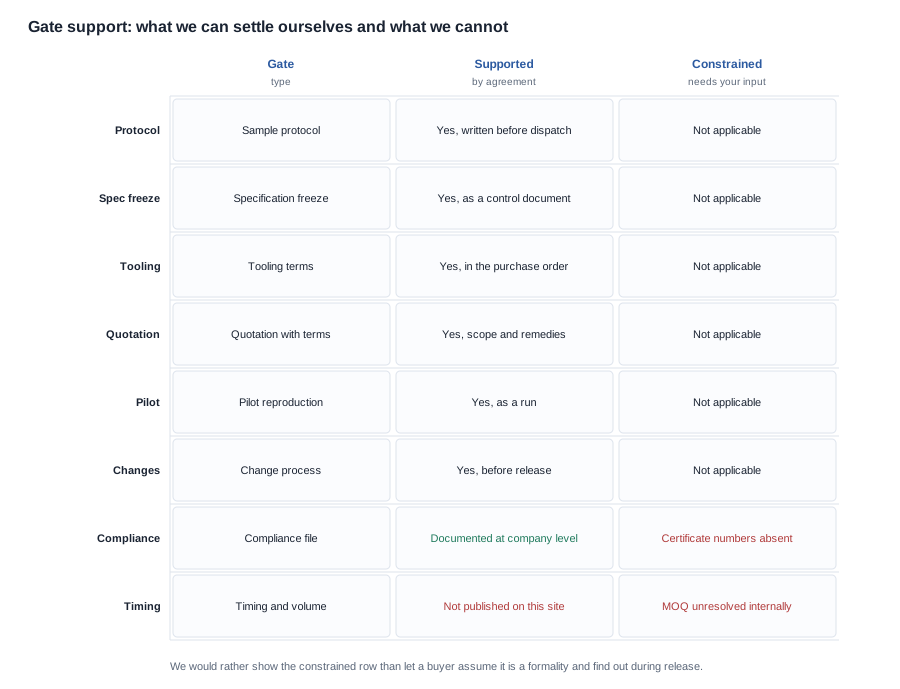
For our range, a complete compliance file for the destination market therefore has to be assembled partly outside our documentation. A buyer who assumes gate four is a formality will discover it during release rather than before, and the discovery will arrive as a schedule event rather than as an administrative one.
This is a structural point rather than a criticism of any particular supplier. In this category the party that assembles a technical file is often not the party that made the product, because the file describes a product placed on a market by an economic operator, and that operator is frequently the brand rather than the factory. The right response is to establish early which parts of the file each party owns, and to have the answer in writing before the first shipment rather than during it.
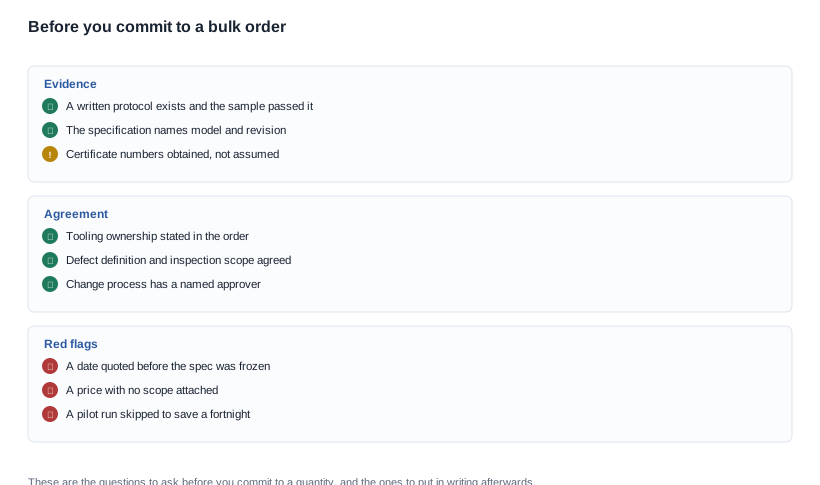
There is a practical method for doing this that costs an afternoon. List every document the destination market requires, mark each one as held by the supplier, held by the buyer, or to be confirmed, and put a name against each of the last two. Documents marked "to be confirmed" with no name are the programme's real risk register, and they are usually longer than anyone expects — in our range they include the certificate numbers, the battery chemistry and service information, and the acoustic and video specifications, none of which our documentation publishes.
The question to ask a supplier about gate four is therefore not "are you compliant", which invites a company-level answer, but "which of these documents can you produce for this exact model code today, which are in progress, and which would we have to obtain ourselves". A supplier who answers that question has given you a schedule for gate four. A supplier who answers the first question has given you a claim.
It is also worth establishing who signs the declaration of conformity, because that determines who carries the regulatory obligation for the life of the product. In an OEM arrangement where the brand owns the listings, the brand is frequently the economic operator and therefore the declaring party, which means the brand needs the evidence even where the manufacturer holds the knowledge. That allocation should be settled while both parties are still being reasonable with each other.

The shortcut that costs more than it saves
Buyers routinely skip gate one and gate two, order against a sample, and fix the specification later. It feels faster because it removes two conversations.
It is slower, because a specification written after the order has to accommodate whatever the sample turned out to be — which usually means a change to the configuration, which reopens gate three and gate four. The two conversations you skipped come back with a change order attached, and a change order is always more expensive than the conversation that would have prevented it.
There is a second shortcut that is even more common and slightly harder to see. Buyers treat the pilot run as a formality because the sample already passed. The reasoning is understandable and wrong: the pilot tests a different question. The sample tests whether the product can be built. The pilot tests whether the line can build the same thing repeatedly, which is a question about process capability rather than about craftsmanship. A factory that can hand-build an excellent unit and cannot hold a tolerance across two hundred is a real and common situation.
The third shortcut is to agree the quotation verbally and the tooling later. Tooling ownership left open until after the tool has been cut is a negotiation conducted from a weak position by both parties, and the party who cuts the tool is the party who has spent the money.
There is a fourth shortcut worth naming because it is invisible: treating gate five's terms as standard. A quotation without a defect definition, an inspection scope and a stated remedy leaves all three to be determined by whoever has more leverage at the moment of disagreement — which is rarely the same party at the moment of delivery. Writing the three down costs an hour at quotation stage and removes an argument that is otherwise certain.
What all four shortcuts share is that they move a cost forward in time to reduce a cost now. That is a legitimate trade when a programme is genuinely at risk of missing a season, and it is a poor trade when it is adopted as a habit, because the programme accumulates unpaid obligations that arrive together at the worst possible moment — usually between the pilot run and the first shipment, when there is no time left to respond to any of them.

What the gates do not settle: timing, volume and price
Timing. Our documentation publishes no lead times, no production capacity figures and no minimum order quantities, and our own source material records the minimum order quantity figures as unresolved.
So the honest answer to "how long will this take" is that it depends on configuration and destination, and both need to be fixed before a date means anything. A date quoted before gate two is a guess, and it is a guess that will be defended as though it were a commitment.
Volume is the same problem in a different form. A minimum order quantity is a function of the configuration, of the tooling involved and of how much of the range can be shared across models. A figure quoted for one configuration says very little about another, which is why a buyer comparing minimum order quantities across suppliers should compare them across like configurations rather than across whatever each supplier chose to publish.
Price follows from all of it. A unit price is a function of quantity, configuration, documentation scope and the schedule at the time of enquiry, which means that two quotations for nominally similar products are only comparable once those four have been held constant. The trade-off worth naming is that the cheapest quotation is frequently the one with the widest specification, and the gap between them is the cost of the specification.
Being direct about where we can and cannot support
We will say plainly that a buyer should spend longer at gate two than moving quickly through the others. The specification is the only document that quietly prevents failures at every later stage, and it is the one most often written in an afternoon and regretted across a production run.
We will also be direct about the limit of what we can settle. Six of the seven gates are agreements we can write and honour, because they are project-specific. Gate four depends partly on evidence our documentation does not hold, and we will say so at the start rather than at release. We publish the configuration space, the cell and case capacities, the camera tiers, the runtimes, the radio versions and the charging interfaces; we do not publish certificate numbers, battery chemistry, cycle life, or the sensor, acoustic and video specifications, and we will not fill those gaps with typical values that would have to be defended later.
Where a buyer needs a gate closed that our documentation cannot close, the useful question to ask is which part of it they will own. A programme that assigns gate four to the buyer with a named owner and a date is a programme that can proceed. A programme that assumes gate four will resolve itself is a programme whose launch date is a hope.
The stage detail is set out in odm development stages. The risks each gate manages are covered in smart glasses oem risk factors, and the protocol for gate one is described in sample evaluation. Send us your written protocol and we will tell you which gates your current information already supports.
One closing point about which gate to enter by. A buyer arriving from a good sample experience usually wants to enter at gate five and is surprised to be sent back to gate two. That is not bureaucracy; gate five is a commercial document about specific goods, and the goods are not specific until the specification is frozen. A buyer who arrives at gate two with a written protocol already in hand moves through the rest of the sequence faster than one who arrives at gate five with an impression.
Related reading
- The stage sequence in detail — odm development stages
- What each gate prevents — smart glasses oem risk factors
- Running gate one properly — sample evaluation
Send us your written protocol and we will tell you which gates your current information already supports.


