

A smart glasses programme can pass a factory audit, clear a sample approval, survive a first shipment and still lose money, because the losses in this category rarely arrive as a bad product. They arrive as a good product that was not what was approved, priced at a landed cost nobody modelled, with a compliance file that describes the previous version of it.
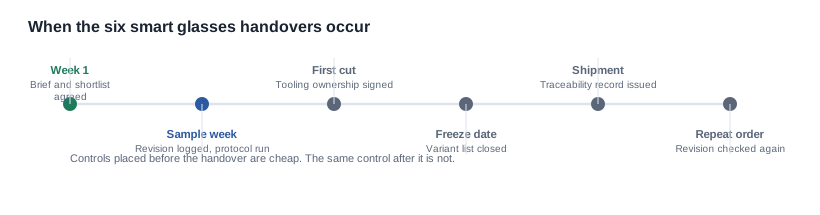
The pattern that shows up in every post-mortem worth reading is the same: the risk did not occur where the buyer was looking. It occurred at a handover, in the gap between two organisations that each believed the other was holding the detail. Six handovers account for most of it.

This article is organised around those six handovers rather than around a generic risk list, because a generic list produces a document that sits in a folder. For each handover, the question is what specifically fails, what it costs, and what single control prevents it. Where a fact is not published, the answer is written as a question to ask rather than a number to trust, which is the honest position when the buyer is several organisations away from the person who knows.
Smart glasses OEM risk factors: six handovers where money disappears
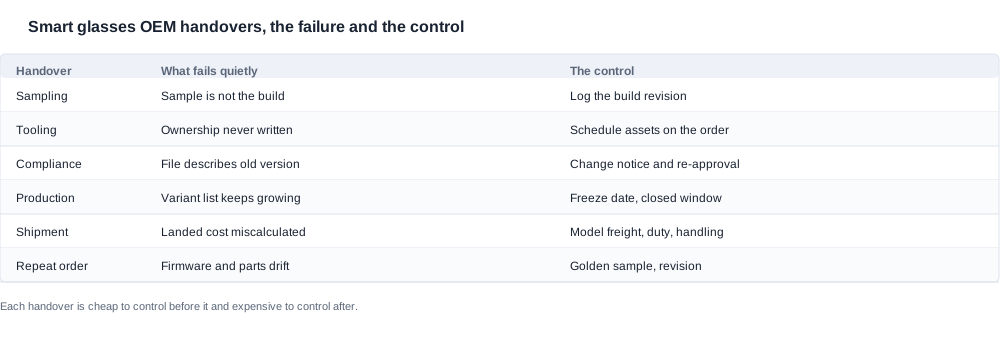
1. Sampling. The most common failure is a sample built from a better component lot, a different firmware revision, or a hand-finished temple that the production line cannot reproduce. It is not a dishonest failure. It is a sympathetic one: the factory is showing you the product at its best, because a sample that flatters the product is easier to approve. The problem is that the sample then becomes the benchmark your customer approval is measured against, and the production unit misses it. The control is narrow and specific: ask for the sample's build revision in writing, ask whether the components are from the same production line, and get the revision recorded on the approval form. Sample-stage controls are covered under sample evaluation.
2. Tooling. Who owns the mould, who pays to modify it, and how the modification cost is recovered are routinely left as verbal understanding. This is the handover where a dispute is most likely to be expensive and least likely to be your fault. The control is a tooling schedule attached to the purchase order: asset identifier, cavity count, ownership, maintenance responsibility, the event that transfers the asset, and what becomes of the asset when the programme ends. See customization cost factors for what a custom mould and a customised temple actually cost in setup.
3. Compliance. You change a colourway, a temple shape, the Bluetooth device name or a lens option. The technical file behind an existing conformity claim no longer describes the product. Nobody notices until an audit or a market surveillance question, and the cost is not the re-test. It is the delay and the re-work after production has started. The control is a change notification clause, and the reason it matters so much here is that our catalogue publishes no per-model certification row at all: the export certification page is an image-only page carrying ten patent certificates, eight of them design patents and two of them utility models, with no model list on any of them. There is no baseline to check a change against unless the factory gives you one.
4. Production. The variant list grows after the freeze date. Ten colourways and ten firmware builds are twenty build combinations, not two, and each combination is a separate setup, a separate instruction sheet and a separate opportunity to drift. Variant complexity is the quietest cause of a missed delivery date in this category, and it is quiet because nobody ever decides to add ten variants. It accumulates one sensible request at a time. The control is a freeze date with a change window that closes, and a per-unit build identifier that tells you what you actually received.
5. Shipment. Landed cost is calculated on the factory price, and the actual landed cost erases the margin. Battery products carry transport obligations that non-battery products do not, and our entire range is battery-powered. This is worth modelling properly before the first purchase order rather than after, and the shipping and logistics reference covers the structure. There is a documentation layer underneath it: for not one of the twenty-eight entries in our range do we publish the cell chemistry, the cycle life or the replaceability, so a logistics plan that assumed a general-goods shipment needs correcting before the first booking.
6. Repeat order. Firmware drifts from the approved sample, or a component supplier substitutes. On a first order this is a small inconsistency. On the fifth, it is the reason a customer churns and the reason your own staff stop trusting the product. The control is a retained golden sample, a named firmware revision per order, and a written change notification that reaches the buyer before the substitution reaches the warehouse.
The six are worth reading as a sequence rather than a list, because they cascade. A sample built from a different firmware revision is a small inconsistency at handover one. It becomes the approval baseline at handover two when the tooling is cut around a finish that the production line cannot reproduce. It becomes a documentation problem at handover three, because the technical file describes a build that will not ship. It becomes a schedule problem at handover four, when the first production batch misses the approved colour and the programme is reworked. It becomes a landed-cost problem at handover five, because the units that did not pass are still units you paid for. And it becomes a churn problem at handover six, when the fifth order is shipped from a slightly different configuration and the channel notices.
Each link in that chain is individually plausible. That is what makes it dangerous. No single handover would trigger an investigation, and each of them has a defensible explanation at the time. The chain is only visible when you have written down, at each handover, what the previous one established, which is exactly why the specification document is a control device and not paperwork.
There is also a pricing dimension to the cascade. When a handover fails late, the cost does not land as a single penalty. It lands as rework hours, as a re-test, as a delayed launch window, as freight on units that were paid for and cannot be sold, and as a margin that was planned at a certain landed cost and arrives at another. None of those appear on a supplier's invoice, which is why a buyer who only tracks the unit price sees a programme that is going well right up until the quarter it is not.

Why smart glasses are harder to de-risk than most categories
Buyers arrive at this category with a risk register written for a simpler product, and three properties of smart glasses make that register inadequate.
Everything is a battery product. That single fact brings transport obligations, a cell specification, an end-of-life question and a spare parts question into every programme. Our documentation does not publish cell chemistry, cycle life or replaceability for any entry in the range, so these are not parameters you can look up and accept. They are questions you have to get answered in writing before you can plan a first shipment, and the supplier who cannot answer them has a bigger problem than your register does.
The published claims are thin, and thin claims produce false comparisons. Third-party acoustic measurement is published for no entry at all. A frame weight appears on a single entry, and that figure covers the glasses alone. An ingress rating appears on two entries only. Nowhere in the catalogue is there a capacitive-touch row, and nowhere is there a translation row either. So when a buyer compares a competitor's published leakage figure against one of our surround-audio descriptions, the comparison is between a measurement and an adjective, and the project brief that results from it can be built on a false premise. Risk is not only about what goes wrong. It is also about deciding to build something on a comparison that was never valid.
A single configuration change is a multi-domain change. Change the charging interface and you affect the bill of materials, the cable in the box, the packaging artwork and possibly the documentation. Change the case and you affect the accessory story, the freight weight and the unboxing. Four entries in our range do not publish a charging method at all, so for those the very first row of a new configuration is an open question. In a category where the configuration space is that coupled, a change is not a small administrative event, and treating it as one is the risk.
There is a fourth point, and it is about the range rather than the product. The published colour options are narrow: three options on one camera entry and four on another, and nothing published for the rest of the catalogue. Marketing pages tend to imply more flexibility than the option list supports. A buyer who plans a colour strategy around an implied range will discover, late, that the extra colourways are new developments with new tooling, new setup and new documentation scope. That is a schedule risk and a price risk, and it is entirely avoidable by asking which colourways exist as configurations rather than as intentions.

Due diligence that finds the problems before the smart glasses tooling is cut
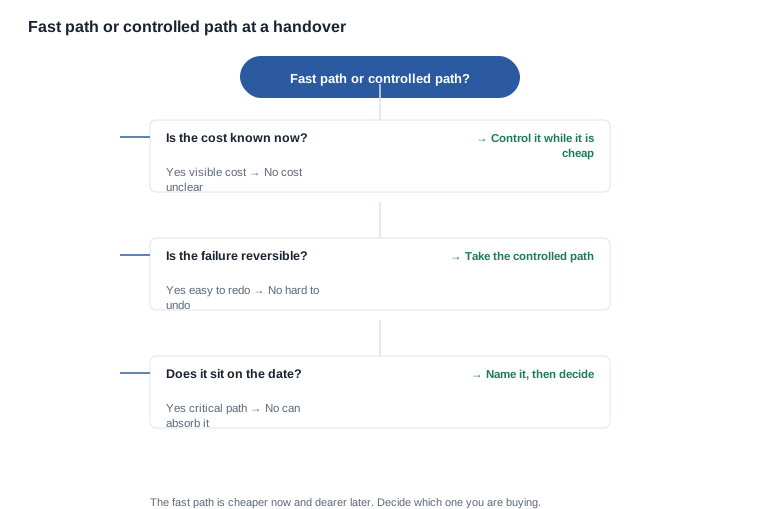
Most of the six handovers can be made safe by a single document, agreed before the first cut: the written specification the project is being built to, naming the model, the build revision, the variant list and the agreed published figures. If that document does not exist, each of the four risks above is unmanaged by default, and the programme discovers it at the first disagreement rather than at the first audit.
Eight questions get you most of the way, and they are worth sending to every supplier on the shortlist in the same order so the answers can be compared.
- What is the exact model and configuration in this quotation, and which published rows does it take from the catalogue?
- What is the build revision of the sample, and how does it differ from the production build?
- Which components in the sample differ from the production component list, and why?
- Who owns the tooling, and what event transfers ownership?
- What change notification will we receive, in writing, and how much notice does it carry?
- Which documents cover this exact model in our destination markets, and can we see the model list on each?
- What cell specification, charge test condition and runtime test condition will be provided for this model?
- Which build identifier or traceability record will be issued with the shipment?
There is a related check that belongs in the same exercise, and it is about the counterparty rather than the product. If the party opposite you does not hold the tooling, the test equipment and the production lines, then the handover risks are multiplied by every layer between you and the factory. The factory versus trading company comparison is the relevant reference, and the supplier verification reference covers what an audit should and should not be allowed to establish. An audit is a snapshot of a process on one day. It does not tell you whether the same process runs on the day your order is scheduled.

The trade-off between speed and control at each smart glasses handover
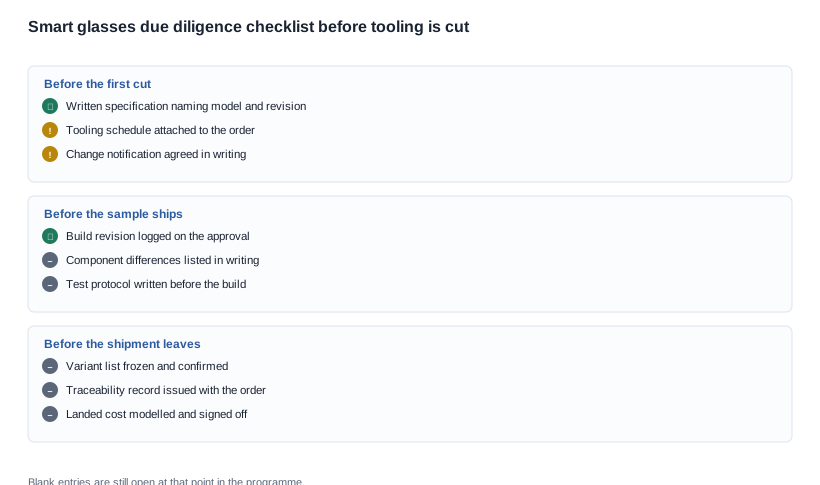
Every handover offers a fast path and a controlled path, and the two are not equally expensive. Knowing which is which is more useful than a general instruction to be thorough, because the fast path is often correct and the controlled path is often a luxury a schedule cannot carry. The negotiation around a handover is usually about price rather than about the control, which is exactly why the control is the thing that gets dropped.
| Handover | Fast path | Controlled path | What the control actually buys |
|---|---|---|---|
| Sampling | Approve the unit in the room | Log the build revision on the approval | The benchmark survives the first production batch |
| Tooling | Assume the supplier owns it | Schedule the assets on the order | A second market or a second supplier is still possible |
| Compliance | Change it and sort the paperwork later | Written change notification with re-approval | The technical file still describes what ships |
| Production | Add the variant when the request lands | Freeze date with a closed change window | The delivery date survives the request |
| Shipment | Land on the factory price | Model the freight, duty and handling | The margin is the margin you planned |
| Repeat order | Ship it again | Golden sample and named revision | The fifth order resembles the first |
The pattern in that table is worth stating plainly. The fast path is cheaper at the moment it is taken and more expensive at the moment it is discovered. The cost of a control is paid once, in advance, and it is visible in the schedule. The cost of no control is paid later, in delay, in rework and in a return rate, and it is invisible until it is large. Buyers who lose money in this category are usually not the ones who refused to write a clause; they are the ones who wrote the clause, believed it was in force, and never checked that it was.
The one place where the fast path is usually correct is sampling. A controlled sampling protocol that takes a week is rarely worth it, because a sample that fails at this stage costs a fortnight of the factory's calendar. What is worth doing at sampling is the cheap half: a written build revision, a photograph of the unit against its label, and a note of what was tested. That is an hour of work, and it is the difference between a benchmark and an anecdote.

Which model carries the highest documentation risk in a smart glasses range
Not every entry in a range carries the same risk, and if you are choosing what to launch with, the documentation profile of the model matters as much as its specification.
The highest documentation risk sits with an entry where several published rows are missing at once. In our range that means an entry whose charging method is not published, or whose Bluetooth version is not published, or whose charging case position is ambiguous, or whose case capacity is not published even though a case exists. Four camera entries do not publish a charging method. Three entries have no case row at all and one explicitly has no case, while two have a case with no published capacity. Eleven camera entries publish no Bluetooth version. An entry like that is not a bad product; it is an entry where every question has to be asked rather than looked up, and the answers arrive as a conversation instead of a catalogue.
The lowest documentation risk sits with an entry whose published rows are dense and internally consistent: a charging method, a charge time, a capacity, a case position and a runtime that agree with each other. For those, a buyer can write a specification in an afternoon and a factory can quote it in a week. Which one you lead with is a decision about how much uncertainty your launch can absorb.
A second axis of risk is the claim rather than the specification. If your product page is going to say waterproof, the entry that publishes IP54 gives you something to point at and the other twenty-six give you nothing. If the page is going to say light, one entry publishes a weight. If the page is going to claim a surround-audio experience, a small number of entries carry that description. The claim and the model have to be selected together, and the alternative is a listing that cites a figure belonging to a different product in your own range.
The third axis is your market. An entry with a family document covers some markets more cheaply than one that needs its own testing, and our catalogue publishes no per-model row, so this is not something a buyer can establish from the product pages. It is a question for the supplier, and it belongs in the same request as the price rather than in a separate email three weeks later.
If you are running a shortlist, these three axes make good criteria because they are objective and they are knowable before the quotation. Ask every supplier on the list to complete the documentation rows for the same two or three candidate entries, and compare which ones can fill the rows and which ones cannot. The answer tells you more about the programme you are about to run than a unit price comparison will.
There is a version of this analysis that is worth repeating rather than doing once. Every quarter, mark each entry in your range against three questions: which specification rows could you fill from published data, which ones did you have to ask for, and which ones are still open. After three quarters the marks form a trend. An entry whose rows were always open is an entry where every new question costs a week, and it should never be your lead product. An entry that used to be complete and no longer is telling you that something changed on the factory side, and it is the cheapest early warning a buyer gets.
The risk shape also changes with the channel, and the weighting is worth separating before you build the criteria. A brand launching into a single market concentrates documentation risk at one moment, and the cost of getting it wrong is a delayed launch. A distributor selling into several destinations carries the same risk spread across markets, with the additional question of who is the importer of record in each one and who carries the recall liability. A marketplace seller carries the risk at listing level, because a listing is where the claims are made, and a single claim that cannot be supported is a compliance problem rather than a marketing one. The due diligence questions are the same in all three cases. What differs is how much weight each one gets, and writing that down before you approach suppliers is what stops the weighting from being decided by whoever is most enthusiastic in the room.
There is one more decision to make, and it applies whenever a row genuinely cannot be filled. There are three honest answers. You can change the claim so the row is never needed, which is the cheapest and the most underrated. You can change the model so the row is published, which costs a shortlist change but removes the uncertainty for good. Or you can accept the row as open, with a named owner, a date and a written record of what you decided to risk. What you must not do is fill the row with an estimate and let it travel into a product page, a specification sheet or a contract. An estimate that becomes a claim stops being an estimate, and at that point it is a risk with a document behind it rather than a risk in a spreadsheet.
We publish what our documentation states and mark the rest as not published, which means our own risk profile includes the gaps above. We would rather you find them here than in a returned shipment. Where we can be specific, we will be: send us the model, the configuration and the destination markets, and we will tell you which rows of the specification we can populate for you today and which ones will need a written answer from our engineering and compliance teams. The commercial rows follow the same rule: the unit price, the minimum order quantity, the production lead time and the warranty term are each confirmed per enquiry and are not published here, and so are the certification documents themselves.
Related reading
- Building the specification document — customization cost factors
- Transport obligations for battery products — shipping and logistics
- Verifying published figures — supplier verification
Send us the model and configuration you are scoping and we will tell you which specification rows we can complete for you today.


