

Smart glasses bluetooth version: a row that screens
The Bluetooth version is the row that appears on almost every datasheet in this category, and it is the row that tells you the least. It is a protocol generation rather than a feature, and two products carrying the same generation can behave completely differently. That does not make the row useless; it makes it a screen rather than an answer, and the purpose of this article is to say what to look at instead. The whole exercise takes about four minutes on a datasheet if you know which rows to skip to, and about four weeks if you skip them.
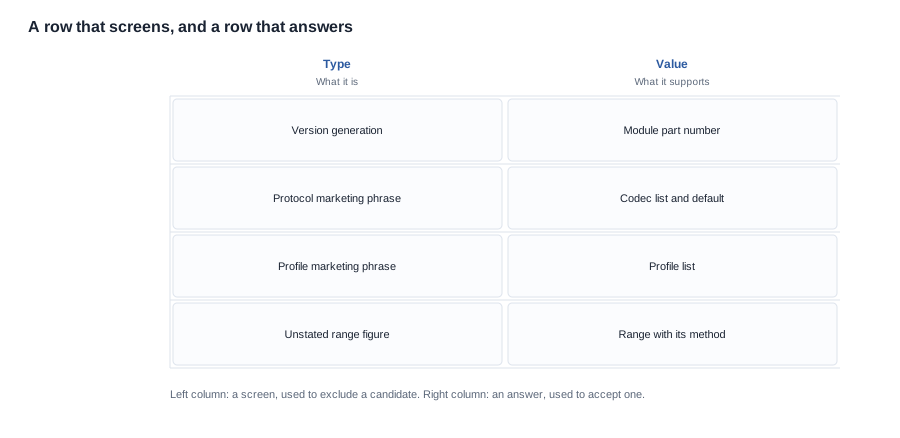
Smart glasses bluetooth version smart glasses how to read a datasheet is therefore two activities, and they are worth separating. The first is a screening activity, done in four minutes, where the version row excludes candidates from consideration. The second is an acceptance activity, done over weeks, where the five rows that actually describe the radio decide whether a candidate is bought.
What this read actually settles
It settles four things, and none of them is a product performance claim.
Which candidates are worth a deeper look. A generation tells you the era of the platform and roughly what the compliance position looks like, which is enough to exclude a supplier who is quoting a radio two generations behind what your market expects, and not enough to accept anyone.
What to ask for next. The version row points at the module, and the module points at the behaviour. Once you know the generation, the questions that matter are the ones about the module part number, the profile list, the codec list, the multipoint configuration and the firmware update path.
Who owns the radio. This is the question a private-label buyer most often gets wrong. A brand that designed the product owns the radio decisions. A factory that bought a platform owns the radio decisions but not necessarily the update path. A brand that inherited a radio from a previous generation owns neither, and is buying a dated component with somebody else's support window.
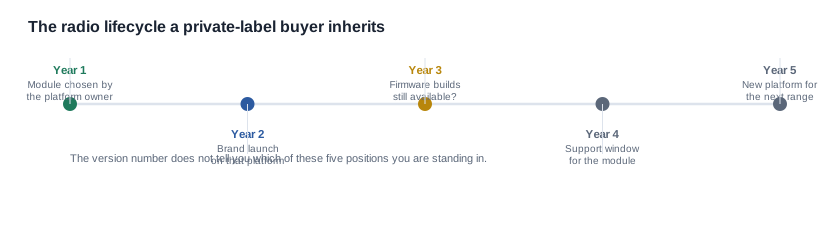
How much of the lifecycle you are inheriting. The radio has a support life, and a version number does not tell you where in that life you are standing.
The buyer who already has three quotes in front of them
A channel buyer comparing three suppliers' Bluetooth audio ranges holds three catalogues, a target price and a marketplace listing to write. Their exposure is the return rate and the listing suspension, and the version row is the only radio information they were given, so they default to comparing it. Two of the three quote 5.4 and one quotes 5.3, and the obvious reading is that the 5.3 supplier is the weaker option. On the published evidence in our own range, that reading is not supportable, because the two 5.3 models, the K01 and the K02, are not the entry-level products in any published respect except the version row itself.
A brand product manager choosing between a platform for a new range holds a supplier's module reference, a target bill of materials and a launch date. Their exposure is the range architecture, and the radio is the component most often locked in by the platform choice and least often reviewed afterwards.
A compliance reviewer holds a regulatory checklist and a list of models. Their exposure is the conformity file, and the radio version interacts with the cybersecurity requirements in a way that is worth understanding before the file is assembled rather than after.
All three are working from the same row, and all three need something the row does not contain.

Where the radio sits in the cost and the compliance schedule
What the version number really is, on the radio
Bluetooth 5.3 and 5.4 are the generations that appear in our published range. The 5.3 generation improves connection stability and energy efficiency over what preceded it, and 5.4 improves further and adds support for AES-CCM encryption. Both are protocol-level statements about the radio and the stack, and neither one tells you whether the product supports multipoint, which audio codecs are available, how far the link reaches, or how the device behaves when the phone walks out of range.
In our catalogue, Bluetooth 5.3 appears on the K01 and the K02, and Bluetooth 5.4 appears on the D11, the D12, the LC-105-1, the LC-105-2, the G07, the YK12, the YKC02, the D17, the ZH12, the A07 and the electrochromic and AR models. The whole camera family publishes no version at all, and neither does the bone conduction model or the A05 and the A06. A blank cell in that list means the documentation is open, not that the radio is old, and a buyer who reads a blank as a red flag will disqualify a model for a reason that has nothing to do with the radio.
The compliance direction that makes the row worth reading
The direction of travel is worth noting even though the row is thin. The cybersecurity requirements of the Radio Equipment Directive become a mandatory part of CE marking from 1 August 2025, described by the EN 18031 series of harmonised standards, which cover secure communication, encryption, secure storage, user consent and a process for handling identified vulnerabilities. A radio design that already supports modern encryption is closer to that requirement than one that does not, so the version number is a weak but real signal about the compliance workload ahead of you.
The honest statement of what that means is narrow. A 5.4 radio is not a compliance certificate, because the requirement covers the device and its update path, not the radio generation. What it does mean is that a platform on an older radio will need the security work done later, at a point when the brand is less willing to pay for it.
The cost structure underneath the row
Four layers, and the version row sits in the middle of them rather than at the top.
The module itself, which is a bought-in component with a unit cost that moves with volume and is rarely the biggest line in the quotation. Its cost is the part most visible to a buyer and least determinative of the radio's behaviour.
The certification and the conformity work, which is per product family and per market, and which is affected by the radio because the radio is what the cybersecurity requirements are written about. A platform with modern encryption may shorten that work; it does not remove it.
The firmware and the update path, which is where the cost of an ageing radio eventually lands. Every firmware build has to be built, tested, signed and published; every build the customer does not receive is a support case, and every radio that stops pairing with a current handset is a return.
The support window, which is the cost nobody quotes. It is set by the module maker, not by your factory, and it is the number that decides whether a product bought today is supportable in year five. A version row tells you nothing about it, and the question is worth asking before the first order.
The five rows that carry more information than the version
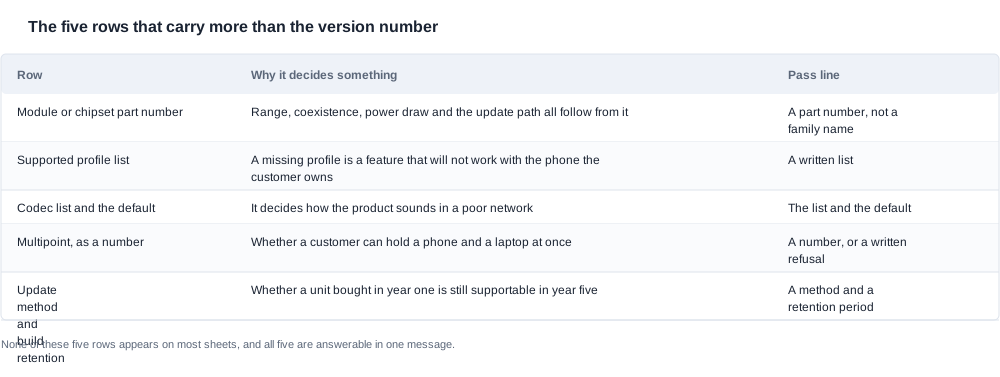
This is the section to work from. The five rows below are the ones a buyer should ask for on every candidate, and the pass line is what a usable answer looks like.
The thresholds behind each of the five rows
The chipset or module part number. This is the row that actually determines radio behaviour: range, sensitivity, coexistence with Wi-Fi in the same band, power consumption and the update path. A supplier who gives you a version number and refuses the part number is telling you that the part number is the interesting one. The pass line is a part number that can be looked up, with the module maker named, so that you can find the module's own documentation rather than accepting a summary of it.
The supported profile list. A wearable audio device needs the audio distribution profile and a telephony profile, and the specific list matters, because a missing profile is a feature that will not work with the phone the customer actually owns. The row to read is the profile list, not the marketing phrase about hands-free calling. The pass line is a written list, and it should be checked against the handsets your own customer base uses, not against a reference list from a manufacturer.
The codec list, and the default. This is the row that decides how the product sounds, and it is the one buyers most often skip. A device with no high-quality codec available sounds like a phone call, whatever the acoustic design does. The pass line is the list plus a named default, because a device that negotiates one codec and a device that negotiates several behave very differently in a poor network, and the default is what the customer will actually experience.
Multipoint, stated as a number. Whether a device can hold two connections at once is a stack configuration decision, and it is not implied by the version. It matters enormously for a customer who moves between a phone and a laptop, and it is not published for any model in our range. The pass line is a number, or a written refusal, and a written refusal is still useful: it tells you the product is a single-connection product and you have to position it accordingly.
The update method, and how long builds are kept. How firmware reaches a unit that is already in the field, and how long the builds are available. This is the row that determines whether a product bought in year one is still supportable in year five, and it is invisible on almost every datasheet. The pass line is a method and a retention period, and a retention period that nobody will state is itself a finding about the platform's age.
What these five rows are not comparable across
Two of the five cannot be compared between suppliers at all, and a buyer who puts them in a chart will publish a false conclusion.
Range. A range figure without a method is not comparable, because range in this category depends on the transmit power, the antenna design, the body of the wearer and the environment. One supplier's figure is measured in a line-of-sight corridor and another's is measured through a wall, and both are printed on a sheet as a single number. Ask for the conditions, and then test in the place the product will actually be used, because the customer's environment is not the laboratory's.
The update method. Two suppliers can both support over-the-air updates and mean entirely different things. One publishes builds for two years and the other for five, and the difference is invisible until year three, when the first one stops issuing firmware and a customer with a newer handset cannot pair. Compare the retention period, not the method.
The other three — module, profiles and codecs — compare cleanly once the conventions are the same, and the conventions are usually visible on the sheet. A codec list without a stated profile is a list of possibilities rather than a list of what will happen.

The reading order, and the four checks that follow it
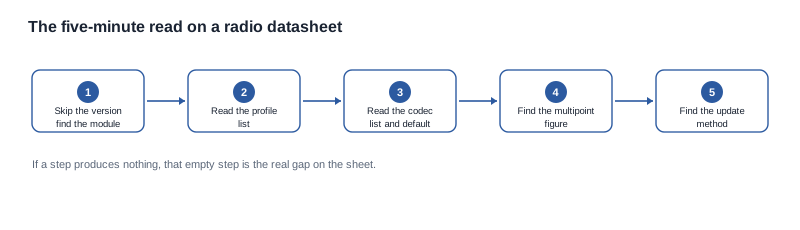
1. Skip the version number and find the module or chipset part number. If the part number is absent, that is the first and largest gap on the sheet.
2. Read the profile list and check it against the handsets your customers use. Not against a reference list. A profile list is a compatibility statement, and a compatibility statement is only useful against real devices.
3. Read the codec list and note which one is the default. The default is what the customer hears. The list is what the customer could have.
4. Find the multipoint figure. If it is absent, ask. Multipoint is a product decision for a business channel and a disadvantage for a consumer channel, and the same number serves both.
5. Find the update method and the range condition. If either is absent, that is the real gap on the sheet, and it is a gap you should put in writing before you commit to a supplier.
6. Check the qualification position. This is the one row in the list with a legal dimension rather than an engineering one, and it deserves its own step because it affects your packaging and your listing rather than your hardware.
The qualification question, which is a different question
Whether the brand is entitled to use the Bluetooth trademark is a separate matter from whether the radio works, and the two are routinely confused. The Bluetooth SIG qualification is required before the trademark can be used on the product, on the packaging or in the listing. The question a private-label buyer has to ask is who holds the qualification for their brand, because in a private-label arrangement the qualification often sits with the factory, the platform owner or the original brand, and the trademark is a licensed use rather than an owned asset.
This is not a technical problem and it is not a high-visibility problem. It is a packaging problem, and packaging problems are discovered after the artwork is approved, which means after the moulding, after the print, and after the artwork approval round that costs a week per round. Ask it in week one.
The radio evidence to request before the deposit
The module or chipset part number, with the module maker named. The supported profile list. The codec list and the default. The multipoint configuration, as a number or as a written refusal. The firmware update method, with the build retention period. The range condition, if a range figure is published at all. The qualification position for your brand, and who holds it. The certificate numbers for the rest of the conformity file, with the issuing body and the validity dates. The model designation written on the quotation, because without it no document can name your unit.
Ask for all of it in one message, per model, and mark the answers that arrive without a condition attached.

Where a connectivity programme loses its position
Five failure modes, and the prevention that closes them
The version is compared as if it were a quality ranking. The symptom is a procurement file where two 5.3 models have been ranked below two 5.4 models, and the ranking is invisible on the product. The root cause is that the version was the only radio row on the sheet. The prevention is to use the version to exclude and to screen, never to accept, and to write the five rows into the request.
A feature does not work with the customer's handset. The symptom is a returns cluster concentrated in one model and one operating system version. The root cause is that the profile list was never supplied and never checked against the real devices. The prevention is to ask for the profile list and to test on the handsets your own customers use before the first order.
A customer who uses a phone and a laptop cannot use both. The symptom is support contacts from exactly the business users the product was sold to. The root cause is that multipoint was never established. The prevention is to ask for the multipoint configuration as a number, and to treat a written refusal as a positioning constraint rather than as a technical detail.
The product stops pairing after a handset update. The symptom is a returns spike with no pattern the brand can see, because the pattern is on the customer's side. The root cause is that the update path and the build retention were never established, and the platform is at the end of its support life. The prevention is to obtain the retention period in writing before the deposit, and to treat a short one as a launch-timing problem rather than a technical one.
A private-label listing carries a trademark the brand is not entitled to use. The symptom is a marketplace takedown or a legal query in a market where the listing is already established. The root cause is that the qualification position was treated as the factory's business. The prevention is to ask who holds the qualification for your brand, and to make it a line in the purchase order.
Where the negotiating room is in a radio package
In a radio package the volume tier is the largest single lever, because a platform is normally bought against a committed configuration count rather than a unit count. The volume tiers and the unit price, particularly if the brand is prepared to commit to a configuration count rather than a unit count. The accessory set and its minimum order quantities, since the charging cable and the case are often bundled into a radio package in this category. The packaging specification, which is a low-cost negotiation with no tooling implication. Delivery splitting against a sample-approval milestone, which is often granted more easily than a price concession. Payment node structure, with a balance on inspection before shipment and a retention held against the documentation package. And the firmware support commitment itself, which is a negotiable term in the sense that a supplier willing to commit to a build retention period in the contract is making a statement about the platform's future that the version row does not.
The radio module is the fixed element in a Bluetooth package, and once a product has been designed around it, swapping it means re-qualifying the whole device. The module itself, once the platform is chosen, because a radio that has been designed around does not get swapped for a cheaper one without a re-qualification of the whole device. Certification cost and certification time, which follow the process and the testing body. Tooling, which is a one-off cost usually amortised across the first order, and the question worth asking is over what volume it is amortised and what happens to the tooling if the programme is discontinued.
Four clauses belong in a radio purchase order, and the qualification clause is the one that affects packaging rather than hardware. The module part number as a line item, with the qualification position attached. A clause requiring notice before any change of module, firmware branch or radio configuration, because a change here alters the conformity file, the pairing behaviour and the power budget at the same time. The acceptance criteria for the sample, referencing the profile and codec checks. And a clause on who bears the cost when a lot fails the acceptance criteria.
A radio platform decision, and what our catalogue does and does not publish
The scenario and the reading it produced
This is a hypothetical scenario, written to show the decision sequence rather than to report an outcome. No customer, project or order is being described.
Assume a brand-side product manager choosing between two platform suppliers for a business-emphasis open-ear range, with a procurement manager running the comparison and a launch date in four months. The binding constraint is not the radio price. It is that the intended customer works between a phone and a laptop all day, and nobody has established whether either platform can hold both connections at once.
Step one, the screening. The manager reads the two sheets and screens on the version row. One supplier quotes 5.3, the other 5.4. The screen excludes nothing, and the manager writes that down, because the only published difference between the two platforms on this row is not a difference in behaviour and both models quoted at 5.4 in the audio tier are not the strongest products in the range on any other published row either.
Step two, the five-row request. The manager sends the five-row request to both suppliers, per model. The 5.3 supplier answers the module part number, the profile list, the codec list and the default, and answers the multipoint question with a number. The 5.4 supplier answers four of the five and cannot give a build retention period. On the evidence now available, the older platform is the better-documented one, which is exactly the conclusion the version row would have prevented the manager from reaching.
Step three, the qualification. The manager asks who holds the Bluetooth qualification for the brand's own label. Neither supplier can answer that on the spot, which turns into a week of correspondence, and the answer turns out to be that the qualification sits with the platform owner and covers the module, not the private-label product. That is a fact the brand now has in writing before the packaging is designed rather than after.
Step four, the acceptance test. The manager writes a four-part sample protocol: pair with the customer's handset models, pair with a second device and confirm multipoint holds both, confirm the negotiated codec on a live call in a poor network, and confirm the update path by checking that a firmware version can be installed and rolled back. The multipoint test is the one that decides the brief, and it takes ten minutes on a sample.
Step five, the commercial structure. The manager negotiates the volume tier against a committed configuration count and the accessory minimum separately, and adds a clause requiring notice before any change of module or firmware branch, with a build retention commitment attached.
Step six, the outcome. The programme launches on the platform with the better documentation, and the version number that the sheets led with has turned out to be the least useful of the six rows. The decisive steps were the five-row request and the ten-minute multipoint test, and both of them happened in the first three weeks of a four-month programme.
The boundary of our own published rows
The version number is a screen rather than a specification, and we will publish it where the catalogue states it and mark it as not published where it does not. We publish Bluetooth 5.3 on the K01 and the K02, and Bluetooth 5.4 on the D11, the D12, the LC-105-1, the LC-105-2, the G07, the YK12, the YKC02, the D17, the ZH12, the A07 and the electrochromic and AR models. For the camera family, the bone conduction model, the A05 and the A06, the row is open.
We do not publish the chipset, the profile list, the codec list, the multipoint configuration, the range, the update method or the qualification position for any model, and we will not infer any of them from the version number. We will also not tell you that a newer version is a better product, because on our own published evidence it is not one, and we will not present a protocol generation as a performance claim.
What we will do is take a datasheet you have received and tell you which of the six rows in the reading order it actually answers, and which of them it shows you a version where you needed an answer. That is a service we can perform on any supplier's sheet, including one that is not ours, and it costs a day.
Related reading
- The connectivity rows across the range — Bluetooth connectivity
- What the version is worth commercially — cost against performance
- The models that carry a published version — Bluetooth audio glasses range
- The regulatory direction the newer generation points at — certification checklist
Send us a datasheet and we will mark the rows it answers in the six-step reading order, and the ones where you are being shown a version instead of an answer.


