

Smart glasses frame materials: the empty rows decide
A frame datasheet is the easiest document in this category to read badly. It contains a dozen short rows, most of them filled in with a resin family name and a weight, and it will look complete. The rows that decide whether the product survives contact with a customer are usually the rows that are empty, and the difference between a good materials sheet and a decorative one is almost entirely in which rows the supplier was willing to commit to.
Smart glasses frame materials smart glasses how to read a datasheet is a read on commitment rather than on composition. The question is never "what is this frame made of"; it is "which of these rows will the supplier put their name against, and which of them can be verified on a unit in your hand".
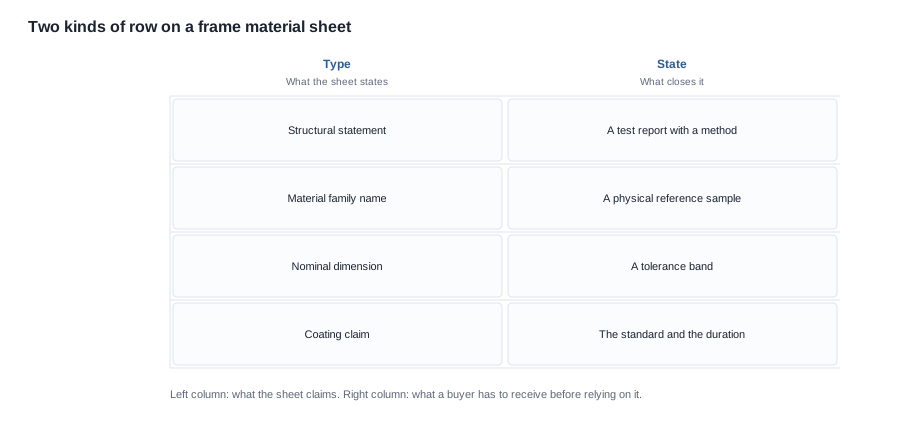
What a materials read has to settle
Whether the sheet is a specification or a description. A description lists what exists. A specification commits to what must be true of the unit you receive, and the difference is visible in the last column of the matrix above: a tolerance band, a test standard, a physical reference sample, a report with a method. Anything else is a description of a prototype.
Who controls the material decision. A frame in this category is not a frame. It is a structural member that has to carry a cell, a radio, a camera module on some models and a heat source, and it has to do that while being worn on a head for hours. That means the material decision is made jointly by the brand, the tooling owner and the component suppliers, and a buyer who does not know where that decision sits will negotiate in the wrong place.
What will be expensive to change. A tolerance band agreed with the tooling layer costs nothing. The same tolerance renegotiated after the first production run costs a new mould, a new sample round and a new approval cycle. Reading a materials sheet is therefore mostly an exercise in identifying which rows are still cheap to change.
Which claims the brand will have to defend. Every material statement that reaches a product page becomes a claim. A material a customer has been told about is a material they will blame when the frame cracks, discolours or irritates.
The buyer holding a full-looking material sheet
A brand product manager who has received a full-looking materials sheet from a supplier holds a weight, a material family, a colour name and a set of nominal dimensions, and is about to treat that as a specification. Their exposure is the first article, where the parts that do not match the nominal drawing arrive and the tooling either passes or does not.
A quality engineer or specifier writing the frame requirements for a new platform is the person who will be asked, six months later, why the tolerance band was not agreed. Their exposure is internal, which usually means it is the exposure that is hardest to defend later, because nobody outside the team can see it.
A private-label buyer working from a catalogue rather than from a factory is in the weakest position of the three, because the material rows in a public catalogue are the rows the supplier chose to publish, and the rows they did not publish are usually the ones that decide the programme. Their exposure is a product that arrives without a material record at all, which makes every downstream question — the conformity file, the packaging fit, the customer complaint — harder than it needs to be.

Where a frame material decision actually costs money
The four cost layers: tooling, tolerance, skin contact and rework
The mould itself. The front and the temples are moulded, and a mould is a one-off cost amortised across the first order. The question worth asking is not whether the supplier will waive it, but over what volume it is amortised and who owns the tool if the programme is discontinued. A buyer who leaves that ambiguous discovers it when the second range is on a different platform and the tool has already been handed over.
The tolerance band. A moulded plastic part is not identical to the same part a year later, and a tolerance band tells your packaging, your lens alignment and your incoming inspection how much variation they have to absorb. This is the row that separates a factory from a workshop, and it is the row that decides whether your first article rejection rate is a nuisance or a crisis. A datasheet with nominal dimensions and no tolerance is describing a prototype.
Skin contact. Temple tips, nose pads and the inner face of the front are the parts a wearer reacts to first and the parts that meet sweat over a long day. In a category where the product is worn on the face for hours, skin-contact failures generate returns that get filed under comfort rather than under materials, which makes them very hard to diagnose after the fact and very easy to prevent before it.
Rework and containment. Every tolerance band that is too wide is paid for in three places: at incoming inspection, in the assembly line, and in the field. A frame that needs an extra operation to fit is a frame that costs more to build, that ships with a wider gap between the front and the temple, and that produces a seam line in exactly the place a customer photographs.
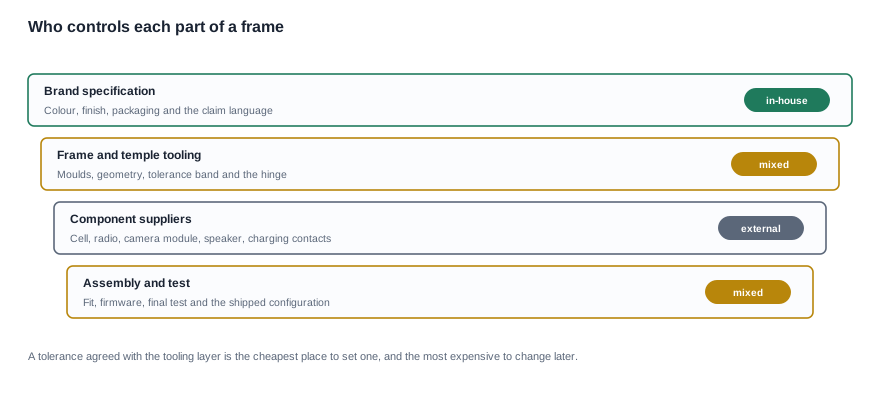
The layer diagram above is the part buyers most often skip, and it is the part that decides where a material question should be sent. A question about the tolerance band goes to the tooling layer. A question about the cell or the charging contacts goes to the component suppliers. A question about the assembled product going out of the door goes to the assembly and test layer. Sending a tolerance question to a component supplier is the fastest way to get a slow answer, because they do not own the answer.
Material strength is not a durability rating
Material lists often include a tensile or impact figure, and buyers read it as a durability rating. It is not one, and the distinction is worth a paragraph because it is the single most common misreading of a materials sheet in this category.
A material strength number says what a sample piece of polymer can take. It says nothing about a hinge, a solder joint, a flexing antenna or a cell swelling under the frame. Endurance in this category is a system property, not a material property, and the honest answer to "how durable is this" is a cycle test result: how many hinge operations, how many drops onto a desk, how many hours in a hot vehicle.
Our catalogue publishes no such figures, because we do not hold test reports for them. Where we do have a published specification, it is in the form of a component capability or a configuration option. The V03 Pro publishes flexible temples among its main specifications, and the G07 carries ultra-thin and detachable temples as configuration options. Both are structural statements. Neither is a durability test result, and we would not want a buyer to read them as one, because a detachable temple that has been cycled ten thousand times is a different claim from a detachable temple that exists.
The rows that commit, and the rows that decorate
Send the table below to every supplier. The right-hand column is the useful one: it tells you which rows you can rely on and which ones you will have to close yourself.
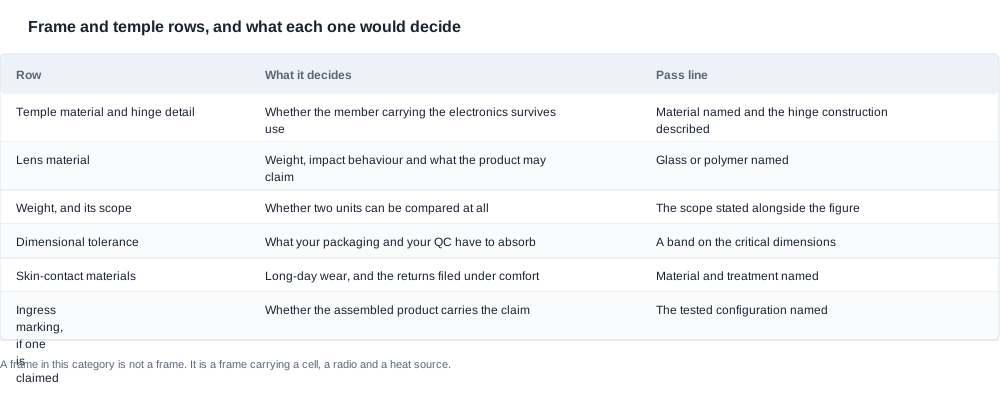
The thresholds that turn a material row into a commitment
The temple material, with the hinge construction described. The temple is the structural member that carries the electronics, so the hinge detail is not a cosmetic row. A reinforced front with an unspecified temple tells you the failure mode: the temple cracks at the hinge and the whole unit is scrap, including the cell, the radio and the camera module. The threshold is a named material plus a description of how the hinge is built and retained.
The lens material, named as glass or polymer. These are not interchangeable, and the difference shows up in three places at once: the weight, the impact behaviour and the cost. Glass brings a different assembly approach and a different shipping profile; polymer brings a different tooling approach and a different scratch profile. The row is often buried in a line that was never meant to be read closely, and a buyer who wants to make a claim about the product needs to know which of the two is in the front.
The weight, with its scope stated. Our own catalogue publishes a weight for exactly one model, 158 g for the MT6, described as the complete unit as shipped. We publish it that way because a weight without its scope is a number you cannot compare to anything. A bare frame weight, a frame-with-battery weight and a complete-unit weight are three different numbers, and a comparison chart that mixes them is a chart of nothing.
The dimensional tolerance, on the dimensions that matter to you. Not on every dimension, and not necessarily the same dimensions the factory considers critical. The buyer should nominate the dimensions that affect the product: the temple-to-front fit, the charging contact position, the button protrusion, the lens seat. A band on those is worth a great deal; a band on a dimension nobody cares about is worth nothing.
The skin-contact materials, with their treatment. The temple tips, the nose pads, the inner face of the front, and any coating or treatment they carry. The threshold is a named material for each, because a reaction over a long day is filed as comfort and is therefore never traced back to the material that caused it.
The ingress marking, if one is claimed. A rating covers an assembled product, not a frame. The interesting question is whether it was measured on the finished assembly with the same cell, the same lens and the same seals you are shipping, or whether it was inherited from a frame design that has since changed.
Why the temple row outranks the weight row
The instinct on receiving a materials sheet is to read the weight first, because it is the one number a buyer can repeat in a sales conversation. In this category that instinct is usually wrong, and the reason is structural rather than editorial.
The weight is a consequence. It is the sum of a cell, a radio, a camera module on some models, a pair of temples, a front and a hinge, and it tells you what the product will feel like without telling you whether it will last. The temple row is a cause: it tells you what is carrying the load, how the load is transferred at the hinge, and therefore what will fail first and what it will cost when it does.
There is a commercial consequence too. A weight is very hard to change late in a programme, because it means changing a material that the moulds, the fit and the packaging are already built around. A temple specification that is agreed early can be adjusted across two or three materials with a tooling change; a weight target agreed late can only be met by removing something, and what gets removed is usually the cell.
The third reason is the one a compliance reviewer cares about. A weight figure without a scope cannot be attached to a technical file, a carton or a listing without an assumption, and assumptions in a conformity file are liabilities. A temple specification with a named material and a described hinge can be attached without one.

Turning a material sheet into a checkable specification
The five-question request, and what a precise answer sounds like
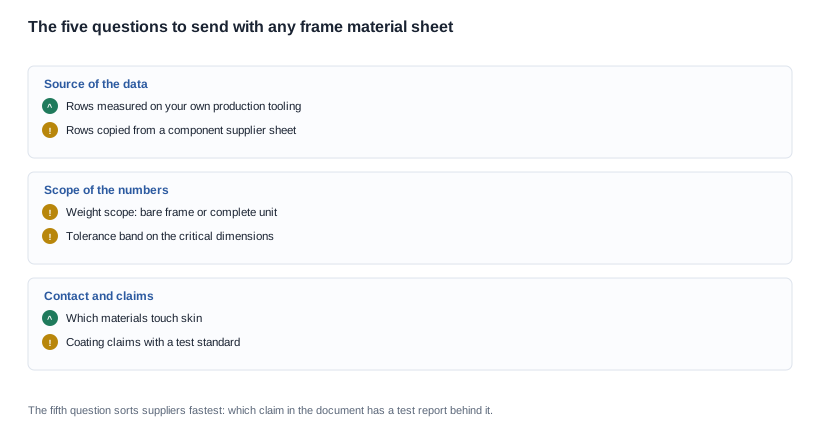
1. Which rows on this sheet are measured on your production tooling, and which are taken from a component supplier's datasheet? This is the question that sorts the sheet into two stacks, and the split is usually not obvious from the layout. A factory that answers it precisely is telling you which parts of its own document they stand behind, which is exactly the distinction your quality team will need later.
2. What is the weight measured on, and is it the complete unit as shipped? The answer should be a scope, not a number. "Frame only, tolerance ±" is a useful answer; "38 grams" is not, because it tells the buyer nothing about what was weighed.
3. What is the tolerance band on the dimensions we consider critical? A band, on named dimensions, expressed in the units the buyer will use in incoming inspection. A supplier who answers with the mould tolerances of every feature on the drawing has answered a different and much easier question.
4. Which materials touch skin, and what coating or treatment do they carry? A list, per contact point, with the treatment named. This is the question that prevents the long-day return that nobody can diagnose.
5. Which claim in this document has a test report behind it, and which does not? This is the question that sorts suppliers fastest, and it is the one that produces the most useful answer, because a precise answer is a map of the supplier's own confidence. A supplier who returns a numbered list of claims with the reports attached has given you their documentation maturity in one message.
The evidence to request before the tooling release
The dimension schedule for the front and the temples, with the tolerance band on the critical dimensions. The material designation for the front, the temple and the temple tip, from the supplier's own nomenclature rather than a generic family. The hinge construction, with the retention method described. The weight scope statement, with the figure if it is measured and a written statement that it is not published if it is not. The skin-contact material list with the treatment on each entry. A physical colour reference, and a statement of which parts the reference applies to. The ingress marking, if one is claimed, with the tested configuration named. And the certificate numbers for the rest of the conformity file, with the issuing body and the validity dates.
The timing matters as much as the list. A tolerance band requested before the tooling release is a line in a drawing. The same band requested afterwards is a new mould, a new sample round, a new approval and a schedule that has already moved.

Where a frame programme fails, and where the leverage sits
Five failure modes, and the answer for each
The temple cracks at the hinge and the whole unit is written off. The symptom is a return cluster in the first months, concentrated in one batch and one hinge revision, each return carrying a value far above the unit price. The root cause is that the hinge construction was never specified, because the materials sheet listed a material and a weight and looked complete. The answer is to name the hinge construction and the retention method in the specification, and to put it in the acceptance criteria for the first article.
A first article arrives with parts outside the drawing and the mould is accepted anyway. The symptom is a team that signs off a sample because the sample is the only one available, and then discovers the variation in production. The root cause is that there was no tolerance band, so there was nothing to fail against. The answer is to nominate the critical dimensions and agree the band before the tooling release.
Skin irritation appears after three months and is filed as comfort. The symptom is a review that mentions discomfort without naming a material, and a support team that cannot reproduce it. The root cause is that no skin-contact material was specified, so the coating and the tip material were whatever the tool room had. The answer is to specify the skin-contact list, and to ask whether the treatment has been tested for the sweat exposure the product will actually see.
A colour variant shows a seam at every junction. The symptom is a return on the colour that sold best, and a supplier that insists the samples are representative. The root cause is that the colour reference was a name or a screen code rather than a physical master, and it was not stated which parts it applies to. The answer is to request a physical reference per part, to state that it applies to the front, the temples and any internal parts, and to approve it as a sealed sample.
A material claim reaches the product page without a report behind it. The symptom is a claim the brand cannot evidence when a customer or a platform asks, usually about scratch resistance or sweat resistance. The root cause is that a coating claim was copied without the standard and the duration. The answer is to ask for the test standard and the duration with the claim, and to leave the claim out of the listing if either is missing.
The commercial terms, and where a frame programme has leverage
The tolerance band is where a materials programme has its leverage, and it is worth spending the negotiation time on it rather than on the unit price. A band agreed with the tooling layer is free to agree and expensive to change. A supplier who resists naming the critical dimensions is telling you the mould is already cut, and that is a fact the buyer needs before the deposit rather than after the first article.
The unit price on a frame-led order is genuinely negotiable, and it is more negotiable than a buyer usually assumes, because the cost of a frame programme is concentrated in the tooling rather than in the piece. The questions worth asking are over what volume the mould is amortised, whether the amortisation is shown as a separate line or buried in the unit price, and who owns the tool if the programme is discontinued or transferred. A frame programme is also where the volume tier matters more than usual, because a frame is usually ordered in a small number of configurations across a long production life.
The colour and finish count is a negotiation point in its own right, and the rule is the same one that applies across this category: negotiate the configuration count, not the unit count. Three colours with two logo treatments is six configurations, and a supplier who prices units and a supplier who prices configurations are making two different offers, and the second one is the one that determines the landed cost.
What does not move on a frame programme is the mould itself, once it is cut, and the hinge construction once it is tooled. Certification cost and certification time are also not commercial levers: the cost is per product family and the elapsed time belongs to the test laboratory and the review queue. Tooling questions and ownership questions are the useful ones, and they are worth putting in writing before the first deposit because they are the terms that survive the end of the programme.
The clauses to write into the frame purchase order
Four clauses carry a frame order. The dimension schedule with the tolerance band attached, as a document reference in the order. A notice obligation before any change of material, hinge, temple geometry or surface treatment, because each of those changes the mould and the conformity position. The acceptance criteria for the first article, referencing the nominated dimensions and the seal condition of the physical colour reference. And a clause on who bears the cost when a first article falls outside the agreed band, which is the clause that makes a rejection enforceable rather than a disagreement.
A private-label brand with no material report of its own
The scenario and the tolerance decision
This is a hypothetical scenario, written to show the decision sequence rather than to report an outcome. No customer, project or order is being described.
Assume a private-label brand manager who has received a materials sheet for a proposed frame: a material family for the front, a weight, a colour name, and a set of nominal dimensions with no tolerance band. The brand intends a two-year life with three colours and a private logo. The binding constraint is not the price of the mould. It is that the brand has no idea whether the hinge will survive a year of daily handling, and cannot tell from the sheet.
Step one, the question about the source. The manager asks the five questions and gets a clear answer to the first one: the material family and the colour come from a component supplier's datasheet, the dimensions come from the mould room, and the hinge detail is absent. The sheet is now split into two stacks, and the empty stack is the interesting one.
Step two, the hinge. The manager asks for the hinge construction and the retention method. The supplier provides it and notes that the temple is a flexible element on this platform, with a detachable option. The manager notes, correctly, that a flexible or detachable temple is a structural statement and not a durability result, and does not put it in the listing as one.
Step three, the tolerance. The manager nominates four dimensions that matter to the programme: the temple-to-front fit, the charging contact position, the button protrusion and the lens seat. The supplier answers with a band on each. The brand writes the band into the purchase order and into the first-article acceptance criteria, and it costs nothing to agree.
Step four, the weight. The manager asks what the weight is measured on. The answer is that the sheet carries a bare-frame figure, and that no complete-unit figure has been established. The manager leaves the weight out of the listing rather than publishing a scope-free number, and notes that 158 g is the kind of figure a complete-unit specification should carry, because that is the scope a customer can actually picture.
Step five, the skin contact. The manager asks which materials touch skin and what treatment they carry, and receives a list covering the temple tips, the nose pads and the inner face of the front, with a treatment named for each. The brand writes the list into the specification and into the care instruction, so that a reaction months later can be traced.
Step six, the commercial structure. The manager negotiates the mould amortisation and the tool ownership in writing, negotiates the price against a committed configuration count of three colours with two logo treatments, and adds the notice clause covering material, hinge, temple geometry and surface treatment.
Step seven, the first article. The incoming inspection is run against the four nominated dimensions rather than against the drawing, and the colour reference is a sealed physical sample for the front and the temples. The first article either passes the band or it does not, and either outcome is cheap at this point in the programme.
The result is a frame that is specified rather than described, with the four decisions that mattered — the hinge, the tolerance, the weight scope and the skin contact — taken before the tooling release, when all four were still free to change.
What our catalogue publishes about materials
A materials datasheet should be judged by what it commits to rather than by how full it looks, and we publish the material rows we have actually confirmed. For the frame, the temple and the lens material of our own models we currently publish none, which is why this article spends its time on how to read somebody else's sheet rather than on our own numbers. We will not fill a datasheet with a plausible resin grade, and we will not convert a component capability such as the flexible temple published for the V03 Pro, or the ultra-thin and detachable temple options published for the G07, into a durability claim.
We will also not estimate a weight where none is published, and we will not present the 158 g published for the MT6 as representative of a category when it is a single model on a single definition. A weight without a scope is a number you cannot compare to anything, and we would rather publish one figure with a clear scope than a table of estimates.
What we will do is read a materials sheet you have received and mark the rows that hold up, the rows that are decoration, and the rows we can answer from our own documentation. That is a service we can perform on any supplier's sheet, including one that is not ours, and it usually saves a mould revision.
Related reading
- The ergonomics questions that a material sheet does not reach — materials and ergonomics
- The rows that describe the electronic side of the product — camera and imaging specifications
- The document set that has to accompany the hardware — certification checklist
- How to check a unit that arrives in front of you — sample evaluation
Send the datasheet and the intended annual volume, and we will mark the rows that hold up and the rows that need a supplier to commit in writing.


