

Smart glasses battery life: rating and condition
The gap between a published runtime and a customer's experience has one cause, and it is almost never the cell. The published figure is a rating produced under a condition — a workload, a volume, a radio state, a temperature and a starting charge — and the customer experiences a duty cycle, which is a different thing entirely. A buyer who commits to a runtime figure in a purchase agreement without the condition attached has not made a small mistake; they have written a warranty they will pay for.
The decision, in three sentences. Treat every published runtime as a screening number until a sample confirms it under the workload you actually need, and ask the supplier for the four conditions — what was active, the volume and content, the radio duty cycle, and the ambient temperature with the starting state — in identical words across every model in the comparison. If the supplier will not produce a runtime for your duty cycle, the figure is a rating, and you should either measure it on three units yourself or publish it with a condition attached. Two models with the same cell can carry different runtimes and both be honest, because the loads are different, and that is exactly why capacity cannot be used as a proxy.
The three readers this article is written for. A procurement manager is committing a runtime figure to a purchase agreement and needs it to be a condition rather than a number. A product manager is planning the customer's charging routine and needs to know whether that routine is a nightly top-up or a mid-shift one. A channel buyer is writing the runtime copy, and that copy has to survive a customer testing it in their own conditions on day one.
What our catalogue publishes, and the shape of the range. Cell configurations from 40 mAh on the A05 and the A06 up to 290 mAh on the L1 Pro, the CY03 and the CY05, and the L2 Utral, with dual-cell configurations published per side at 55 mAh, 70 mAh and 90 mAh on the LC-105, the YKC02 and the G07, the K01 and the K02, and the YK12. Charge times of two hours or less on most models and about one hour on the D17 and the ZH12. Rated runtimes of roughly five to eight hours across the camera tier, roughly six to eight across the audio tier, and roughly twenty on the children's models. Case capacities of 900, 1200 and 1400 mAh.
What we publish for none of them is the workload behind the figure, the state distribution, the charge-time starting point or a cold-weather derating factor. Those are exactly the four rows that decide whether a runtime can be written into an agreement.
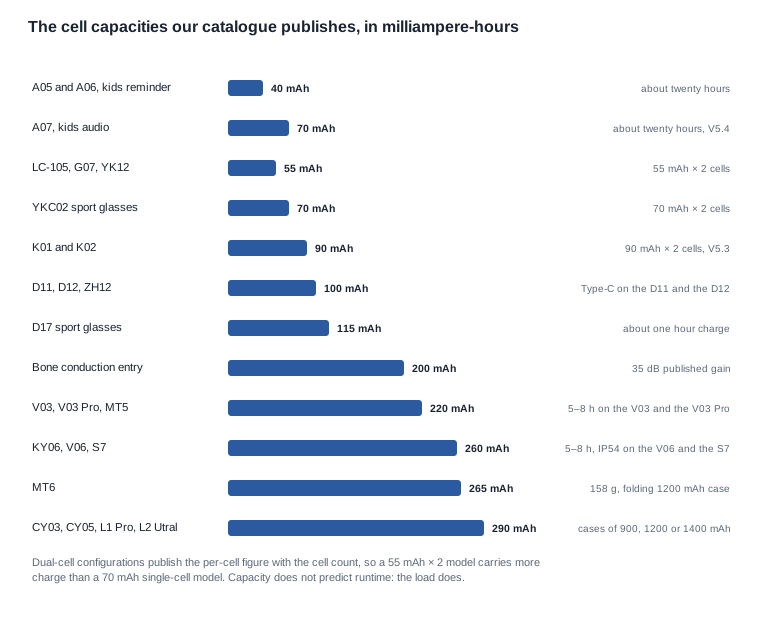
Why capacity is the wrong proxy, in one sentence. A 55 mAh dual-cell model carries more charge than a 70 mAh single-cell model, and the children's tier reaches about twenty hours on a 40 mAh cell because the workload is light and the standby is long — which means a buyer who ranks models by milliampere-hours will rank the wrong product in both directions.
Where a runtime claim sits in the quotation. Runtime is the row a customer compares against a competing product on a shelf, and it is also the row that decides whether a device has to be charged during a shift, at a conference, or between two site visits. A product whose charge interval lands in the middle of a working day is a product with a support cost, a returns cost and a listing that has to explain itself. That is the commercial content of a runtime figure, and it is worth more to a buyer than a per-unit price reduction.

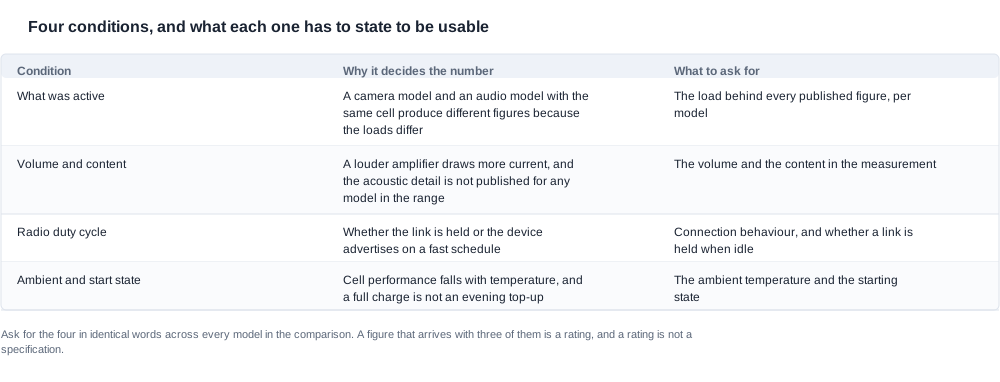
The four conditions, and the four requests that make a published figure usable
| The condition | Why it decides the number | What to ask for |
|---|---|---|
| 1. What was active | The camera, the audio, the radio, the assistant, or a combination. A camera model and an audio model with the same cell produce different figures because the loads are different | The workload behind every published figure, per model, stated in identical words |
| 2. The volume and the content | A louder amplifier draws more current, and the acoustic detail is not published for any model in the range, so the relationship between volume and consumption cannot be modelled from a datasheet | The volume and the content in the measurement |
| 3. The radio duty cycle | Whether the link is held continuously, and whether the device advertises on a fast schedule | The connection behaviour, and whether the product maintains a link when it is not in use |
| 4. The ambient and the starting state | Cell performance falls with temperature, so a figure measured at room temperature does not describe a cold market, and a figure measured from a full charge does not describe a customer who tops up in the evening | The ambient temperature, and the starting state of the charge |
The four requests, and what each one is for
The test condition behind each published figure, asked in identical words across every model in the comparison. Identical wording is not pedantry: it is what makes two answers comparable, and a supplier who answers one model in detail and another in a sentence has told you which figure was measured.
The runtime for the duty cycle you actually have. If the supplier will not produce it, the published figure is a rating and not a specification, and the buyer's position is to say so in writing at the point of quotation rather than to discover it during a dispute.
The state distribution — the hours in active use, in connected idle and in deep sleep. A runtime without a distribution cannot be compared with another runtime, because the two figures may be describing entirely different machines: one that spends its time working and one that spends its time waiting.
The charge-time starting point, because a two-hour figure from empty and a two-hour figure from a partial charge are different products, and a customer who tops up for ten minutes before leaving the house is buying the second one.
A fifth request worth adding for any line sold into vehicles, warehouses or construction sites: the behaviour of the device across a long period of intermittent connectivity, because a radio that keeps re-establishing a link in a poor-signal environment is a different load from one that holds a link. No supplier in this category publishes it, and it is the kind of question that changes the product you should be shortlisting.
The duty cycle, the cold case, and the state distribution
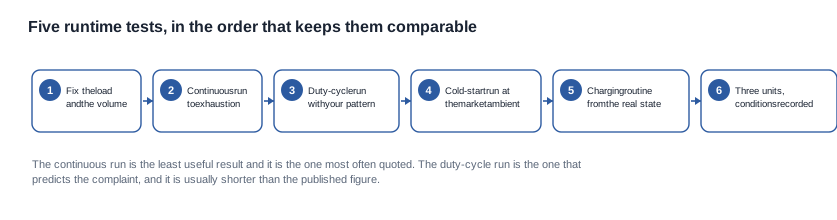
Five tests, run in this order, because the order is what keeps the results comparable.
Test one, the continuous case. Run the unit to exhaustion at the target brightness or volume, with the radio connected as it would be in use, and record the elapsed time. This is the baseline against which the other four are read, and it is almost always the number a supplier quotes.
Test two, the duty-cycle case. Run the same unit with the workload the customer actually has: a long idle period, a short active period, and a charge in the middle. This is usually the result that matters and it is usually shorter than the published figure, because the published figure is often a continuous measurement while the customer experience is an intermittent one. The ratio between the two is more informative than either number, because it is the ratio you have to manage.
Test three, the cold case. Run at the ambient the market sees in winter, from a cold start, and record the elapsed time. A room-temperature figure does not describe a cold morning, and a returns cluster that appears in the cold months is almost always a figure that was measured in a warm room.
Test four, the charging routine. Charge from the state the customer will actually charge from, and time it. This is the test that turns a runtime claim into a routine, and the routine is what the customer experiences and what the support script has to answer.
Test five, the repetition across units. Run the same protocol on at least three units, and record the conditions with every result. A single unit on a single occasion is an anecdote, and a runtime number without its conditions is not a measurement. Where the spread between the three units is wide, that spread is a consistency finding about the supplier rather than a measurement error.
The one-line version of the duty cycle to build. Write the customer's day as a sequence: how long the product is off, how long it is on, how long it is connected but idle, and how long it is actively capturing or playing. Multiply your own measured consumption against that sequence and you have a number you can defend, in a form you can put in a listing and in an agreement. Most buyers never do this, and it is the cheapest piece of work in this article.
What to record with every result. The model designation and configuration, the unit serial, the firmware version, the ambient temperature, the starting charge state, the volume or brightness setting, the radio state during the run, the interval pattern of the duty cycle, the end point that defined exhaustion, the tester and the date. A runtime figure without the end point is not comparable with anything, because two testers will call exhaustion differently.
What these five tests cannot establish. They do not establish the behaviour of the production lot that will be shipped, they do not establish the derating over a product's life, they do not establish the runtime in a market you did not test in, and they do not establish the safety or transport position of the cell, which comes from documents. The sample route is set out at sample evaluation, and the measurement method is covered under battery life specifications.

Six ways a runtime claim goes wrong, and the early warning for each
The published figure was published as a working day. The symptom is a customer in a heavy-use pattern who is disappointed within a week. The root cause is that a rating with no condition was treated as a guarantee. The prevention is to quote it with its condition attached, or not at all.
A continuous figure was compared with a duty cycle. The symptom is a product chosen for a channel and then found wanting in a different one, with the comparison made on a spec sheet rather than on a test. The root cause is that two different workloads were charted against each other. The prevention is to measure the duty cycle on a sample before the shortlist is agreed.
The cold case was skipped. The symptom is a returns cluster that concentrates in the cold months and disappears in the summer. The root cause is that a room-temperature figure was treated as a field result. The prevention is to run the cold test on at least one unit, and to publish the figure for the ambient you actually sell into.
The charging routine was never modelled. The symptom is a customer who needs to charge mid-shift and finds the product does not survive the shift. The root cause is that the runtime was published without the routine it implies. The prevention is to test the routine, and to publish the charge interval alongside the runtime.
The state distribution was never asked for. The symptom is two products with the same cell producing figures that cannot both be right. The root cause is that one of them is describing a mostly-idle machine. The prevention is to request the distribution, and to discount any figure that arrives without it.
The result was recorded without its conditions. The symptom is a dispute nobody can settle, because the number exists and the conditions do not. The root cause is that the protocol was informal. The prevention is to record the conditions with every result and to put the same conditions in the agreement.
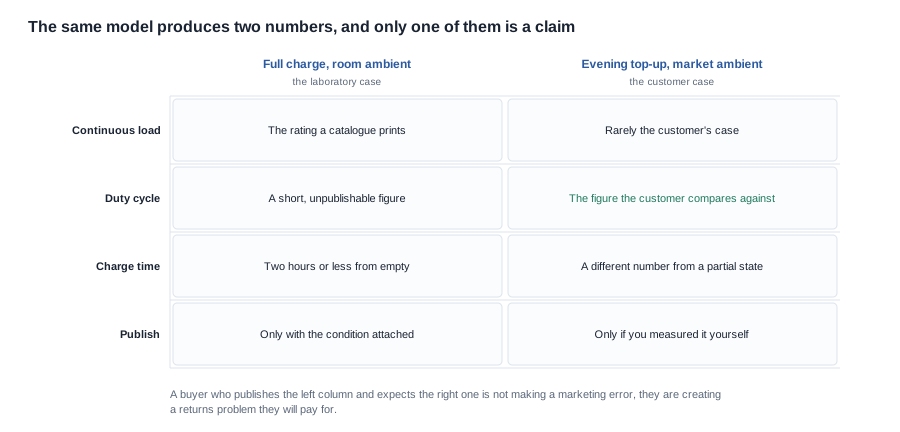
The red flags that should stop a shortlist before any sample is opened. A runtime published with no workload at all. A runtime and a charge time that cannot both be true, because the charge time assumes a charge curve the runtime does not reflect. A cell configuration quoted per side on a dual-cell model without the cell count, which is the number a buyer needs for the transport paperwork. And a supplier who will not name the starting state, because a figure measured from empty and a figure measured from a full charge are two different claims about the same product. If a candidate shows two of these, the signs that it is a rating rather than a specification are strong enough to disqualify it before the sample round.
The shortlist rule that keeps a runtime comparison honest. Which one of the candidates you should take is decided by the duty cycle, not by the published number: write your own duty cycle down, run it on two or three candidates, and take the one whose measured result supports the claim you intend to publish. That is the whole of the decision, and it is available without any published specification at all.
What a defensible runtime claim is worth in the negotiation
A runtime claim with a condition attached is narrower than one without, and narrower is worth more. In a channel where the customer tests the product on day one, an unqualified figure is a liability and a conditioned one is a specification. The commercial consequence is that a conditioned figure survives the first complaint, which means fewer refunds, fewer listing edits and a support script that can actually answer a question.
The unit price is the smallest line here, and the runtime is what determines the return rate. The negotiation worth spending capital on is the set of minimum order quantities for the accessory and charging set, since a product that needs a second cable or a spare cradle is a product with an accessory attach rate, and the accessory minimum is often more awkward than the product minimum. The packaging specification, the delivery split against a sample milestone, the payment nodes against inspection, the warranty period with a stated response time and the return terms are the other lines that move.
The return terms are the line that moves most where the runtime claim is what the customer bought. A customer who bought a product on a runtime figure and finds it does not meet that figure has a legitimate expectation problem, and the return terms decide whether that is a credit or a dispute. Agreeing the figure and the condition in the order, and tying the return terms to the same condition, removes the ambiguity before it is exploited.
The pilot tier is worth more than the run tier when the claim is the differentiator. Buying part of the quantity at a pilot price, with the balance against a measured result, converts an unproven figure into a proven one before the bulk money is committed. The supplier's reluctance to do this is itself information about how confident they are in the figure.
Two quotations in this category can be quoted but not negotiated, and they are often bundled together in a way that hides which is which. The cost of a certification, and the time the test takes, are fixed by the programme and the body that runs it. Tooling is a one-off usually amortised across the first order, while certification cost is per product family — so ask which one you are being quoted, because the two are frequently presented as a single line. Tooling also carries a question worth asking: over what volume is it amortised, and what happens to it if the programme is discontinued.
Writing the runtime condition into the agreement is what makes a runtime claim enforceable, because a runtime figure without its condition is not a specification. Put into the agreement the published rows for the configuration ordered, the runtime with its condition, its duty cycle and its state distribution, the charge time with its starting point, the measured result from the sample programme with the conditions attached, the warranty period with a stated response time, and the return terms, tied to the same condition as the runtime.
The agreement should equally bound what may be claimed from it: no runtime figure without a condition, no claim that the figure represents a working day, and no statement that the figure is typical rather than measured.
A worked runtime programme for a field-sales channel
This is a hypothetical case rather than a real engagement, and it exists to make the order of decisions visible rather than to report a result.
Assume a brand selling a camera-equipped pair to field-sales teams, where the daily pattern is ninety minutes of driving with the camera off, a two-hour site visit with intermittent capture, a working lunch with audio on, and an afternoon of notes. The supplier publishes five to eight hours for the camera tier and the brand's copy currently says "up to eight hours of use", which its own product manager does not believe.
The first decision is the sequence, written out. The brand writes the day down as a sequence of active and idle blocks and sends it to the supplier with the request for a runtime measured against that sequence. The supplier cannot produce it, because no such measurement exists, and the answer — the honest one — is that the published range is a rating produced on a different workload.
The second step is the brand's own measurement, on three units. The continuous case, the duty cycle, the cold case, the charging routine, all with the conditions recorded. The duty-cycle result is materially shorter than the published range, and the ratio between the two is the number that matters: it tells the brand that the "up to eight hours" claim describes a situation the sales team will never be in.
The third decision is the copy. The brand replaces the claim with the measured duty-cycle figure, states the workload in the sentence, and adds the charge interval — a nightly top-up — because that is the part of the runtime story the customer actually acts on.
The fourth decision is the commercial one. Rather than argue about the unit price, the brand takes part of the quantity at a pilot tier against the measured result and asks for a warranty period with a stated response time, and for return terms tied to the same condition as the published figure. The supplier concedes these more easily than a price reduction because the figure is now defensible and the exposure is shared.
The fifth step is the change control. The brand adds a clause requiring notice before any change of cell, cell count or firmware that affects the power budget, because a silent change in that area invalidates the figure in its own listing.
The outcome is a narrower claim, a support script that can answer a question, and a warranty that is a specification rather than an aspiration. Nothing in the sequence required the supplier to publish anything new.
Where our runtime rows stop being usable
The boundary we hold: the published runtime figures in this range are usable as ratings and useless as guarantees, and the gap between the two is closed with a test rather than with a footnote. We will not publish a runtime condition, a state distribution, a charge-time starting point or a cold-weather derating factor for a model where the manufacturer has not provided one, and we will not present a rating as a working day.
We will also not infer a chemistry from a milliampere-hour figure, because the same capacity figure can describe cells with different behaviour under load, and a buyer who reads a chemistry into our published number is reading something we have not written. What we will do is give you the four conditions, the five tests and the four requests that turn the published rows into something you can put in an agreement.
Three things to settle before a runtime claim is published
Request the four items in one message, in identical words, for every model you are comparing. A supplier who answers all four for every model has a measurement habit; a supplier who answers for one model has a number rather than a habit.
Run the five tests on at least three units, and record the conditions with every result. The duty-cycle run is the one that predicts the complaint, and it is the one most often skipped.
Model the customer's charging routine from your own results, then write the claim the routine supports. The measurement method is covered under battery life specifications, the target side is set out under choosing a runtime target, and the sample protocol is at sample evaluation.
Related reading
- How it is measured — battery life specifications
- Setting the target — choosing a runtime target
- The sample protocol — sample evaluation
Tell us the duty cycle, the climate and the models you are comparing, and we will tell you which figures are documented and which have to be measured.


