
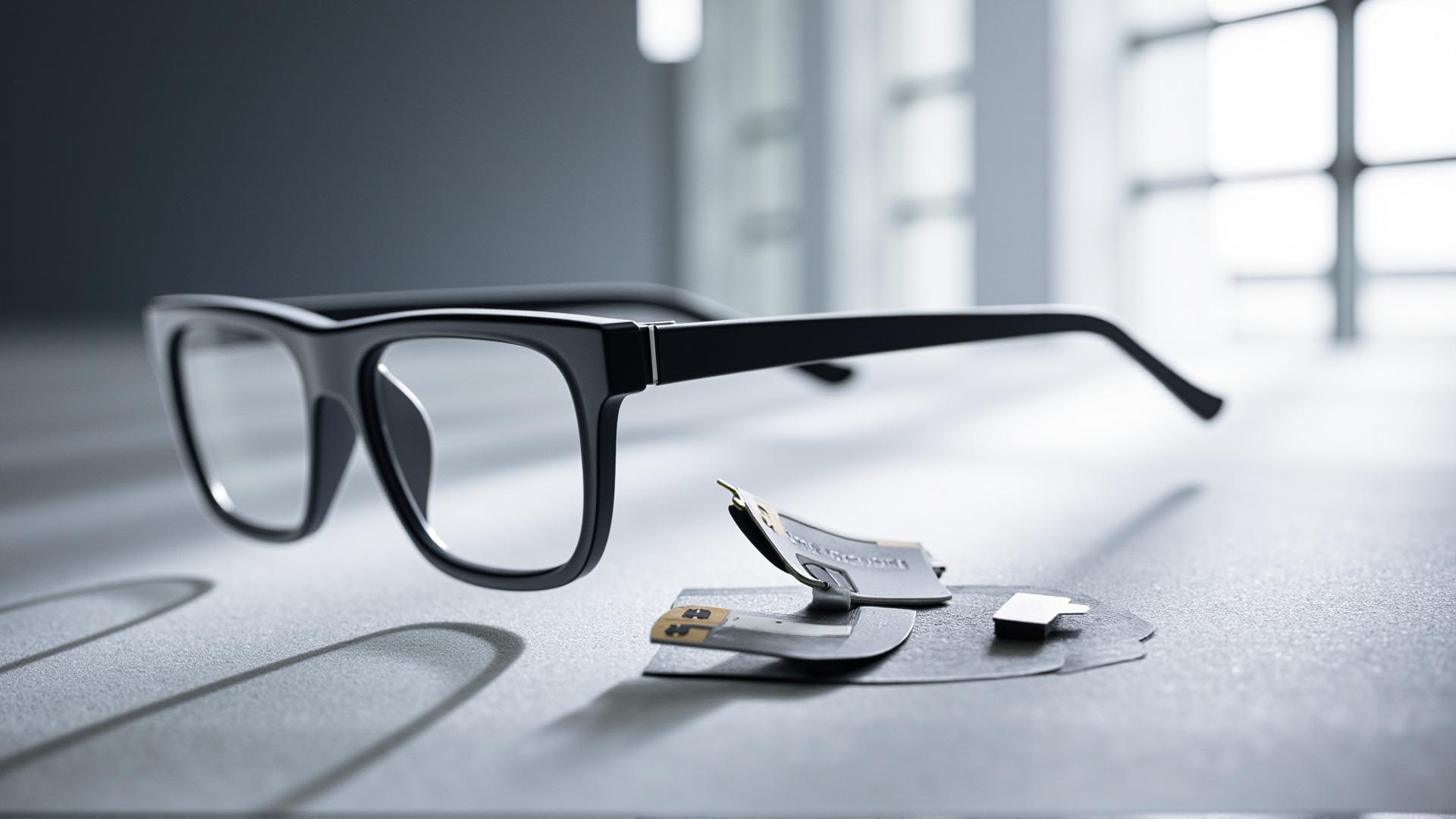
The A05 is a lens-based electronic fogging product with posture and distance detection, a 40 mAh cell, about 20 hours of endurance and magnetic charging. How it is used is decided by two things the catalogue does not describe: what the reminder actually does, and what the lens does. Everything in the routine below has to be established against a real unit, and the first week is where it gets established.
That matters for the buyer as much as for the end user. A channel that sells a children's product is selling a set of claims, and the claims come from six published feature rows on this page. They are real rows, they are specific, and none of them is described in operational terms. What a reminder looks like, what triggers it, what the fogging unit does and what the lens does under each condition are all things you can only learn from a unit in front of you, and the first week is the shortest honest way to learn them.

A05 usage starts with the six rows the catalogue publishes
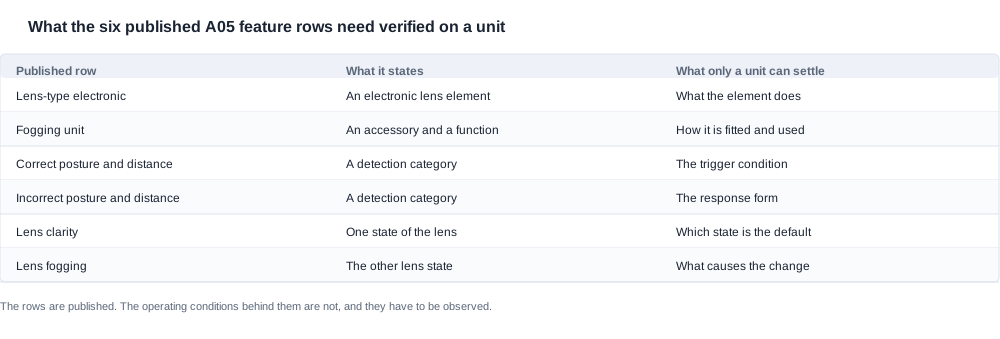
The published feature rows for the A05 read as a set: a lens-type electronic element, a fogging unit, a correct posture and distance row, an incorrect posture and distance row, a lens clarity row, and a lens fogging row. Read in that order, they describe a product that senses two things — how the wearer is sitting and how far the wearer is from what they are looking at — and then does something to the lens in response.
Read carelessly, those same six rows become something else entirely: a promise about eyesight. That reading is not supported, and it is not what the catalogue says. The rows describe the presence and the categories of a detection function and a lens response. They are not an optical prescription, not a therapeutic statement, and not a claim about how the eye develops. A product in this category is an electronic sensing accessory, and the language on the packaging, in the listing and in the channel script has to stay inside what the rows actually say, which is that the unit detects posture and distance conditions and can change the lens state.
Two of the six rows deserve particular care in how you write about them. The fogging unit row describes an accessory and a function, not a parameter of the lens itself, and a listing that describes the lens as if it were the fogging device has already misdescribed the product. The lens clarity and lens fogging rows describe two states, and the useful question for a buyer is which state is the default, how a state change is triggered, and whether it is automatic or manual. None of that is published, and all of it is observable on a unit.
The other thing to notice is the absence of the row you might expect. There is no Bluetooth row for this model. The A05 publishes a 40 mAh cell, about twenty hours of rated use, a charge time of two hours or less and magnetic charging, and it publishes no radio version. It also publishes no frame weight, no lens material, no ingress rating, no touch control row, no charging case and no per-model certification entry. So there is no pairing step in the routine below, and no app to configure, and the entire operating sequence happens on the product itself with whatever controls it physically carries.
That last point deserves one sentence of caution. The catalogue publishes no touch control row for any model in this range, so the physical interaction method on the A05 — whatever switches or buttons the unit has — has to be confirmed from a unit rather than assumed from a picture on a listing page. Assume nothing about it, because a buyer who writes a quick-start guide from an assumption produces a guide that does not match the product and a support queue that fills up in the first week.
Charging the A05 and what the twenty-hour rating does not settle
Forty milliamp hours is a small cell, and about twenty hours is a long rating for it. The pairing of those two numbers in the catalogue is unusual enough that a buyer should look at it carefully rather than repeat it.
The rating is a rated figure. The catalogue does not publish the operating mode that produces it, the duty cycle, the temperature, the condition of the detection function, or whether the rating is measured with the reminders active or idle. Twenty hours of rated use is not the same claim as twenty hours of continuous operation, and it is certainly not a claim that the product can be worn all day. The defensible form is a rated figure with its conditions attached, and the internal use of that figure is to set a duty cycle of your own for the first production batch to be accepted against.
The charging side is a ceiling. Two hours or less is what the catalogue publishes, and a ceiling is an upper bound rather than a measurement: the starting state of the cell is not published and the point at which the charge is considered complete is not published either. That second omission is the one that bites in a channel operation, because "charged" is a state a customer and a warehouse both have to agree on. If your warehouse pulls stock at a fixed interval, you need the completion criterion in writing, and it is a question for the factory rather than an inference from the catalogue.
Magnetic charging is published for this model, which is worth noting because seventeen of the twenty-eight models in the range publish magnetic charging and seven publish Type-C. For a product sold to families, the charging method has a practical consequence beyond the desk: a magnetic dock is easy to lose, and a cable is easy to replace, and the catalogue tells you nothing about what the box contains. Ask what is in the box, because the catalogue gives you a charging method and no packing list.
The twenty-hour figure also interacts with the routine in a way that is easy to overlook. A product with a small cell and a long rating is likely to spend a lot of its life in a charging state rather than an active one, and the practical question for a family is not the endurance figure at all — it is how often the product has to be put on the dock for the reminders to be there when they are needed. That is a behaviour question, and the way to answer it is to watch what the unit actually does over a week, which is what the next section is for.
A first-week routine built around supervision, not around a checklist
The routine below is written for the person who has to write the quick-start guide that ships in the box, and for the compliance and channel teams who have to sign off on it. It is deliberately arranged so that the unknowns get resolved before anything is printed, because printed guidance is expensive to correct and unprinted guidance costs nothing.
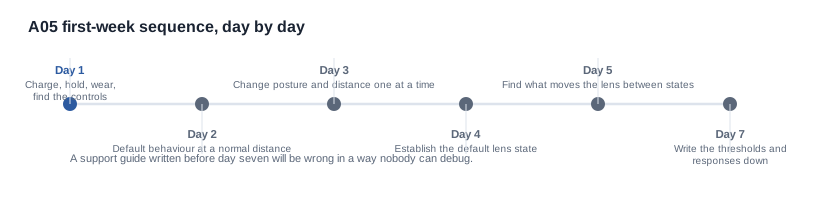
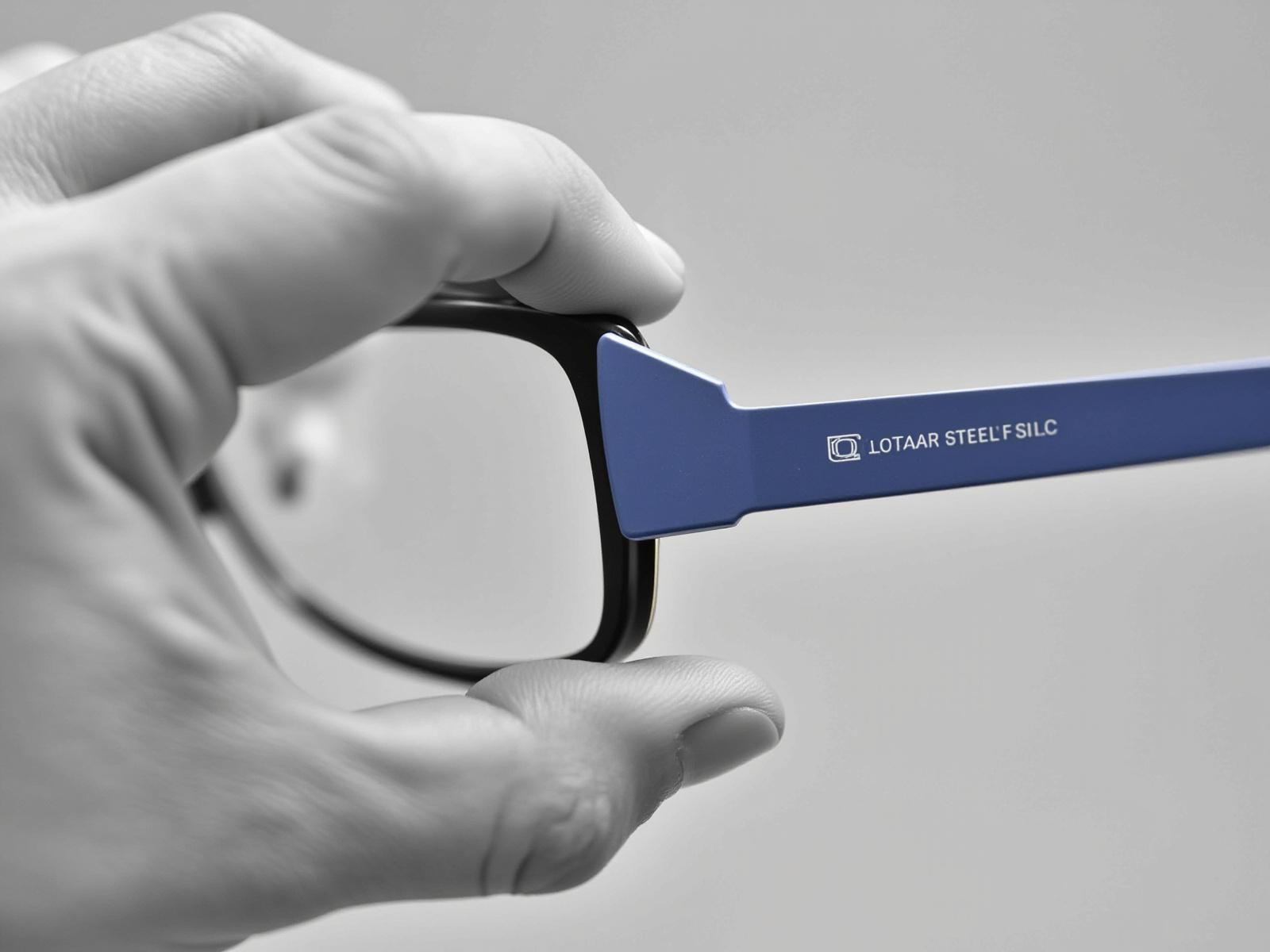
Day one, the physical baseline. Put the unit on the magnetic dock and establish what a full charge looks like on the product itself, whatever indicator it carries. Then hold it, wear it, and note the weight and the balance, because the catalogue publishes no frame weight for this model and because a product used around a child's face needs to be judged by a person rather than by a spec sheet. Note the physical controls: how many, where, and what each one does. Note whether anything is configurable, and if so by what means.
Days two and three, the detection behaviour. This is the part that cannot be shortened. Sit at a normal working distance and observe what the unit does when the posture and distance are correct. Then deliberately change one variable at a time — move closer, move further, slouch, straighten — and record what changes, whether anything happens audibly, visually or through a change in the lens state, and how long the response takes. The detection thresholds are not published, and the only way to know them is to find the boundary empirically and write it down.
Days four to seven, the fogging and the lens. The fogging unit and the two lens states are the published features that will be demonstrated to a customer first, so they need the most attention and the least assumption. Establish which state the lens is in by default, what moves it between states, whether the transition is automatic, and whether the unit does anything to the lens without being asked. Record it in the same observational form, because a description that says "the lens fogs" without a trigger condition is not a description a support agent can use.
Throughout the week, the supervision context. This is a children's product and the routine has an adult in it. A05 is published in the children's row of the catalogue alongside the A06 and the A07, and the features it publishes are sensing and lens-response features that a child interacts with. Ask what the intended age band is, since the catalogue does not publish one, and let your compliance function classify the product for the destination market on that basis. Whether EN 71 applies, and what the United States position is under ASTM F963, are requirements determined by your own compliance function after it has classified the product by destination market and age band — they are not things the catalogue states, and they are not ours to state either.
A05 records to collect for a children's product
The paperwork is the part of a children's product that is decided before the product exists, and the A05 is no exception. The list below is what a due diligence pass on this model should produce.
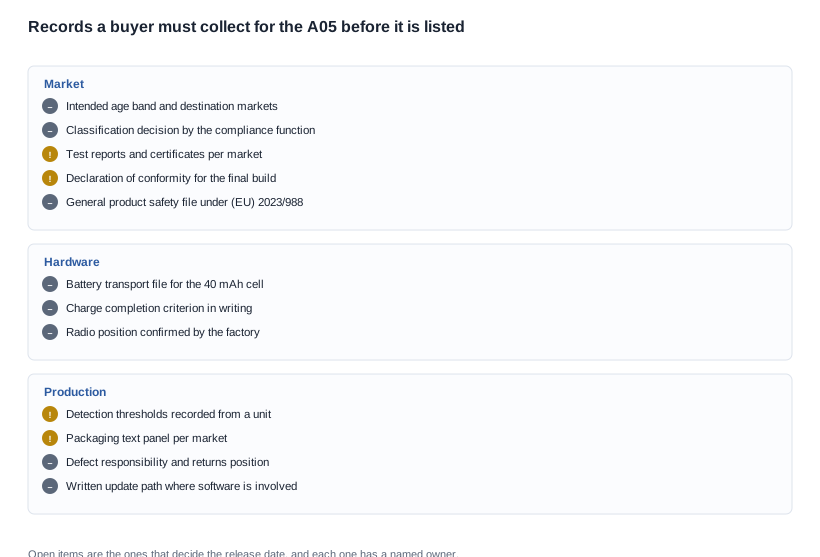
- The intended age band and the destination markets, since the catalogue publishes neither.
- The classification decision your compliance function makes for the product in each of those markets.
- The test reports and certificates that follow from that classification, per market, for the final build.
- A declaration of conformity for the configuration that will actually ship, signed by the party responsible.
- The European Union market's general product safety file, (EU) 2023/988, where that market is in scope.
- The battery transport documentation for the 40 mAh cell, including the transport test report where one is required for the cell and the packaging combination.
- The radio position, if the product is later confirmed to contain a radio, and the corresponding conformity route under the Radio Equipment Directive (EU) 2014/53/EU or the EMC Directive (EU) 2014/32/EU. The catalogue publishes no radio version for this model, and the question of whether any radio is present at all has to be answered by the factory.
- The charge completion criterion and the cell start state, in writing.
- The detection thresholds, expressed as the boundary conditions observed on a unit, so that they can be checked on a production batch.
- The packaging and the insert, with the text panel per market, and the artwork approval record.
- The defect responsibility split and the returns position for a product used by children.
- A written update path, if any software is involved in the reminders.
The last three items on that list are the ones that get skipped, and they are the ones that decide whether the second order is the same product as the first. A production batch checked against an unrecorded threshold will fail on a difference that nobody can argue about, because the threshold was never written down. That is the practical value of collecting the record while a unit is in front of you: it converts an argument into a check.
Two further points on how to evaluate a supplier on this model. The first is that a factory which answers "the child will be reminded" without a trigger condition has answered a marketing question, and the questions to ask are the operational ones: under what condition, how often, in what form, and can it be switched off and by whom. The second is that the A05 and the A06 publish the same rows — the same cell, the same rating, the same charge time, the same charging method and the same six feature rows — which means a supplier answering about "the kids sensing model" may be answering about either. Ask for the model identifier in the answer.

Choosing an A05 supplier on evidence rather than description
For a product in this row, the difference between a good supplier and a weak one is visible in how the answers arrive, not in how the product is described. The published rows are the same for every factory quoting this model, and the claims in a presentation will be the same too. What differs is the quality of the evidence offered behind them.
There are four criteria worth applying to a first quotation, and each of them is a question that has to be answered specifically.
Does the answer name the build? A reply that describes the product in the catalogue's own words is describing the catalogue, not the product. The useful answer identifies the configuration, the firmware or program version if there is one, and the state of the unit that the observation was taken from. A supplier who is willing to be that specific has an internal record; a supplier who is not, does not.
Does the answer include a threshold? "The unit reminds the child" is a description. "The unit reacts when the viewing distance falls below the distance observed at a normal desk position, and the response takes the form of a lens state change" is a threshold. The second one can be tested on a production batch; the first one cannot be tested at all, which means every unit you receive is a unit you have to investigate.
Does the answer separate what is published from what is observed? A good supplier will tell you which of the six rows is a catalogue statement and which part of it is a behaviour they have confirmed on a unit. This matters for your documentation, because the gap between the two is exactly where an inaccurate product description creeps in — and on a children's product that gap is where the risk sits.
Does the answer name a document? Ask for the conformity documentation for the final build in your destination market, and see what comes back. The documentation the factory holds is usually the evidence that the factory has already done this work before. A supplier who answers with a general statement about the factory's capability has answered a different question, and the due diligence is not complete.
The trade-offs in this evaluation are practical rather than philosophical. A supplier with a mature, documented product may quote a longer lead time because the documentation is already in place; a supplier promising a shorter one may be promising to assemble the paperwork later, at your cost and on your schedule. A supplier with a well-instrumented unit will produce a first-week observation in a few days; one without will need a week of your own team's time. The total cost of a children's product includes that engineering and documentation time, and it is the part of the cost that never appears on an invoice.
Two red flags are worth naming. The first is a supplier who asks you to confirm the age band and the destination markets without offering a classification position of their own, which means the compliance work is being pushed into your organisation. The second is a supplier who quotes the twenty-hour figure as though it were a continuous-use figure, because the language will end up on your listing and the evidence behind it will not.
Before you commit, put the four questions in writing and require the answers in writing. Then check the shortlist of documentation you need against what has actually arrived, rather than against what was promised in a meeting. The checkpoints that matter are simple: a build identifier, a set of observed thresholds, a conformity document for the configuration you are buying, and a charge completion criterion. A factory that produces all four is a factory the next order can be repeated with, and a factory that produces three is a factory you will be re-investigating in six months.
What the A05 catalogue leaves to the supplier
Here is the whole published record for this model: a 40 mAh cell, about twenty hours of rated use, a charge time of two hours or less, magnetic charging, and the six feature rows covering a lens-type electronic element, a fogging unit, correct and incorrect posture and distance, lens clarity and lens fogging.
What we do not publish: a frame weight, a lens material, an ingress rating, a radio version, a touch control row, a charging case capacity, an age band, a charge completion criterion, or any per-model certification entry. The catalogue also carries a company-level section on export certification, and the content on that page is graphical rather than textual. A patent certifies nothing about a product. The catalogue text names none of the market-access marks a buyer will ask about.
We will not fill any of those gaps with estimates. We will not describe a detection threshold, a fogging behaviour or a charging rule that has not been observed on a unit, and we will not present a sensing accessory as anything to do with eyesight, because the published rows do not support that and the product is not a medical device. Where a specification is silent we would rather hand you the question to put to the factory.
The kids smart glasses page groups the three models in this row, and the differences between them are structural rather than cosmetic: the A07 publishes a radio version and no detection rows at all, while the A05 and the A06 publish the same detection rows and no radio version. If the deciding question for you is which published row matches your requirement, that page is where the comparison belongs, and if the deciding question is what the factory has to confirm, the certification checklist sets out the order in which to ask.
Send us the destination markets and the age band you intend to sell into, and we will come back with the confirmation list our own team would work through with the factory for the A05.


