

Using the A06 smart glasses is a six-step routine — charge, identify, observe, record, supervise, hand over — and the reason this article exists is that three of those steps depend on information the manufacturer has not published. The A06 is documented as a kids smart protection model with a lens-type electronic element, a fogging unit, posture and distance detection, a 40 mAh cell, magnetic charging and about 20 hours of endurance. What is not documented is the app, the detection thresholds, and the certification position. For a buyers' guide, that means the operating routine is only half the story.
The other half is harder to say out loud. The A06's published rows are the same as those of the other sensing model in this row of the catalogue, and that fact creates a problem that has nothing to do with how the product works. If two products publish identical data, then the published data cannot be the thing that selects between them — which means the whole of the selection logic has to move somewhere the catalogue does not reach.
A06 selection starts where the specification stops
Here is the published record for this model, in full: a cell of 40 mAh, roughly twenty hours of rated use, a ceiling of two hours or less on the charge, magnetic charging, no published radio version, and six feature rows. Two of those rows describe a lens state — one for clarity and one for fogging. Two describe a condition of posture and distance, one for the correct condition and one for the incorrect condition. The remaining two name a lens-type electronic element and a fogging unit.
That is the same set of rows the sibling model in this row publishes, down to the cell, the rating, the charge ceiling and the charging method. The catalogue does not publish a colour line for either, nor a weight, nor a lens material, nor an ingress rating, nor a touch control row, nor a charging case, nor any per-model certification entry.
Read as a specification, this row is thin. Read as a selection criterion, it is close to empty, and that distinction is worth being blunt about, because it is where procurement conversations go wrong. A buyer who is asked to choose between this model and the other sensing model in the row, and who is given a specification sheet to do it with, is being handed a sheet that cannot answer the question. Any claim that one of them is the newer, the upgraded or the better-equipped version is a claim about something the catalogue does not publish, and it is exactly the kind of claim that turns into a listing dispute later.
The practical consequence is that the selection has to be made on identifiers and on programme content rather than on headline figures. That is not a weakness in the product; it is a fact about the record. And a record like this is entirely workable once you know where to look, because the identifiers are stable, they are printed on the goods, and they are the thing a warehouse, a listing and a customs declaration all have to agree on.

Two identical rows and one variable that separates them
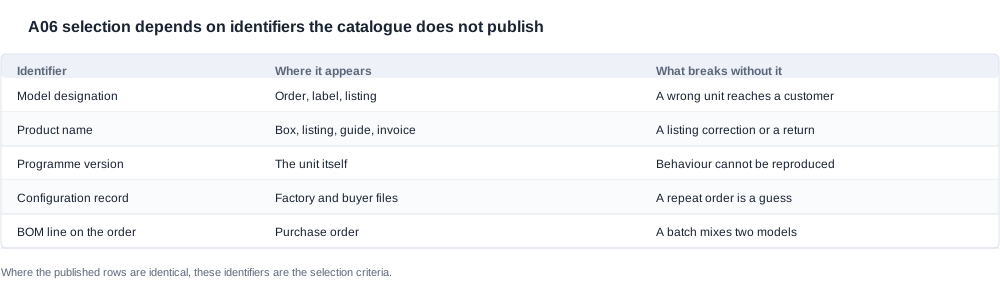
When two catalogue rows are identical, the variable that separates them is the identifier set, and the identifier set is worth enumerating precisely, because each one is checked at a different point in the chain.
The model designation is the first. It is the shortest of the identifiers and the one most likely to be mis-set, because it is a short string, it looks like the other one, and it is typed by hand into a purchase order and a listing. If two models in the same row differ by a single character, a single-character transcription error is a realistic failure mode rather than an exotic one, and it is invisible in every downstream check that only compares quantities.
The product name is the second, and it is the one that reaches the customer. It appears on the packaging, on the listing, in the quick-start guide and on the invoice. It has to be consistent across all four, and a divergence between the name on the box and the name on the listing is the kind of defect that generates a returns request rather than a complaint, because a customer who receives an item with the wrong name on the box will not describe it as a mismatch, they will describe it as a faulty product.
The programme version is the third and it is the one that matters most. Two units with identical specifications can carry different programmes, different detection behaviour and different default lens states, and none of that appears in a catalogue row. Asking for the programme or build identifier on the unit is what turns "the A06" from a name into a thing that can be ordered again.
The configuration record is the fourth. This is the document that says which model identifier, which programme, which packaging and which market documentation were used to produce the batch. A buyer who has it can repeat an order; a buyer who does not has a catalogue page and a guess.
The BOM or version line on the order is the fifth, and it is the cheapest insurance in the whole list. A purchase order that carries the model designation, the product name and the programme version on a single line, and a goods-in check that verifies all three against the same record, removes most of the realistic ways for the wrong unit to reach a customer.
The risk is not theoretical in the way that a compliance failure is theoretical. A mixed delivery is a returns problem, a listing correction, a repackaging cost and an inbound logistics cost, and all four land in the same quarter as the first order, when the budget for handling them is smallest.
Building the A06 usage routine around identification
Because the selection cannot be made on specifications, the operating routine has to start one step earlier than it would for a model with a differentiating row. The identification step is not a formality here; it is the step that makes the rest of the routine refer to a specific product.
- Receive against the identifier record. Check the model designation, the product name and the programme version on the unit and on the packaging against the configuration record for the order. Anything that does not match stops the batch rather than going to the shelf.
- Charge on the magnetic dock and note what a full charge looks like. The charge time published for this model is a ceiling of two hours or less, and the start state of the cell and the point at which the charge is treated as complete are not published. Both belong in a written record from the factory.
- Find the physical controls. No model in this range has a touch row published, so the way the unit is operated has to be read off the product and written down, not assumed.
- Observe the sensing behaviour. Establish what happens at a normal posture and distance, then change one variable at a time and record the threshold and the form of the response. The published rows name the conditions; they do not give the values.
- Establish the lens states and the fogging unit. Which state is the default, what moves it, whether the transition is automatic, and what the fogging unit does when it is fitted.
- Record the programme identifier on the unit and attach it to the acceptance record for the batch, so the next order is reproducible.

The twenty-hour rating is worth one more paragraph, because it is the figure a channel will put on the packaging. About twenty hours is a rated figure, and the catalogue does not publish the duty cycle, the operating mode, the conditions or whether the detection function is active during the measurement. It is also an unusually long rating for a forty milliamp hour cell, which tells you something about how the measurement was taken even if it does not tell you what the measurement was. Publish it as a rated figure with the conditions you have written down; do not publish it as a continuous-use time, and do not turn it into an all-day claim in a channel script.

A06 documentation: the file set for a children's model
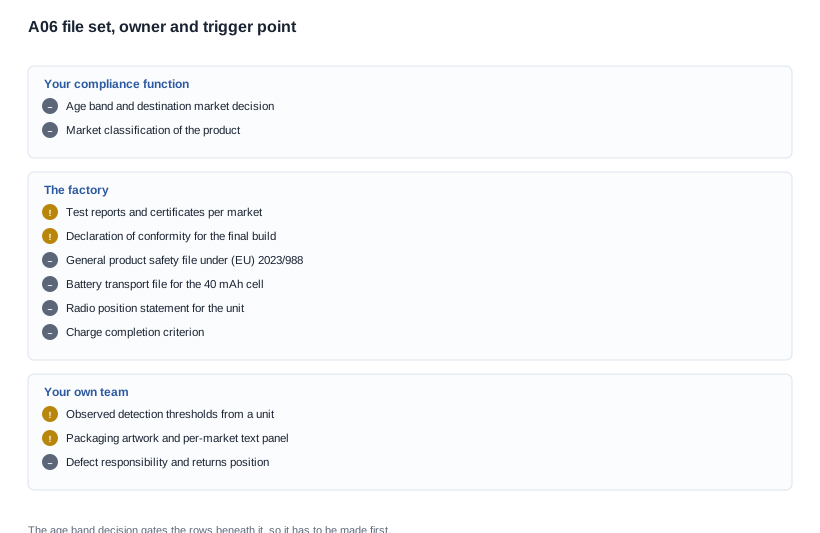
The document set for a children's product is decided by the destination market and the age band, and neither of those is published for this model. What follows is the structure a due diligence pass should produce, and the column that matters is the second one, because it identifies who has to sign.
| Document | Who signs it | When it is needed |
|---|---|---|
| Age band and destination market definition | Your compliance function | Before the sample is approved |
| Market classification of the product | Your compliance function | Before any listing copy is written |
| Test reports and certificates per market | The factory, for the final build | Before the production release |
| Declaration of conformity for that build | The factory | With the first production delivery |
| General product safety file under (EU) 2023/988 | The factory, where the market applies | Before the European Union release |
| Battery transport file for the 40 mAh cell | The factory | Before the first shipment |
| Radio position statement for the unit | The factory | Before any radio claim is made |
| Charge completion criterion | The factory | Before the warehouse writes its procedure |
| Observed detection thresholds and lens behaviour | Your own team, from a unit | Before the quick-start guide is printed |
| Packaging artwork and per-market text panel | Your own team, approved by the factory | Before the packaging is produced |
| Defect responsibility and returns position | Both parties, in the agreement | Before the first order |
The classification row is the one that causes the most delay in practice, and the reason is that it cannot be started until somebody has decided the age band. The catalogue does not publish one for this model, and the age band is a commercial decision as much as a compliance one, because it determines which requirements apply, which documentation is needed, and which markets the product can be sold into at all. Deciding it late is the single most expensive sequencing mistake available on a product in this row.
On the radio, keep the two frameworks apart. If a radio is present, the relevant framework is the Radio Equipment Directive (EU) 2014/53/EU; electromagnetic compatibility is covered by the EMC Directive (EU) 2014/32/EU, and the two standards involved, EN 300 328 and EN 301 489, are harmonised standards a route relies on rather than certificates in themselves. This model publishes no radio version, so the starting position is that a factory has to answer whether a radio is fitted at all before a listing mentions one.
There is an export certification section in the catalogue, at company level, and its content is graphical rather than textual. A patent does not certify a product, and no per-model certification row exists anywhere in the range, so the documentation set above is not a formality that the catalogue has already satisfied for you.
There is a criteria question hiding in that table, and it is the one that separates a supplier who can support the product from one who can only describe it. Does the answer arrive with an owner and a date, or with a statement of general capability? A file that arrives with a named owner, a build identifier and a date is evidence. A statement that the factory is able to provide such documentation is a claim about the factory, not about the product, and it tells you nothing about the state of the file for your build. On a product where the age band decision gates four of the rows beneath it, the difference matters, because an unowned document in the middle of the chain does not block a date — it blocks everything after it, quietly, until the shipment is due.
How the duplicate rows change the questions to ask
When two rows are identical, the questions to ask a supplier change shape rather than just change content. The usual first questions — how long does the battery last, how long does it take to charge, what is the radio version — return the same answers for both models, which means they are not questions at all, they are confirmations. Confirmation has value, but it settles nothing, and a buyer who stops there will make the decision on a feeling.
The questions that do the work are the ones about identity and behaviour. What is the model designation on the label and the order line. What is the product name on the packaging. What is the programme version on the unit, and what changed between versions. Which detection thresholds apply, expressed as a boundary condition rather than as a description. What is the charge completion criterion, in writing, so that the warehouse and the customer agree on what "charged" means. Whether the build supplied for this order carries any configuration difference from the last order. Those are the questions to ask, and a supplier who answers them specifically has given you a shortlist you can act on.
There is one more habit worth forming, and it is about the order rather than the product. When the specification cannot separate two options, the comparison has to be built from the commercial terms instead: the minimum order quantity per identifier, the cost of a programme change, the cost of a packaging change, the lead time attached to each, and the price difference if there is one. Those are the criteria a buyer can actually evaluate, they are documented in a quotation rather than a catalogue, and they are the ones that will still be true when the next order is placed.

The A06 and A07 decision, made on published rows
The kids row of the catalogue holds three models, and only two of them are in the same group: this one and the other sensing model. The third is the audio model, and it is worth setting the three side by side, because the published rows separate them cleanly even though the product names sit close together.
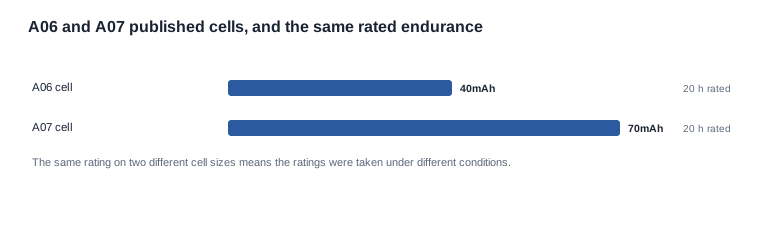
The audio model publishes a 70 mAh cell, a rated twenty hours, a two-hour ceiling on the charge, magnetic charging and Bluetooth V5.4, and it publishes no sensing rows at all. The two sensing models publish 40 mAh of cell, that same twenty-hour rating, that same two-hour ceiling, magnetic charging, no radio version, and the identical six sensing rows.
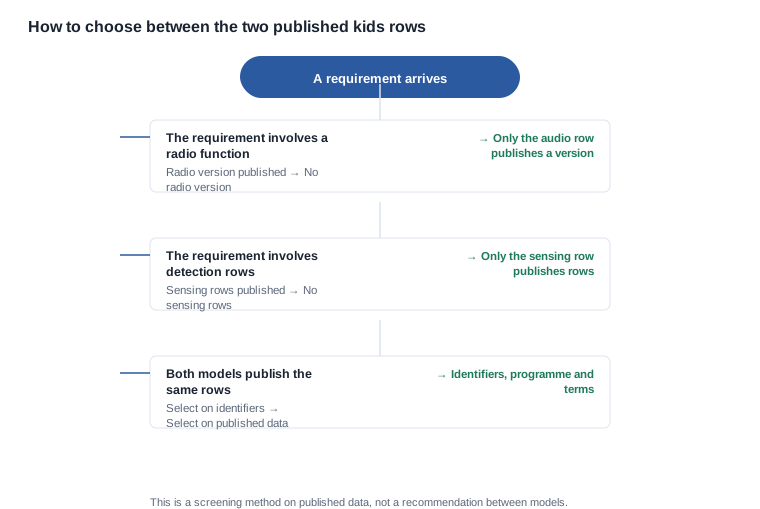
So the screening method is straightforward, and it is a method rather than a recommendation. If the requirement in front of you involves a radio function, then the only model in this row with a published radio version is the audio one, and the two sensing models are not candidates on the published data. If the requirement involves the detection and lens rows, then the only models with published rows of that kind are the two sensing models, and the audio one is not a candidate. The rest of the decision — which of the two sensing models, and on what basis — cannot be made on the published data at all, and has to be made on identifiers, on programme content and on the commercial terms.
One observation from that table deserves emphasis, because it is the kind of thing that gets misread. The two models publish the same rated endurance on cells of different sizes. A forty milliamp hour cell and a seventy milliamp hour cell carrying the same twenty-hour rating means the two ratings were reached under different conditions, which means the rating is a description of a measurement rather than a property of the cell, and which means the two numbers should never be placed next to each other in a comparison as though they were the same measurement. The same applies within a model: the twenty-hour figure is a rated value, and the conditions behind it are unpublished.
Where the A06 catalogue ends
The published record for this model is: 40 mAh of cell, a rated twenty hours, a two-hour ceiling on the charge, magnetic charging, no published radio version, and six feature rows describing two lens states, two posture-and-distance conditions, a lens-type electronic element and a fogging unit.
We do not publish a weight, a lens material, an ingress rating, a control row, a case capacity, an age band, a rule for deciding a charge is complete, a detection threshold, or a per-model certification entry for it, and we will not put numbers into any of those gaps. We will also not describe a sensing accessory as though it had any bearing on eyesight, and we will not present a fogging unit as a lens specification. The published rows are the boundary of what can be claimed, and a claim that goes past them is a claim the documentation will not support when it is tested.
The kids smart glasses page carries all three models in this row, and the two sensing models sit next to each other there, which is the useful place to confirm the structure before a shortlist is drawn. If the question is what has to be obtained in writing before the first order, the contract terms page is where the responsibility split and the repeat-order mechanism are set out.
Give us the age band and the two markets you are opening for, and we will send back the identifier set we would require on the order so that the A06 reaching your customer is the unit you bought.


