

The CY03 publishes an 8 MP camera, a 290 mAh cell, charging in two hours or less, roughly 7 hours rated and a 1400 mAh charging case — one of only a handful of documented case capacities in this range. That makes the case the first thing to establish, both for use and for your own unit economics. This page is written for the buyer who has to write the quick-start guide, set the acceptance criteria and defend the case economics, and it is organised around the first-session sequence that a channel's support load depends on.
The published row is short and one part of it is a gap. There is no charging method row on this model, which is unusual and easy to miss when you are comparing against products that name their interface. What the page does publish is the cell, the rating, the charge ceiling, the camera resolution class and the case capacity. Everything else — the sensor, the field of view, the frame rate, the video format, the storage, the transfer path — is absent, and a first session is the only way to find out what you have actually bought.
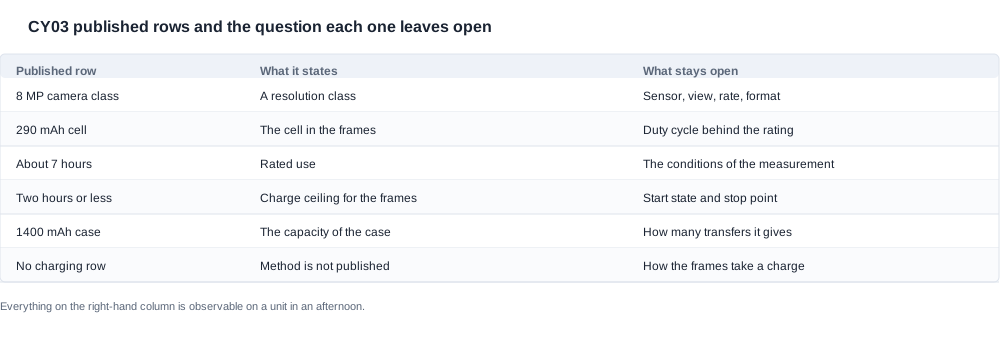
CY03 operation starts with the case, because the charging method is not published
Four models in this range publish no charging method row at all, and the CY03 is one of them. The catalogue lists the cell capacity, the rated use, the charge time, the camera class and the case capacity, and then stops. There is no magnetic contact and no Type-C connector named for the glasses themselves.
That is worth understanding properly, because the absence is easily misread in two opposite directions. It is not a statement that the product cannot be charged, and it is not a statement that it has no charging case — the case is the one piece of charging hardware this model publishes, with a 1400 mAh capacity. What it is, is a statement that the method by which the glasses themselves draw their charge is not published. Whether the case charges the frames inductively, through a contact, or by another arrangement is a question for the factory, and so is the question of whether a direct cable connection exists at all on a production unit.
The practical consequence for a first session is straightforward. You cannot write a charging instruction until you know where the charge enters the frames and how long it takes from the state the case itself is in. The published ceiling of two hours or less applies to the frames; whether the case takes longer, and whether the case can be topped up while the frames are charging, is not published and matters a great deal to anybody planning a working day around the case.
There is a second reason the case has to come first in the routine, and it is the reason the buyer's attention belongs on it before it belongs on the camera. The case is the only published power source in the row, and it is the component that determines how many working sessions a single charge of the case supports. Everything downstream — the recharge plan, the packaging decision, whether the case is a product or an accessory, the support script for a customer who runs out of power — derives from one number and one set of questions about how the case behaves.
The camera deserves attention too, and it gets its own section below, but the sequencing is deliberate. A camera that cannot be powered through a full session is a different product from one that can, and the case is what decides which one you have.

The CY03 recharge arithmetic the 1400 mAh case allows
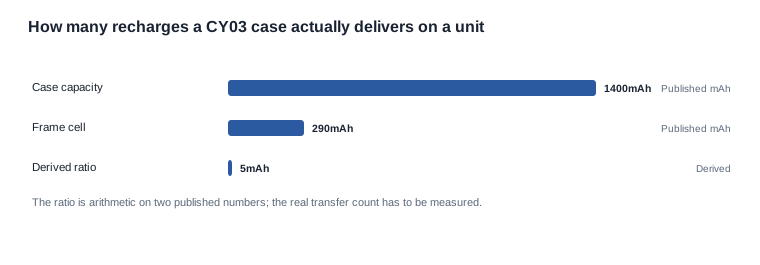
The two capacities published for this model are 290 mAh for the cell in the frames and 1400 mAh for the case. Dividing one by the other gives a little under five, and that ratio is a derived figure rather than a published one — it is arithmetic performed on two published numbers, not a claim the catalogue makes, and it should be labelled as derived wherever it is used. It is also a ceiling of a ceiling, because a case does not deliver its full rated capacity to a frame in practice.
What the ratio gives you is a planning figure, not a guarantee. A reasonable working assumption for a case of this size is that it supports a small number of full frame charges plus a partial one, and the number that actually matters is the one you measure on a unit: how many full recharges a fully charged case delivers to fully drained frames, and what the frames deliver in the first twenty minutes after a recharge.
The measurement is easy to run and almost never run, and it is the single most valuable number a buyer can take away from a first session. Start with a discharged case and a discharged frame, charge the case, then transfer repeatedly, recording the state of the frames and the case after each cycle until the case is exhausted. The result tells you how many working sessions a customer gets from one case charge, and it tells your support team what the real answer to "how long does the battery last" is, which is a question the catalogue cannot answer and which a customer will ask in the first week.
The second measurement is the one that decides whether the case is a product feature or a box accessory, and it is the recovery rate: how long it takes to move charge from a full case into a frame, and how long it takes to do it again for the second frame. If the first transfer is fast and the second is slow, the case is closer to a battery with a convenience function. If both are consistent, it is a power bank, and it can be sold and documented as one.
The third measurement is the one that catches a packaging decision before it is made: whether the case holds its charge while the frames are in it, and how long a charged case keeps a full frame at a usable level when nothing is plugged in. A case that cannot hold a charge is a case that has to travel with a cable, and a cable is an accessory that has to be counted, shipped, replaced and returned. A case that holds a charge changes what the box contains, and therefore what the unit economics of the product look like, and therefore what a channel can price.
None of this is published, and all of it is observable on a unit in an afternoon. That is the argument for doing it at the first session rather than after the first delivery: every one of these numbers is a selling point, a support answer or a packaging decision, and all three are locked by the time the first order is placed.
What the CY03 camera row settles and what it leaves open
The camera on this model is published as an eight megapixel resolution class, and that is the full extent of the published camera information. Eight of the eleven camera models in this range sit in that eight megapixel class and three sit in a thirteen megapixel class, and for the CY03 the row tells you the class and nothing else.
The word to be careful about is "megapixels". A resolution class is a count of pixels, and it says nothing about the size of the sensor that collects them, the lens in front of it, the field of view that reaches it, the frame rate the processor manages, the format the footage is written in, or the behaviour of the camera in low light. It is not a quality grade, and two cameras of the same class can behave very differently in the same room. A buyer who treats the class as a quality statement is making a claim the number does not support, and that claim ends up in a listing.
So the published camera information settles one thing, which is that the resolution class of this model is fixed and known. Everything else has to come from the factory in writing or from a unit in front of you. The questions worth asking, in the order that matters for a channel, are: what is the field of view, what frame rate does the camera record at, what format and container does it write, where does the footage go, and how much can be held before anything has to be moved off the device. Those five answers are the difference between a product that can be listed accurately and one that cannot.

The storage question is the one most often left to the customer, and it is the one that creates the worst support tickets. If the answer is that footage is held on the device and has to be moved to a phone or a computer, then the transfer path, the file naming, the transfer duration and the failure behaviour all become part of the product, and the quick-start guide has to describe them. If the answer is that the footage goes somewhere automatically, then the account, the network requirement and the privacy position all become part of the product. Either way, something in the listing has to describe it, and a buyer who has not established which of the two applies cannot write that line.
There is one more published fact that belongs in this section because it is easy to assume the opposite. The catalogue publishes no ingress rating for this model. The two models in the whole range that carry an ingress marking are not this one, and the practical consequence for a camera product is that no statement about water, sweat or rain may appear on the packaging, in the listing, in the support script or in the sales material. If a channel needs a claim of that kind, it has to be established separately and in writing, and it will not come from this page.

A first-session sequence for the CY03
Written for the buyer who is producing the quick-start guide and the acceptance criteria, this is the order in which the work should be done on the first unit, and the order matters because each step depends on the state produced by the one before it.
- Charge the case first and record its state. Establish what a full case looks like, whether it reports a state of its own, and how long it takes to get there. The charge ceiling of two hours or less applies to the frames, so the case timing has to be observed separately rather than assumed to match.
- Establish the recharge count. From a full case and a drained frame, count the transfers and record how much of each one the frames receive. Write the number down, because it is the number your support team will be asked for.
- Find how the frames take their charge. Open the case, connect the frames, and observe what happens physically: whether there is a contact, whether there is a light, and what the frames show when the charge is running. The published row does not name a charging method, so this is an observation, and the guide cannot be written without it.
- Power the frames and read the camera state. Establish what the product shows about its own camera — a status, an indicator, a menu — and record it. Then record what happens on a fresh power-up with no content on the device.
- Capture, and check that the capture happened. Take a short recording and confirm that a file exists, that it opens, and that it plays. The common failure in a first session is not a broken product; it is a product that was never recording, and the person wearing it did not find that out until the footage was already gone.
- Move the footage and time it. Record how long the transfer takes, what happens if it is interrupted, and what the file looks like once it is on another device. This is the step that decides the length of the support script.
- Work through the battery until it is nearly empty, then recharge once from the case and repeat step two. A single capture on a full battery tells you nothing about the product at hour six.
- Write the guide from the observations, and only from the observations. Every sentence must be traceable to a step above, and anything the factory has not confirmed in writing does not go in.

Acceptance checks for a CY03 batch
The first production batch is the last point at which these checks can be written rather than argued. A short list, agreed before the sample is approved, is what makes a later claim defensible.
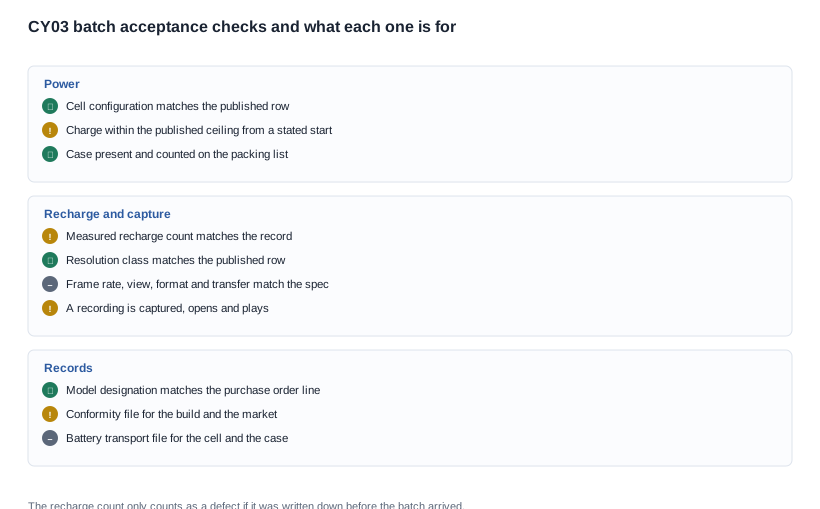
- Power. The cell is the one the row describes. A charge begun from a recorded state finishes inside the published ceiling. The case is present, counted on the packing list, and its capacity is the published one.
- Recharge. The measured recharge count from a full case matches the figure in the acceptance record. A unit that delivers materially fewer transfers is a defect, and it is only a defect if the number was written down first.
- Camera. The resolution class matches the published row. The frame rate, the field of view, the format and the transfer behaviour match the written specification the factory supplied.
- Capture integrity. A recording is captured, a file appears, the file opens and the file plays. The indicator behaviour that shows a capture is in progress is recorded, because it is what the support script will describe.
- Identifiers. The model designation on the unit and on the packaging match the purchase order line, and the programme identifier is recorded where the unit carries one.
- Records. The market and build paperwork the factory is required to hold is present, the paperwork for moving the cell and the case is present, and the model designation on the unit and on the packaging matches the purchase order line.
Three of these deserve a note, because they are the ones that go wrong quietly. The recharge count is the first: without a recorded figure, a batch that delivers three transfers instead of four is indistinguishable from a batch that delivers four, and the complaint arrives as a battery complaint. The capture integrity check is the second: it is the only check that catches a product that appears to work and does not record, and it is cheap. The identifier check is the third: a camera product with a case in the box has more components to mix than a product without one, and the mixing failure is invisible in every check above except this one.
A final note on the documentation set, which is where most of the remaining time goes. The export certification pages in the catalogue are company-level, and their content is graphical rather than textual, so they settle nothing for a particular model. Nothing in the catalogue certifies an individual model, and a patent does not certify a product. A product in this category is covered, where a radio is fitted, by the Radio Equipment Directive (EU) 2014/53/EU, and its electromagnetic compatibility obligation sits under the EMC Directive (EU) 2014/32/EU, with the general product safety framework for the European Union market at (EU) 2023/988. The battery transport file has to cover the cell and the case, because they travel as two items rather than one.
The criteria above are deliberately short, and the reason is that a long checklist on a model with this few published rows gets diluted rather than strengthened. What to ask, before you commit, is a shorter list than most buyers expect: what the measured recharge count is, what the capture indicator does, what the transfer path and its duration are, and which document covers the build in the destination market. Those four answers are what separate a channel that can describe this product accurately from one that will collect returns. The trade-off is that each of them takes an afternoon with a unit, and the alternative is a first shipment that arrives with four open questions and a support desk that cannot answer any of them.
Where the CY03 catalogue stops
The published record for this model, stated once: an eight megapixel camera class, a 290 mAh cell, a rated seven hours, a charge ceiling of two hours or less, and a 1400 mAh charging case. There is no charging method row, no radio version, no weight, no ingress rating and no per-model certification entry.
We do not publish a sensor model, a field of view, a frame rate, a video format, a storage capacity, a frame weight or a lens material for it, and we will not quote an estimate for any of them. The weight is worth a specific mention, because one model in this range publishes a figure of 158 g for the glasses alone, excluding its folding case, and it is a different model; a number from that page says nothing about this one, and copying it would be a fabrication rather than a shortcut. Where the catalogue is silent, we will hand you the question for the factory rather than a number that looks better on a spec sheet.
The ai camera glasses page groups the eleven camera models in the range, and the published differences between them — the resolution classes, the cell configurations, the case capacities and the four models whose charging method is not published — are all visible there. If the question is how a first unit should be worked through, the sample evaluation page sets out the structure, and the production capacity page is where a delivery date should be checked against the documentation work above it.
Give us the recharge count you measured on a case and the capture behaviour you observed, and we will come back with the acceptance record we would use to compare your first batch against a reference unit.


