
The CY05 is an 8-megapixel camera glasses platform with a 290 mAh battery, magnetic charging and a 1400 mAh charging case, and working with it is less complicated than the feature list on the box suggests. How to use cy05 smart glasses comes down to one sequence: open the case, pair the frames once, confirm the camera is genuinely recording, then leave the case on the table for the rest of the session. The common failure is not a broken product. It is a unit that never started recording, and nobody notices until the moment the footage is needed and turns out not to be there.
This guide is written for the buyer who has to produce that sequence for somebody else — for a channel, for a quick-start guide, for a support script — and for the buyer who has to decide whether a second unit from the same factory is the same product as the first.

CY05 operation opens with a published camera class and a published case
The published row for this model is short: eight megapixels in the camera class, a 290 mAh cell, roughly seven hours of rated use, two hours or less on the charge, and a 1400 mAh charging case.
The camera class is the part buyers reach for first, and it is the part that most needs qualifying. Eight of the eleven camera models in this range sit in the eight megapixel class and three sit in the thirteen megapixel class. A resolution class counts pixels. It does not describe the sensor behind them, the lens in front of them, the field of view that reaches them, the rate at which the processor writes frames, the format the footage lands in, or what the camera does in a dim room. Two cameras of the same class are not interchangeable, and a listing that treats the class as a quality grade is making a promise the number cannot carry.
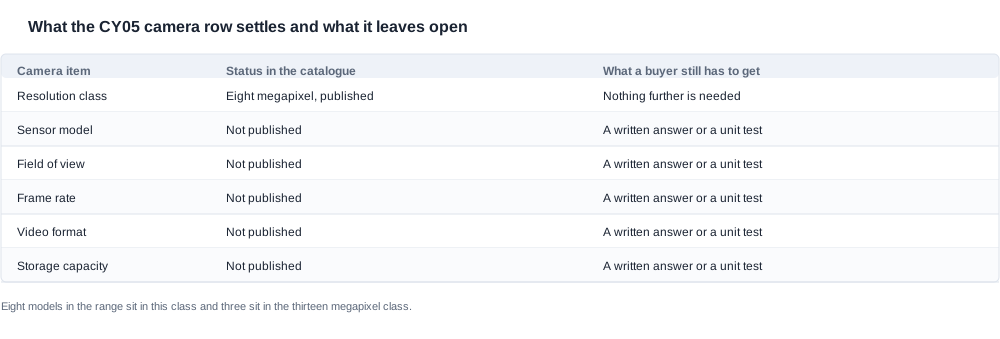
What the published camera row does settle is the resolution class of this model, and that is a fixed, known point. Everything else about the imaging chain is either a written answer from the factory or an observation from a unit, and the operating sequence below is built so that the observations happen before anything is documented.
The case is the second published fact with operational weight, and it is the one that decides how a session is planned. A 1400 mAh case against a 290 mAh cell is a ratio of just under five, which is a derived figure rather than a published one, and a derived figure is a planning hint and not a count. How many full charges a case actually delivers to drained frames has to be measured, because the case is the only published power source in the row and it is what a customer will actually run out of.
There is a third fact worth putting in front of a buyer at the outset, and it is a gap rather than a number. This model publishes no charging method row for the frames. Four models in the range are in that position, and this one is one of them. The charging hardware that is published is the case; the arrangement by which the frames themselves take a charge is not, so the first item in the sequence is an observation rather than a step that can be read off a manual.

A first-session sequence for the CY05
- Charge the case and note the state it reports. The two-hour ceiling published for this model applies to the frames. The case timing is separate and has to be observed, and so does the question of whether the case can be replenished while the frames are charging.
- Open the case and watch the frames take their charge. Because the method is not published, the physical arrangement — a contact, an indicator, a light, a sound — is what the guide has to describe. The picture of a case that appears to do something is worth less than the observation of what actually happens.
- Power the frames and pair once. The radio version is not published for this model, and the connection routine, the device list and the reconnection behaviour are not published either. All three are observable, and the reconnection behaviour is the one a support agent will be asked about first.
- Capture something and prove it happened. Make a short recording, confirm that a file exists, confirm that the file opens and confirm that it plays. The indicator that shows a capture is running is the single most important line in the whole guide, because it is the difference between a customer who knows they are recording and a customer who assumes they are.
- Move the footage and time the transfer. Record how long the transfer takes, what a file is called when it lands, and what happens if the transfer is interrupted. This step sets the length of the support script and the expectations a channel should set about storage.
The transfer step is where a camera product is either made supportable or not, and the reason is that a customer who cannot retrieve a file does not describe the problem as a storage problem. They describe it as a broken product, and they return the unit. Measuring the transfer once, on one unit, under one condition, produces a number that a guide can quote and a support agent can use; measuring it three times, in a quiet room and a busy one and with a large file and a small one, produces a range, which is what a channel actually needs to set expectations. 6. Run the frames down and recharge once from the case. A capture made on a full battery tells you nothing about the product at the end of a session, and the case is the part that will run out first in real use. 7. Write the sequence down from the observations only. Any line that cannot be traced to a step above either arrives from the factory in writing or stays out of the guide.
The reason this sequence starts with the case and not with the camera is worth stating once, because it looks backwards. A camera that runs out of power mid-session is a different product from one that does not, and the case is what decides which one you have. The camera class is published and will not change; the case behaviour is not published, and it is the part that runs out first in real use. Establishing it first also means the first session produces a number the factory can be held to, rather than a description that can be argued with.
There is one more thing to capture in the first session while the unit is still on the bench, and it costs nothing: the behaviour of the product when it is failing rather than working. What the unit shows when the case is nearly exhausted, whether the capture indicator warns before the battery gives out, and whether a recording is silently truncated when the power runs low mid-capture. Those three observations are the difference between a support script that can help a customer and a support script that can only apologise, and a truncated recording is the kind of failure a customer reports as a lost file rather than as a flat battery.
Qualifying a second CY05 unit against the first
A camera product has a failure mode that a catalogue row cannot detect: a unit that looks identical, behaves identically on the bench, and records differently. The published row is the same for every unit of this model, which means consistency between units is a property of the production run and not of the specification, and it has to be established deliberately.
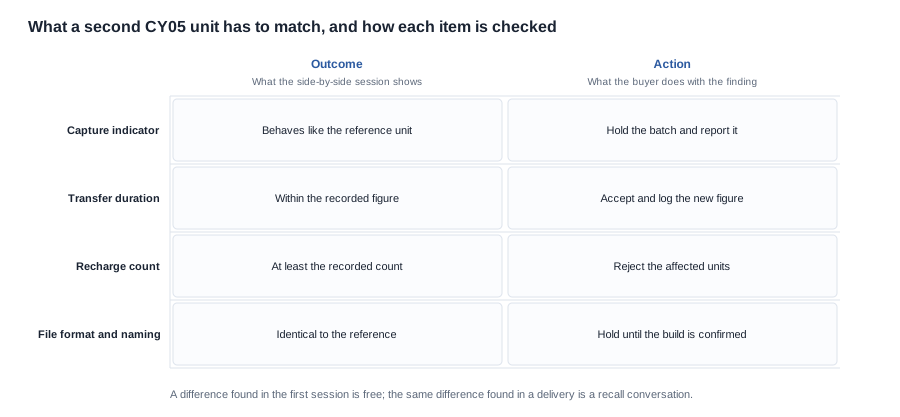
The comparison is easiest to run as a side-by-side session with two units and a written record. Set both up the same way, run the same steps, and compare the results rather than the impressions. The things worth comparing are the capture indicator behaviour, the transfer duration, the recharge behaviour from the case, the file naming and format, and the menu or status output at power-up. Any difference between the two units is a finding, and a finding found in the first session is free, while the same finding found in a delivery is a recall conversation.
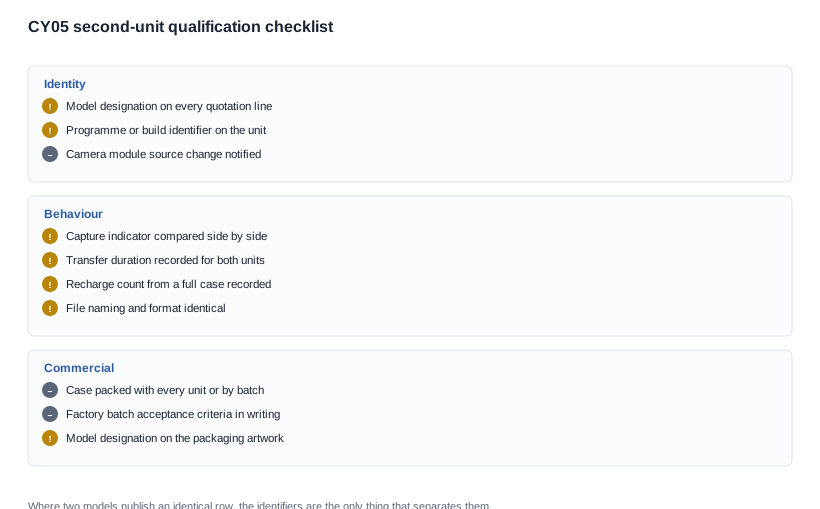
Two models in this range publish an identical row for this one, including the cell, the rating, the charge ceiling, the camera class and the case capacity. That is worth stating plainly, because it has a direct commercial consequence: the published data cannot be used to tell the two apart, so the identifiers have to do that work, and a factory quoting "the 290 mAh camera model with the case" is describing two different products. Ask for the model designation on every quotation line, on the purchase order and on the packaging artwork, and treat a quotation that carries only the specification as incomplete.
The consistency questions to put to the factory follow directly from that. Which programme or build identifier runs on the unit, and what changed between builds. Whether the camera module comes from the same source for every unit in a batch, and whether a change of source is notified. Whether the case is packed with every unit or allocated by batch. And what the factory's own criteria are for calling a batch acceptable, written as checks rather than as a general statement about quality.
What a CY05 batch should be accepted against
The acceptance record for a camera product is short, and the reason it is short is that the published row leaves so little to check against. Agreeing it before the sample is approved is what makes it enforceable later.
- Power and case. The cell in the frames is the published 290 mAh one, and a charge started from a recorded state stays within the published ceiling. The case is present and counted on the packing list, and its capacity matches the published figure.
- Camera class. The resolution class on the unit matches the published class, and the frame rate, the field of view, the file format and the way footage moves off the device all agree with the written specification the factory supplied. Capture integrity is checked on its own terms: a recording is made, a file appears, the file opens and the file plays, and the capture indicator behaves as described in the guide.
- Case behaviour. The measured recharge count from a full case is at least the figure in the acceptance record. Identification is checked the same way: what the unit is called, what the packaging is called, and the programme identifier, all of them matched against the purchase order line.
- Files. What the factory is required to hold for this build and market is in place, the transport paperwork for the cell and for the case is in place, and the text panel on the packaging has been approved for that market.
The documentation side of that list is where the time goes, and it is worth being specific about what is and is not available. The export certification material in the catalogue sits at company level and is graphical rather than textual, so it says nothing about a particular model, and nothing in it certifies an individual model. A patent does not certify a product. Where a radio is present, the relevant instrument is the Radio Equipment Directive (EU) 2014/53/EU, and electromagnetic compatibility is a separate obligation under the EMC Directive (EU) 2014/32/EU, with the two harmonised standards it would lean on named EN 300 328 and EN 301 489. The European Union market's general product safety framework is (EU) 2023/988, and the transport paperwork has to cover the cell and the case together, because they travel as two items.
The order in which the acceptance checks should be run
The checks in the list above are not independent, and running them in the wrong sequence wastes the unit. Start with power, because every other check needs a charged frame and a charged case, and because the case recharge count is the measurement that takes the longest of anything in this list. Run the camera class check next, since it is a setting rather than a test and takes seconds. Then run the capture check, which is the one that catches a unit that appears to work and records nothing, and then the transfer check, which is the one that needs a second device and a stopwatch. The identifier check runs at the end, against the packaging, and the documentation check is not a unit test at all — it is a file review that has to happen in parallel with the production slot rather than after it.
Two sequencing rules save more time than they cost. The first is that the capture indicator should be established before anything is written for a channel, because the indicator behaviour is the line that appears in the guide, on the packaging insert and in the support script, and changing it later means changing three documents. The second is that the documentation review should start before the first unit arrives rather than after, because the file set for a build takes weeks to assemble and the unit takes an afternoon. Running them in the opposite order means the file set is always the last thing standing between the factory and a delivery date.

How to choose a CY05 supplier on published evidence
A camera product invites a particular kind of quotation, and it is worth recognising the shape of it. The feature summary is long, the images are good, the camera class is stated prominently, and the operational detail is thin. That combination reads as confidence and behaves as ambiguity, and the questions below are the ones that separate the two.
Does the supplier answer with a specification or with an observation? A factory that has measured its own product will describe what the capture indicator does, how long a transfer takes and what happens when the transfer is interrupted. A factory that has not will describe the camera class again. Both replies are fluent, and only one of them can be written into a guide. The criterion to apply is simple: a claim that could be tested on a unit should come with the result of that test, and if the supplier has not run it, the answer is not a delay — it is a signal.
Does the supplier identify the model on every document? This model and one other in the range publish an identical row. A quotation that says "the 290 mAh camera model with the 1400 mAh case" is describing two products, and a purchase order built from it can be filled with either. The requirement is not pedantry: the model designation has to appear on the quotation line, the order line, the packaging artwork, the conformity file and the battery transport file, and if it appears on all five then a mix-up is caught by the paperwork rather than by the customer.
Does the supplier own the documentation, or leave it with you? The catalogue's export certification material sits at company level and is graphical rather than textual, and nothing in it certifies a particular model, so none of the per-model file set is inherited from the catalogue. A supplier who already holds the conformity file for the build, the general product safety file for the destination market and the battery transport file for the cell and the case has done the part of the work that takes longest. The questions to ask are which of these it holds today, for which build, and which of them it will need to assemble again for a repeat order.
Does the supplier describe its own batch criteria? The best answer is a written list of checks with numbers in it, because that list is what a buyer can then hold the factory to. A supplier who answers with a statement about quality controls has given you a marketing asset. A supplier who answers with "the recharge count from a full case is at least N transfers, the capture indicator behaves as described in figure 1, and the file format is as specified" has given you an acceptance record, and the buyer can adopt it unchanged.
The trade-off in choosing between suppliers on a model with this few published rows is that the visible differences are small and the invisible ones are large. Two suppliers can quote the same cell, the same rating, the same charge ceiling, the same camera class and the same case capacity and still be very different businesses to deal with, and the difference shows up in the documentation readiness rather than in the specification. The total cost of a camera product programme includes the cost of the documentation work and the cost of a first batch that has to be reworked, and both of those costs are invisible in a unit price comparison. The shortlist criterion that is worth most is therefore not the price and not the specification; it is which supplier can produce a per-build file set without a four-week project attached to it.
Where the CY05 catalogue stops
Stated once, the published record for this model is: an eight megapixel camera class, a 290 mAh cell, a rated use of seven hours, a charge time of two hours or less, and a 1400 mAh charging case.
Nothing is published about the sensor behind the lens, the view it covers, the rate it records at, the format it writes, the storage it holds, the way the frames themselves are charged, the radio version, the weight, the ingress marking or any per-model certification entry, and we will not put a number against any of those either. The weight is worth one specific sentence, because elsewhere in this range a model publishes 158 g for the frames only, with its folding case weighed separately, and that figure says nothing about this one. No statement about water, sweat or rain may be attached to this model, because the two models in the range that carry an ingress marking are not this one.
The ai camera glasses page holds the eleven camera models together with the published differences between them, and the quality consistency page is where a batch-to-batch check is usually specified. If the question is how a first unit is run through, the sample evaluation page shows the structure, and the production capacity page covers where a promised date gets checked against the file work in front of it.
Send us the transfer duration you measured and the file format the footage arrived in, and we will return the acceptance record we would use to sign off your first CY05 batch.


