
The D11 publishes Bluetooth V5.4, a 100 mAh cell, a two-hour ceiling on the charge, roughly 7 hours of rated use, Type-C charging and a surround-sound listing. No acoustic figures, no microphone pickup distance, no frame weight, no pairing procedure and no app are published — so this guide gives you the hardware sequence accurately and marks the parts that need written confirmation from us. It is written for the buyer who has to produce the quick-start guide, set the acceptance criteria for a first batch, and decide whether the surround-sound listing survives contact with a customer.
The reason that decision sits at step four is the shape of this model's published row. A surround-sound descriptor is a marketing statement, and a marketing statement is not a specification until somebody converts it into a measurement. Everything below is about making that conversion on one unit, cheaply, before a production slot is booked.
D11 first-charge strategy comes before anything else on the bench
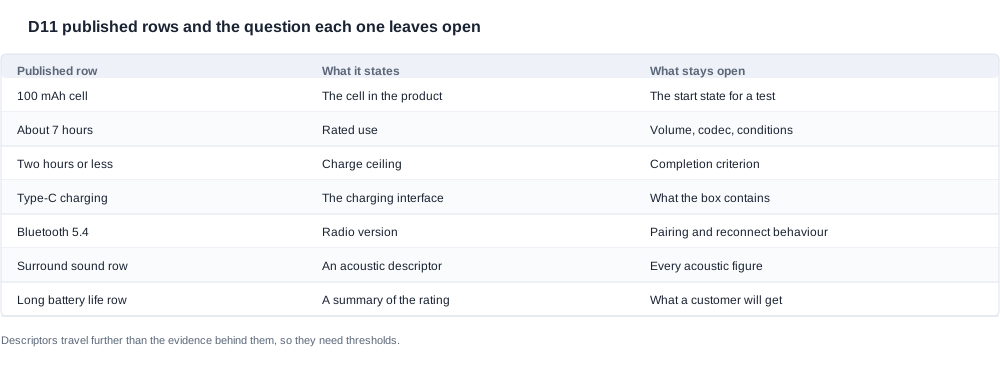
The published specification for this model, in the order it appears on the page: a 100 mAh cell, roughly seven hours of rated use, a charge time of two hours or less, Type-C as the charging interface, Bluetooth V5.4, and two descriptors — a surround-sound row and a long-battery-life row.
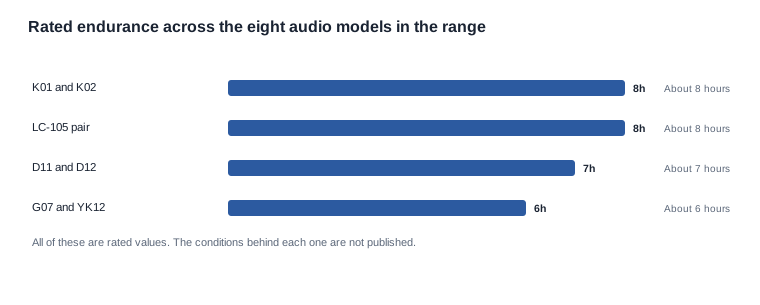
The first thing to do with those numbers is stop them being confused with guarantees. Seven hours is a rated figure and the catalogue does not publish the conditions behind it: not the volume, not the codec, not the content, not the ambient noise, not whether the radio is connected throughout. Two hours or less is a ceiling, and the catalogue publishes neither the state the cell is in when the clock starts nor the point at which the charge counts as finished. That second omission is the one that shows up in a warehouse, because "charged" has to mean the same thing to the person putting it on the dock and to the customer who expects it to work.
The interface being Type-C is a genuine part of the published row, and it is worth noting that the product in your hand is the one that decides how the box is packed. The cable is a component that gets counted, shipped, replaced and returned; a dock is a component that gets lost. Nothing else about the charging arrangement is published, and that is exactly what the first step of the sequence below is for.

The first-charge strategy deserves its own paragraph because it is the step most often skipped, and skipping it produces a bad first day of testing rather than a bad product. A cell that has been sitting on a shelf, or has been part of a returned unit, arrives with an unknown state. Testing an endurance figure from an unknown state gives a number that is too pessimistic, and a buyer who then writes that number into the packaging has published a worse figure than the product deserves. The correction is simple and takes one extra cycle: charge the unit fully, leave it to settle, then run the endurance observation from a full and freshly measured state, and record the start state in the same line as the result.
There is a second reason the first charge has to be taken seriously, and it is about the seven-hour rating rather than about the cell. A rated figure is a number produced under a stated method, and the method for this model is not published. What a buyer can do instead is define a method of their own, apply it identically to the sample and to the production batch, and be explicit that the figure they publish is the observed figure under the buyer's method. That is a weaker claim than a factory rating, and it is the one that can actually be defended when a customer measures a different number.
The D11 surround-sound descriptor is not an acoustic specification
Here is what a resolution class tells you about a camera, applied to sound: a surround-sound descriptor counts channels or a listening configuration, and it does not describe the drivers, the amplification, the frequency response, the separation between the left and right paths, the behaviour at low volume, or the behaviour in a room with reflections. It is a label, and the label travels further than the evidence behind it.
The catalogue publishes no acoustic figure for this model — no output power, no driver size, no frequency range, no separation, no microphone specification, no pickup pattern, no noise handling figure. A buyer who wants to sell an acoustic claim has to build the measurement, and a buyer who does not want to sell an acoustic claim has to decide what to say instead. Both of those are decisions, and both cost money: the first in engineering time, the second in marketing options.
The comparison worth making is inside the audio group rather than outside it. One of the eight models in that group publishes a surround-sound row and a long-battery-life row and nothing else, so the descriptor pattern is not unique to this model. The other model in the same pair publishes exactly the same five lines as this one and adds no acoustic row at all. That makes this model the one carrying an acoustic claim and its sibling the one carrying none, which is a real difference for a channel that has to write two product pages, and it is a difference that exists in the catalogue rather than in a laboratory.
The other descriptor, the long-battery-life row, sits directly on top of a numeric rating, and the two together are the most likely source of a mismatch between what a channel writes and what a customer measures. About seven hours is what the catalogue publishes; the long-battery-life row is a summary of that number rather than an addition to it. A listing that quotes seven hours as a rating is defensible. A listing that quotes seven hours as what a person will get is a different claim, and it is the one that produces a return.
The measurement that closes both gaps is the same measurement: run the product at three volume levels, in a quiet room and in a noisy one, and record what happens. That single test produces the acoustic behaviour for the guide, the observed endurance for the packaging, and the evidence for or against the descriptor.
D11 runtime decay across a working session
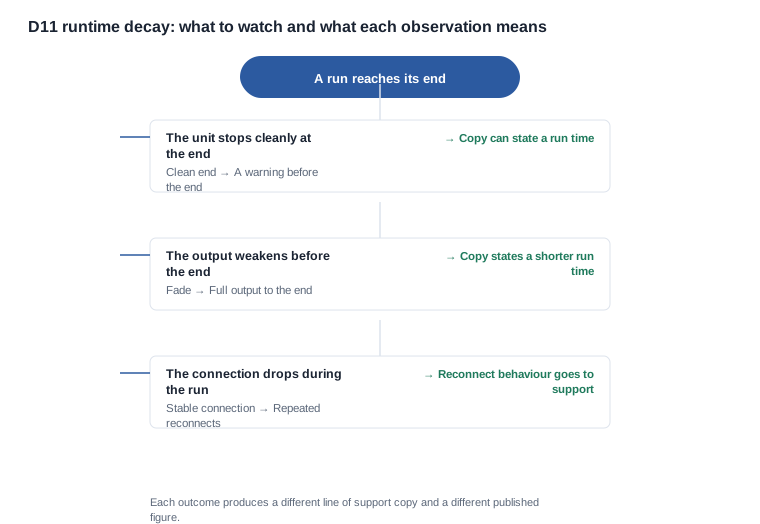
A rated endurance figure is a single number at the end of a run. A customer experiences a curve, and the curve is what a support agent has to answer about. For a product with a 100 mAh cell and a rated figure in the region of seven hours, the questions that matter are whether the run ends abruptly, whether the last hour is weaker than the first, and whether the behaviour changes in a way the customer will interpret as a fault.
The observation is simple to run and takes a working day rather than an afternoon. Charge the unit fully, record the start state, then run it with a fixed content source at a middle volume for the whole session, checking the remaining runtime at intervals. Write down what the product reports, if it reports anything, and what actually happens in the last stretch. The three outcomes a buyer is looking for are a clean end, an end with a warning, and a fade, and each of them produces a different piece of support copy.
The observation that matters most commercially is the volume interaction, because it is the one that connects the acoustic question to the endurance question. A product that runs for a stated time at a low volume and for considerably less at a high one is not a defective product; it is a product whose endurance figure has to be published with the volume attached. A channel that writes "up to seven hours" without that condition has produced a claim that a customer will disprove in an afternoon, and a claim that a competitor can disprove publicly.
There is a second decay effect that is easy to miss because it is not about the cell at all. If the radio stays connected for the whole session, the pairing state is part of the power budget; if it disconnects and reconnects repeatedly, the reconnect behaviour is part of it too, and a product that reconnects badly may spend a meaningful share of a working day re-establishing a connection. On a product where no pairing procedure is published, the reconnect behaviour is one of the more valuable things a first session can establish, because it is invisible in a specification and obvious to a user.
The practical outcome of a runtime observation is a small table with two columns — conditions and result — and that table is the evidence behind every endurance statement the channel makes. It also becomes the reference against which a production batch is compared, which is the only way a claim survives contact with a customer at scale.
Turning the D11 descriptor into an acceptance test
A test that a factory can run, a buyer can verify and a channel can repeat is built from the product's own behaviour rather than from a laboratory profile. This is the version that works on a bench.
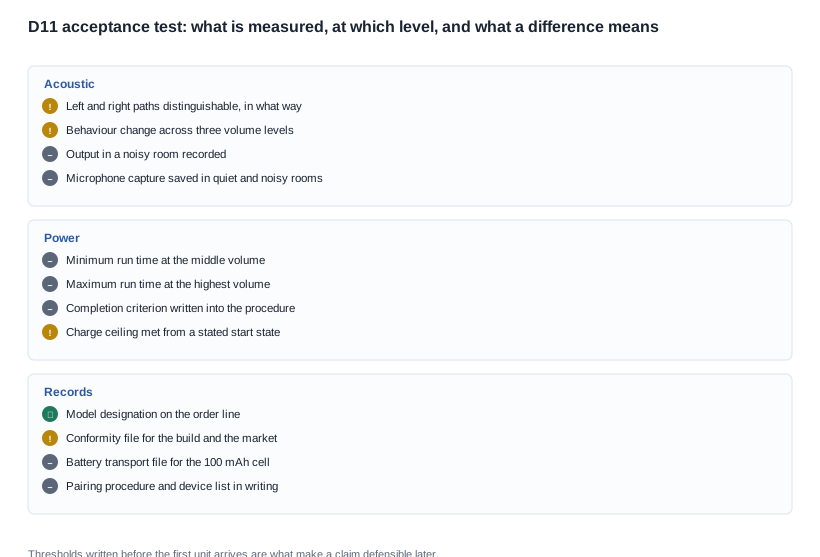
The conditions. Fix the content — the same source, the same track, the same position relative to the product — and then vary one thing at a time. Volume in three steps, with the middle step being the one a customer would actually use in an office. Room in two conditions: a quiet room, and a room with ordinary background noise such as a fan, a corridor or a café. That second condition is the one that matters commercially, because it is where a customer discovers what the product is like, and it is where a microphone question becomes visible.
What to record at each step. Whether the left and right paths are distinguishable, and in what way — not "good" or "bad" but a description a customer could recognise. Whether the behaviour changes with volume, and where it stops behaving as expected. Whether background noise affects the output and by how much. How long the product runs at each volume, in hours and minutes, from a defined start state. And whether the rating holds at the lower volumes, which is the case that decides whether the long-battery-life row and the seven-hour rating are describing the same thing.
The thresholds. A test without a number is a demonstration, and a demonstration cannot be used to reject a batch. Set the thresholds before the first unit arrives, in the factory's language and yours: a minimum run time at the middle volume, a maximum run time at the highest volume, a statement about what happens to the output in noise, and a capture check that confirms the product is still playing rather than silent. Written in advance, these four numbers are what makes the claim in the listing defensible, because they are the criteria the product was accepted against.
The comparison against the description. The final step is to put the observation next to the descriptor and ask whether the two can be published together. If the unit behaves in a way that a customer would call surround sound, the descriptor is supportable and can stay in the copy. If it does not, then either the descriptor has to be narrowed, or the acoustic configuration has to change, and that is a programme decision with a cost attached. The value of doing this on a sample rather than after a launch is that the answer arrives before the money is spent rather than after.
D11 call and microphone checks the catalogue leaves open
Nothing is published about the microphone on this model, and a buyer who has not tested it will eventually meet a customer who has. For a B2B channel, a call-quality complaint is a returns problem and a reputational one, because it is the complaint that a procurement manager hears about before they place the next order.
Four checks cover most of it. First, capture in a quiet room at a fixed speaking distance, and save the file, because a written description of what the microphone picks up is not something a support agent can act on. Second, repeat it in a noisy room, because the difference between the two is the specification a customer is really asking about. Third, test the behaviour when the product is not being worn properly — pushed forward, sitting loosely — because a microphone specification that holds only in ideal placement is a specification that will fail in a car. Fourth, establish what happens during a sustained call, because a product with a seven-hour rated figure is very likely to be used for a long call at some point, and the question of whether the microphone behaviour holds over that length is the one that generates the "it stopped working" report.
None of this can be written into a listing as a figure, because there is no figure. What it can do is produce a defensible description: the conditions in which the microphone performs as expected, the conditions in which it does not, and the honest statement of what the product is suitable for. That description is worth more than a number would be, because it is the thing a support agent can repeat.
There is one more item in this section that belongs to the product rather than to the customer. The catalogue publishes no frame weight for this model, and one model in the whole range publishes a weight, which is a different model and says nothing about this one. For a product worn across the temples for a working session, the weight is a fact the customer will notice immediately and the factory can answer in one line. Ask for it in the same message as the acoustic questions rather than in a separate round.
Documentation a D11 order needs before it ships
The file set for this model is short, and the reason it is short is that the catalogue does not supply any of it. The catalogue certifies no individual model, and the export certification material it carries is company-level and graphical rather than textual, so it settles nothing for a specific build. A patent is not evidence of conformity.
- The conformity file for the build and the destination market, signed by the responsible party.
- The European Union general product safety file, (EU) 2023/988, for the markets where it applies.
- A radio conformity route, where the product carries a radio, sits on the Radio Equipment Directive (EU) 2014/53/EU; the electromagnetic compatibility obligation is handled separately under the EMC Directive (EU) 2014/32/EU, and the two named standards, EN 300 328 and EN 301 489, are harmonised ones a route leans on rather than certificates in their own right.
- The transport paperwork for the 100 mAh cell, covering the cell and the packaging it ships in.
- The written charge completion criterion and the cell start state.
- The acoustic acceptance criteria in the form described above, with the thresholds, the conditions and the observation record.
- The pairing procedure and the device list, in writing, so that the guide and the support script match the product.
- The packaging artwork, the text panel for each market and the artwork approval record.
- The identification set on the purchase order line: what the unit is called, what the box is called, and any programme identifier that appears on it.
- The defect responsibility split and the warranty position.
The order of that list is the order of the dependencies, and item six is the one that is usually moved to the end and should not be. The acoustic criteria are cheap to write and impossible to write after a batch has been accepted, and every copy decision downstream of them — the listing, the box panel, the script, the video — inherits from them. A buyer who fixes the criteria last is a buyer who will rewrite the copy last, and copy is what customers read.
The questions to ask the factory that produce the best answers are the ones that name a document and a build. Which of these documents are already in place for the standard build. Which of them belong to a specific build. What the factory's own acceptance criteria are, written as numbers rather than as a statement about quality. And what the acoustic behaviour is at the three volumes, if the factory has measured it, because a supplier that has run the test will describe the result in a way that a supplier that has not will not.
Where the D11 catalogue ends
The published record for this model: a 100 mAh cell, a rated seven hours, two hours or less on the charge, Type-C charging, Bluetooth V5.4, and two descriptors, a surround-sound row and a long-battery-life row.
Acoustic figures, microphone specifications, the weight of the frame, what the lenses are made of, the ingress marking, the control method, the case size and the per-model certification status are all unpublished for this product, and we will not estimate any of them. No claim about water, sweat or rain may be attached to this product, since the ingress marking in this range appears on two other models and on this one it does not appear at all. We will also not publish an acoustic claim for a build that has not been measured, and we will not convert a rated endurance into a continuous-use promise.
The bluetooth audio glasses page carries all eight models in this group with the published differences between them, and it is the right place to see how this one compares with the sibling that publishes no acoustic row at all. For a first unit, the sample evaluation page shows how, and the contract terms page is where the acceptance criteria and the responsibility split belong.
Tell us the three volume settings and the two room conditions you intend to test, and we will send back the acceptance record we would use to decide whether the surround-sound row can stay in the copy.


