

A first session is short. What it produces decides whether the next hundred sessions go smoothly, and whether the documentation that ships with the product matches the object inside the box. This guide treats that first session as a fixed sequence with an evidence log attached, written for the person who will be held to the answers later: a buyer, a channel partner, or the person who inherits the product after a customer complains.
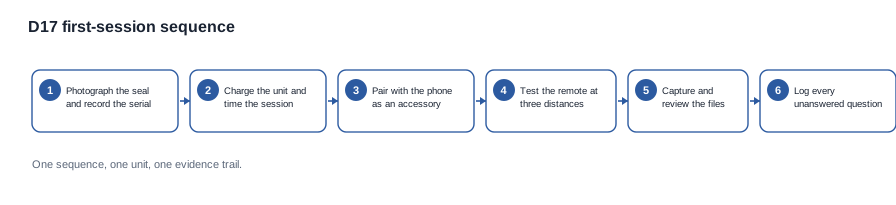
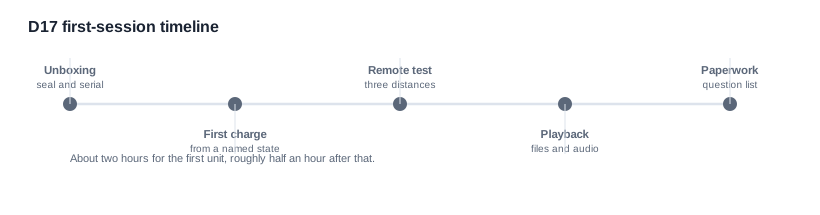 The order is deliberate. Charging comes first, because a unit that is flat produces shutdown behaviour that looks like a fault. The remote shutter comes second, because it is the interaction most likely to be misunderstood by a first-time user and the one a customer will test within a minute of opening the box. Paperwork comes last, because a gap only becomes meaningful once it is attached to something you actually observed on the unit.
What follows is the sequence in order, then the log to keep beside it, then the checklist for a unit that is about to leave your bench, and finally the questions that only the supplier can close.
D17 first-week sequence: what to do on day one
Day one is about producing a clean, repeatable baseline. Anyone who repeats the same steps on a second unit, a month later, on a different batch, produces a comparison; anyone who improvises produces an anecdote. The value of the sequence is not that it is thorough. It is that it is repeatable by a different person without a briefing.
- Photograph the D17 carton seal before opening it, and keep the photo with the unit.
- Record what the box says: the model designation, the printed serial, the accessory list.
- Note the cell state on arrival, then charge the unit and time the session.
- Pair the unit with a phone and confirm it appears as an accessory, not as a media device that nobody sees.
- Test the remote shutter close to the face, then at arm's length, then across a room.
- Capture a short session and review the files on the phone before anything else.
- Listen to the playback through the glasses and check call handling with the microphone.
- Write down every question the printed material left open, in the wording the box itself uses.
Three of these steps carry more weight than they look. The seal photograph is what turns a damaged-goods claim into a packaging question, because packaging damage is far more common than hardware damage and is much cheaper to fix upstream. The capture-and-review step is where a file-transfer problem becomes visible, and it is invisible to anyone who only checks that the pairing succeeded. The remote test at three distances is what turns "the shutter is unreliable" into a measured statement about range, because a single close-range test proves nothing about how the unit behaves in the customer's hand.
Do not skip the timing on the charge. A charge time that is close to what the catalogue publishes is a claim you can put on a product page with a defensible basis. A charge time that nobody measured is a number a customer will measure for you, usually on a video, and usually on day one.
There is one decision to make before the unit is opened, and it is cheap to make early. Two sample units out of a fresh shipment can tell you whether a defect is a one-off or a pattern; one unit cannot. If the shipment is large enough to justify two units, the shortlist of what to compare between them is short and specific: seal condition, print quality of the designation, charge behaviour from the same state, and the number of remote attempts. If the shipment is small, take one unit and write down the acceptance criteria you applied to it, so that the next shipment can be compared against a recorded standard rather than against a memory.

Reading the D17 published rows before the first charge
The published rows are the floor of what you can write, not the ceiling. Everything above them has to be earned from a sample unit or an answer from the supplier, and the two are not equally durable: a sample observation can be invalidated by the next production batch, whereas a written supplier answer can be quoted.
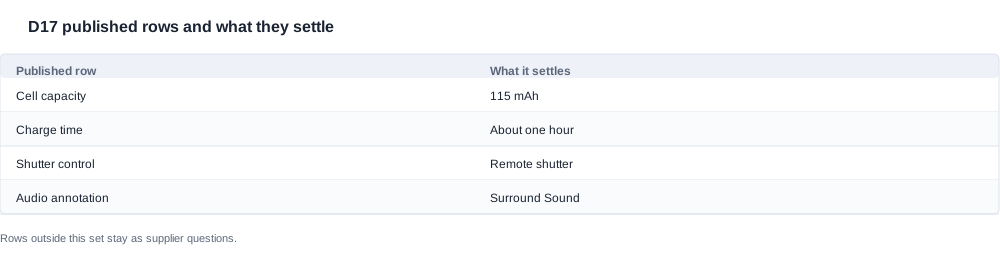 For this model the catalogue publishes four things that matter operationally, and they are worth quoting precisely because everything else is missing.
The cell capacity row reads 115 mAh. That is the anchor for every runtime conversation, and the only number in the published set that lets a buyer estimate whether a charge will survive a working day. The charge-time row reads approximately one hour, and this sits apart from the catalogue's general position: twenty-six models are published at two hours or less, and only two models sit at roughly one hour. So the hour here is a distinct row rather than a restatement of the ceiling, and it should be published with the same care.
The third row is the one most buying teams read past: this model publishes a remote shutter. A shutter operated from a separate control is not the same interaction as a button on a temple. It introduces an association step, a working distance, and a possible delay, and each of those needs its own line in the manual and its own line in your customer FAQ. The fourth published item is an audio annotation reading Surround Sound. That annotation is not the same object as the catalogue's dedicated surround-sound row, which belongs to another model, and copy that merges the two is a claim you cannot support later.
The rows that are absent are as informative as the rows that are present, and each absence is a question rather than a defect:
- The camera resolution for this model is not among the rows we hold, so any imaging claim has to come from a written answer or from a measured sample.
- No capacitive touch panel appears anywhere in the catalogue; the one published control-surface row sits on a different product and does not apply here.
- No colour range is published for this model, so a colour shown on a product page has to be confirmed against the units actually in the box.
- No ingress rating is published for this model, which is a material gap for a sport-oriented unit.
- We hold no runtime figure and no charging-case row for it, so both stay open until the supplier answers.
Ask for these five before you write the spec sheet, not after. The order of the questions matters commercially as well as technically: a missing runtime row blocks the product page, a missing camera figure blocks the comparison against a competing camera unit, and a missing ingress rating blocks the outdoor use case that the category position is built on. The screening criteria for this model are therefore narrow by design, and a buyer who tries to close every gap with a guess ends up with a page that no supplier will stand behind.
The D17 case, the cell and the charge cycle
Charging is where first sessions go wrong, and the errors are cheap to prevent but expensive to live with. Three separate things get confused in conversation: the capacity of the cell, the time the unit takes to charge, and whether the charge happens on the glasses or through a case. A buyer who has all three in a single sentence is making a claim they cannot defend.
 This model publishes a single cell figure of 115 mAh. Elsewhere in the same catalogue you will find dual-cell models published as two equal figures and models with no case row at all, so the convention has to be confirmed rather than assumed: ask whether the published figure describes one cell or a pair, whether the unit charges through a case or on the glasses directly, and what happens to the case if the unit is charged without it. Each of those answers changes what you write on the box and what you write in the manual.
Time the charge from a state you can name. Write the start state, the wall-clock start, the wall-clock end, and the state you reached. If the unit arrived part-charged, the published hour may not describe what the customer sees, and you have to decide which number your page states. The defensible choice is to publish the measurement condition, not the friendliest number: a charge time measured from empty, or a clear statement of the upper bound.
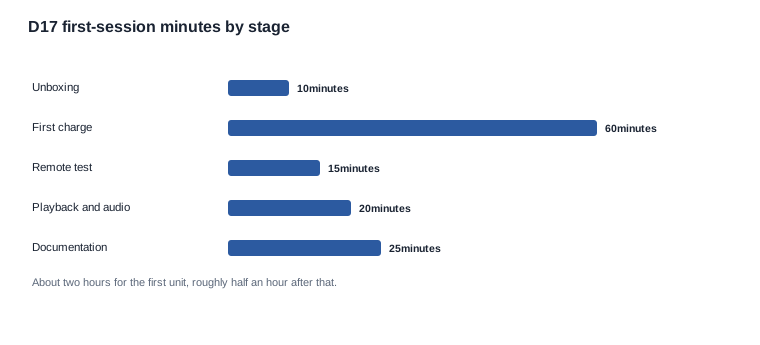
Budget about 10 minutes for the unboxing block, 60 for the first charge, 15 for the remote test, 20 for playback and audio, and 25 for the documentation pass. That is roughly two hours for the first unit of a model and closer to half an hour for every unit after it, which tells you how many sample units to request before a range launch. If a unit arrives with no documentation at all, the two-hour figure becomes a working day, and that condition belongs in the supplier conversation before the balance of the order is released rather than after it has shipped.
The same arithmetic applies to the case. A case with no published capacity is a case whose behaviour you have to observe: how many charges does it hold, does the unit report case state separately, what happens to the case when it is empty, and does the case charge from the same connector as the unit. The trade-off is straightforward: a case that arrives undocumented adds a support surface to every shipment, while a case documented by the supplier removes one entirely. Ask for the case behaviour in writing, because "the case charges the glasses" is an ambiguous sentence that customers read in three different ways, and because the total cost of a charging complaint is paid in returns handling rather than in the price of the unit.
Where the case row is genuinely absent from the published set, that absence has consequences that are easy to miss while you are still comparing models. A unit that arrives without a case is a unit whose charging accessory list on your product page has to be written from the packing slip, and every customer who cannot find a matching charger will read that list as an error. The reverse mistake is more expensive: a case that is included but undocumented generates a second category of question, because customers will assume the case behaves like the case of another model they have seen. Two things prevent both errors. The first is a packing slip that names the case and the connector explicitly rather than saying "accessories". The second is a supplier reply that states the case capacity, the number of charges it holds, and whether the unit charges without it.
There is a third question worth asking while the case is on the bench, and it is the one buyers skip: what happens to the unit when the case is full, and what happens to the case when the unit is flat but the case is not. Some units refuse to charge a case that is already at its limit, some ignore it, and some simply continue. None of this is visible on a specification row, all of it is visible in five minutes of testing, and the answer determines whether the charge instruction in your manual is one sentence or three. Record it in the same log as the runtime observations, because the two questions share an answer whenever the supplier treats the case and the unit as one power system.
Finally, plan the bench time as a capacity decision rather than a per-unit decision. If a first unit takes two hours and each later unit takes half an hour, then a shipment review of ten units is a working afternoon, not a working week, and the review can be scheduled before the launch rather than during it. That is the difference between a supplier question raised with time to answer it and one raised the week before the goods have to be in the warehouse.

D17 daily use: what a procurement team should log
The first session answers whether the unit works. It does not answer what happens in week two, and week two is where returns come from. A daily log costs a procurement team about five minutes per unit per day and it is the cheapest early-warning system available to you.
 Record five things every day, in the same order, so the series can be read rather than skimmed.
- Cell state at the start of the day and at the end, so a runtime pattern emerges instead of one complaint.
- The shutter path: remote paired or not, distance used, number of attempts, and whether the user had to look for the remote.
- Pairing behaviour, including whether the phone had to reconnect after sleep, after a restart, or after a call.
- The capture session: how many clips, where they were stored, and whether transfer was immediate or deferred to an app.
- Anything a user said out loud, in the user's own words rather than in a summary.
Two kinds of entry change the conversation with the supplier, and both are easier to raise with a log than with a complaint. A repeatable pairing failure is one of them: once you know it recurs, you can ask whether the accessory pairing flow or the documentation should change, and the answer becomes a decision rather than an opinion. The second is a runtime that disagrees with what the published rows imply for a given mode, which usually means a record mode is running at a higher setting than the manual claims and needs to be documented differently.
Log storage as well. A unit that quietly fills a phone becomes a unit that customers switch off, and no support ticket arrives to explain why. Record whether clips land in the camera roll or in a dedicated app folder, what the file naming looks like, and whether the user is warned when storage fills. None of that behaviour is published for this model, so each observation is a question you can put to the supplier and a line you can fix in your own copy.
The acceptance criteria for the log itself are simple enough to state in a procurement policy: two consecutive weeks without a recurring pairing failure, a shutter that works at the distance your marketing material implies, and no unexplained runtime collapse. When those criteria are met, the unit moves from the evaluation list to the order list; when they are not met, the log is the evidence that lets you decline it. A daily log is a due diligence tool, not a diary, and treating it as one is what separates a procurement decision from a purchase.

Checks to run on a D17 sample before it ships
A working unit is not a shippable unit. The second checklist is different in kind from the first session: it protects the launch date rather than the unit, and it is run on a unit that is representative of the shipment you are about to buy, not on the friendly sample that came first.
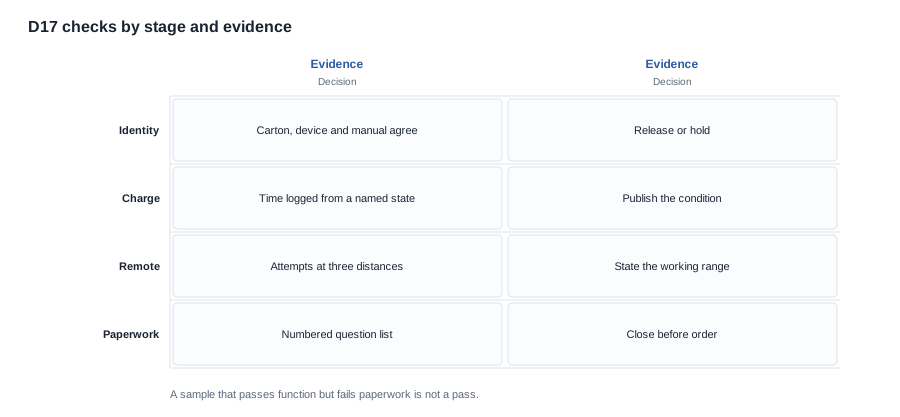
Start with identity and print. Does the model designation on the carton match the device, the manual, and the listing you intend to publish? A mismatch here is nearly free to fix before production and expensive to fix after it has been printed onto inserts and outer boxes. Then the packaging itself: carton drop handling, how the unit sits in its insert, and whether the insert holds the temples through a courier journey. These are observations rather than tests against published figures, because no drop or ingress figure is published for this model.
Move to function and completeness. Does the unit charge, pair, capture and play back exactly as the first session recorded? Does the box contain what the packing list promises, with no region-specific substitutions? Then documentation consistency: read the manual against the published rows and confirm that the cell capacity, the charge time, the remote shutter and the audio annotation are described in the same terms in both places. A manual that says two hours where the catalogue row says one hour is a support-cost item already scheduled.
Finally, the compliance trail. The catalogue's export certification page is an image page showing patent certificates, and the catalogue carries no text entries for CE, FCC or RoHS anywhere. That is a statement about what is visible in the materials you hold, not a statement about certification status, and it means the certificate trail for your target market has to be requested and filed rather than assumed. Record what arrives, in what form, and what does not arrive at all.
Write the acceptance rule down before the checklist starts, not after: a sample that works but whose paperwork is incomplete is not a pass. Either the documentation gap closes before the order is confirmed, or the model does not enter the range yet. Fixing the rule in advance prevents the schedule argument that otherwise turns up at the worst possible moment, and it gives the packaging and documentation teams a single reference to work against.
What the D17 documentation does not answer
A handful of questions cannot be answered from a catalogue page or from one sample unit, and the only way to move them is to send them to the supplier in writing, as a numbered list, with a reply date attached. Sort them so the cheapest answers sit at the top, because one reply should be able to close several items at the same time.
- Which power connector and which supply are specified for the published charge time?
- Which physical controls exist on the unit, and what does each one do?
- How does the remote associate with the glasses, and how does the user confirm the association worked?
- What is the tested shutter latency, and over what distance was it measured?
- What does the audio annotation mean in channel terms, and under what conditions was it evaluated?
- Is a charging case supplied with this model, and if so what capacity does it hold?
- What resolution does the camera capture at, and where are files stored on the phone?
- Which certificate documents exist for the markets we sell into, and how would you deliver them?
- Does any ingress rating apply to this model, and against which standard was it tested?
- Which colours are actually produced for it, and how many?
Our position on this model We will publish the rows we hold, mark everything else as unverified, and we do not publish a runtime figure or a control description that the evidence does not support. A number missing from the source is not a licence to fill it with an estimate; it is a question that belongs to the supplier, and it belongs there for a reason you can state in one sentence to a customer who asks.
For adjacent reading, the samples page explains what a D17 sample request needs to contain before it is worth sending one, the sport smart glasses page shows where this model sits in the wider line, and the after-sales packaging notes describe the box and insert format that returns come back in. If your team runs a review rather than a resale, the shipping weight reference is the page to check before a unit is shipped to a customer demonstration.
Charge once, watch the remote, log what happens, and turn every silence in the manual into a numbered question for the supplier.


