
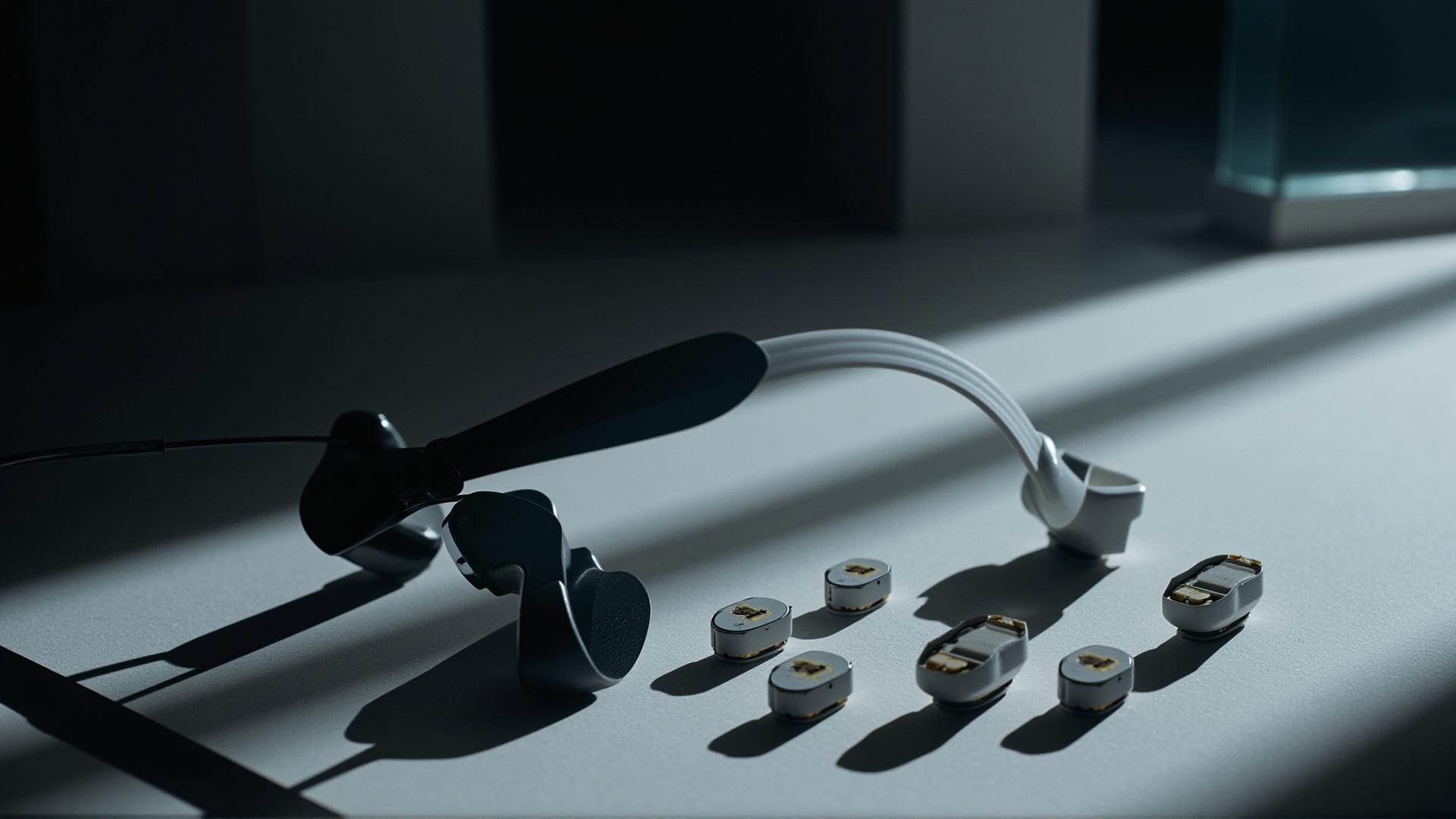
Audio glasses are judged on the first ten minutes, because that is how long a buyer, a channel partner or a customer will spend before deciding whether the product "works". This guide sets out the operating routine for the K01 in the order it should actually happen, together with the checks that tell you whether a unit is fit to leave your bench and the questions that only the supplier can answer.
 It is written for the person who signs off on the order rather than for the person who enjoys the product. Every step below produces a record, and every record either supports a claim you intend to publish or shows that you cannot publish it yet.
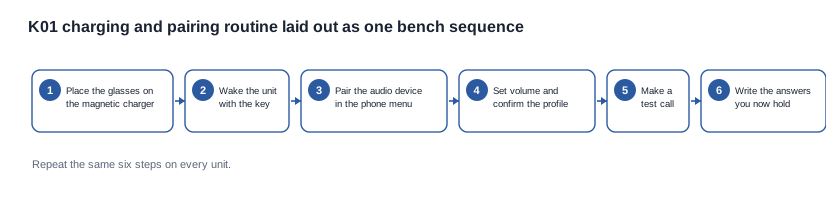
The routine in one line: seat the K01 on its magnetic charger, pair the audio device from the handset menu, confirm the profile, make a test call, and record what the printed card left unexplained.
K01 before you switch it on: the published rows and their limits
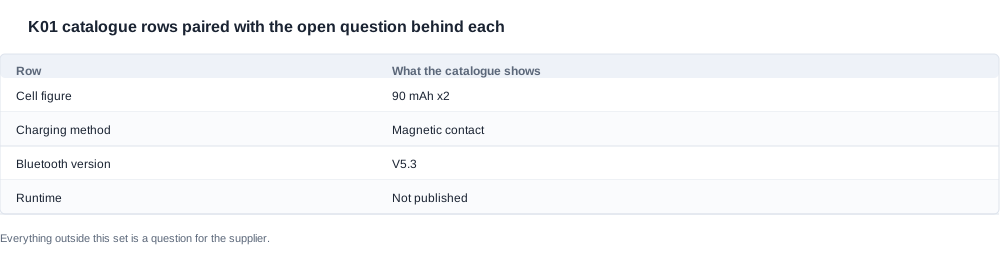
Five rows are published for this model, and they carry most of the operational weight. The cell figure appears as 90 mAh x2, which reads as two cells of that rating rather than one pack. The charging method is magnetic contact. The Bluetooth row reads V5.3, placing this model inside the subset of the range that states a Bluetooth version at all. The charge ceiling is two hours or less, and the rated use time is about eight hours, printed without the test condition that would make either figure quotable as a promise.
The gaps between those rows matter as much as the rows themselves, because they define what a product page can and cannot say:
- A rated use time of about eight hours appears in the catalogue, but no test condition is printed beside it, so an endurance figure you can defend still has to come from a measured sample or from a written supplier answer.
- No audio specification row is published beyond the Bluetooth version, so a codec, a driver arrangement or a named sound profile cannot be taken from the catalogue.
- The catalogue carries no capacitive touch row at all, so the K01 controls have to be read off a sample rather than assumed.
- Nothing in the catalogue states an ingress rating, and the colourway list for this model is not published either.
That is not a shortcoming of the catalogue. It is the normal state of a pre-production range, and the practical response is to turn each absence into a question with an owner. A buyer who tries to close every gap with an estimate ends up with a page that no supplier will stand behind, and that page is a liability rather than an asset.
The order in which the rows get read also matters. Start with the charging method, because it fixes the first physical action of the session and therefore how much of the bench time is spent on power rather than on evaluation. Read the cell figure next, because it frames the endurance conversation you are about to have with the supplier and sets a reasonable expectation for how a session should run. Read the Bluetooth version last, because it is the row a customer will quote back at you, and the one you need to check against the configuration that actually ships.
The third row deserves one extra sentence, because it is the row buyers tend to treat as a formality. A published Bluetooth version tells you which radio the unit uses, but it does not tell you which phones the unit is expected to work with, how many units can be paired to one phone, or whether the pairing survives a restart. Those are the questions a customer actually asks, and they are all answered by observation rather than by the version number.
K01 charging: put the cells on the magnetic charger first
Charge before anything else. The failure mode on an audio-glasses unit is quiet: a flat unit pairs, plays for a minute, and then the customer concludes the product is defective, when in fact nobody charged it. Magnetic contact also makes the physical check possible, because you can see whether the unit is seated on the charger or merely resting on it at an angle.
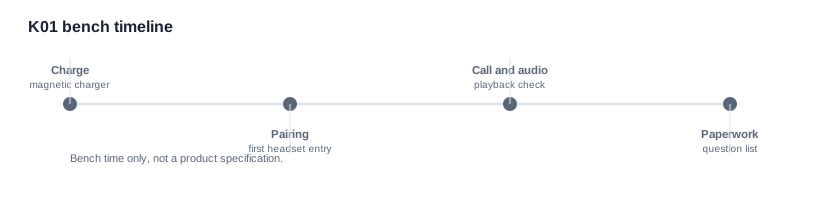
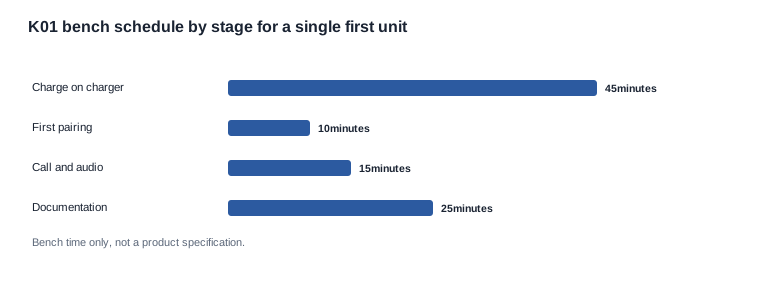
Time the K01 session and record the state you started from. Budget about 45 minutes for the first charging session, 10 for the first pairing, 15 for the call and playback check, and 25 for the documentation pass, which is close to 100 minutes for the first unit. Later units of the same batch take a fraction of that, because what is written down on the first day is what the printed manual is assembled from.
Two catalogue conventions make the charging question sharper here. Some models publish a single cell figure and some publish two equal figures, which is exactly why the 90 mAh x2 row needs an explicit reading before you quote it. Some models also ship with a case and some do not, and where a case exists its capacity may or may not be stated. Two narrow questions therefore settle the charging section of the manual: whether the published figure covers both cells together or each cell on its own, and whether a case is part of the box or an accessory sold separately.
The charger deserves its own line in the record, because it is the accessory most likely to be substituted. Note whether the charger carries a fixed lead or a detachable cable, and whether the unit charges from a wall socket or also from a power bank. These are small facts with large consequences: a fixed lead rules out one desk arrangement and a detachable lead does not, and a customer whose desk differs from the one in your product photograph will meet that difference within a week.
Record what happens at the end of the session as well as the fact that it finished. Does the phone report a full charge? Does anything on the glasses itself indicate charge state, or is the only feedback that the pairing survived? A unit with no state feedback anywhere forces the customer into a trial-and-error routine, and trial-and-error routines generate more support contacts per shipment than any other item on this list.
The same discipline applies to the charger itself. A charger that has been used for a month accumulates skin oil and pocket lint on the contact face, and a unit that charges slowly on a used charger will be blamed on the unit. Wipe the contacts before every session and note it in the record; when a slow charge appears in week two, you will know whether the accessory or the product is responsible.
K01 pairing: the step that decides whether the rest works
The pairing step is where the routine earns its keep and where the acceptance criteria matter most. The path on an audio-glasses unit is short but unforgiving: a device that appears in the phone as a media entry and never as a headset will play nothing, and the customer receives no indication that anything went wrong.
Run the sequence in a fixed order and write down what happened at every step.
- Check that the K01 shows up as a paired audio device rather than only as a media entry.
- Choose a volume profile on the K01, restart the phone, and verify the setting is still there afterwards.
- Run a track all the way through and listen on both sides for dropouts.
- Place a call each way and record how clearly the microphone picks up speech.
- Take the phone out of range, bring it back, and play something short again to see whether the K01 comes back on its own.
Step five is where a K01 routine becomes publishable rather than merely photogenic. A unit that insists on a manual re-pair after every restart is a different product from one that recovers on its own, and the wearer feels that gap as reliability, not as a specification. Where the printed card reduces pairing to a single line, this step is the evidence that says whether the line is accurate.
The Bluetooth row belongs in this section rather than in a feature list, because it is the row that lets you answer a customer's question about which phones the unit is expected to work with. It also raises a compatibility question worth putting to the supplier: whether the radio version named in the catalogue covers every regional configuration, or whether a variant ships with something different. A second question the version row cannot answer is whether two units can stay paired to one phone at the same time, and that is a question a supplier can answer in a sentence while a customer will only discover it by trying.
Record the pairing time as well as the pairing result. A unit that appears in thirty seconds and one that takes three minutes produce the same pass or fail outcome in a checklist, but they produce very different reactions from a buyer setting the unit up for the first time, and very different reviews once the product is in general circulation.
There is one further pairing behaviour worth watching, because it changes what the manual has to promise. Put the unit down mid-playback, leave it for several minutes, and pick it up again. A unit that keeps playing through a pause will be praised, and a unit that stops and needs a button press will be tolerated only if the manual says so. Either way, the behaviour belongs in the written instructions rather than in the customer's memory.
K01 in daily use: the log, and what it tells you
The first session says whether the unit works. Daily use says whether it keeps working, and that is the question a buying team is actually being asked when it places an order. The log for this model is short enough to keep on a phone.
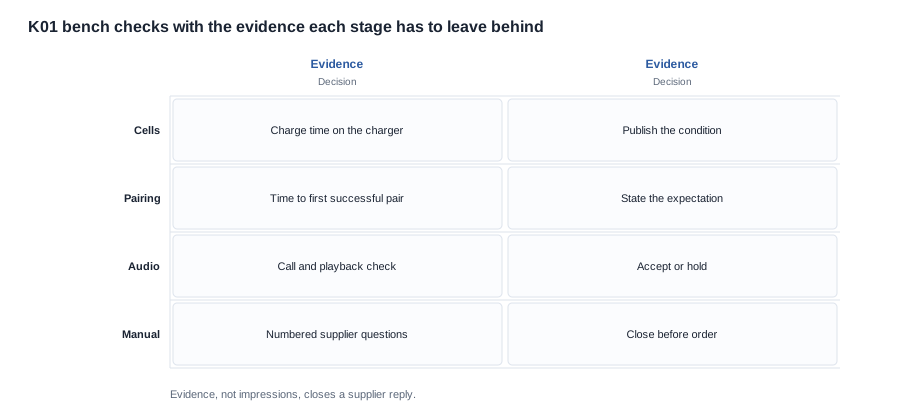
- Cell state at the start of the day and at the end of it, so the runtime pattern becomes visible within a week.
- Whether the unit stayed paired overnight or had to be re-paired, and what event preceded the failure.
- Call quality notes, recorded in the user's own words.
- Whether the magnetic charger was the only charging path used, or whether anyone reached for a cable.
- Anything the wearer said about comfort over a full day, since fit and wearing comfort determine whether a customer keeps the unit on at all.
The K01 pass mark reduces to one line of policy: a fortnight in which no re-pairing is needed, a call route that never interrupts, and nothing said about how the frame feels after a full day. When those hold, the log is the evidence behind the order; when they do not, the log is the evidence behind a refusal, and a documented refusal protects the buyer better than a purchase would have.
Two fields do most of the work in the K01 log, and they are the two most often left blank. Logging the cell level at the start of the K01 day and again at the end turns "the battery is bad" into a number you can defend, with no laboratory test involved. A re-pairing line that names what came first, whether that was a phone restart or an incoming call, is what allows the supplier to tell a handset-side behaviour apart from a fault in the unit. Each entry costs a few seconds, and neither of them can be put back together a week later.
Route the log to the people who can act on it. A note about re-pairing sitting in a buyer's inbox changes nothing, while the same note attached to a packaging revision request changes what ships next month. The packaging team, the documentation owner and the supplier contact should all be able to read the same record without asking anyone to forward it.
Screening this model before the bench time
The published rows will take a model off the list in minutes when they are read in the right sequence, and will point at the wrong model just as fast when they are not. For this category the difference is whether the comparison rests on rows that decide a purchase or on rows that happen to be printed.
The first screening question is the Bluetooth row, and it is the one most buyers look at first and should look at third. The published version reads V5.3, which places this model in the small group of units that state a radio version at all, but a version number does not tell you which phones the unit works with, how many units can be paired to one phone, or whether pairing survives a restart. Those are the questions a customer actually asks, and they are answered by observation rather than by the version.
The second screening question is the cell architecture. The published figure reads 90 mAh x2, which describes two cells at that rating rather than one pack, and it is the row that frames the endurance conversation. A single cell figure and a doubled figure are not comparable numbers, so a comparison that puts them in the same column is misleading in a way that is hard to correct later.
The third K01 screening question is the charging path, because it is the one that changes the accessory list. Across the range, magnetic contact and Type-C both appear, and four models publish no charging method at all. Until the supplier confirms what applies to this model, the packing slip, the invoice line and the manual are all provisional.
Run them in that order because each step costs more than the one before. The K01 Bluetooth row is free and often rules a model out on its own when the customer's requirement is specific. The cell figure is free and frames everything that comes after it. The K01 charging path needs one written question and one reply, so put every outstanding model into that single message rather than sending a separate request for each one.
Once those three answers are in, the K01 choice turns into a running-cost judgement rather than a comparison of printed rows. A K01 that shows up as a headset on the first attempt, comes back on its own after a pause, carries a call cleanly and charges over a socket the customer already has will generate fewer support contacts than a rival that needs a manual re-pair after every restart. That is the judgement a channel partner actually makes on the K01, and it belongs in a note written before the order rather than rebuilt afterwards.
One habit is worth keeping throughout the screening. Buy a pair of K01 samples rather than one sample of each candidate on the list. The second K01 unit is what shows a behaviour is repeatable rather than the luck of one box, and two of one model cost less than spreading a sample budget thinly across models that will never ship.
K01 before it ships: the acceptance checklist
The K01 first-session routine tests function. This checklist tests sellability, and it runs on a production unit taken from the shipment you are about to buy, rather than on the sample that reached the bench first.
- Does the model designation printed on the carton match the K01 unit, the insert card and the listing you intend to publish?
- Does the carton hold exactly the accessory set on the packing slip, with nothing swapped for a regional variant?
- Does the K01 charge on its magnetic base, with the contacts wiped and the unit sitting square?
- Does the pairing screen offer a headset entry rather than only a media entry?
- Do the printed manual and the catalogue rows give the same cell figure, the same charging method and the same radio version?
- Is the K01 document trail for the market you sell into held on file in a shape you can pass to a customer?
On that last point, be exact about what is and is not visible. Nothing in the catalogue text names CE, FCC or RoHS for any model, and the export certification page is an image page carrying patent certificates. Whatever a market requires of you, that evidence has to be requested in writing and filed before you commit, because a visual page is not something you can hand to a tender assessor.
Agree the K01 pass rule in advance rather than after the checklist has been run. A unit that works but whose paperwork is incomplete is not a pass, and a rule fixed in advance keeps that decision from turning into a schedule argument at the worst possible moment. The same rule protects the buyer from the opposite error, which is rejecting a sound unit over a formatting detail that a later instruction could have corrected.
What the K01 documentation still leaves open
Send this list to the supplier as a numbered list, so every item can be ticked off in the reply.
- Does the published 90 mAh x2 figure describe the pair of cells in the unit, and how is total runtime measured?
- Which endurance figure may we publish, and how was it measured?
- Is a charging case included in the box, and if it is, what capacity does it hold?
- What controls are fitted to this unit, and what does each one operate?
- Which Bluetooth configuration ships into each region, and what does the published V5.3 row actually cover?
- Can two units be paired to the same phone at the same time?
- Is any ingress rating published for this model, and which standard covers it?
- How many colourways are in production for this model?
- Which certificate documents do you hold for the markets we sell into, and how can they be delivered to us?
Our position on the operating routine We publish the rows the catalogue holds, we do not publish a runtime figure we have not measured, and we do not describe controls we have not seen on a sample unit. The missing numbers are not a reason to delay the launch; they are the content of the supplier conversation that has to be finished before the product page is written, and each one costs a single line to ask and a paragraph to answer.
For adjacent reading, the bluetooth audio glasses for calls page covers the K01 call behaviour this category has to get right, the bluetooth connectivity reference sets out how pairing is described across the range, and the certification checklist lists the document trail to request from the supplier. If you are weighing this model against another in the same category, the G07 specification comparison page sets out how a like-for-like comparison is structured, and the samples page explains what a K01 sample request ought to contain before it is worth sending.
Charge on the charger, pair from the phone menu, make a call, and record every number the card left out.


