

A first session on this category fits inside a supplier call and still changes what you write on a product page. This guide describes the K02 first session in the K02 order it should happen, the K02 record that has to be kept beside it, and the K02 questions that stay open until the K02 supplier answers them in writing.
 The framing is deliberate. Almost every hard conversation about an audio-glasses unit begins as a disagreement about a number nobody wrote down, and the way to end that conversation is to make the observation first and the conclusion second. A buyer who arrives with a timed charge, a recorded pairing time and a note about what the packaging actually contains can close the argument in one message. A buyer who arrives with an impression starts from scratch every time.
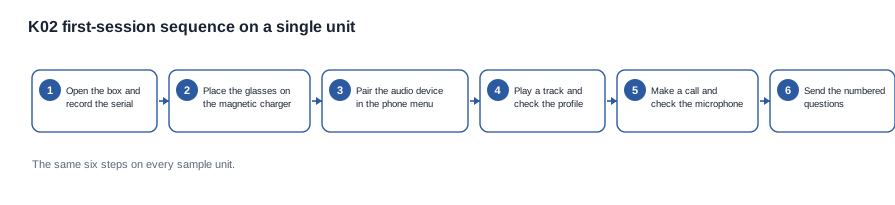
The sequence: open the box and record the serial, seat the unit on the magnetic charger, pair from the phone's Bluetooth menu, play a track and check the profile, make a call, then send the numbered questions. Nothing here is optional, because each step answers a question the next one depends on.
K02 first week: what to do on the first day
Day one produces the baseline that every later session is compared against. Repeatability matters more than thoroughness, because a baseline another person could not reproduce is not a baseline.
- Open the carton, photograph the seal and record the printed model designation and serial.
- Check the box contents against the packing slip and note anything that differs.
- Charge the K02 unit on the magnetic charger and time the session from a named state.
- Pair the audio device from the phone menu and confirm it appears as a headset.
- Play a track, adjust the K02 volume profile, and confirm the profile survives a restart.
- Make a call in both directions and note how the microphone behaves.
- Send the numbered question list to the K02 supplier with the session notes attached.
The seal photograph and the packing-slip comparison take five minutes between them and settle more disputes than any other single action here. Box contents that differ from the slip are the most common reason a customer says the product was incomplete, and a photograph taken before the box is opened is the only way to establish what actually shipped. Recording the printed designation matters for a second reason: it is the cheapest way to catch a packaging revision applied to the outer carton but not to the insert.
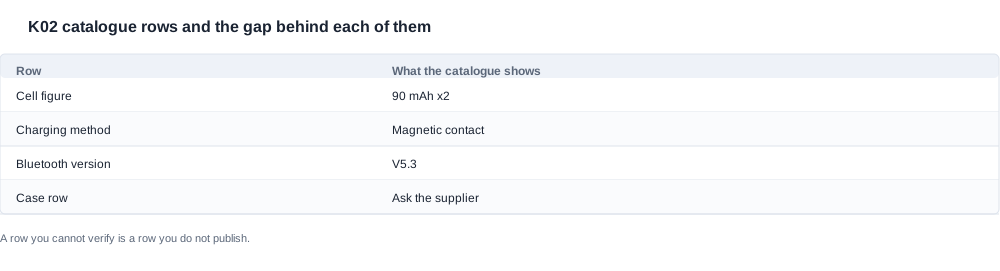
The timing on the K02 charge is the third item not to skip. This model publishes a cell figure of 90 mAh x2 and a magnetic charging method, and it publishes no charge time, so whatever is measured on the bench is the only number available unless the K02 supplier supplies one. Measuring it properly means naming the starting state, the starting time, the ending time and the state reached.
What the published rows settle, and what they leave open, is worth stating precisely, because the gaps shape the entire session:
- The cell figure reads 90 mAh x2, two cells of that rating rather than one pack.
- The K02 charging method is published as magnetic contact, which means the physical seating of the K02 unit matters and is visible on the bench.
- The Bluetooth row reads V5.3, placing the K02 among the part of the range that states a Bluetooth version.
- No runtime figure, no case line, no ingress rating and no colourway list is published for it.
The last line is the one to hold on to while reading the rest of this guide. This is a model where the catalogue supplies three usable facts and leaves the remainder to the bench and to the K02 supplier. The acceptance criteria for the session therefore have to be written by you, in advance, rather than inherited from a manual you do not yet have.
One more thing belongs on the first-day list, and it is the item most often skipped by buyers who want to reach the interesting part: write down what the K02 unit looks and sounds like on arrival. Not a judgement, an observation. How the temples sit, how heavy the frame feels in the hand, whether there is any noise when the arms are moved, whether the printed card is in the box at all. These become the baseline against which every later unit is compared, and comparing a K02 unit against a remembered impression is how a defect gets missed.
K02 charging: the magnetic charger and the K02 cell pair
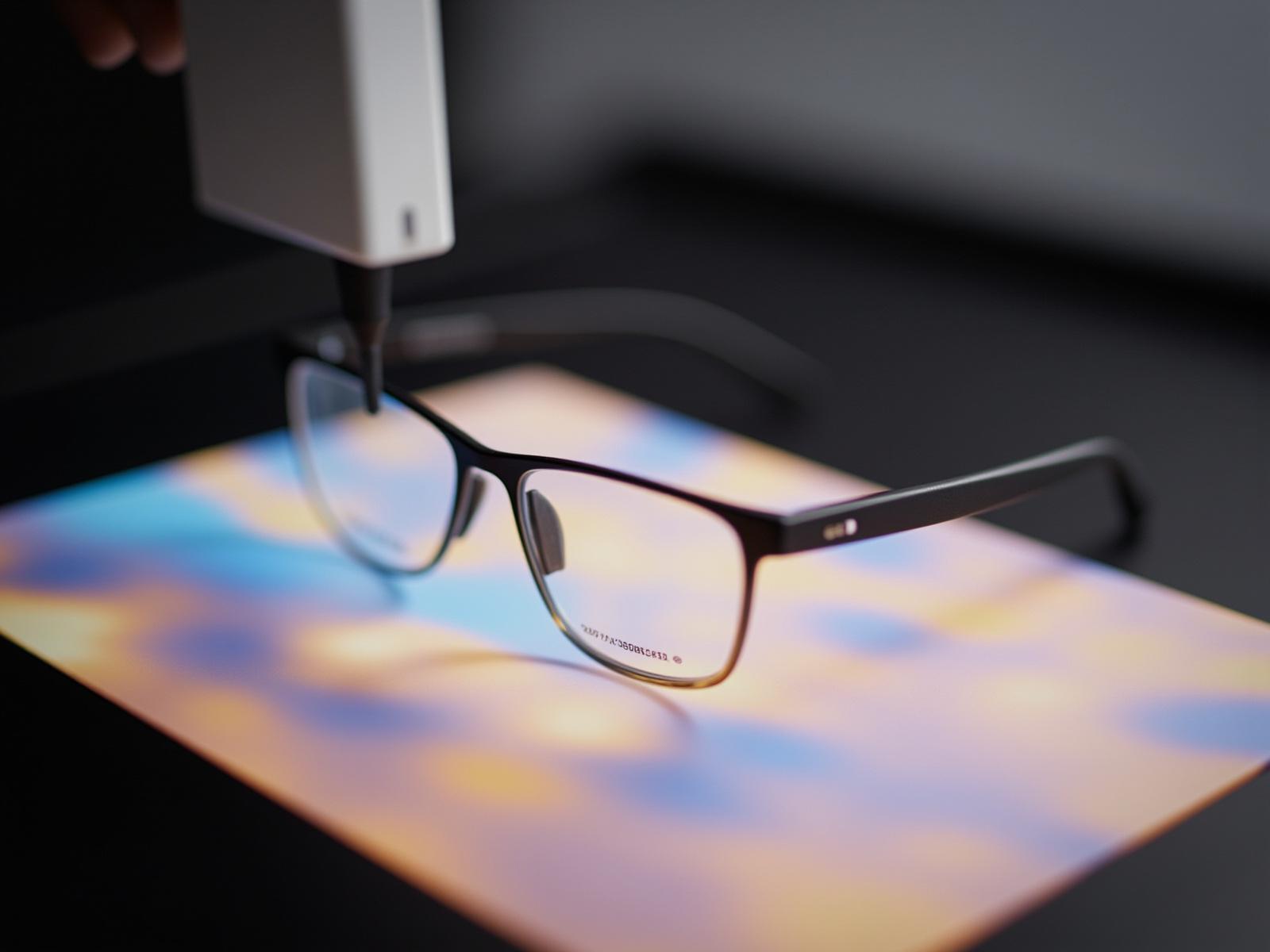
Charge first, and charge on the supplied method. Magnetic contact is not interchangeable with a cable in the way a buyer might assume: the magnets have to meet the charging pads, the K02 unit has to sit flat, and a dirty or misaligned contact is the most common cause of a K02 unit that appears to charge and does not. Look at the contact surface when the session starts and note its condition, because that observation is worth more later than any number.
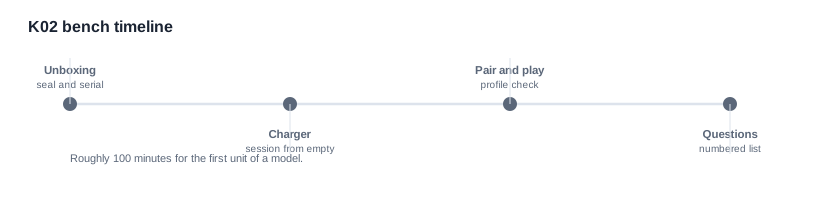
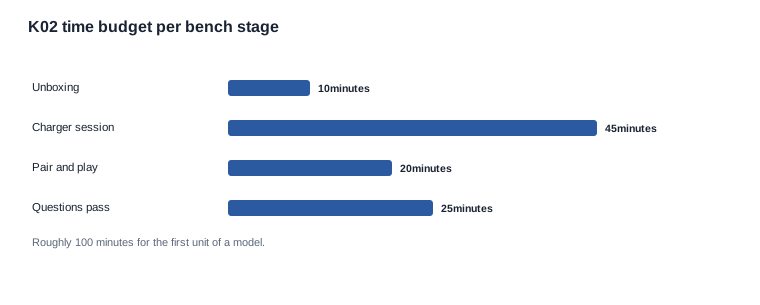
Budget about 10 minutes for the unboxing block, 45 for the K02 charger session, 20 for the K02 pairing and playback check, and 25 for the documentation pass. Close to 100 minutes for the first unit of a model, and faster for every unit after that. If a K02 unit arrives without any printed material, the documentation pass grows into the rest of the afternoon, and that condition is worth raising with the K02 supplier as a separate item rather than absorbing quietly.
The cell figure needs one clarification before it can be used for anything. A row published as 90 mAh x2 tells you there are two cells of that rating; it does not tell you the runtime, and dividing a capacity by an assumed current draw produces a figure that looks authoritative and means nothing at all for the K02. Runtime has to be measured on the first K02 sample under a named volume profile, from a named start state, with the result recorded as an observation. Until then, the page states the published cell figure and says nothing further.
Whether a charging case belongs in the box is the other open item on this step. The published rows for the K02 carry no case line, which is different from a line saying there is no case. Ask the K02 supplier directly: is a case included, is it the charging base or a separate travel case, and does the K02 case carry its own cell. Three short answers, and the packing slip, the product page and the K02 manual can all be written from them.
Two smaller charging details are worth capturing while the K02 unit is on the K02 charger, because they cost nothing to observe and cost a lot to fix afterwards. The first is whether the charging base stays warm during a long session and whether that warmth reaches the frame. The second is whether the K02 unit can sit on the K02 charger with the arms open or has to be folded, which decides whether a customer can charge and wear in the same position without a second cable.
K02 pairing: the step customers test in the first minute
The pairing path on an audio-glasses unit is short, and the failure is quiet. A device that appears in the phone as a media item but never as a headset will play nothing, and the customer has no way to tell that the K02 unit is a headset, so they conclude the product is broken and return it. This is the most expensive silent failure in the category, and it is entirely avoidable with a two-minute check.
Run the K02 pairing steps in this order and write down what you saw at each one.
- Look for the K02 in the phone's device list as a headset or audio entry rather than only as a media source.
- Choose a volume profile, then power the phone down and bring it back up to see whether the setting survived.
- Start a track and listen the whole way through for dropouts on either side.
- Place a call and write down whether the K02 microphone takes speech clearly from an ordinary speaking distance.
- Step away far enough to break the link, come back, and start the track once more to find out whether the K02 unit re-links unaided.
Step five is where a K02 routine starts to earn its place on a product page. A unit that wants a manual re-pair every time the phone restarts is a different product from one that restores the link on its own, and the wearer experiences that difference as reliability rather than as a specification. When the printed card reduces pairing to a single line, step five is the evidence behind the claim.
Two supplier questions belong with this step rather than with the feature list. The published Bluetooth version is useful, but the customer asks which phones it is expected to work with, so ask whether the version we publish covers every regional configuration or whether a variant ships with a different one. And ask whether re-pairing after a restart is expected behaviour on some platforms, because if it is, the K02 manual should say so, and if it is not, it belongs on the defect list.
There is a third pairing question that only shows up in the second week, and it is worth raising early because it is cheap to fix and expensive to discover late: whether the K02 unit will remember several phones, and whether a customer moving between a work phone and a personal phone has to re-pair each time. A unit that remembers both behaves very differently in daily use from one that does not, and the difference is invisible to a ten-minute test.
K02 in daily use: the weekly record that settles it
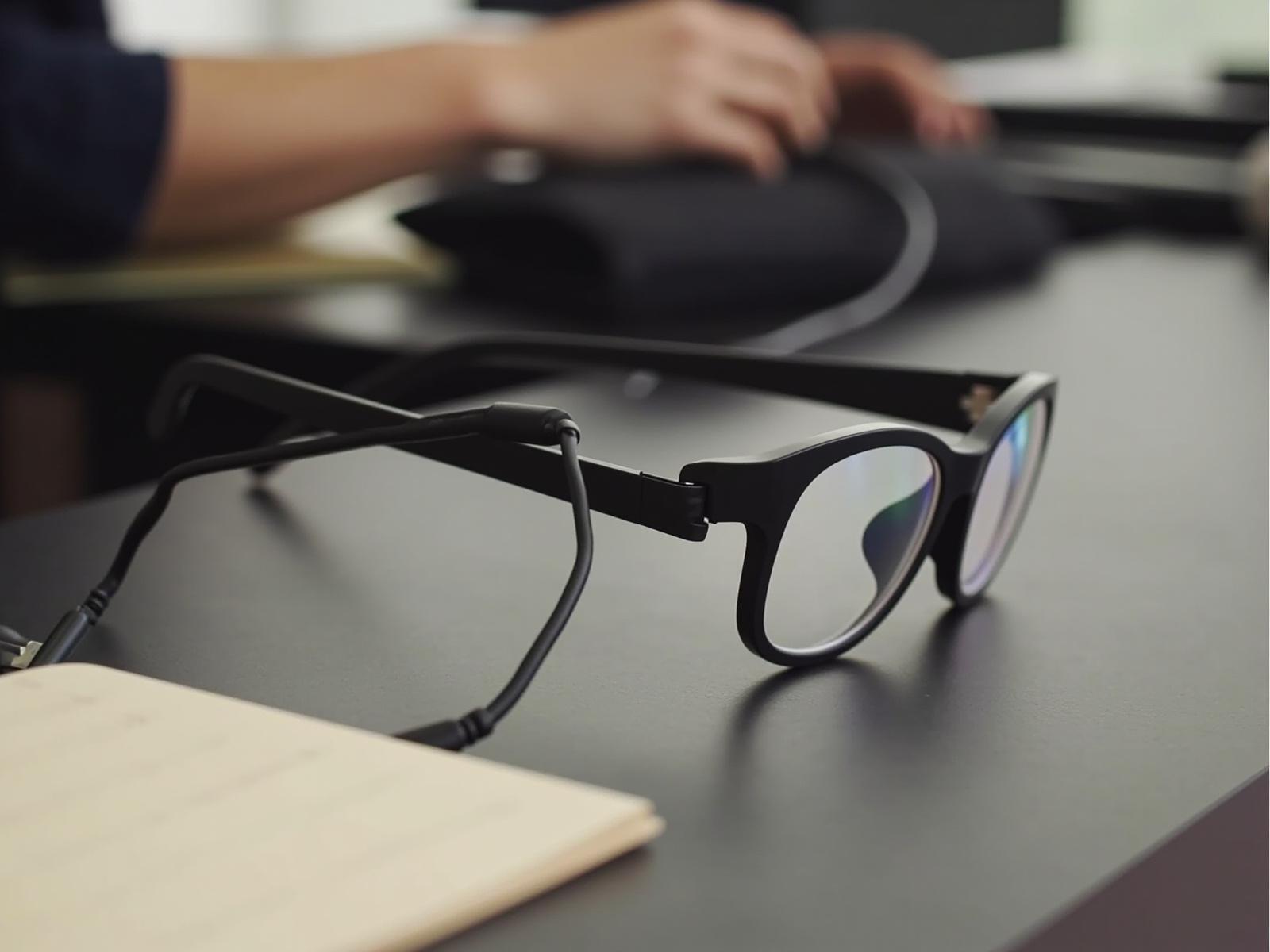
The opening session settles whether the K02 unit functions. What follows, over the following week, settles whether it keeps functioning, and that is where return reasons actually originate. The log is small enough that there is no excuse for not keeping it.
- Cell level at the start and end of the day, so a runtime pattern shows up inside a week.
- Whether the K02 unit held its pairing through the night, or dropped it and had to be joined again, together with whatever preceded the drop.
- Call notes in the wearer's own words, since those words become the support script.
- Charging behaviour: the K02 charger used, how long it sat there, whether the K02 unit was seated correctly.
- Comfort notes from a full day of wear, because a K02 unit that is uncomfortable is a K02 unit that gets returned rather than used.
Set the K02 thresholds before the K02 log begins: a fortnight with no repeat re-pairing, a call route that never interrupts, a charging routine that stays steady, and no remark about the frame. Once they are met, the K02 log becomes the evidence behind the purchase order; where they are not, it becomes the evidence behind a refusal, and that protects the buyer more than a purchase would have.
Log what the wearers say, not what you conclude about it. The phrase a customer uses is usually the phrase your support agent will hear, and it is far easier to change a product page than to change a customer expectation that has already been set by the packaging. Route the K02 log to the packaging and documentation teams directly, because a note saying the K02 needed re-pairing is worth little in a buyer's inbox and a great deal attached to a packaging revision request.
The two entries that settle most disputes are the smallest ones. A cell state written at the start and again at the end of the day turns a vague battery complaint into a runtime measurement. A re-pairing entry naming the preceding event is what separates a platform behaviour from a hardware fault. Both take seconds to write and neither can be reconstructed a week later.
Add one field to the K02 log that costs nothing and pays off later: how the K02 unit was worn. Glasses, over the ears, or pushed up on the head between uses. A unit that is routinely pushed up and then re-worn behaves differently from one that is never taken off, and knowing which pattern produced the observations is what allows the K02 manual to say something useful about handling.
Screening the K02 before the bench time
A first session is worth very little if the K02 should never have reached the bench. Read in the right sequence, the published rows can remove a model in minutes; read in the wrong one, they point at the wrong model just as fast.
The first screening question is what the customer actually needs the K02 unit to do. For this category that is either calls or playback, and the two pull in different directions on cost and on documentation. A buyer who has not answered that question first will end up measuring the wrong things, and the rest of the evaluation will be accurate and irrelevant.
The second screening question is the K02 cell architecture. The catalogue figure reads 90 mAh x2, which is two cells of that rating rather than one pack, and the same row appears on another model in the range. That duplication is the reason a cell-only comparison concludes that two different products are equivalent, which is a conclusion the first customer who tries to pair them will contradict.
The third K02 screening question is the charging path, and it decides the accessory list. Charging methods are published for most of the range, with magnetic contact and Type-C both appearing, and four models carry no published method. Until the K02 supplier confirms what applies here, the packing slip, the invoice line and the K02 manual are all provisional, and a wrong assumption on the packing slip becomes a shipping error on every unit that ships.
Work through them in the order that matches what each one draws from the budget. The use-case question is settled by talking to the customer. The cell row costs nothing and frames the rest. The charging path costs a written question and a reply, so ask it once, covering every model still on the list, in a single message.
The total cost calculation then becomes the real decision. A unit that pairs as a headset straight away, keeps a profile across a restart, takes calls intelligibly and charges over a method the customer already owns carries a lower support cost than a rival unit that needs a manual re-pair after every restart and arrives with an accessory the customer has to order separately. That is the comparison a channel partner will weigh, and it belongs in writing before the K02 order rather than reconstructed afterwards.
One habit is worth keeping throughout. Buy a pair of K02 samples rather than one sample of each candidate in front of you. The second unit proves that a behaviour repeats rather than being the luck of one box, and two of one model cost less than a sample budget spread thinly across models that will never be ordered.
K02 before it ships: the acceptance checklist
Working is not the same as sellable. Run this K02 checklist on a production unit taken from the consignment you are about to pay for, not on the first K02 sample that happened to arrive first.
- Does the printed K02 designation match the unit itself, the insert card, and the listing you plan to publish?
- Does the box contain exactly what the packing slip promises, with no regional substitutions?
- Does the K02 unit charge on the magnetic charger, with the contact clean and the unit seated correctly?
- Does pairing produce a headset entry, and not only a media entry?
- Do the K02 manual and the published rows agree on the cell figure, the charging method and the Bluetooth version?
- Is the K02 certificate trail for the market you sell into on file, in a form a customer can check?
- Does the carton carry the same designation as the unit inside it?
On that last point, be precise about what is visible and what is not. The catalogue records no CE, FCC or RoHS text for any model; what sits on its export certification page is a set of patent certificate images rather than a list of test reports. A market that requires a certificate from you therefore needs the trail requested in writing and filed before you commit, not inferred from a picture of a document.
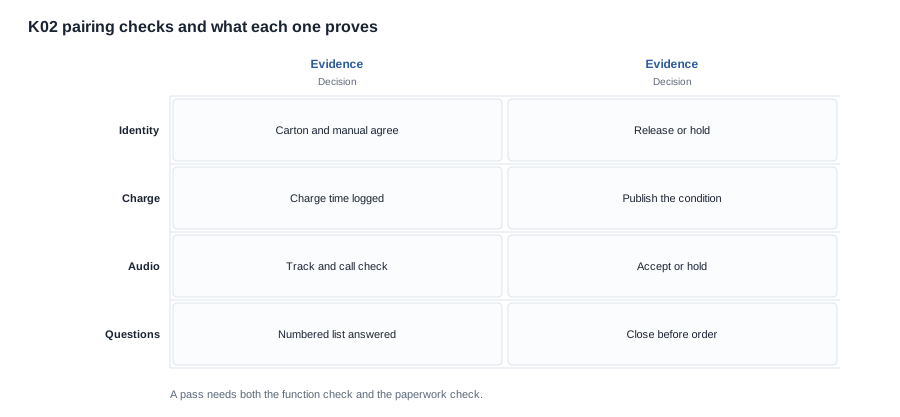
Agree the pass rule before the K02 checklist starts rather than afterwards. A unit that passes the function check but not the paperwork is not a pass, and a K02 rule settled in advance keeps that from turning into a schedule argument in the final week before the goods are needed. The same rule guards against the opposite error, which is turning down a sound unit over a packaging detail that a later instruction could have fixed.
What the K02 documentation does not answer
Put this list to the K02 supplier as a numbered list and attach the session notes beside it, so each answer can be checked against what was actually observed.
- Does the 90 mAh x2 row cover both cells, and which endurance figure may we publish?
- Is a charging case included in the box, and does the K02 case carry its own cell?
- What controls does this unit carry, and what is each of them for?
- Does the K02 unit reconnect automatically after a restart, and is re-pairing expected on any platform?
- Which Bluetooth configuration ships in each region, and does the V5.3 row we hold cover all of them?
- Can the K02 unit remember two phones at once, and how does it behave when it switches between them?
- Does an ingress rating exist for the K02, and what standard was it tested against?
- Which colourways are available for the K02, and how many?
- Which certificate documents can you provide for the markets we sell into, and in what form?
Our position on the K02 The three rows we hold are the three rows we publish, we do not publish a runtime figure we have not measured on a named profile, and we do not describe physical controls we have not seen on a sample unit. The gaps are not a reason to hold the launch; they are what the K02 supplier conversation has to settle before the product page is written.
For adjacent reading, the bluetooth audio glasses comfort and fit page covers the wear questions that decide returns on this category, the bluetooth audio glasses troubleshooting page sets out the failures that most often reach support, and the samples page sets out what a K02 sample request should contain before one is worth sending.
Charge, pair, call, and write down everything the printed card left out.


