
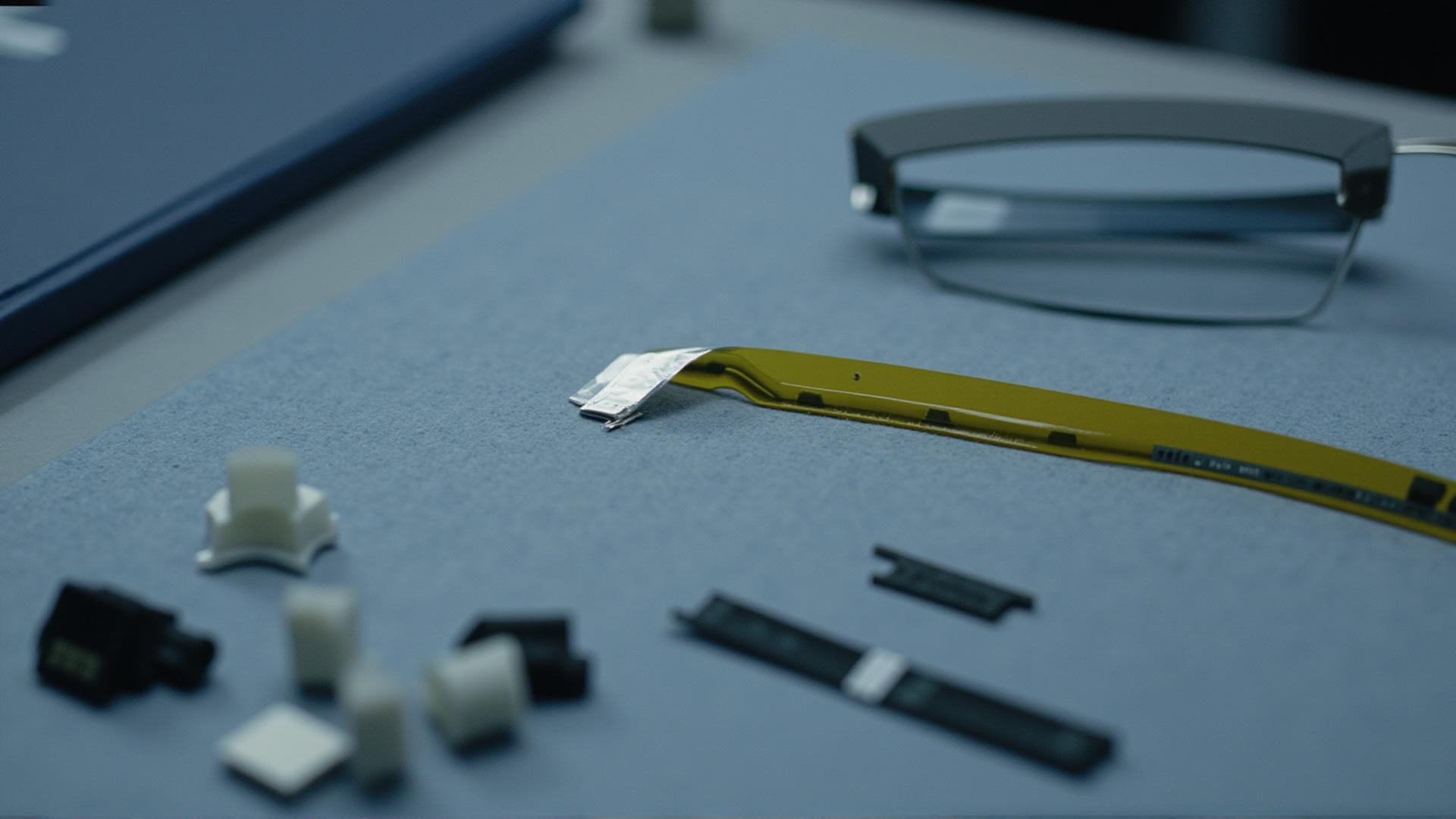
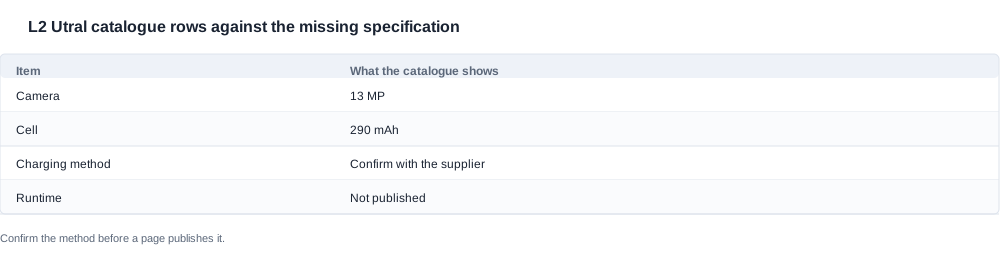
Two rows are published for this model and they carry most of the operational weight: a camera at 13 MP, and a 290 mAh cell beside it. Everything else a buyer would normally check is missing or uncertain, which is why the L2 Utral routine below is built around observation rather than around a manual. Written for the person who signs the purchase order, it turns each gap into a question with an owner and a deadline.
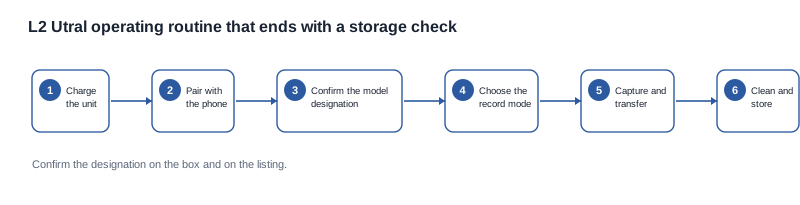
 The discipline that makes the routine work is simple. Do not describe a feature you have not seen on a unit, do not publish a number you have not measured, and do not let a first session end without a written record. Everything else follows from those three rules.
The routine in one line: charge, pair, confirm the model designation, choose the record mode, capture and transfer, then clean and store.
L2 Utral before you start: what the two published rows settle
The catalogue publishes two rows for this model, and they are worth reading carefully because they constrain everything else. The camera row reads 13 MP, which places this model among the small group of camera products in the range whose resolution is stated. The cell row reads 290 mAh. Neither figure is a runtime, and neither figure tells you how the unit is charged.
The gaps are as follows, and a buyer who treats any of them as a given will discover the problem in front of a customer:
- The charging interface for this model is published as Type C, and the case is listed with two capacities, 900 and 1400 mAh, so confirm which configuration a given order carries instead of assuming the larger one.
- A rated endurance of about seven hours is published for the L2 Utral, but with no test condition attached, so endurance across a working day still has to be measured rather than quoted.
- No Bluetooth version is published for this model, and camera models across the catalogue generally do not carry one.
- No ingress rating and no colour row is published.
Two of those gaps are directly commercial. The case configuration determines the packing slip, the product page and the accessory line on the invoice, so a wrong assumption there produces a shipping error on every unit. The published endurance needs the same care: the catalogue prints about seven hours for this model with no test condition attached, and a customer who reads that number as a promise will keep it as a promise after two hours of use.
The remaining gaps are cheaper but still real. A missing ingress rating does not stop the launch, but it does stop you from claiming the unit is suitable for outdoor use, and for a camera product aimed at active users that claim is often where the differentiation is supposed to live. A missing colour row means the colour shown on your product page has to be confirmed against the actual units, which is a five-minute check on the bench and a returns problem if it is skipped.
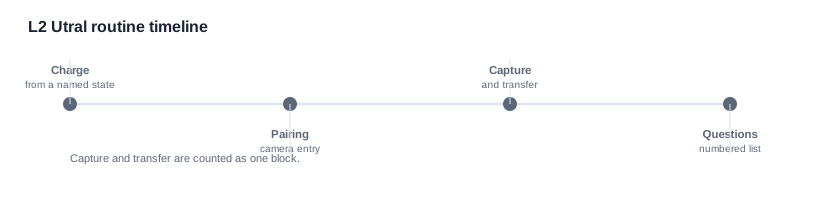
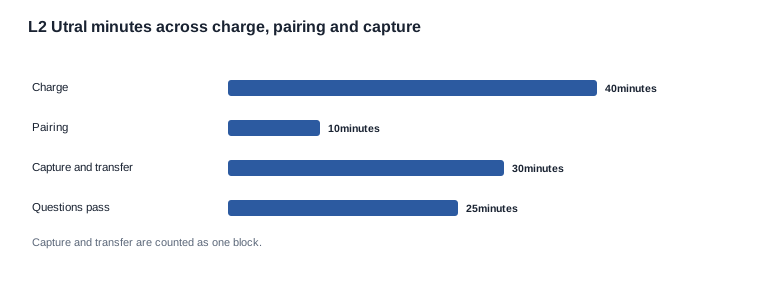
Budget roughly 40 minutes on the L2 Utral charge stage, 10 on pairing, 30 on the capture-and-transfer block, and 25 on the paperwork that has to be completed before the unit leaves the bench.
That is roughly 100 minutes for the first unit of a model, and the first unit is always the slowest because the notes taken on day one become the manual you print later. Subsequent units of the same batch take a fraction of that, which is why the second unit is worth ordering even when the budget only covers one.
L2 Utral charging and pairing: the two steps that set the day up
Charge before pairing, and record the state you started from. The pairing step on a camera-glasses unit has one specific failure that is worth testing for explicitly: whether the phone exposes the unit as a camera with its own storage path, or only as a generic media device. A customer who can play sound through the glasses and cannot find a recording will assume the camera is broken, and they will not call you to correct the impression.
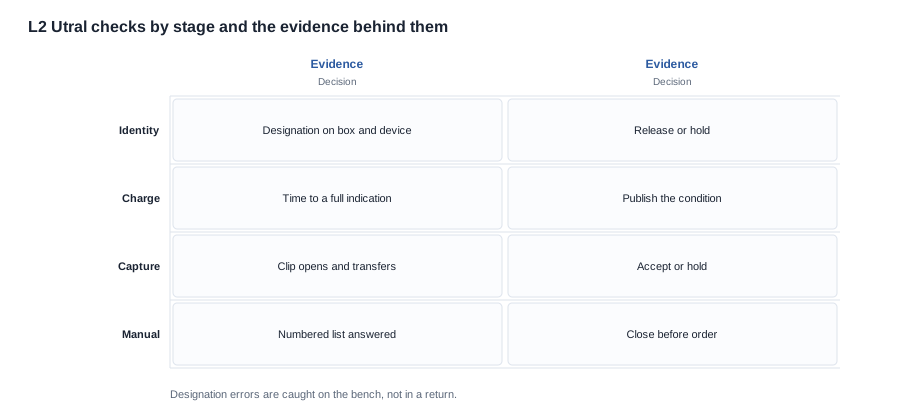
 Confirm the model designation on the device, on the packaging, and on the insert card before you do anything else with the unit. It sounds pedantic, and it is the single cheapest check in the whole routine, because a designation mismatch is invisible in a functional test and expensive to fix after inserts are printed.
The pairing and charging sequence, in order:
- Charge the L2 Utral and record the start state, the wall-clock start and end, and the state reached.
- Confirm the model designation across the carton, the device and the insert card.
- Pair with the phone and confirm the unit appears with its own camera and storage path.
- Capture one clip immediately and open it on the phone before recording anything else.
- Confirm whether the files land in a dedicated application folder or in the standard camera roll.
- Note down every question the printed material left open, using the wording the box itself uses.
The fourth step is the one that ends the session early when it fails, and that is the point of doing it first. A unit that pairs, records and produces an unopenable file is a unit that cannot be evaluated on function, and finding that out in the first ten minutes leaves you a full afternoon to write to the supplier instead of a full afternoon spent generating more recordings that will not open.
Step five is the question that decides whether transfer is a task or an invisible side effect. If the files land in the camera roll, transfer happens on its own and the only thing worth logging is where the files went. If they land in an application folder, then transfer is a separate step with its own failure modes, and the manual has to describe it, and the customer has to be told what happens if the application is not open.
L2 Utral daily use: the working day and its record
A camera-glasses product is used in a pattern, not in a session. The pattern for a typical wearer is short capture runs through the day with a charge between them, and the routine has to survive that pattern without anyone having to think about it.
- How many clips each run produced, and whether the run ended by choice or because the unit stopped accepting more.
- Which folder the clips landed in, and whether any of them refused to open or never reached the phone.
- Charge remaining at the beginning and at the end of the L2 Utral day, so a pattern emerges rather than an impression.
- Whether the unit wanted a mid-day top-up, and how long the wearer was without it.
- Whatever the wearer said about comfort and about weight over a full day, in their own words.
The thresholds are what turn a daily log into a procurement document rather than a diary.
The second group covers interrupted work in the L2 Utral day. A full day of capture with nothing lost, nothing that failed to transfer and no unexplained interruption, held over two consecutive days, is the evidence that moves the model from an evaluation list to an order list. If the thresholds are not met, what the log supports is a refusal, and a refusal written down protects the buyer better than an order nobody checked.
Two failure modes deserve their own line in the record because they are the ones that generate returns rather than support tickets. The first is a full card: a unit that stops recording silently destroys the recording a customer believed they still had, and the customer cannot tell you what disappeared, so the complaint is unanswerable. The second is a deferred transfer: a unit that captures correctly but leaves the user hunting for files is a unit that gets switched off within a week, and no complaint reaches you at all, which is worse.
The 13 MP camera row makes the storage question more important rather than less. Larger files fill the available space faster, so the behaviour when storage runs short has to be observed deliberately rather than discovered. Fill the storage deliberately, watch what the unit does, and write down whether it warns, silently stops, or overwrites. All three behaviours are acceptable if they are documented, and only the first is acceptable if they are not.
There is a third behaviour worth watching on a camera unit used through a whole day: whether the unit needs to be taken off and put back on to wake. Some camera-glasses units stay awake for a fixed window and then sleep, which is good for battery life and bad for a user who expects to raise the unit and shoot instantly. Test it at the start of a second session, because a user who raises the unit and gets nothing will assume it is broken.
L2 Utral when the routine breaks: failure modes and their cost
A routine that only describes the successful path is a brochure. What a procurement team actually needs is the list of things that go wrong, because a buyer who has never seen a unit fail cannot separate a real defect from a bad morning, and the two get argued about in exactly the same tone.
 For this model the failures divide into three groups, and the grouping that matters is by cost rather than by symptom. The first group is silent loss: a unit that stops recording when storage fills, a unit that files its output somewhere the user will not look, and a unit that recycles the oldest clips. Each of them produces the same outcome at the customer end, a recording that no longer exists, and none of them produces a support ticket at the moment it happens. That is precisely why the daily log has to carry a clip count, because the log is the only place the loss becomes visible.
The second group is interrupted work. A unit that wants a mid-day charge, a unit that sleeps between sessions, and a unit that stays silent unless the phone application is open each break the working day into pieces. Nothing is lost, and the damage is to how long the customer keeps the product in use. This group is more expensive than it looks, because a camera product that is used for an hour a day is a product that generates no returns and no referrals either.
The third group is what shows up in the returns box: heat, weight and fit over a long session. Nothing is published about any of these for this model, and that silence is exactly why the comfort field in the daily log exists. A wearer describing the unit as heavy and a wearer describing a pinch after ninety minutes are reporting different problems, and a summary that reduces both to "uncomfortable" throws away the part you need in order to act.
Each L2 Utral failure in the record needs four fields: what the user experienced, what you saw on the unit, whether it came back on a repeat test, and what the supplier would have to change. The fourth field decides whether a finding is worth escalating, and it is the one most people skip. A failure with no supplier-side fix is still worth recording, but it belongs in a different conversation from one where a firmware change or a packaging change would close it.
The escalation order follows the cost. Silent file loss ranks first: data the customer believes they still have is destroyed. Interrupted work ranks second, because it changes the way the product gets used rather than the way it feels. A comfort complaint ranks third, because a bench observation of comfort is an opinion until a wearer confirms it. Set that order down before the failures appear, because in the moment the loudest complaint is rarely the most expensive one, and a loud complaint will otherwise crowd out a quiet one that costs more.
Deciding between the units you are looking at
Before the bench time is booked, a buyer has to decide whether the L2 Utral belongs on the shortlist at all. The published rows make that call possible in minutes, and they also make it easy to reach the wrong answer, because the two rows that are published are not the two rows that decide a purchase.
The first screening question is the customer's use. This category splits cleanly into units sold for still capture and units sold for video, and the two pull in opposite directions on file size, on endurance and on what a customer expects to find when the files are opened. A buyer who has not settled that question first will end up measuring the right things accurately and irrelevantly, which is the most expensive way to spend a sample budget.
The second screening question is the camera row itself. The published figure reads 13 MP, and only three models in the range publish a resolution at that level, the rest of the camera products sitting at 8 MP. For a customer whose use involves reviewing footage afterwards, that difference is the difference between a unit worth a second look and one that is not, and it can be quoted without any measurement at all.
The third screening question is endurance, and the published set says nothing about it. The cell figure of 290 mAh frames the expectation, but a frame is not a runtime, and the two are easily confused in a buying conversation. That gap is exactly why the daily record in this guide carries a charge state at both ends of every day, because a buyer who has to defend an endurance figure to a customer has to produce one rather than derive it.
Run the three in that order, because each step costs more than the last. The use-case question costs a conversation with the customer and should come first. The camera row costs nothing and will often eliminate a model on its own. The endurance question costs a measured working day on a sample, and it is worth that cost only after the cheap questions have narrowed the field.
Once the three answers are in, the L2 Utral decision becomes a total cost calculation rather than a spec sheet comparison. An L2 Utral that records at the resolution the customer needs, runs a full working day on one charge, and stores files where the user expects them generates less support work than a cheaper unit that needs a mid-day pause and leaves the user hunting for clips. That is the comparison a channel partner will actually weigh, and it belongs in writing before the order is placed rather than reconstructed afterwards.
Two habits keep the screening honest. Take two samples of the model you have selected rather than one of every candidate, because the second unit is what shows a behaviour holds rather than being a one-off. And write the acceptance criteria for each candidate down before the samples arrive, so the models are measured against the same standard rather than against whichever one happens to be in front of you on the day.

L2 Utral before it ships: the acceptance checklist
A unit that captures is not a unit that can be sold. This checklist runs on a unit drawn from the shipment you are about to buy rather than on the sample that arrived first.
- Is the L2 Utral designation printed on the carton, on the unit and on the insert card in the same form?
- Does the box contain exactly what the packing list promises, with no regional substitutions?
- Does the unit charge as the supplier described in writing, using the accessory that ships in the box?
- Does the camera produce a playable file straight after pairing?
- Do the manual and the catalogue agree on the camera figure and on the cell figure?
- Are the documents for the markets you sell into held on file in a form you can pass to a customer?
On that last point, be precise about what the catalogue does and does not contain. The export certification page shows patent certificate images, and no CE, FCC or RoHS text entry appears anywhere in the catalogue. That is a statement about the visible materials, not a statement about certification status, and it is exactly why the L2 Utral certificate trail has to be requested and filed rather than assumed. If a tender requires a certificate, the request goes in on the day the model is shortlisted, because the reply comes from the person who owns the documents rather than from the production schedule.
Decide the pass rule in writing before the checklist starts. A unit that passes the function checks but fails the paperwork is not a pass, and a rule written in advance stops that from turning into a schedule argument two weeks before the goods are needed. That rule also guards the buyer from the opposite mistake, which is refusing a sound unit over a packaging detail a later instruction could have corrected.
What the L2 Utral documentation does not answer
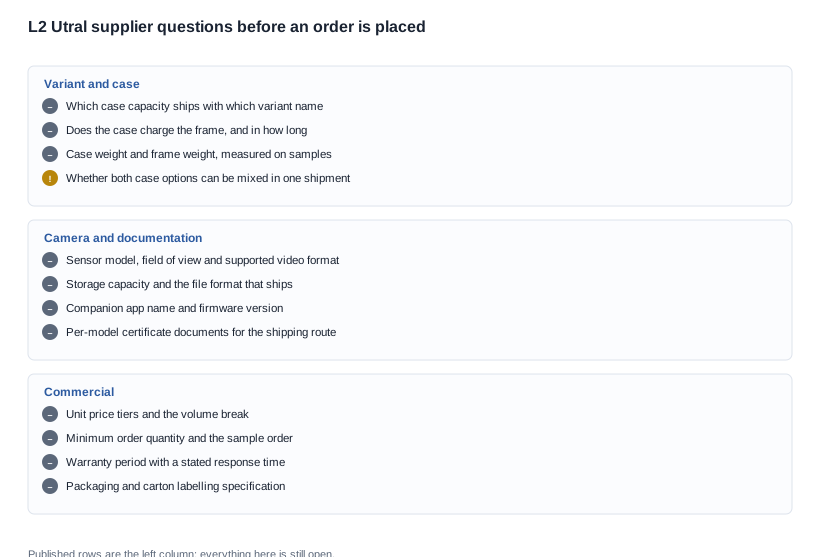
These nine questions go to the supplier as a numbered list, so each one is answered on its own.
- How is this model charged, and does the box include a case?
- What endurance figure should the page carry, and how was it measured?
- Is 13 MP the default recording resolution, or only the maximum?
- Where do the L2 Utral files land on the phone, and is the transfer immediate or held back until the app opens?
- What happens when the storage runs out, and does the unit warn the user before it stops?
- Does the unit sleep automatically, and how does it wake?
- Which controls are fitted to this model, and what is each one for?
- Is there any ingress protection for this model, and which standard covers it?
- Which colourways exist for this model, and how many of them?
- Which certificate documents can you provide for our target markets, and in which form?
Our position on this model The L2 Utral 13 MP camera row and the 290 mAh cell row are the two figures we publish. An endurance figure appears only once we have measured one under a stated setting, and the charging method stays off the page until the supplier has confirmed it in writing. Gaps on an L2 Utral are normal; unasked questions are not.
Begin with the camera imaging reference, which shows how the range describes L2 Utral imaging behaviour. The AI camera glasses charging case options page compares the case configurations available on this category, and the samples page sets out what a sample request needs to contain. If you resell rather than manufacture, the AI camera glasses product page is where you can see how this model sits within the wider line.
Charge, confirm the designation, capture, check the files, and keep the questions on the list until they come back in writing.


