

A pair of Bluetooth audio glasses is simple to operate and surprisingly hard to document, because almost everything a buyer needs to publish about it is a habit rather than a specification. This guide takes the model in the order the gaps appear and works through what can be written down from the published rows, what has to be observed on a sample unit, and what the documentation simply cannot supply without a supplier answer.
 The title says what is missing, and that is deliberate. Most product pages for this category are written as though nothing is missing, and the result is a page that repeats the cell figure, describes pairing in one sentence, and stays silent on everything a customer actually asks.
The published set for this model is narrow. One row is genuinely useful, and the rest of the operating picture has to come from the bench.
LC-105-1 pairing: what "paired" has to mean in writing
Pairing is where the documentation for this category usually fails, because manuals describe the action without describing the outcome. "Pair the glasses with your phone" is an instruction that leaves the customer with no way to know whether it worked, and a customer who cannot tell whether the unit is paired will conclude that it is faulty.
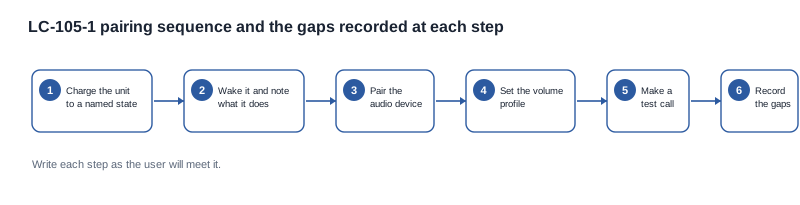
Write the pairing section as a sequence with observable checkpoints, which is what turns an instruction into something a support agent can quote back.
- Charge the unit to a state you can name, and record the time it took from empty.
- Wake the unit and note what it does on its own before you touch the phone.
- Pair the audio device from the phone's own menu, not from an application.
- Confirm the unit shows up as an audio device rather than only as a media entry.
- Set the volume profile, then restart the phone and check the profile was retained.
- Play a track, then make a call, and note whether the microphone is picked up clearly.
- Record the gaps, in the words the customer would use.
Step four is the checkpoint that matters most. A unit that pairs as a media item will play nothing and gives the customer no signal that anything has gone wrong, and that is the failure that comes back as a return rather than as a question. Step two is worth doing because it separates a unit that needs a deliberate action to wake from one that does something on its own, and the two require different first lines in the manual.
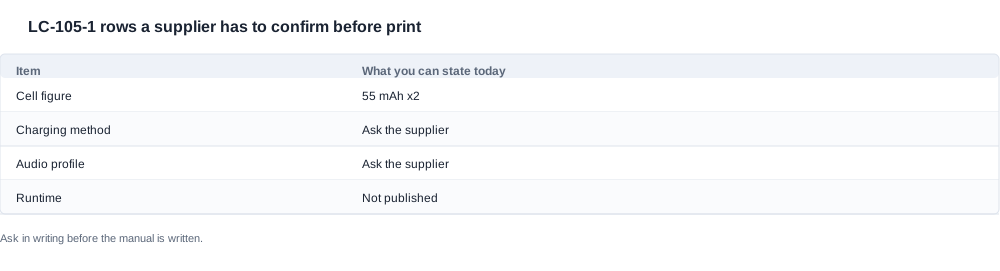
The published cell figure for this model reads 55 mAh x2, so two cells are involved rather than one. That single row is useful for framing the endurance conversation and for setting expectations about how many charges a day should need, but it does not give you a runtime, and dividing a capacity by an assumed draw gives a number that looks authoritative and means nothing for this model either. Runtime has to be measured on the sample, at a named volume profile, from a named start state, and recorded as an observation.
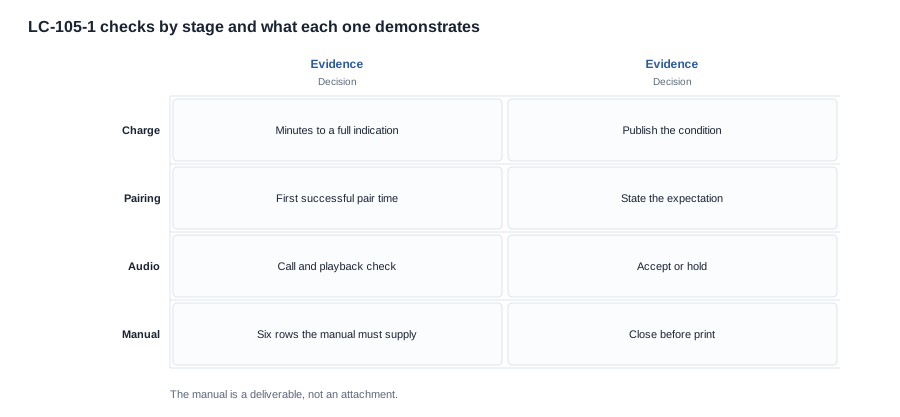
The acceptance criteria for the pairing stage are worth writing down before you start rather than after, because they are what a later reader will use to judge whether the unit passed. A headset entry in the device list, a retained volume profile after a restart, and a call that works in both directions without intervention are three short criteria, and all three can be checked in under five minutes.
One pairing behaviour is worth adding to the criteria, because it separates a category leader from a category average: whether the unit reconnects by itself after the phone has been away for a few minutes, or whether the user has to repeat the pairing. Two units on the same specification sheet can differ here, and the difference is invisible in a ten-minute test.
LC-105-1 the control method, and why it is the row buyers miss most
The catalogue publishes no capacitive touch row anywhere in its range, and its single published control-surface description sits on a different product with an indicator light and a button. The practical consequence for this model is specific and useful: the controls here are physical, and a buyer who writes a touch-panel interaction into a product page for this model has written a feature that does not exist.
That is why the control question is worth asking the supplier in writing even when the answer seems obvious from handling the sample. You need three things in the manual, and all three come from a single reply: which controls exist, what each one does on a short press, and what each one does on a long press. A model with several buttons can have meaningfully different behaviour per button per press, and that behaviour is exactly what a customer cannot work out alone.
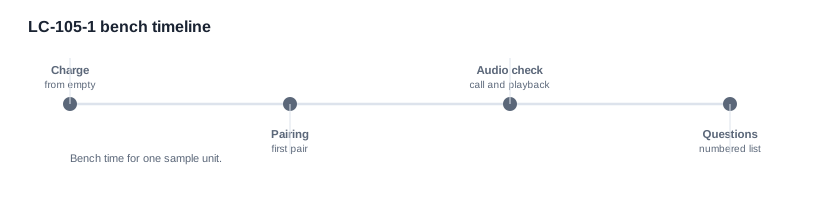
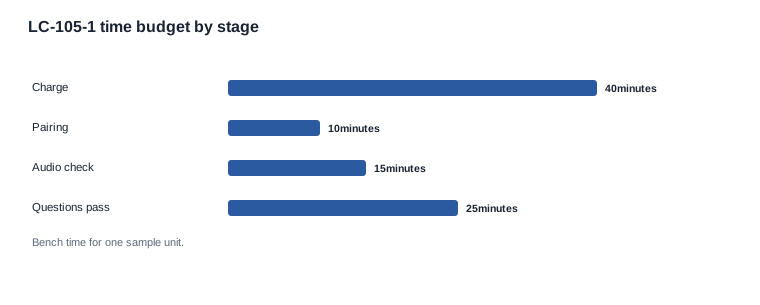
Budget roughly 40 minutes on the LC-105-1 charge stage, 10 on pairing, 15 on the audio check, and 25 on the documentation pass before the unit leaves the bench.
That is roughly 90 minutes for the first LC-105-1 unit, and the split matters for planning: the documentation pass is the part that cannot be compressed, because it is the part that produces the notes the manual is later written from.
Two further observations belong in the same record. First, whether the unit reports charge state to the phone at all, since a unit with no visible or reported state forces the customer into a trial-and-error routine. Second, whether the charging method is stated in the material that ships, because the published rows for this category include models with magnetic contact, models with a Type-C connector, and models whose charging method is not published at all, and this model should not be assumed to match any of them.
A third observation costs nothing and saves an argument later: where the controls sit on the frame. A buyer who photographs the buttons for the product page needs to know whether they are visible from the front, reachable only by feel, or both, because that changes the photography, the manual diagrams and the instructions for a visually impaired user.
LC-105-1 audio behaviour, which the category description does not answer
The audio section of a product page is where unsupported claims accumulate fastest on this category. Terms like surround sound, stereo and hi-fi appear across the range in different forms, and the safe approach is to quote only what the row for this model actually says, then describe the observable behaviour in plain language.
For this model, the published rows do not include a dedicated audio specification row. So the audio description on the page has to be built from what you measured, and the measurements that matter are unglamorous: whether the sound is balanced across both sides, whether there is a noticeable delay between the audio and the lips on a video, how the microphone behaves on a call in a noisy street, and whether the volume survives a phone restart.
Record those four, in the user's words where possible, and they will carry an audio page that is more useful than a paragraph of adjectives. A delay figure in particular is worth publishing, because it is a number a customer can check, and because a customer who discovers a delay that was never mentioned will treat it as a defect.
The acceptance criteria for the audio stage are simple: sound on both sides without dropout during a five-minute track, a call that is intelligible from a normal speaking position, and a profile that survives a restart. Those three, tested on the sample, are enough to write the page and enough to support it if it is challenged.
There is one more audio question worth asking that no specification row will answer for you: whether the unit is intended for calls, for media playback, or for both, and whether those two uses interfere with each other. A unit that switches modes on a button press and a unit that mixes both simultaneously are different products in the customer's hands, and the difference determines how many controls the manual has to describe and how long the pairing instructions need to be.

LC-105-1 in daily use: what the log has to carry
The first session says whether the unit works. The second week says whether it keeps working, and the second week is where the returns come from.
- Charge level at both ends of the day, so the runtime pattern shows up inside a week.
- Whether the unit stayed paired overnight, or had to be re-paired, and what came just before the failure.
- Call notes in the wearer's own words, because those words become the support script later.
- Which charging path was used in practice, and whether anyone reached for a cable that was not in the box.
- Comfort over a full day of wear, because an uncomfortable unit is a unit that gets returned rather than used.
The LC-105-1 moves from evaluation to order once the log shows two weeks with no repeated pairing, a call route that never interrupts, and no remark about how the frame feels. Once those conditions hold, the log stands behind the purchase order; where they do not, it stands behind a refusal, and a refusal backed by a log protects the buyer more than a purchase would have.
Two small entries carry most of the LC-105-1 weight, and they are the ones people skip. Recording the LC-105-1 cell state at both ends of the day turns "the battery is bad" into a runtime figure, with no controlled test needed. A re-pairing entry that names the preceding event, such as a phone restart or an incoming call, is what lets a supplier distinguish a platform behaviour from a hardware fault. Each entry takes seconds to write, and neither of them can be reassembled a week later.
Share the log with the packaging and documentation teams, because a note saying the LC-105-1 needed re-pairing is worth little in a buyer's inbox and worth a great deal when it is attached to a packaging revision request. Where the log changes what a customer will read on the product page, the page is the cheapest place to fix the problem, and it is always cheaper than the returns desk.

LC-105-1 screening: three questions before the bench time
Before any bench time is booked, a buyer has to decide whether the LC-105-1 belongs on the shortlist at all. The catalogue rows make that decision possible, but only when the comparison is built on the rows that settle a purchase rather than the ones that are simplest to print on a spec sheet.
The first screening question is the cell architecture. The catalogue figure reads 55 mAh x2, and two models in the catalogue carry that same row. On its own it says very little, and any comparison that stops there is comparing nothing. What it does tell you is that the power budget per unit is fixed and identical between the two, which means the specification sheet for this model will be won or lost on the rows that follow it.
The second screening question is audio. This model publishes no audio specification row, which removes it from any comparison that is written around sound quality, and that is the comparison most buyers of this category want to make. The practical consequence is that audio has to be screened on observed behaviour instead, which is what the measurements in this guide are for: balance across both sides, delay against video lip movement, microphone pickup in noise, and whether the volume profile survives a restart.
The third screening question is the charging path, and this is the one that catches people out. Charging methods appear across the catalogue for most models, with magnetic contact and Type-C both in use, while four models show no published method at all. A buyer who assumes this model matches a neighbouring product will ship an accessory list that is wrong on every unit.
Run the three in that order, because each one costs progressively more. The cell row costs nothing and often removes a model on its own. The audio observations cost an hour on a sample and will rule out a model for a customer who cares about calls. The charging path costs a written supplier reply, so put every model still on the list into one message instead of asking separately.
The total cost of the decision then becomes visible. A unit that pairs cleanly, holds its settings across a restart and charges over a method the customer already owns, and that takes calls intelligibly, carries a lower support cost than a nominally similar unit that needs a proprietary accessory and re-pairing after every restart. The comparison a channel partner needs is between two support workloads, not between two spec sheets, and that is the calculation worth presenting.
One discipline is worth keeping throughout the screening. Take two samples of the model you have decided on rather than one of each model you are considering. The second unit is what proves a behaviour holds rather than being a one-off, and it costs less than widening the sample list across models that will never ship.
What the operating routine costs a buyer
The routine in this guide is cheap to run, and it is worth being explicit about why, because the alternative is a buyer who treats a sample request as a formality and then treats the answer as a surprise.
The cost of the routine is bench time and attention. Roughly ninety minutes for the first unit, and something closer to half an hour for every unit after it, provided the same person runs the same sequence each time. That is the whole cost. There is no equipment beyond the phone and the charger that came in the box, there is no laboratory, and there is no specialist skill. What the time buys is a record that survives the arrival of a customer complaint six weeks later, and it is very difficult to reconstruct that record after the fact.
The cost of skipping the LC-105-1 routine is different in kind. It is not time saved, it is exposure bought. A unit whose pairing behaviour was never observed cannot be defended when a customer reports that it stopped connecting after a restart, and the response to that customer is a refund rather than a firmware change. An endurance claim that was never measured cannot be defended when a customer asks how long the LC-105-1 lasts, and the response is a hedge in a listing that weakens every other claim on the page.
The third LC-105-1 cost is the one that is easiest to overlook: the cost of the unanswered question. Each row that the supplier never confirms stays open in your copy, and open rows accumulate. A product page written around open rows has to be reviewed every time a new question arrives, which means the documentation never settles, which means the page never gets published. That is a recurring cost that sits quietly on the books and is paid by whoever owns the listing.
The saving is the mirror image of all three. A closed row is a row that never has to be re-asked, a measured figure is a figure that never has to be defended, and a documented behaviour is a behaviour that never has to be re-tested. The supplier conversation in the final section of this guide is short because the bench work in the earlier sections has already narrowed it to the questions that only the supplier can answer.
One closing point on the LC-105-1 order of work. The acceptance criteria in this guide are settled before the measurements are taken, and that is deliberate rather than bureaucratic. A criterion written after the fact is always shaped by the result, and that is how a sample that fails quietly ends up filed as a sample that passed. A criterion written in advance turns the LC-105-1 first session into a decision rather than an opinion, and makes the refusal of a model as defensible as its acceptance.
LC-105-1 the six rows the documentation cannot supply
Everything below is missing from the published material for this model, and every line on it is a question a customer will eventually ask.
- Which charging method applies to this model, and does the box include a case or a cable?
- Which endurance figure may we publish, and under which test conditions?
- Which physical controls exist, and what does each one do on a short press and on a long press?
- Which audio profile is used, and what does the published Bluetooth version cover?
- What ingress rating, if any, applies to this model, and against which standard was it tested?
- Which certificate documents do you hold for our target markets, and how can they be delivered?
Our position on this model We publish the cell figure we hold, an endurance figure only after measuring one under a stated profile, and we do not publish an audio or control claim that the sample did not demonstrate. A documentation gap is not a reason to delay the launch; it is the content of the supplier conversation that has to be closed before the page is written.
Read alongside this one: the bluetooth audio glasses charging options page lays out how the charging routes in this category differ, the bluetooth audio glasses comfort and fit guidance handles the wear questions buyers ask first, and the certification checklist lists the documents worth asking for. Where you buy to resell rather than to build a range, the samples page shows what belongs in a sample request before it is sent.
Pair it, call with it, wear it for a week, and put the six rows on the list until they come back in writing.


