
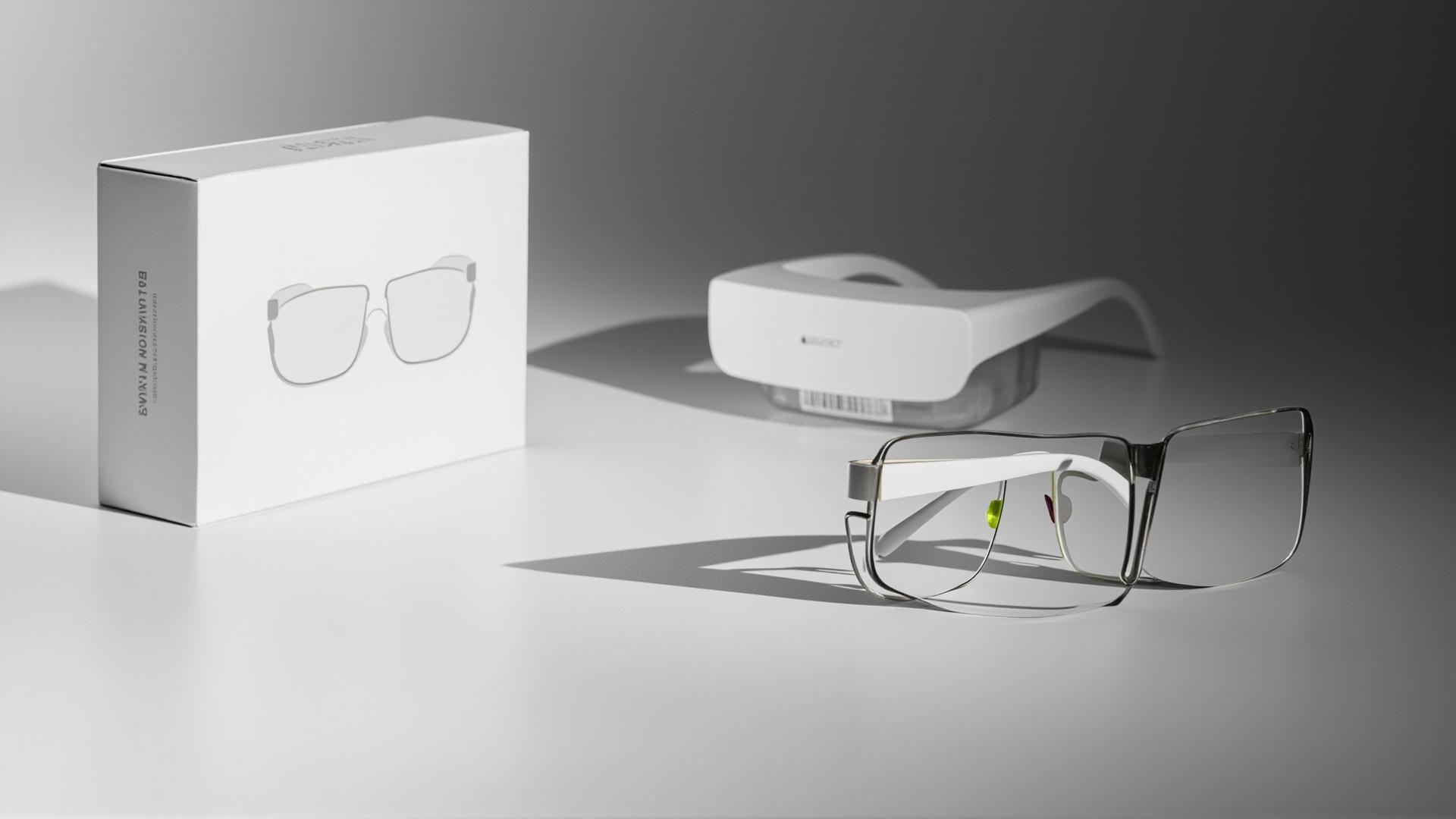
Two products in this category carry nearly identical published rows, and that is exactly why a buyer has to be careful with this one. The published set for this model is narrow, the operating picture depends on a handful of observations that nobody has written down yet, and the only way to publish this product without guessing is to separate clearly between the two categories of statement: the rows the catalogue gives you, and the behaviours you measured on a unit in front of you.
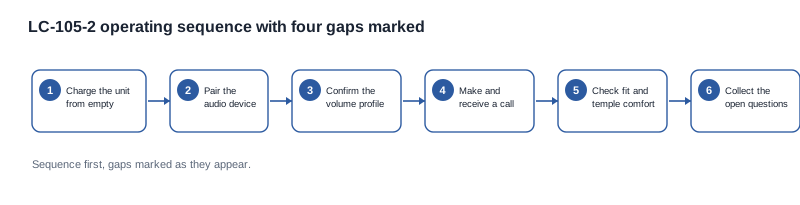
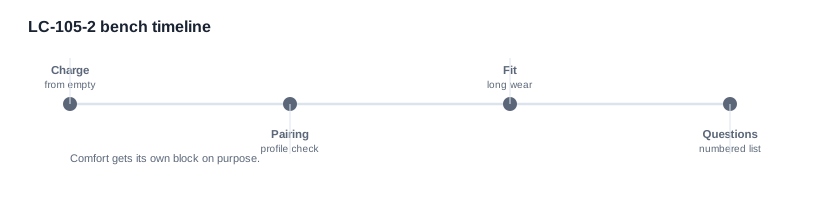 This guide is structured around that separation. It walks the operating sequence, marks the four points where the documentation cannot yet supply an answer, and ends with the question list that has to be closed before the manual is printed.
The sequence in one line: charge from empty, pair the audio device, confirm the volume profile, make and receive a call, check fit over a long wear, then collect the open questions.
LC-105-2 what the published specification does support
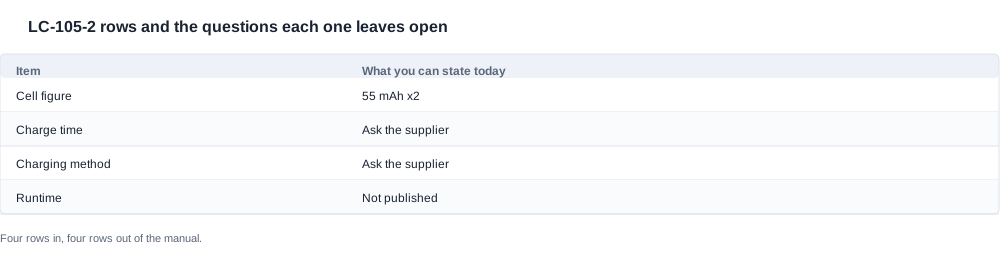
Start with what you can state today without qualification. The cell row for this model reads 55 mAh x2, two cells of that rating rather than one pack. That is the one row that is unambiguously usable, and it does real work in the manual: it lets you describe the power architecture and it frames the endurance expectation you will quote to a customer.
Everything else needs a decision before it can appear on a page:
- The charging arrangement for this model has to be confirmed in writing rather than inferred from the model beside it in the catalogue, because the range prints a charging row for most models and nothing at all for four of them.
- A rated endurance of about eight hours is published for the LC-105-2, but with no test condition attached, so any endurance figure you quote still has to come from a measurement.
- Nowhere in the catalogue is a capacitive touch row published, and the only control description on file belongs to another product, so the controls here have to come from a sample unit.
- There is no published ingress rating and no published colourway list for this model.
- No audio specification row beyond what the manual shows, so surround sound, stereo and driver claims are all off the table until the supplier confirms them.
That list is not a complaint about the catalogue. It is the normal state of this category at pre-production stage, and the useful response is to convert each absence into a specific question. The distinction to hold is simple: a row you can quote is a row you can publish, and everything else is a question with an owner and a date.
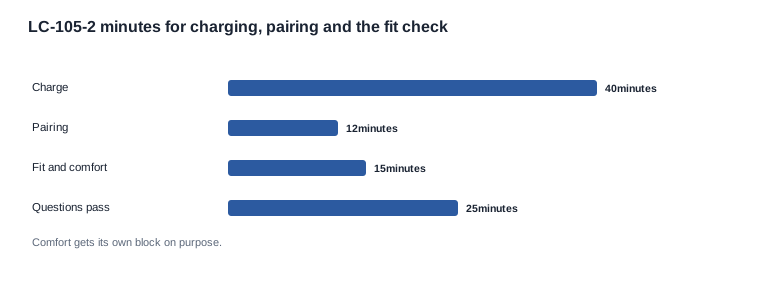
Budget about 40 minutes for the charge stage, 12 for pairing, 15 for the fit and comfort block, and 25 for the documentation pass. That is roughly 90 minutes for the first LC-105-2 unit, and the documentation pass is the part that cannot be shortened, because it is the part that becomes the manual.
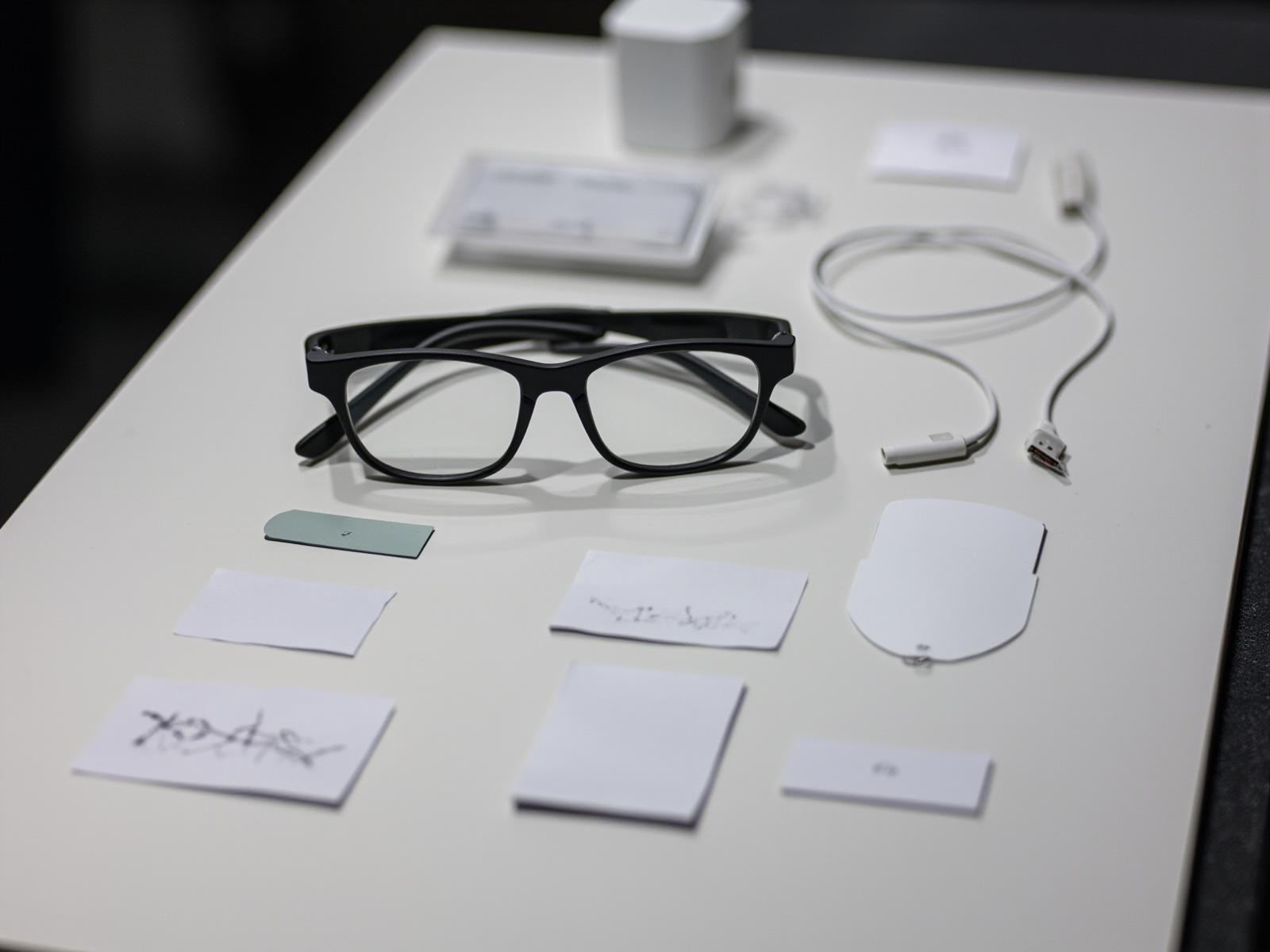
LC-105-2 the operating sequence, with the four gaps marked
The sequence below is written as a manual author would write it, with the gaps marked where they occur. That way the customer-facing text and the supplier question list come from one document rather than two.
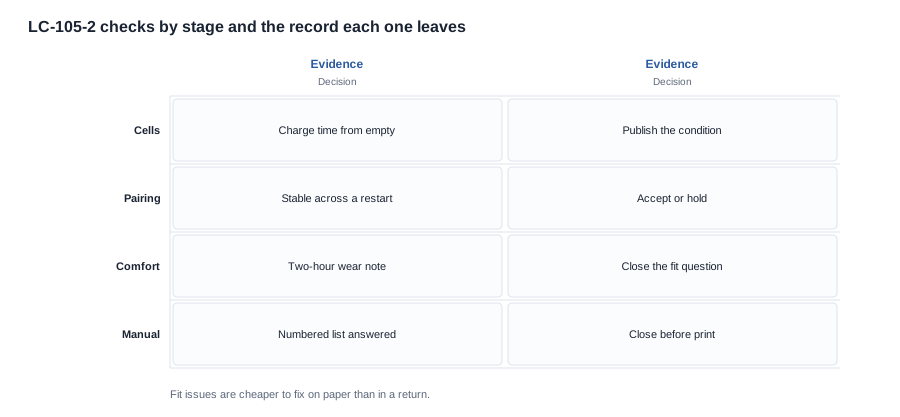
- Charge the unit from empty and record the wall-clock time it takes to reach the state you consider charged.
- Pair from the phone's own menu, and check that the unit registers as a headset rather than only as a media source.
- Set the volume profile, then confirm it survives a restart of the phone.
- Make a call in both directions, and note whether the LC-105-2 microphone picks up clearly from a normal speaking position.
- Wear the unit for a long session and note where the temples sit and whether anything shifts.
- Collect every open question in a single numbered list and send it with the notes attached.
Gap one is the charging method. Some models in this category charge over magnetic contact, some over a Type-C connector, and some publish nothing at all, so the first line of the manual cannot be written until the supplier answers. Gap two is the runtime, which sits immediately behind the charging instruction and is the number customers compare across products.
Gap three is the control set. The manual needs to say which controls exist and what each does on a short press and on a long press, and none of that is derivable from a cell figure. Gap four is the audio description, which cannot be written from the catalogue at all and has to come from the supplier or from careful listening on a unit.
Write the pass mark down before the sequence starts, because a later reader will use it to judge the unit: a headset entry in the device list, a volume profile that survives a restart, a call that works both ways without intervention, and a fit that holds through a long session.
Two details in step five reward attention because they are where returns actually originate. Note whether the temples slide forward as the session goes on, since that changes the fit assessment from a single moment into a trend. And note whether the arms of the frame press on the top of the ear after an hour, which is a different complaint from discomfort in general and needs a different remedy.
LC-105-2 against the model with the same cell row
Two rows in the catalogue read 55 mAh x2, and buyers will eventually be asked why the two products are sold at different prices. The honest answer is that the cell row does not decide the comparison, and a page that implies otherwise is misleading in a way that is hard to walk back.
A cell figure tells you the power architecture and nothing else. It does not tell you the driver configuration, the microphone quality, the fit, the charging method, the runtime, the colour range, or the ingress rating, and for a buyer those are the rows that decide whether the product works for the customer they are selling to. Two products with identical cell rows can sit at completely different points on the specification sheet, and the practical work of separating them is exactly the question list in this guide.
So the comparison you write for a customer should be built from the measured behaviour, not from the cell row. State the charging method once it is confirmed, state the runtime once it is measured, state the fit from the wear test, and describe the audio in the terms the supplier has confirmed. That is a smaller set of claims than a catalogue line-by-line comparison, and it is the set that will hold up when a customer asks why the two products differ.
If your team needs to distinguish the two models in the range for a channel partner, the practical approach is to put the same four questions to the supplier for both and place the answers side by side. The questions are identical, which makes the reply cheap, and the answers are what finally separates the two products in writing.
The trade-off to keep in mind is between a comparison that is detailed and one that is defensible. A buyer who publishes a full side-by-side table before the answers arrive will publish figures that later have to be retracted, and a retraction on a product page costs more trust than an absence ever does. Publish the rows you hold, mark the rest as pending, and update the page once the reply lands.

LC-105-2 screening before the bench time
The published rows make it possible to remove a model from consideration in minutes, which is the most valuable use of a catalogue page. They also make it possible to arrive at the wrong answer, which is the most expensive. The difference between the two is whether the comparison is built on rows that decide a purchase or on rows that are simply available.
 Start with the cell architecture, because it is the row everybody quotes and the row that decides least. The published figure reads 55 mAh x2, and a second model in the catalogue carries exactly the same row. A comparison built on the cell figure alone therefore compares two identical numbers and concludes that the two products are equivalent, which is a conclusion that will be contradicted by the first customer who tries to pair them.
The second screening question is the charging path, and it is the one that most often separates two models that look identical on paper. Across the catalogue, charging methods appear for most of the range; magnetic contact and Type-C are both present, and four models show no published method at all. Until the supplier says which applies here, the packing slip, the accessory line and the manual are all provisional.
The third screening question is fit, and it is the one a spec sheet never answers. Audio glasses are worn on the face for hours, and nothing about weight, temple position or slip resistance is published for this model. Fit is also the cheapest of the three to observe and the most predictive of returns, because a unit that slips is returned and a unit that is merely uncomfortable is usually tolerated.
The order of those three steps is set by what each one costs. Write the shortlist down before the questions go out, because a list written afterwards is a list written to fit the answers. The capacity row costs a minute of reading and will on its own remove a model from the list. The charging arrangement costs one written enquiry and one reply, so it should go out once covering every model still standing. The wear test costs an afternoon, which is why it sits last and only for the models the first two did not remove.
With those three answers in hand the comparison stops being a line-by-line reading of two data sheets and becomes a running-cost calculation. The total cost of each option, not the unit price, is what settles it, and the honest way to build that total is to write it down before you order while the assumptions are still visible. An LC-105-2 that stays put through a long session, registers as a headset on the first attempt and recharges on hardware the customer already has generates less support work than a rival unit that slips, re-pairs repeatedly and needs a proprietary charger. That is the argument a channel partner weighs, and it belongs in writing before the purchase order is raised rather than after the first complaint.
Keep one habit throughout: order two units of the model you have settled on rather than one of each candidate you are still weighing. A second unit is what separates a behaviour that holds from a one-off that happened once, and two units of the right model cost far less than a sample spread thin enough that none of them carries a verdict.

LC-105-2 what the operating routine costs a buyer
The sequence in this guide is cheap to run, and it is worth setting out plainly what it costs, because the alternative is a buyer who treats the sample request as a formality and then treats what comes back as a surprise.
The running cost of the LC-105-2 procedure is operator time and nothing else. Allow an hour and a half for the first unit of a given model and nearer to half an hour for each unit after that, on the condition that one person works the same steps in the same order every time. The only equipment involved is a phone and the charger supplied with the model; there is no instrument to buy, no laboratory to book and no specialist qualification to hire. The result is a written record that still stands when a customer complaint arrives six weeks later, and a record of that kind cannot be rebuilt once the event has passed.
Skipping the procedure does not save time, it buys exposure. How to evaluate a model without that record is not a question with an answer, and the red flags in a supplier's reply are the rows that come back qualified rather than clear. If pairing behaviour was never watched on this model, a customer reporting that the unit stopped connecting after a phone restart cannot be answered with a fix, only with a refund. If runtime was never measured, a customer asking how long the LC-105-2 lasts receives a guess, and a guess on a product page undermines the claims sitting next to it.
The third cost never shows up on an invoice either, because it is the cost of the question that was never answered. A due diligence item left open is worse than one never asked, because an unasked question can still be asked. Every specification the supplier leaves open stays open in your copy, and open specifications accumulate rather than cancel out. A listing built on open rows gets reopened each time a new question lands, the document never settles, and the page never reaches a published state. Whoever owns that listing pays for it in revision cycles that nobody budgets for.
The saving arrives as time you do not spend twice. A row the supplier has confirmed in writing does not come back with the next sample, a runtime you measured on this unit does not need measuring again for the next quotation, and a behaviour you wrote down in order survives the handover to the packaging team. By the time the supplier list at the end of this guide is complete, every remaining question already has a named owner and a date attached, which is what keeps the product page from reopening.
Two closing points on the LC-105-2 order of work. The first concerns who writes the manual. The person who ran the bench sequence is the only one who knows which gaps were closed by observation and which by a supplier reply, and that distinction has to survive into the printed manual. Hand the notes to a writer who was not on the bench and the two kinds of evidence flatten into one voice, which is exactly how an unconfirmed row ends up printed as a specification.
The second point concerns production timing. A model that is being evaluated while it is already in production has a different risk profile from one that is still a sample: the first has a page to write, the second has a date to hit. Decide which situation you are in before the samples are ordered, because the sequence of work that follows is different in each case, and a bench routine that starts after the launch date has already been announced is a bench routine that gets skipped.
What the LC-105-2 programme costs beyond the bench The measurements are the cheap half of this exercise. The expensive half is everything that happens once the observations exist and have to become a product page, a manual and an accessory line that three different teams have to sign off.
The supplier conversation is the first of those costs. The questions to ask are therefore set once and sent together, and what to ask is decided before the samples are ordered rather than while the first reply is being drafted. Ask for the eight rows one at a time and the answers arrive one at a time, which turns a single question into a two-week exchange. Ask for them together, in one numbered list, with the model designation attached, and the reply usually comes back as a single document. The difference is not politeness, it is how long the LC-105-2 product page sits in a provisional state.
The second cost is the waiting. While the answers are outstanding the page cannot be published, and a week of waiting is a week in which units in the warehouse cannot be sold. For a pre-production range that wait is normal, but it should be scheduled into the launch plan rather than discovered in the last week, which is why the supplier question list is the closing section of this guide and not an appendix.
The saving from working this way is measured in review cycles rather than in money. A confirmed row does not come back with the next sample, a measured figure does not need re-measuring for the next quotation, and an observed behaviour does not need re-testing when the customer asks again. Every remaining question at that point already has a name against it and a date attached, which is what stops the page reopening itself.
One sequencing point, because it decides whether the exercise was worth running at all. The pass conditions are fixed while the LC-105-2 sample is still on the bench, never afterwards. The criteria double as the shortlist filter: a model that cannot meet a threshold set in advance is a model to decline, and a documented refusal is easier to defend than a purchase nobody checked. Thresholds written after the measurement describe what you were hoping the unit would do, and that is how a sample that never paired cleanly ends up filed as a pass. Thresholds written in advance turn the first session into a decision rather than an impression, and they give a buyer a refusal they can show a supplier with the criteria attached.
The second point concerns the pair in this catalogue that carry the same 55 mAh x2 cell row. Those two models cannot be separated on capacity, so the only thing that will separate them is the answer to the same question put to both suppliers on the same day. Put the eight questions below to each, lay the two sets of replies side by side, and let the differences in the replies carry the decision. Capacity was never going to do it.
LC-105-2 what still needs answering before a manual can be written
Send these eight questions to the supplier as a numbered list, one line per question.
- Which charging arrangement applies to this model, and what arrives in the box for charging?
- Which endurance figure are we allowed to publish, and what conditions produced it?
- Which physical controls exist on the unit, and what each one does on a short press and a long press?
- Which audio configuration is fitted, and what does the published Bluetooth version actually cover?
- What is the frame material, and over what range can the temples be adjusted?
- Which ingress rating, if any, covers this model, and against which standard was it tested?
- Which colourways are produced for this model?
- Which certificate documents exist for our target markets, and how would they be handed over?
Our position on this model We publish the cell row we hold, we publish a runtime only after measuring one against a stated profile, and we do not print an audio, control or rating claim the sample did not demonstrate. A specification sheet carrying four unconfirmed rows is worse than one carrying a single confirmed row, because it invites the customer to lean on the unconfirmed ones.
Related pages: the bluetooth audio glasses comfort and fit guide sets out the wear questions behind returns on the LC-105-2; the bluetooth audio glasses charging options page puts the charging routes in this category side by side; the certification checklist lists the document trail a buyer should ask for. For a worked comparison structure, the G07 specification comparison page shows how two models are laid out against each other.
Charge it, call with it, wear it for a long session, and answer the eight questions before the manual is printed.


