

The conclusion comes first on this model: a camera-glasses unit that ships with a charging case cannot be documented by a single set of operating instructions, because the case and the unit are two separate power systems with two separate sets of behaviour. Any manual that treats the case as an accessory bracket will produce support contacts that nobody can resolve, because the customer and the agent will be looking at different halves of the system.
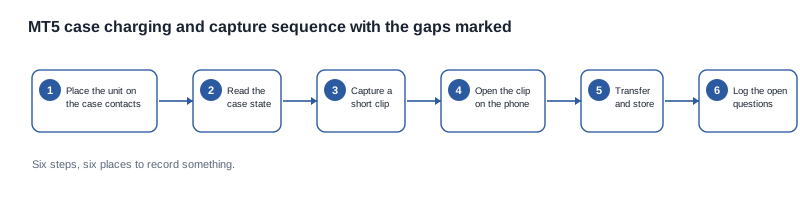
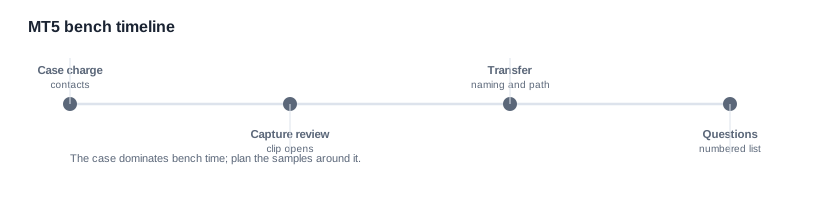 This guide sets out what the published rows settle, what the case adds to the operating routine, and the documentation that has to exist before the model is ordered in volume.
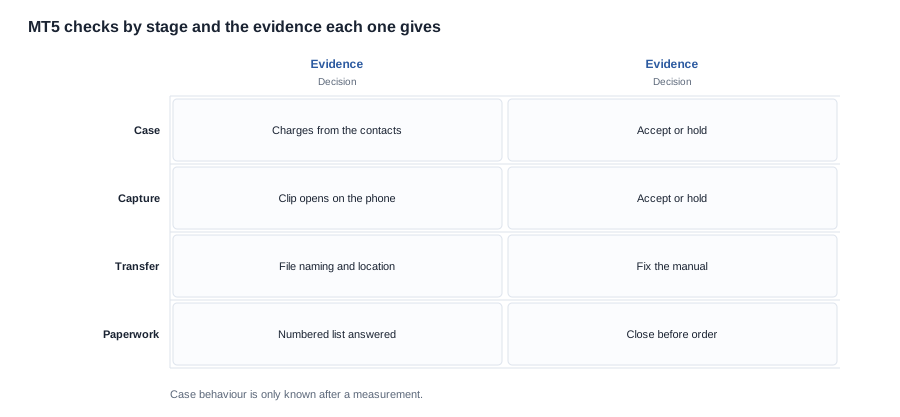
The sequence: charge through the case, read the case state, capture a clip, open it on the phone, transfer and store, then log the open questions.
MT5 what the manual has to tell you, and what it usually does not
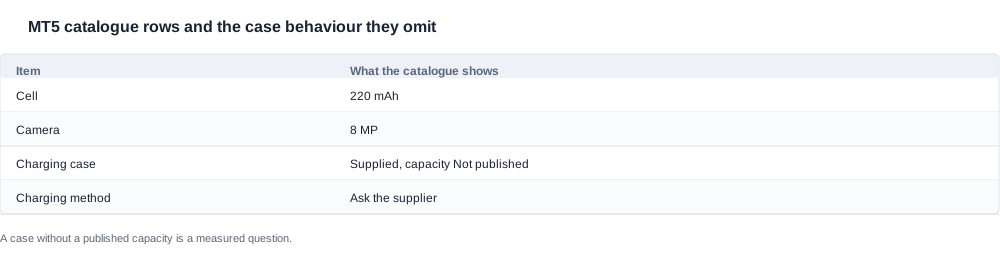
Five rows are published for this model and they establish the shape of the product: a 220 mAh cell, an 8 MP camera, a charge ceiling of two hours or less, a rated endurance of six to eight hours, and magnetic charging with a case supplied. The third of those is the one that changes the documentation, because a case introduces its own state, its own charge time and its own failure modes.
The rows that are not published are where most of the manual will come from:
- The case has a presence in the catalogue but no capacity figure, so how many charges it holds is a measurement rather than a specification.
- A rated endurance of six to eight hours is published for the unit, but without a test condition, so endurance per charge still has to be observed.
- The catalogue records magnetic charging with the case, so whether the unit can also be charged without the case is a question for the supplier.
- The catalogue publishes no capacitive touch row, and its single control-surface description belongs to another product, so the controls on this model have to be read off a sample.
- No Bluetooth version, no ingress rating and no colour row are published.
That is a long list, and it is also the normal condition of a pre-production camera product. The useful frame is to separate two categories of statement in the manual. The first category is what the catalogue publishes, which is short and quotable. The second is what you measured, which is specific to your configuration and to your sample. A manual that never mixes the two is worth more than a manual with a longer feature list.
The gap that causes the most returns in practice is the simplest one: the relationship between the case and the unit. A customer who charges a unit overnight in the case and finds it flat the next morning will not read the manual to find out why. They will return the unit, and the agent handling the return will not have the answer either unless the case behaviour was written down before the launch.
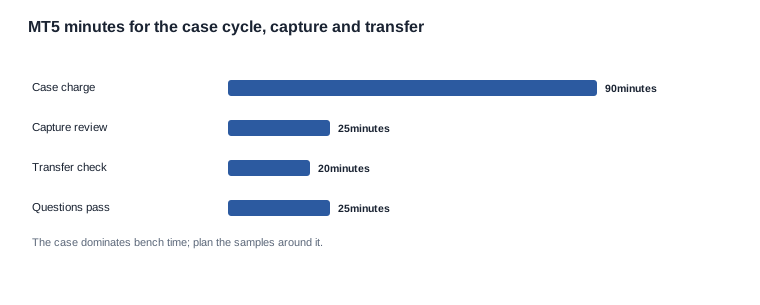
Budget about 90 minutes for the MT5 case charge cycle on the first unit. The capture review takes a further 25 minutes, the transfer check 20, and the documentation pass 25. The case dominates the bench time, and that is not a detail of the test plan. It is the reason a first unit has to be requested early, because the case is where the surprises live.
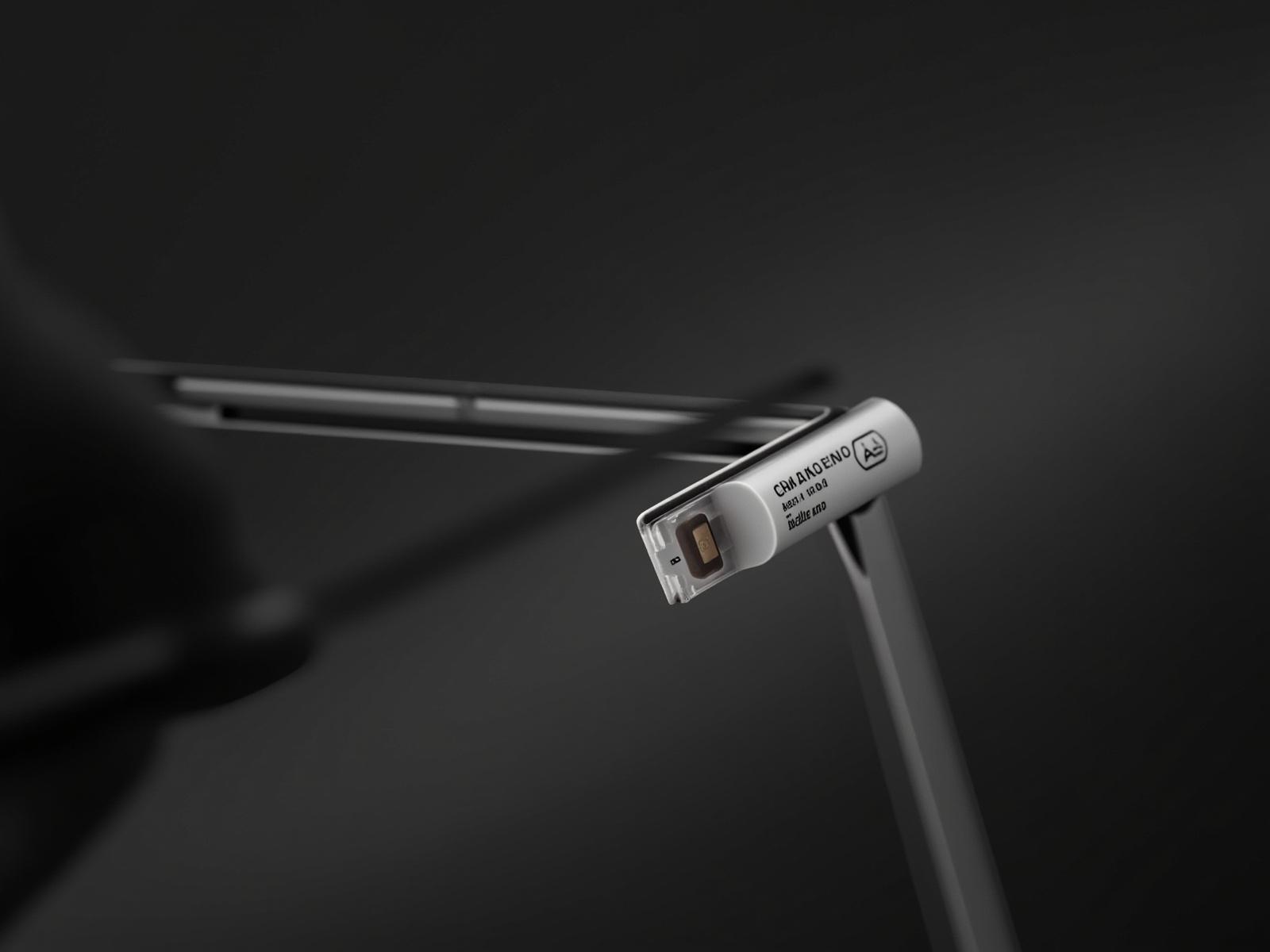
MT5 the case, the cell and the charge cycle
The case is the operating system of this product. Three behaviours have to be observed on it, and each of them is a line in the manual.
 The first is the charge path. Does the unit charge only when it is seated in the case, or does it also accept a direct connection? Both arrangements exist across this category, and the difference decides whether the case is a convenience or a dependency. A dependency has to be stated plainly, because a customer who buys the glasses and loses the case has bought an unusable product.
The second is the state reporting. Does the case show its own charge level, does the phone report it, or does the customer have to guess by the behaviour of the unit? A case that reports nothing produces a weekly charging ritual and a steady trickle of "is it charged?" questions.
The third is the arithmetic. How many charges does the case hold for this unit, and what happens to the unit when the case is full? Does it refuse, does it ignore it, does it continue? None of this is visible on a specification row and all of it is visible in an hour of testing.
The cell row for the unit reads 220 mAh and the camera row reads 8 MP, and both are worth putting on the page. The endurance question still needs a measurement: run the unit from a full charge to shutdown under a named recording mode, record the wall-clock result, and repeat it on a second unit to check that the number holds. Two units is the minimum that tells you whether you are publishing a figure or a coincidence.
A recording camera changes the storage arithmetic in a way that has to be stated. Eight megapixels is a sizeable file per frame relative to a phone, so the question of what happens when the storage fills is not academic. Fill the storage deliberately on one unit and record whether the unit warns, stops silently, or overwrites the oldest files. The first is acceptable, the second is a returns problem, and the third is a data-loss problem that no support policy can absorb.
Two case details are worth adding to the record because they decide whether the case is a daily-use item or a travel item. First, whether the case lid closes with the unit inside and stays closed in a bag, because a case that springs open in a pocket is a case that loses its contents. Second, whether the unit can be replaced in the case without a tool, which determines how a customer with a dead unit handles the first week.
MT5 in daily use: the log that catches problems early
The first session says whether the unit works. A week of use says whether it keeps working, and for a product with a case, the week is where the case behaviour shows itself.
- Number of clips recorded per session, and whether any session ended because the unit stopped accepting more.
- Where the files were stored and whether any failed to open or failed to transfer.
- Cell state at the start and end of the day, and the case state at the same points.
- Whether the unit was charged through the case or directly, and how long the charge took.
- Whether the case went flat before the unit did, and how many days of use that covered.
- Anything the wearer said, in the wearer's own words.
The acceptance criteria are what turn a daily log into a procurement record rather than a diary.
The second group of MT5 failures covers interrupted work around the case. A full day of capture with no lost clip, no failed transfer, a case that outlasts the unit across a working week, and no user complaint about charging is the evidence that moves this model from an evaluation list to an order list. Once those criteria are met, the MT5 log is what backs the purchase order; where they are not, it is what backs a refusal, and for a product with a case that is a genuinely useful outcome.
Two short entries carry most of the MT5 log's weight, and they are the ones people skip. The case state written at the same points as the unit state is what turns "the case is rubbish" into a measured number of charges held, which is a conversation the supplier can act on. The count of days the case outlasted the unit is what tells you whether the case is dimensioned for the product it ships with.
Give the log a distribution list. A case finding belongs to the accessory owner, a file-naming finding to the documentation owner, and a charging-path finding to the supplier contact. A single note emailed to one buyer changes nothing about what ships next month.
MT5 shortlisting: three questions the case makes urgent
A product with a charging case has to be screened differently from one without, because the case changes what the buyer is committing to. The published rows for this model make the first part of that judgement easy, and they also make it easy to stop too early.
 The first screening question is imaging. The published camera figure reads 8 MP, and it belongs to a group of eight models in the catalogue that carry that resolution, alongside three models published at 13 MP. Whether 8 MP is enough for the customer is a question about their use rather than about the range, and it is a question worth asking before any bench time is booked, because a resolution that does not fit the use will not improve with testing.
The second screening question is endurance, and the case makes it more important rather than less. The published cell figure reads 220 mAh, and the published endurance runs from six to eight hours with no test condition attached. A camera product is used in bursts, and the burst pattern determines how often the case is needed, so a buyer who is screening on endurance has to think about the customer's day rather than about a nominal figure.
The third screening question is the case itself, and it is the one that decides whether the documentation problem is manageable. The case is published as supplied, with no capacity figure, so how many charges it holds, whether the unit can be charged without it, and whether the case reports its own state are all open. A model whose case answers those three questions cleanly needs a page; a model whose case does not needs a manual and a support script.
Run the three in that order because each one costs more than the last. The camera figure costs nothing and can disqualify a model immediately. The endurance question costs a measured run on a sample, which takes a working day. The case questions cost a supplier reply, so bundle every model still on the list into a single message and use the waiting time to run the endurance measurements.
The total cost calculation then becomes the actual decision. A unit that records at the resolution the customer needs, runs a working day on one charge, and comes with a case that holds several charges without a proprietary cable carries a lower support cost than a cheaper unit that needs a daily top-up from a wall socket. That is the judgement a channel partner will weigh, and it is worth writing down before the order rather than reconstructed afterwards.
One discipline is worth keeping throughout. Take two samples of the model on your shortlist rather than one unit of each candidate, because the second unit of the same model is what proves the case behaves consistently and that the file handling is not a one-off. It costs less than spreading the sample budget across models that were never going to ship.
What the case routine costs a buyer
The case routine in this guide is cheap to run, and it is worth putting a number on what skipping it costs, because a buyer who treats the sample request as a formality is buying exposure rather than saving time.
The cost of the routine is bench time and attention. Ninety minutes for the first unit, largely taken up by the case charge cycle, and closer to half an hour for every unit after that, provided the same person works through the same sequence without help from anyone else. There is no laboratory and no specialist skill involved. What the time buys is a written record that is still legible when a complaint arrives six weeks on, and a record of that kind cannot be reconstructed once the event has passed.
The cost of skipping it is not time saved, it is exposure bought. A case whose capacity was never measured cannot be defended when a customer reports that the glasses were flat after a night in the case, and the answer to that customer becomes a replacement rather than a corrected instruction. An endurance figure that nobody measured is impossible to defend once a customer asks how long the MT5 holds up, and the answer becomes a hedge on the listing that weakens every other claim on the same page.
The third cost never appears as an invoice. The case is a second power system with its own state, its own behaviour and its own failure modes, and every one of those that is not documented becomes a support question that the agent cannot answer. A model whose case behaviour is written down produces a manual. A model whose case behaviour is not produces a support script that has to be improvised, one agent at a time, for as long as the model is on sale.
The saving is the mirror image of all three. A documented MT5 case is a case that never has to be re-explained, a measured runtime is a figure that never has to be defended, and a recorded storage behaviour is one that never has to be re-tested. The reason the supplier list at the end of this guide is short is that the bench work earlier has already narrowed it to the questions only the supplier can answer.
Two closing points on the MT5 order of work. The acceptance criteria for this model are fixed ahead of the measurements, and that is deliberate rather than bureaucratic. Any criterion written after the fact is shaped by the result, and a sample that fails quietly then gets filed as one that passed. A criterion fixed in advance turns the MT5 first session into a decision rather than an opinion, so that a refusal can be defended as easily as an acceptance.
The second point concerns the MT5 case itself. Two samples of the same model are worth more than one sample of each model under consideration, because the second unit of the same model is what demonstrates that the case holds its charge consistently and that the file handling is a property of the product rather than of the individual unit. It also costs less than spreading a sample budget across models that were never going to be ordered.

MT5 a five-step check before the documentation is signed off
Before the manual is printed and before the volume order is confirmed, run this check on a unit drawn from the shipment you are about to buy.
- Does the printed model designation match the unit itself, the manual and the page you intend to publish?
- Does the box contain the charging case, and does the case match the description in the manual?
- Does the unit charge through the case as the manual describes, and does the case report its state as described?
- Does the MT5 camera produce a file that plays on the first attempt after pairing, and does the storage behave as documented when it fills?
- Do the manual and the catalogue agree on the cell figure and the camera figure, and is the certificate trail for your target market on file in a form you can hand to a customer?
Read that point carefully rather than quickly. The export certification page carries images of patent certificates rather than a list of test reports, and the catalogue text contains no CE, FCC or RoHS entry at all. That says something about the material in front of you, not about the certification status of the product, and it is why the MT5 certificate trail has to be requested in writing and filed instead of assumed. If a tender requires a certificate, raise the request on the day the model is shortlisted, because that answer sits with a document owner rather than with a production schedule.
Ask for it in writing, on the day the model is shortlisted.
That request goes in on the day the model is shortlisted, not the week before the goods are needed.
Settle the pass rule before the five-step check begins. A unit that passes the function checks but fails the documentation is not a pass, and an MT5 pass rule set before the checks begin stops that turning into a schedule argument a fortnight before the goods are needed.
The four questions the MT5 file will not answer
These nine items go to the supplier as a numbered list, so the reply comes back line by line.
- What capacity does the charging case hold, and how many charges does it provide for this unit?
- Can the unit be charged without the case, and if so with which connector?
- What runtime should we publish, under what test conditions, and at which recording mode?
- Does the case report its charge state, and to the unit, to the phone, or to neither?
- What happens when the recording storage is full, and does the unit warn the user?
- Which controls are fitted to this model, and how does each respond to a short press and to a long press?
- Which ingress protection, if any, applies to this model?
- Which colourways do you actually build for this model right now?
- Which certificate documents exist for the territories we sell into, and how do they reach the buyer?
Our position on this model We publish the 220 mAh cell row and the 8 MP camera row as published, a runtime figure, and only once one has been measured under a stated mode, and we do not describe case capacity, charging path or control behaviour that the supplier has not confirmed and the sample has not demonstrated. For a product whose defining accessory is the case, the case documentation is not an appendix to the manual. It is the manual.
For adjacent reading, the AI camera glasses charging case options page sets out the case configurations offered across this category, the camera imaging reference covers how the range describes MT5 imaging behaviour, and the certification checklist lists the trail of documents to request. If the product is sold on rather than made in-house, the AI camera glasses product page shows how this model sits in the wider line.
Charge through the case, watch what it reports, capture a clip, and answer the questions before the manual goes to print.


