

The first thing to establish is that an ingress rating is not a regulated requirement. No directive obliges a manufacturer to test for, declare or mark an IP code, and there is no certificate to obtain and no authority that issues one. A rating is a manufacturer's own statement about its own product, backed by a report. That is why the regulations reach it indirectly, through the file rather than through the rating, and understanding how is what separates a buyer who can rely on a claim from one who is relying on a slogan.
IP rating: publishing one is your own claim
The regulatory stack in this category is long and mostly unrelated to ingress. It covers radio behaviour, electromagnetic emissions, chemical restrictions in materials, transport of the cell, cybersecurity of the update path, and the general obligations of a manufacturer towards a consumer. None of them mentions an ingress code, and none of them requires one to be tested, declared or marked.
What that absence means in practice. The accuracy of an ingress claim, and the consistency between the code and the words printed next to it, sits entirely with the manufacturer and entirely with the buyer's diligence. There is no authority reading your product page, no certificate that expires if the claim is wrong, and no registry entry where a customer can look it up and find the truth. The claim is a private assertion, and the only check on it is the check you decide to run.
Why that makes the claim more fragile rather than less. A regulated claim carries a regulator's authority behind it: the customer can complain to someone, the claim has a certificate number, and the obligations are defined. An unregulated claim has none of that. The consequence of being wrong is entirely in the commercial channel — returns, reviews, marketplace listings, and the correspondence that follows. Buyers sometimes assume that because there is no regulator, there is no risk. The opposite is true: with no regulator, there is no third party who will catch the over-claim for you.
Where the regulations do bite. They bite on everything the rating depends on. The frame material, the cell, the radio, the firmware, the packaging claim, the batch identity and the model list each sit inside a document that is maintained by somebody. An ingress claim made on a product whose supporting documents have gone stale is a claim resting on a file that cannot be produced.
The consequence for a procurement task. The compliance work and the material work have to be scoped together rather than discovered in sequence. A buyer who commissions an ingress qualification and, separately, a conformity file, and who treats them as two projects with two timelines, will find that a single engineering change moves both — and that the second project's owner is usually not in the first meeting.

The change-to-document map: a seal change moves more than the seal
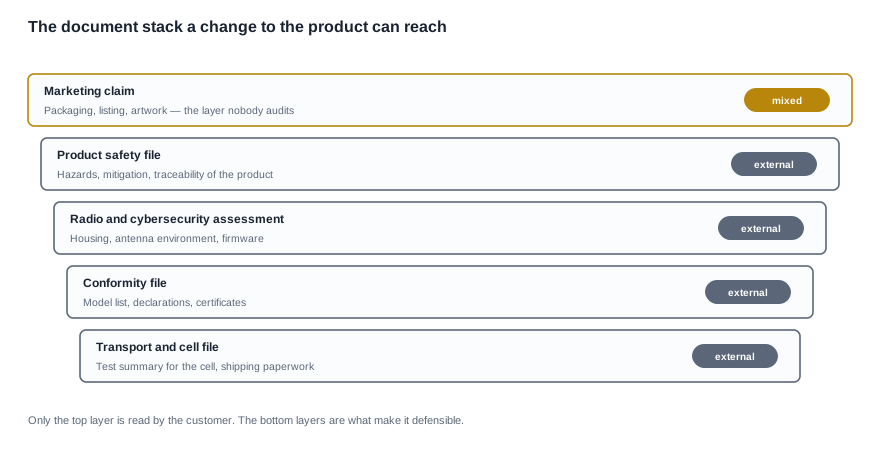
The document stack in the diagram is the useful mental model: five layers of documents, of which only the top one is read by the customer and all five of which can be disturbed by a change to the product. The ingress rating sits inside the second and third layers rather than at the top, which is why it is affected by changes that have nothing to do with water.
How a change travels. Take one engineering change — say, the frame material — and follow it through the stack.
- The ingress report. The tested configuration names a material, and a material change may invalidate it. A re-test or a re-issue is a laboratory matter with a queue.
- The radio assessment. The frame is part of the antenna environment. A change of housing material or a change in the position of the cell can move the radio behaviour of a product whose electronics are identical.
- The substance declaration. Material declarations are written for a specific material, so a material change means a new declaration.
- The product safety file. The hazards and their mitigations have to be described for the product as it is, so the file changes with the mitigation.
- The marketing claim. The wording on the packaging and the listing has to follow whatever the other four layers now support.
Five documents, one change. This is the reason the ingress qualification cannot be treated as an isolated test, and the reason a buyer should insist on knowing, before the tooling order, which documents a change of the enclosure will reach.
The classification step that decides the cost. Every change falls into one of three classes, and classing it correctly is worth more than any individual document request.
- A change that touches the enclosure, the seal or the interface. It reopens the ingress configuration, and usually the radio assessment too. It is the expensive class.
- A change that touches the material without touching the geometry. It reopens the ingress report and the substance declaration. It is the middle class.
- A change that touches only the surface or the print. It usually needs a per-variant configuration confirmation and nothing else. It is the cheap class.
The classification mistakes that cost money. Treating a material change as a surface change, because the geometry looks identical. Treating a port move as a component substitution. And treating a component substitution as a purchasing decision, which is the most expensive mistake of the three because it removes the change from the change-control process entirely.
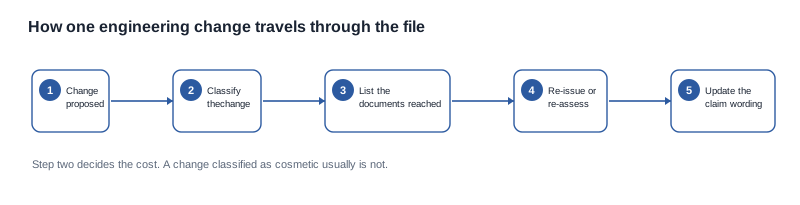
A change-control checklist. What changed, mechanically. Which of the five documents it reaches. Which document has to be re-issued, and which has to be re-assessed. Whether the change affects the tested configuration. Whether the marketing claim needs to change with it. And who signs off that the change is closed before the next shipment goes out.
Who owns the change review, and why it is usually nobody
In most organisations the ingress claim, the radio assessment, the substance declaration and the marketing copy sit with four different people, and the change request sits with a fifth. The review therefore happens by accident, in whichever forum the change happens to be raised, and the documents that need to move are discovered one at a time.
The ownership question to settle. The change review needs one owner with the authority to hold the whole stack, and that owner is rarely the engineer who raised the change and rarely the person who writes the copy. It is usually a product or sourcing role, because that is the role that owns the commercial consequences of a delayed qualification.
The three-line record that makes the review work. Which documents the change reaches. Which document is re-issued and which is re-assessed. Which date the claim wording has to follow. A change review that produces these three lines has done its job, whatever forum it happened in, and the lines can be attached to the change request rather than living in somebody's inbox.
The standing temptation to avoid. The temptation is to treat the copy change as a downstream administrative step, because copy is the layer nobody sees until the end. It is in fact the layer that carries the claim to the customer, so it is the layer that has to move in step with every other layer — and it is usually the one that moves last.
How the safety file, the radio assessment and the transport file interlock
The general product safety regulation, which reaches the claim hardest
The General Product Safety Regulation, (EU) 2023/988, has applied since 13 December 2024. It covers consumer products made available on the market in the European Union regardless of where they were manufactured, and it places two obligations on a manufacturer that bear directly on an ingress claim.
The first is the product safety file, which has to describe the product, its hazards and the mitigation for each one. An ingress claim sits inside that file, because water ingress is one of the foreseeable hazards for a product that is worn outdoors, and a file that describes a splash-protected product while the packaging says waterproof is a file that contains an inconsistency a market surveillance authority can act on.
The second is traceability, which means the product, the batch and the economic operator have to be identifiable. Which is what makes the rating's tested configuration a question that matters: a claim attached to a batch that cannot be identified cannot be defended for the unit a customer holds.
The radio framework, which reaches it through the housing
The Radio Equipment Directive 2014/53/EU applies to a Bluetooth product placed on the European market, and its assessment is made on the finished product. The frame is part of the antenna environment, so a change of housing material, a change of hinge arrangement or a change of the position of the battery can move the radio behaviour of a product whose electronics are identical.
This is the point at which an ingress claim and a compliance assessment meet. A sealed housing is not only a mechanical and water decision. It is a change to the antenna environment, and therefore a change to a document that has to be re-issued or re-assessed. A buyer who plans to specify a higher ingress level should establish, before the tooling order, whether the change moves the radio assessment.
The cybersecurity rules, which reach it through the firmware
From 1 August 2025 the cybersecurity requirements of the Radio Equipment Directive became a mandatory part of CE marking, described by the EN 18031 series of harmonised standards, covering secure communication, encryption, secure storage, user consent and a process for handling identified vulnerabilities.
A firmware change that affects the update path, the consent mechanism or the storage is a change to that assessment. This does not reach the ingress claim directly, but it reaches the same design decisions, and a programme that is changing the enclosure and the firmware at the same time is changing two assessments rather than one.
The substance and the transport rules
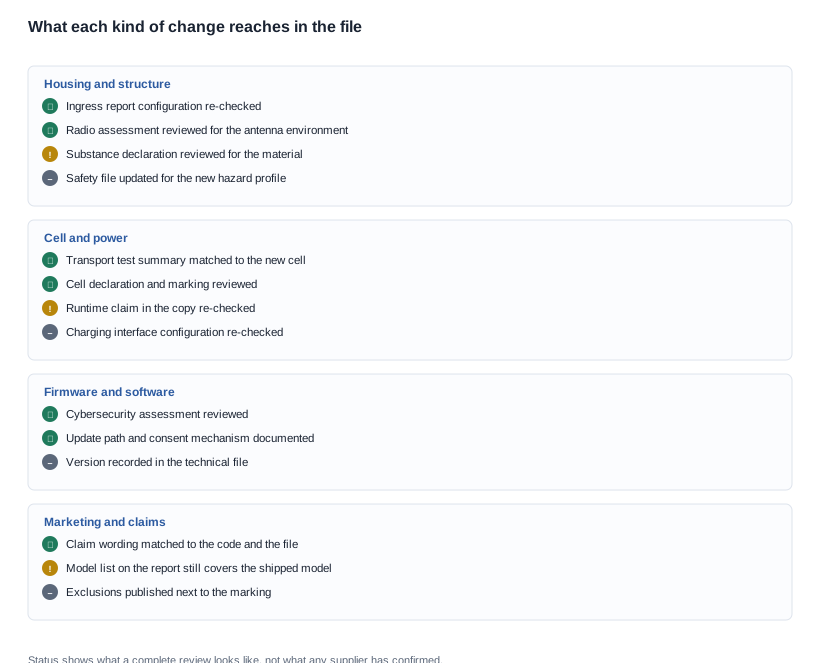
A material change moves the substance declaration, because the declaration is written for a specific material. A cell change moves the transport documentation, because the test summary under the United Nations Manual 38.3 test standard is tied to a cell model, and a charging case with a second cell is a second declaration. A buyer who changes the housing material and the cell in the same revision is changing three documents.
The Bluetooth qualification, and the gap in the chain
Where the brand is qualified to use the Bluetooth trademark, a change to the radio or to the qualified product moves the qualification. And there is a gap in the chain worth naming: nothing in the regulatory stack requires an ingress rating to be evidenced, and nothing in the stack checks a marketing phrase against a code. Which means the accuracy of the claim, and the consistency of the phrase with the code, is entirely the manufacturer's responsibility and entirely the buyer's diligence.
The interlock, stated as a single idea. These files are not parallel documents that happen to describe the same product. They describe the same product at different levels of the same design, so a change at one level moves the others. That is why the review of a change should be one review with five outputs, rather than five reviews with five calendars.

Traceability, the batch and why the tested configuration is a legal question
Traceability is the least glamorous of the obligations in this category and the one that most often converts into a procurement failure.
What it asks for. That the product, the batch and the economic operator can be identified. In practice, that means a record that connects a unit on a shelf to the production lot it came from, and that lot to the configuration that was tested.
Why the tested configuration is the weak point. A rating is attached to a configuration. A configuration is a set of attributes — the material, the port, the contact arrangement, the seal, the interface, the model designation. If the record identifies the batch but not the configuration, then the batch has a label rather than a position, and no claim can be defended for a specific unit. The record has to carry the configuration, not just the lot.
The commercial consequence. A claim you cannot defend for a specific unit is a claim that will eventually be tested by a customer. The test arrives in the form of a return, a review, or a marketplace message, and it arrives with a specific unit attached — which is exactly the level at which the defence has to work. The question for a buyer is therefore not whether the supplier keeps batch records, which they nearly always do, but whether those records carry the configuration.
The four questions to ask about traceability.
- What identifies a production lot, and what does that record contain besides the date?
- Does the lot record carry the configuration — the material, the port, the contact arrangement, the seal?
- How long is the record kept, and in what form?
- Can a claim made about a specific unit be traced back to the qualification that supports it?
The answer that matters is the fourth one. A supplier who keeps batch records but cannot connect a unit to a qualification is still going to be asked, one day, by a customer or an inspector, whether the product they bought is the product that was tested. Being able to answer that question is worth more to a buyer than any additional row in the specification.
Where this lands in the change-control procedure. Every change that reaches the ingress configuration should update the lot record template, because a lot record that predates the change is a record that describes a configuration the company no longer builds. That is a cheap control with an expensive failure mode, and it belongs on the change-control form rather than in a policy document.

A change-control scenario: sealed housing plus new cell
This scenario is invented for a specific purpose: to let one engineering change travel through a document file so that each document it touches can be seen. No customer is named and no result is reported; the sequence is the deliverable.
A brand has qualified a sport platform carrying an ingress marking, and is now asked to deliver a sealed variant with a different cell for a channel that expects a longer runtime. Two changes arrive in the same revision: a housing material change to support the sealing, and a cell change to extend the runtime.
Classification. The material change is a middle-class change: it reopens the ingress report and the substance declaration, and because the housing is part of the antenna environment, the radio assessment has to be re-examined. The cell change reopens the transport documentation, because the test summary under the United Nations Manual 38.3 test standard is tied to a specific cell model, and it reopens the runtime claim in the copy.
The compounding. The two changes together touch the ingress configuration, the radio assessment, the substance declaration, the transport file and the marketing claim — five documents, from a single revision. This is the practical content of the interlock idea, and it is invisible in a change request that says "update the housing and the battery".
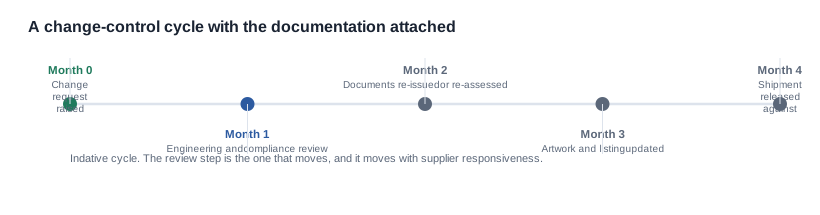
The sequencing decision. The brand asks which of the two changes has to land first. The answer is that the housing change determines the configuration and therefore determines the tested sample, so the qualification has to be run on the final configuration rather than on the current one plus a promise. Sequencing the cell change after the housing qualification avoids running the laboratory twice, and it is cheaper by the whole of one laboratory cycle.
The copy consequence. The runtime claim on the packaging moves with the cell, and the ingress marking on the packaging moves with the housing. The brand's artwork therefore has two dependent changes rather than one, and it puts both in the same artwork revision rather than approving them separately.
What the brand writes into the change-control form. A classification of the change against the five documents; a statement of which document is re-issued and which is re-assessed; a confirmation that the marketing claim has been updated to match; and a lot record template that carries the new configuration.
The question the buyer should ask at the end. Can you tell, for a unit leaving the line today, which qualification supports the ingress claim printed on its box? If the answer is yes, the change has been managed. If the answer is a description of what used to be true, the change has been absorbed rather than processed.
What our documentation contains, and what remains unconfirmed
Because no rule obliges a manufacturer to publish an ingress rating, the claim depends more rather than less on the discipline of the manufacturer, since nothing external will check it. We will publish the marking we have, we will not present an annotation as a tested specification, and we will not let a phrase in our own material sit next to a code it contradicts.
In our catalogue the IP54 marking appears on the V06 and the S7, as an annotation, with no third-party test report number, no standard, no test condition, no sample size and no laboratory behind it, because the company has not confirmed them. No other model carries a published ingress rating, and the Bluetooth audio family carries none at all.
We publish no model-level certificate numbers, no test report numbers, no general product safety file, no minimum order quantities, no capacity and no lead times, and all of those remain open internally.
Six questions to send in one message, before the order is placed.
- Which documents exist for the exact model designation I would order, and who holds them?
- Which of those documents name the configuration I would ship?
- What does a lot record for this model contain besides a date?
- Which changes to the product would require a document to be re-issued, and who signs that off?
- Which document supports the wording that will appear on my packaging?
- Is the charging case inside the claim or outside it?
What we do with a specific model and a specific set of changes. We will take them and tell you which of the documents in the chain each change reaches, so that the compliance work and the material work are scoped together rather than discovered in sequence. Where a document has not been confirmed to us we will say so rather than describe it.
The codes and what each one permits are at IP ratings explained; what a claim needs behind it is at certification requirements; the claims a buyer should distrust are at manufacturer claims; and the document set as a whole is at certification checklist.
Related reading
- The codes and what each one permits — IP ratings explained
- What a claim needs behind it — certification requirements
- The claims a buyer should distrust — manufacturer claims
- The document set as a whole — certification checklist
Send the model and the changes you are planning, and we will map the documents each one reaches.


