

The K01 is one of only two catalogue rows published on Bluetooth V5.3, and it is the row that pairs that radio with a dual-cell battery and magnetic charging inside an eight-model audio category. That combination puts it in the middle of the range rather than at either edge: newer radio rows exist, single-cell rows exist, and the charging method it uses is the one most of the catalogue shares. What follows compares the K01 against the audio models we publish, using catalogue rows as the only evidence. Where a row is missing, it is marked missing rather than estimated.
Three tiers of information appear in every comparison like this, and they are worth separating before the numbers start. The first tier is what the catalogue publishes, which is verifiable and dated. The second tier is what a supplier states in a quotation, a brochure or a sales call, which is real but belongs to that conversation. The third tier is what an analyst infers from comparable models, and it is the tier that quietly enters most shortlists because nothing else was available. Our method is to use the first tier wherever it exists, to convert the second tier into a written answer before it is used, and to refuse the third tier. That refusal is not caution for its own sake: an inference that turns out to be wrong is discovered by the customer rather than by you, and it is discovered at the moment it costs most.
K01 inside the eight-model audio category
Our catalogue covers 28 rows, and they are not one family with different finishes: 11 rows are camera models, 8 rows are audio models, 3 are sports models, 3 are children's models, and 3 carry no model label at all. The K01 belongs to the audio group of 8, which is the group where cell configuration, charging method and radio version are the rows that actually separate one model from another.
Five rows are published for the K01. The battery row reads 90 mAh × 2, which is two cells rather than one. The charging row reads magnetic. The radio row reads Bluetooth V5.3. The endurance row reads approximately 20 hours. The charging-duration row reads up to 2 hours. Those five rows are the complete published specification, and any comparison that runs past them is a comparison of somebody else's marketing copy rather than of our catalogue.
That constraint shapes the article in a practical way. A buyer comparing audio glasses usually arrives with a longer list than that: weight, colourway, ingress rating, microphone count, codec support, latency, an audio profile, whether the frames can be swapped, whether a charging case exists. Almost none of those rows exist for this category in our published data, so a comparison that fills the gaps from a distributor's brochure inherits that brochure's incentives.
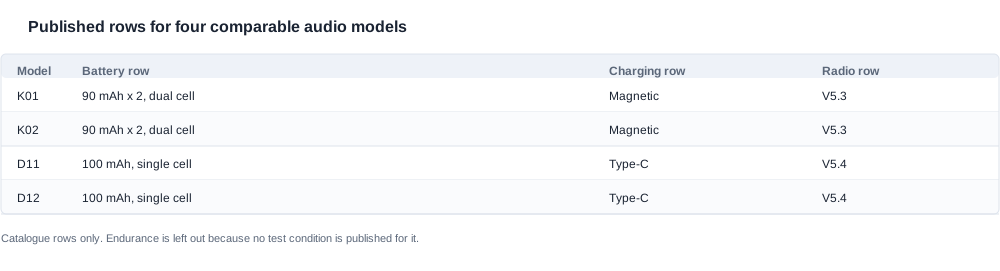
Placing the K01 inside its category is therefore a question of structure rather than of ranking. The audio rows divide along three visible seams. Cell count splits the dual-cell rows, such as the K01 and the K02, from the single-cell rows, such as the D11 and the D12. Charging method splits magnetic rows from Type-C rows and from the rows that publish nothing at all. Radio generation splits the two rows on V5.3 from the twelve catalogue rows on V5.4.
Against the K02 the K01 is hard to separate. Both publish the dual 90 mAh cells, both publish magnetic charging, and both publish the V5.3 radio. On the three rows that carry the most weight in a range decision, the two rows say the same thing, which means a buyer who wants a genuine difference between them has to go looking for something our catalogue does not publish.
Against the D11 and the D12 the K01 is easy to separate: both of those publish a single 100 mAh cell and Type-C charging, and both sit on the newer radio generation. The D11 additionally publishes a surround-sound row, which the D12 does not. That is the shape of the category — one model whose published rows are largely shared, two models whose rows are structurally different, and a handful of rows that publish almost nothing at all.
The last point deserves stating plainly, because it decides how much weight any comparison can carry. Four rows in the whole catalogue publish no charging method. Eleven camera rows publish no Bluetooth version. Only one row in the entire catalogue publishes a weight. A shortlist drawn across all 28 rows is therefore a shortlist built on very uneven evidence, and the honest comparison is the one that shows the unevenness rather than smoothing it over.
One test separates a structural difference from a cosmetic one before any question is sent to a supplier. Ask what a customer would have to do differently. If the answer is that nothing changes for the person wearing the product, the difference belongs in a specification table and not in a product story. If the answer is that the carton, the accessory, the balance of the frame or the service workflow changes, then the row is structural, it deserves a question, and it deserves a line in the cost model. Applying that test across the audio category is what turns a page of features into a page of decisions, and it is why the two rows examined next sit at the top of the grid rather than the radio version.

Cell architecture and charging interface: the two structural splits
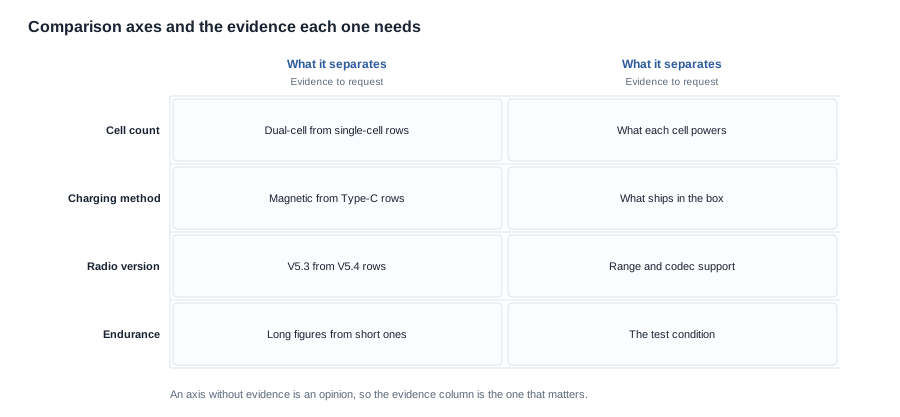
The first seam is the battery. The K01 publishes 90 mAh × 2, two cells; the D11 and the D12 publish a single 100 mAh cell. Read as a capacity comparison, 180 against 100 looks like a clear win, and that is exactly the trap. A dual-cell architecture distributes mass across both temples rather than concentrating it in one, and the catalogue does not publish the weight of either arrangement, so the comfort consequence of the two-cell frame cannot be derived from the numbers. Nor does the catalogue say whether the two cells feed one electronics package or power the two sides separately, which changes what a single-cell failure means and how the endurance figure should be read. Both are questions to put in writing before a frame goes into a mould tool.
The second seam is the charging method, and it is the one that moves fastest through a supply chain. The K01 charges magnetically; the D11 and the D12 charge over Type-C. Magnetic charging needs correct alignment and a pad or dock to work reliably, and what ships in the box is a packaging decision that the catalogue does not record for this row. Type-C charging needs a cable, and in some markets that cable is expected in the box while in others it is not, which changes both the carton contents and what a customer support call is about.
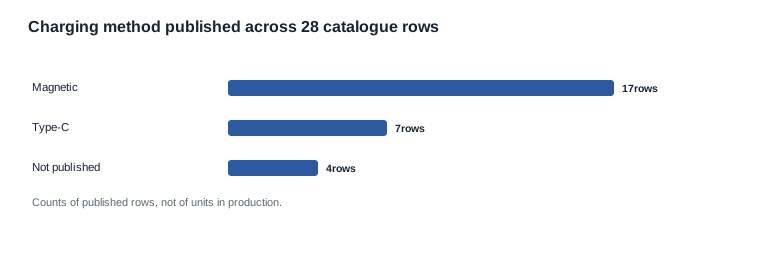
Across the full catalogue the split is lopsided: 17 rows publish magnetic charging, 7 publish Type-C, and 4 publish no charging method at all. That distribution tells you something a single-model comparison cannot. Magnetic is the house style of this catalogue, so choosing the K01 keeps a buyer inside the pattern that most of the range already follows, while choosing a Type-C row puts the accessory, the cable and the instruction leaflet outside it.
The practical sequencing follows from this. Cell topology is the blocking question, because until you know whether 90 mAh × 2 means two independently powered sides, the endurance row cannot be interpreted. Charging contents are the second question, because they decide carton cost and the first customer complaint you will field. Radio version is the third, and it is the one most buyers ask first and least often need, for reasons set out next.
There is a range-level cost that the per-model comparison hides. A radio generation is not a property of a product; it is a property of a certification file, a test matrix and a set of internal documents. Every additional generation inside a line multiplies the review work behind a market-access claim, and that work is rarely visible in a per-unit comparison because it does not scale with volume. If you are deciding a range rather than a model, the sensible order is to fix the radio generation first and then choose models inside it, rather than to choose models on their individual merits and discover the fragmentation afterwards. One such decision often removes several rows from the comparison before it starts.
Radio generation, and the column that decides less than it appears
Only 14 of the 28 catalogue rows publish a Bluetooth version. Two of those 14 are on V5.3 — the K01 and the K02 — and the other 12 are on V5.4. That is a real split, and for one kind of buyer it is decisive. If you are qualifying a whole range of audio glasses for a single market-access route, or building a product line where every unit must share one radio, then a V5.3 row and a V5.4 row are two qualification paths rather than two models. In that situation the radio column decides, and the K01 is on the older of the two.
For almost everyone else the radio version decides much less than it appears to. One generation of a protocol that is still current does not change daily pairing behaviour, and it does not change what the buyer sees when the product is used for audio or calls. The version is visible in a specification table and largely invisible in the product. Treating it as the deciding row is the most common shortcut in an audio-glasses shortlist, and it is usually wrong.
The same logic applies to charging duration, and it is worth measuring because the numbers look more differentiating than they are. Twenty-six catalogue rows publish a charging time of up to 2 hours, and only two rows publish roughly 1 hour — the D17 and the ZH12. When 26 of 28 rows share a row, that row cannot carry a product claim, a price argument or a selection decision. It is the catalogue's standard, not a feature.
What this means for the K01 is straightforward. On the published evidence, the K01's genuine position in the audio category rests on two things: a dual-cell magnetic-charging platform shared with the K02, and a radio generation that is one step behind the majority of the rows we publish. The first is a strength in consistency. The second is a decision to defend at range level rather than to argue at model level.
There is a discipline hidden in that conclusion. When most of the table looks identical, the temptation is to add colour from a brochure to make the table look decisive. The better move is to let the identical rows stand, and to spend the remaining effort on the two or three open items that actually change the answer. A shortlist with three honest open items is more actionable than a grid with fifteen rows of borrowed adjectives.
The grid is worth more than the model it describes, because it can be handed to someone else and reused. Keep a note, for every cell, not only of the value but of where the value came from and on what date it was confirmed. A cell that says catalogue, with a date, can be checked; a cell that records only that a supplier said so cannot be checked once the person has moved on. A short change log at the foot of the grid helps as well, because published rows do change and a comparison that was accurate six months ago can quietly become wrong. Re-running the grid before a purchase order is a five-minute task that prevents the most expensive kind of error, which is ordering on a stale picture.

How to build a comparison grid without inventing rows
A comparison grid is worth building only if it stays disciplined about what a cell in it means. The method that works for this category has four columns and one rule. The columns are cell configuration, charging method, radio version, and published extras. The rule is that a cell is either a value quoted from the catalogue or the explicit string "Not published", and it is never left blank and never filled with an estimate.
That rule matters more than it sounds. A blank cell means the analyst did not look. "Not published" means the catalogue does not carry that row, which is a stronger and more useful statement: it tells the buyer that no amount of reading the product description will produce the number, and that the only way to obtain it is a written question to the supplier. On the four rows below, three of the twelve cells are "Not published", and those three cells are where the procurement effort should go.
Fill the grid in a fixed order, because the order determines which questions are worth asking. Structural rows come first — cell configuration, charging method, radio version — because they determine the physical and logistics consequences of the model and they are the rows where the catalogue is densest. Published extras come next, because an extra row is the only thing that can separate two models whose structural rows are identical. Open questions come last, and they are written as questions rather than as gaps.
Three habits keep the grid honest. Quote the value exactly as the catalogue writes it, including its precision, because a precision level tells you how much confidence the published figure can carry into a cost model. Keep "Not published" and "published but ambiguous" as two different strings, because they lead to different supplier questions. And keep the grid in date: a row that was not published when you built the grid may be published by the time you order, and a buyer who re-runs the comparison before signature will find the difference.
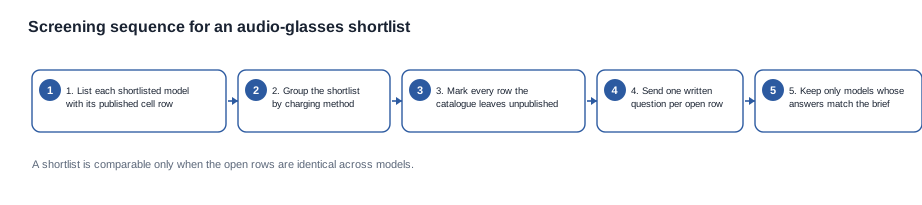
The output of this method is not a winner. It is a shortlist where each model carries an explicit list of open items, and a set of questions that are identical across models so that the answers can be compared. That is the part a buyer can actually defend, and it is the part that survives a procurement meeting where someone asks where a number came from.
A partial answer is worth handling deliberately, because it is easy to let one stand in for a full answer. If a supplier supplies the endurance figure but not its test condition, the figure stays out of the sheet until the condition arrives, and the question stays open on the list. If an answer arrives with a condition that is complete but commercially unusable, for instance a measurement at a volume no customer would use, say so in the file rather than in a meeting note, because the second version of that conversation usually happens without you in it. Recording why an item is still open is what stops an open item from ageing into something a colleague assumes was settled.
Procurement questions that close the gaps in the audio range
Once the grid is drawn, the open items become questions. The order below is deliberate, and it is ordered by how much damage an unanswered question does rather than by how quick the answer is to obtain.
- Is the 90 mAh × 2 figure per cell or a total, and does each cell power one side of the frame independently?
- What test condition produced the approximately 20-hour endurance figure — volume, codec, microphone state, temperature, and whether it describes playback or calls?
- What is supplied for magnetic charging in the retail configuration: dock, pad, or cable?
- Does the K01 configuration include a charging case, and if so what capacity does it carry?
- What is the frame weight measured with cells fitted, and is the measurement published or on request?
- Is an ingress rating available for this row, and under which standard was it tested?
- Which audio profile and codec does the radio negotiate, and does the published configuration pair the same profile to both sides?
- Does a sample ship in the same configuration as the production unit, so that the answers above can be verified by hand?
The first two questions are blocking, because the endurance row and the cell topology are the same question viewed from two ends. If you cannot answer the topology, you cannot use the endurance figure in a product claim, and a customer who runs the frame down faster than the published number will treat it as a defect. The third and fourth questions decide the carton and the accessory line, which is where the cost of a magnetic-charging model either lands or disappears. The fifth and sixth have no published row to answer them at all, so they must be obtained in writing or left as explicit exclusions in your own specification sheet.
The cost of leaving them open follows a predictable order. First comes a claim you cannot defend: a listing that repeats the endurance figure without a method, or states an ingress rating that no report supports. Second comes a return rate driven by an interface mismatch, when a customer expects a cable and the unit ships with a dock. Third comes the quietest and most expensive failure, which is a specification sheet your own sales team cannot answer, so the customer asks you instead.
Two habits prevent this. Send the same question set to every supplier on the shortlist, so the answers can be placed in the same cells of the same grid and compared like for like. And put the answers in writing, attached to the purchase order, because a verbal answer given by a sales representative does not survive the supplier's own organisation. The sample policy is the practical first step, since a sample in the retail configuration is the cheapest way to settle questions 1, 3 and 7 by observation rather than by assertion.
The handover discipline matters more than the method itself, since most comparison work outlives the person who did it. Keep three things together: the grid with its dates, the written answers as they arrived, and a short statement of what the comparison does and does not establish. When the range is reviewed, whether in six weeks or six months, that bundle lets a new owner re-check the decision instead of restarting it, and it lets a buyer who was not in the room see the reasoning rather than only the conclusion. If the catalogue adds a row in the meantime, the handover note is where that change is noticed, because it names the rows the decision actually depended on.
The limits of a cross-range comparison
A published-row comparison has a floor, and the floor is lower than buyers expect. Every row in a table like this describes what a maker chose to print, not what a product does. The K01's five rows tell a buyer that it carries two 90 mAh cells, charges magnetically, runs on V5.3, is rated at approximately 20 hours and charges in up to 2 hours. They do not tell a buyer how it sounds, how it fits, or whether it survives a working week.
Some of the missing evidence is structural across the whole catalogue rather than specific to one row. Only 14 rows publish a radio version, so 14 models cannot be compared on radio at all. Four rows publish no charging method. Eleven camera rows publish no Bluetooth version. Only one row in the catalogue publishes a weight — the MT6 at 158 g — so weight cannot serve as a comparison axis for audio glasses at all. Only two rows publish an ingress rating, and both are camera rows, which means the audio category publishes no water or dust figure to compare.
Our position on ranking these models: we will not publish a league table of the audio rows, because the evidence behind those rows is not comparable across the category, and a ranking that rests on mixed evidence would be a ranking we could not defend. What we will do is publish the rows exactly as they stand, mark the missing ones as missing, and give you the question set that closes the gaps.
That is a smaller promise than a winner's table, and it is the one that holds up. A buyer who ends up with a shortlist of four models, a grid with twelve cells and four open questions per model, and a written set of supplier answers can defend every element of it. A buyer who ends up with a ranked list and no sources cannot defend the first row, let alone the last.
For the wider picture of how these audio models are specified, the Bluetooth Audio Glasses collection page is the natural starting point. If you want to work through the runtime arithmetic behind the endurance row before you ask question 2, the battery life method note sets out what a usable test condition contains.
There is a final practical point about the limits of the comparison, and it is the one that saves the most time later. Because the evidence in this category is uneven, the most useful document you can hand to a buyer is not the grid alone but the grid with its gaps ranked by cost. The gaps that change a customer's decision sit at the top, the gaps that only matter to your internal costing sit below them, and the gaps nobody will ever ask about can be closed or dropped. Ranking the gaps that way turns an unfinished comparison into a decision plan, and it tells the buyer exactly which two questions are worth their time.


