
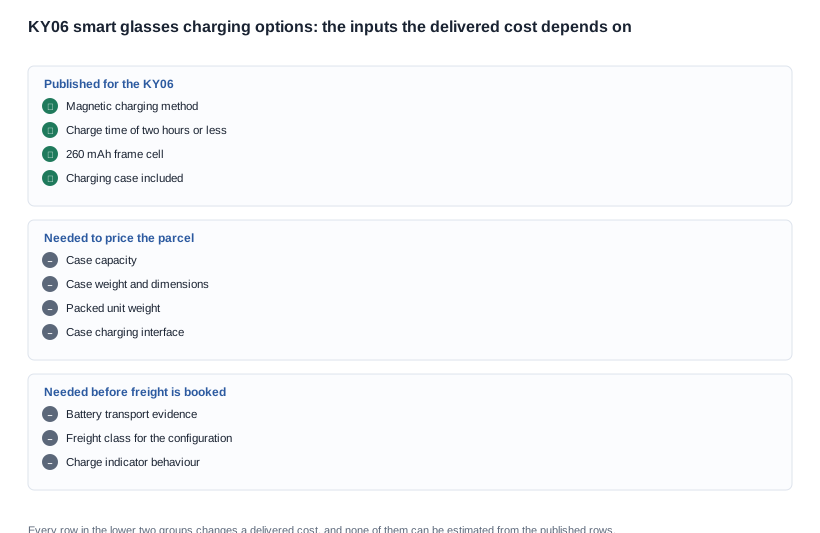
KY06 smart glasses charging options are published as a charging method rather than as a set of alternatives: magnetic charging together with a charging case. Everything a buyer needs in order to plan a parcel, a freight file or a shift handover is either a related number or an open item, and separating those two groups is the whole of the sourcing work. The published row for this model gives a 260 mAh cell, a runtime band of six to eight hours, a charge time of two hours or less, and magnetic charging alongside a charging case. The capacity of that case is not published. How the case itself is replenished is not published. Whether the case travels inside the same carton as the glasses or on a separate line is not published either.
Those omissions are not defects and they are not unusual for a catalogue written as a product sheet rather than as a logistics document. They matter because a camera-glasses model with a case is, at the freight level, a two-lithium-item product, and a product with two lithium items has a different documentation path, a different packing decision and a different cost structure than a single-item product with the same cell. This article is written for procurement teams, channel managers and online sellers who need to decide what to specify, what to ask for, and which parts of the delivered cost are driven by the charging arrangement rather than by the unit price of the glasses.
KY06 smart glasses charging options: what the published row settles and what it leaves open
Start with the four values that are published, because every downstream calculation starts there and because they are the values a supplier's own quotation will be checked against.
The cell. 260 mAh. This is the capacity of the cell fitted in the glasses. It is a published figure and it is a hard figure in the sense that no other capacity for this model appears in the catalogue.
The runtime. Six to eight hours. A band rather than a point, which tells a buyer two things at once: the manufacturer is not claiming a single measured number, and the spread between the ends of the band is wide enough that the operating assumptions behind it matter. Ask for the assumptions rather than the average — the number of hours in a typical shift, the recording load, the screen state, the ambient conditions — because the two ends of a band usually correspond to different operating profiles.
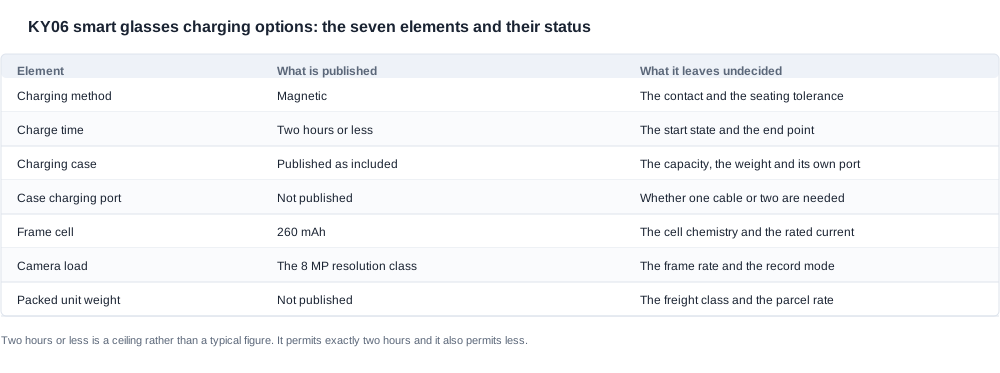
The charge time. Two hours or less. Read this as a ceiling, not as a measurement, and it is worth being precise about why, because this is one of the most frequently misread numbers in the whole range. The catalogue publishes a charge time for every model in the range, and for the overwhelming majority it publishes a ceiling in this form. A ceiling carries no starting state and no termination rule: it does not say whether the charge begins from empty, whether the cell has been conditioned, and — critically — what level of charge counts as finished. Without a termination rule, a charge time cannot be converted into a shift interruption, and it cannot be used as a case turnover time either, because the case's own replenishment cycle is a different measurement with its own starting state.
The charging method. Magnetic charging together with a charging case. This is the answer to the question the keyword asks, and it is more specific than it first appears, because it names two physical interfaces: a magnetic contact between the glasses and the case, and a case that has to be refilled from somewhere else. That second interface is the one that is not documented.
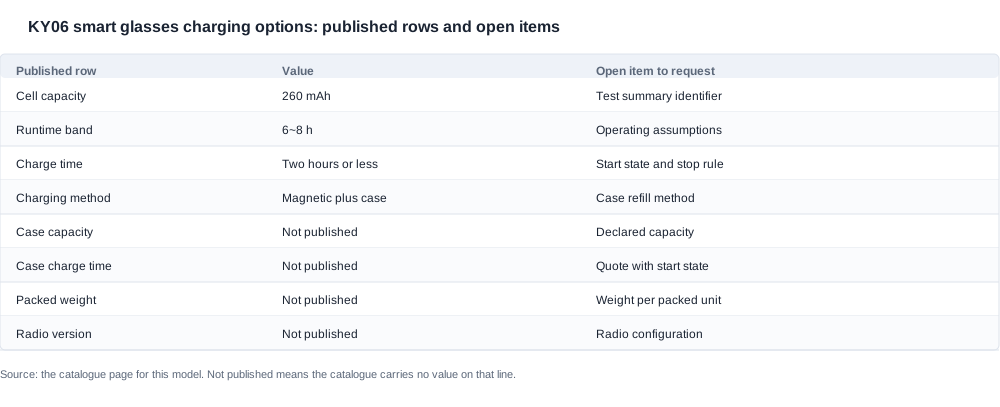
Now the open items, listed precisely, because a buyer who can name the gaps is in a far stronger position than a buyer who suspects there are some.
- The charging case capacity is not published for this model. The catalogue publishes case capacities for five camera models, leaves the capacity unstated for two camera models including this one, and publishes no case row at all for three more.
- The method by which the case is replenished is not published. Whether the case is filled from a wall adapter, a computer, a power bank or a dock is simply absent from the published material.
- No case charge time is published for this model, and no case cycle life is published.
- The packed weight of the unit and of the case is not published. The only weight published anywhere in the catalogue is 158 g for a different model — the MT6 glasses body, explicitly excluding its folding charging case — so no packed or gross weight figure exists for this model or for any charging case in the range.
- No ingress rating is published for this model, which matters for charging decisions only in a peripheral way, but matters for storage decisions if a case is left in a vehicle or a warehouse.
The right response to that list is not to treat the model as unsuitable. It is to convert each open item into a written request, because each one is cheap to answer and expensive to discover late. A buyer who asks five precise questions in the first supplier brief spends an afternoon; a buyer who asks them after the first production order has been shipped spends the freight cost of a re-classified consignment.
KY06 smart glasses charging options compared across the camera range
Charging arrangements are one of the few dimensions on which this catalogue is genuinely comparable model by model, because the standard rows — cell capacity, runtime band, charge time, charging method, radio version — are published for every model. That makes the camera models a useful comparison set for a buyer building a shortlist, and it also exposes how many different arrangements a channel has to support.
Within the eleven camera-glasses models, the charging method splits three ways. Five publish magnetic charging: V03, this model, MT5 and V06, and S7. Two publish Type-C charging: V03 Pro and L2 Utral. Four publish no charging method at all: L1 Pro and CY05, and MT6 and CY03. Note what that last group means for a buyer. It does not mean those models lack a charging path; it means the catalogue carries no charging-method row for them, so the method has to be confirmed in writing before it can be compared against anything, and before it can be described on a product page.
The charging case splits four ways, and the four ways are not equivalent. Five models publish a case capacity: CY03 and L1 Pro, and CY05 — each at 1400 mAh, L2 Utral at 900 mAh or 1400 mAh, and MT6 with a 1200 mAh folding case. Two models ship with a case whose capacity is not published — this model and MT5. Three models have no case row in the catalogue at all: S7 and V03, and V06. One model, V03 Pro, is published explicitly as being supplied without a case. The distinction between the third group and the fourth is the one that causes arguments: "no row" is an unstated attribute, while "published without one" is a stated fact, and only the second can be quoted back to a supplier as a specification.
| Model | Published charging method | Charging case status | Published cell |
|---|---|---|---|
| V03 | Magnetic | No case row published | 220 mAh |
| V03 Pro | Type C | Published as supplied without a case | 220 mAh |
| KY06 | Magnetic plus charging case | Capacity not published | 260 mAh |
| CY03 | Not published | 1400 mAh | 290 mAh |
| CY05 | Not published | 1400 mAh | 290 mAh |
| L1 Pro | Not published | 1400 mAh | 290 mAh |
| L2 Utral | Type C | 900 mAh or 1400 mAh | 290 mAh |
| MT6 | Not published | 1200 mAh folding case | 265 mAh |
| MT5 | Magnetic | Capacity not published | 220 mAh |
| V06 | Magnetic | No case row published | 260 mAh |
| S7 | Magnetic | No case row published | 260 mAh |
Two selection rules follow from the table, and they are written as rules rather than as recommendations, because a model should be short-listed only against a requirement the buyer has actually written down.
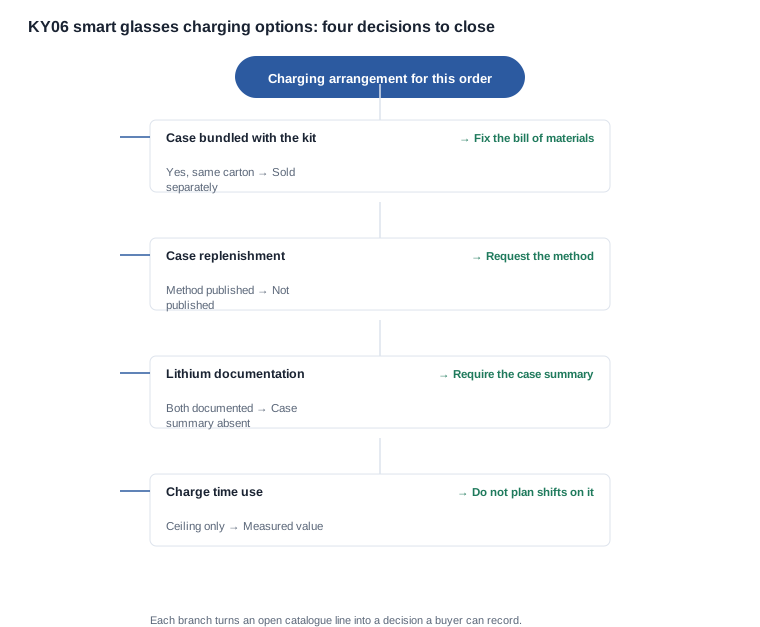
Rule one: if the channel requires one lithium item per parcel, then the shortlist cannot be finalised on published data. Every camera model whose case row is not published — including this model — needs a written confirmation of the bill of materials before it can be assumed to travel as a single item. Models published with a case and a stated capacity are verifiable on this point; the two models with a case of unstated capacity are not, and the difference is exactly the difference between a one-line question and a re-classified consignment.
Rule two: if the requirement is a documented single charging path for a managed fleet, then the models whose charging method is not published cannot be compared against the models whose method is published, because a comparison needs two stated values. This model and MT5 publish magnetic charging with a case; V03 Pro and L2 Utral publish Type-C charging; S7 and V06, and V03 publish magnetic charging with no case row. Each of those arrangements produces a different bill of materials, a different accessory policy and a different support story for the end user, so the comparison a buyer actually wants is between arrangements rather than between model names.
What the table does not attempt is to say which arrangement is better. That judgement depends on facts this catalogue does not carry: what a case costs to the factory, what a charger costs to the customer, how the two lithium items interact with a given destination's carriage rules, and what the buyer is actually trying to optimise. A note on the accessories available for this product family, including how the case is positioned relative to the glasses, is published separately; the point of the comparison above is to establish that the published evidence is not identical across the range, so any shortlist has to be built on confirmed rows rather than on an assumption that the camera models all charge the same way.

KY06 smart glasses charging: the case, the carton and the second lithium item
A case in the box is a packaging decision with a compliance tail, and it is worth being clear about the chain of consequences, because the chain is where the cost actually lives.
Consequence one: the consignment contains two lithium items. The glasses carry a 260 mAh cell. The case carries its own cell, whose capacity is not published, but which exists — the model ships with a case, and a case that charges a device carries a cell of some kind. Two lithium items inside one consignment means the dangerous-goods paperwork has to describe both, or the description does not match the parcel. Under most carriage regimes a lithium item shipped with, or contained in, equipment is treated differently from a lithium item shipped alone, and the treatment depends on how the item is packed and what the test summary says about it. If the case's cell is not covered by the summary that travels with the glasses, a forwarder has grounds to reclassify, hold, or route the shipment differently, and the cost of that is not a document — it is days of delay and a change in the landed cost.
Consequence two: the case's capacity determines the parity between shipped energy and usable energy. A buyer who hears "six to eight hours" and "magnetic plus a case" may reasonably assume the case is a meaningful reserve. The catalogue does not support that assumption, because the case capacity is not published. The published 260 mAh is the cell in the glasses. Any total-energy figure that includes the case would be a derived number presented as a published one, which is exactly the sort of claim that causes problems when a channel listing is audited.
Consequence three: the case changes the packing decision. A unit with a case and a unit without one are different carton configurations, and the difference propagates into everything the buyer pays for. If the case ships in the same master carton, the outer dimensions grow by the case's volume and the unit count per carton may fall. If the case ships separately, the consignment count doubles and the per-parcel handling cost doubles with it. This is where the charging arrangement meets the bulk order arithmetic, and it is why a packing list matters more for this model than for a model published without a case. The bulk ordering note for this family covers how order quantity and carton configuration interact; the shipping weight note covers the weight side of the same calculation.
Consequence four: the replenishment path is undocumented. If the case is refilled from a wall adapter, the buyer needs to know because the adapter is either bundled, sold separately, or documented as an accessory — and each of those is a different accessory policy, a different listing decision, and a different support burden for the end user. If the case is refilled from a computer or a power bank, the buyer needs to know because that changes what the end user is told to expect. The catalogue publishes none of this for this model, so it is a question, not a conclusion.
KY06 smart glasses charging: how the arrangement moves landed cost and freight paperwork
Buyers who compare quotations tend to compare unit price and stop. For a model that ships with a charging case, that comparison is incomplete in a way that is measurable, and the cheapest way to see the shape of the problem is to build the parcel cost from components rather than from a single quoted figure.
Component one: the goods themselves. Unit price is a quote, not a fact in this catalogue — no prices are published, and the price tier for a given order quantity is a commercial term the buyer negotiates. What the catalogue does contribute is the physical description that the quotation is attached to: a 260 mAh cell, a case whose capacity is unstated, and a glass frame with a camera module. A quotation that quotes the glasses and treats the case as an implied inclusion is incomplete in a way that shows up at packing, because the case occupies real space.
Component two: the packaging. Gross weight and outer dimensions per unit are not published for this model, so a buyer cannot calculate volumetric weight from published data. That is a real gap, and it is why the request for packed dimensions and packed weight per unit is worth making early — it is the input to freight cost per unit, and freight cost per unit is usually large enough to change the sourcing decision when order quantities are large. The same request should ask for the carton unit count and the master carton dimensions, because a packing decision that fits more units into a carton reduces the freight cost per unit directly.
Component three: the dangerous-goods handling. Two lithium items, each with its own test summary, means a forwarder is classifying more than one item per parcel. The handling time this adds is usually not billed as a premium; it is billed as delay, and delay is what pushes a lead time out of the window the buyer promised to a customer. Asking the supplier which carrier and which classification they use for this model in regular shipments is a cheap way to discover the answer before it is urgent.
Component four: the compliance work. A channel that lists products with batteries, cameras and radios typically requires documentation before the listing goes live. A model whose case carries an undocumented cell adds a question to that submission, and a question is a delay. For sellers, this is the point at which the charging arrangement becomes a listing-readiness question rather than a logistics question.
Component five: the risk reserve. No published figure exists for the rate of in-warranty returns, and we do not publish one. What can be said structurally is that a two-item accessory set has more failure interfaces than a single-item set: the magnetic contact itself, the case cell, and the case's own port. A quality control question — what end-of-line test coverage applies to the assembled kit, what the defect classification scheme is, and how a warranty claim is evidenced — belongs in the same request as the transport documents, because the answers arrive from the same factory systems.
The commercial conclusion is not that a case is expensive or cheap. It is that for this model the charging arrangement determines a meaningful share of the delivered cost, and that share is not visible in any published figure. Buyers should therefore ask for the cost structure as a line-item list — goods, accessories, packaging, freight classification, documentation handling — before comparing quotations, because a quotation presented as a single unit price cannot be compared against another quotation that treats the case as an inclusion, a separate line, or an accessory.
KY06 smart glasses charging options: the request list that closes the open items
The following list is written so that each question produces an answer that can be recorded in a cell of a tracking sheet and re-checked later by someone who was not in the conversation. It is deliberately arranged as separate classes, because a request for "the charging and battery information" invites a general reply, while a request for six named items invites six named answers.
On the charging interface. Which physical interface charges the glasses — the magnetic contacts to the case, a separate port, or both? Is the magnetic contact the only charge path, and if so, what happens if the case is empty? Is a case supplied with every unit, or is it a separately sold accessory, and if separately sold, is it listed as a SKU with its own bill of materials?
On the case. What is the declared cell capacity of the charging case? What is the method by which the case is replenished, and what does the buyer need to supply for that to work? What is the published charge time for the case, and on what start state and termination rule is it quoted? What cycle life does the factory quote for the case cell? Does the case provide any charge indication, and is that indication available to the end user or only to the factory?
On the lithium documentation. What is the test summary identifier for the 260 mAh cell in the glasses? What is the separate test summary identifier for the cell in the charging case? Which packing instruction is used for each item, and which carriage classification does the forwarder apply to this model in practice? Is there a consolidated summary covering the assembled kit?
On the packaging and freight. What is the packed weight per unit, including the case, and the packed dimensions? What is the master carton dimension and the unit count per carton? Does the case ship in the same carton as the glasses? What is the current packed weight and dimension for the shipping calculation, and how often are they re-measured — after a packaging change, a case supplier change, or a moulding revision?
On quality and warranty. What end-of-line test coverage applies to the assembled kit, and does it include a charge-cycle test on the case? How is a defect classified, and how is a warranty claim evidenced against a production lot? Is a production lot or serial scheme recorded against the shipped units, so that a field issue can be scoped?
Two drafting notes make the difference between a list that gets answered and a list that gets filed. The first is to ask for identifiers rather than confirmations. "Do you have the battery test report" can be answered with a yes; "what is the test summary identifier for the case cell" cannot. The second is to attach a date to every open item. An item without a date is an item that quietly becomes permanent, and a permanently open item is a latent cost sitting in the purchase order.
The broader sourcing note on this model family's specifications is useful reading for anyone who wants the published rows separated from the inferred ones, and the limitations note for this model lists the documentation items that remain open across the board. For a bulk order, the sequence matters: confirm the bill of materials and the packing configuration first, because both feed directly into the freight cost that the order is being judged on, and both are the two things that are not published. A sample order is the only reliable way to settle the physical questions — the weight, the dimensions, the case in the box — that no catalogue can answer, and the comparison between a sample's measured packed weight and the quoted freight profile is worth more than any further email exchange.
For teams buying this model, the KY06 smart glasses charging options are settled by four published values and a short list of written questions: magnetic charging with a charging case, a 260 mAh cell, a six-to-eight-hour runtime band and a charge time of two hours or less are the facts on the record, while the case capacity, the case replenishment method, the case's own test summary and the packed weight are the facts that have to be requested. That distinction — published against requested — is what keeps a quotation comparable, a parcel correctly classified and a listing defensible, and it is the same shortlist logic the AI camera glasses product page is built around.



