

The L1 Pro publishes four battery numbers and omits the one that gives them meaning. A 290 mAh frame cell, a 1400 mAh charging case, a charge time of two hours or less, and roughly seven hours of use — that is the published battery row, and the test condition behind the seven hours is not part of it. For a buyer planning a shift, for a channel manager writing a product listing, or for a brand owner deciding whether the case belongs in the box, that omission is larger than it is on a product whose power draw is simple and constant. On a camera model it is the whole question.
This article works from the published rows only. Where the catalogue prints a value, it is repeated here as printed, including the fact that the charging method is not published for this model and that the case capacity is. Where a row is blank, this article says so and turns it into a question to put in the quotation. Where a figure is an approximation, it stays an approximation, because the difference between "about seven hours" and "seven hours" is the difference between a product page you can defend and a claim you cannot.
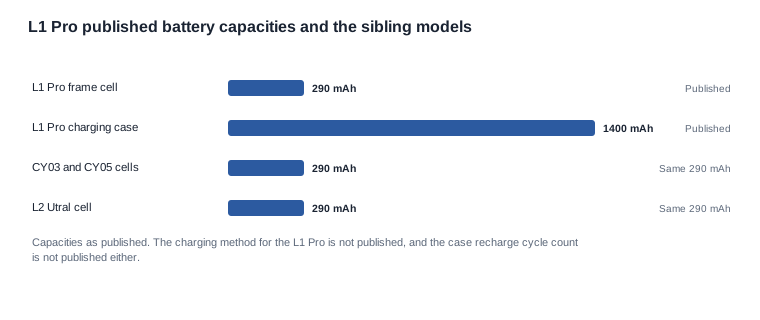
The published battery row for the L1 Pro
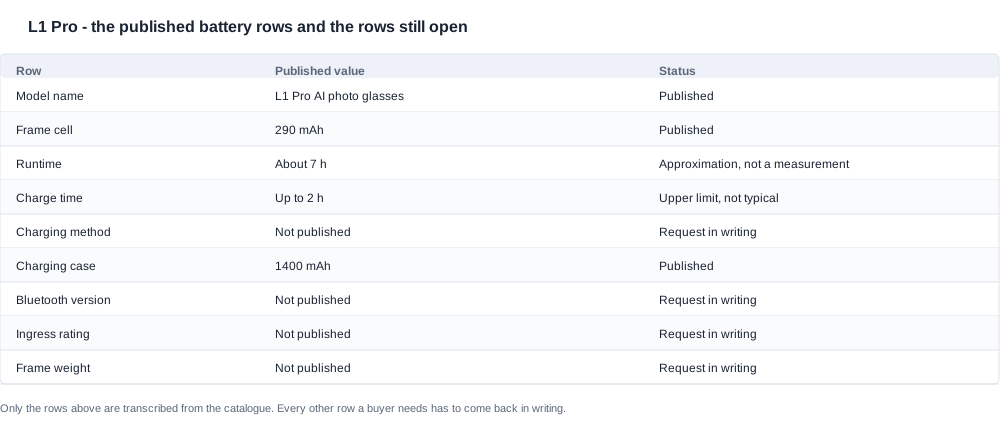
Here is the L1 Pro battery picture exactly as the catalogue prints it, with the surrounding rows included so that you can see which entries belong to this model and which entries the catalogue does not fill in.
| Row | L1 Pro published value | Status |
|---|---|---|
| Model name | L1 Pro AI photo glasses | Published |
| Frame cell | 290 mAh | Published |
| Runtime | About 7 h | Approximation, not a measurement |
| Charge time | Up to 2 h | Upper limit, not a typical figure |
| Charging method | Not published | Request in writing |
| Charging case | 1400 mAh | Published |
| Bluetooth version | Not published | Request in writing |
| Ingress rating | Not published | Request in writing |
| Frame weight | Not published | Request in writing |
The frame cell is 290 mAh, and that figure is shared. The L1 Pro sits in a group of camera models in this range that all carry the same 290 mAh cell, the same roughly seven hour runtime, and the same charge time of two hours or less. The catalogue prints that combination for the CY05 and the L1 Pro, and the CY03 and the L2 Utral alike. The cells are the same size; the published runtime is the same; the charge time ceiling is the same. What separates the four models is the case row and the charging method, which is why the battery comparison between them is a comparison about packaging and charging rather than about endurance.
The charging case is published at 1400 mAh, and that is a real asset. It is roughly five times the frame cell, which makes a case in the box a meaningful part of the product rather than a plastic accessory. The case row is also one of the few battery entries the catalogue actually prints a number into, so it can be used directly in your landed cost and packaging work. The same 1400 mAh case row is printed for the CY03 and the CY05, which means a channel that already stocks one of those accessories is looking at the same case format. The L2 Utral is the exception in the group: its case is published as a 900 mAh or 1400 mAh option, and it is the only one of the four with a charging method published alongside it, listed as Type C.
The charging method for the L1 Pro is not published, and this is the row that will cost you time. The catalogue prints a case capacity but leaves the charging method blank, unlike the L2 Utral in the same group and unlike the magnetic entries printed elsewhere in the range. For a buyer this is the most operationally expensive gap in the whole row. You cannot write a packing list that says which cable ships in the box, you cannot state how the frame is charged when it is away from the case, you cannot quote a charging accessory line, and you cannot tell a customer what to order if the cable is lost. Every one of those answers is available from the factory in a single email, but none of them is available from the catalogue.
The charge time of two hours or less is a ceiling. The catalogue prints it as an upper bound, which means it tells you the longest you should ever wait before you suspect a fault, and it tells you nothing about the typical case. For planning purposes, treat it as the worst case: a night of charging is finished in at most two hours, and a faster charge in your hand is a possibility rather than a promise.
Bluetooth is not published for this model, and the reason is structural rather than accidental. The L1 Pro is a camera model, and across the camera series the catalogue leaves the Bluetooth version blank. Every camera model in this range publishes a runtime, so a runtime and a missing Bluetooth entry are a normal combination here rather than a sign that something was missed. It does mean that a version number for the L1 Pro has to be obtained as a written answer and filed with the rest of the model documentation.
The pattern across the camera tier is worth knowing before you build a comparison. All eleven camera models in this range publish a runtime figure; not one of them carries a blank runtime row. So the runtime row has already been spent as a differentiator across the camera tier, and the remaining levers are the ones this article spends most of its time on: the charging method, the case configuration, the accessory plan, the commercial terms and the quality of the answer you can actually get in writing.
Reading the published runtime without over-reading it
The published runtime for the L1 Pro is about seven hours. It is an approximation, and the word doing the work is "about". It sits in a family of figures in this range that are printed in different shapes — some models carry a range such as 6 to 8 h or 5 to 8 h, and some carry a single approximate value such as roughly 7 h. Those are two ways of saying that the number is not a measurement of a specific unit under a specific condition. A range says the answer lies somewhere in a span; an approximation says the answer is near a point. Neither one tells you which.
That matters because the two shapes invite two different mistakes. A range invites the mistake of reading its lower bound as a worst case and its upper bound as a best case, as if the conditions at each end were defined. An approximation invites the mistake of reading it as a round figure that will show up on a carton, that a competitor can be measured against, and that a customer will hold you to. The safest reading of both is the same: this is the manufacturer's characterisation of the product, not a test report you can file.
What a runtime figure cannot tell you without a test condition. A camera product spends its hours in states, and each state costs differently. Recording continuously costs far more than standing by. A connected device that is syncing costs more than one that is not. A bright display in daylight costs more than a dim one at night. Temperature changes the behaviour of the cell. None of these appear next to the seven hours, so a buyer cannot reconstruct the operating profile from the published row, and neither can a customer who tries to reproduce it.
The comparison with the range-style rows in this range is instructive. A model published as 6 to 8 h and a model published as about 7 h are not directly comparable, and the difference is not a technical subtlety. The first is telling you the span of results the manufacturer has seen; the second is telling you the typical result the manufacturer is willing to print. A buyer who writes "about seven hours" next to "up to eight hours" on the same comparison sheet has put two different kinds of statement side by side and implied an ordering that the catalogue does not support. If your product listing compares this model with another, keep the two shapes of figure separate and label them.
The case does not add runtime to the frame; it replaces it. A 1400 mAh case holds far more energy than the 290 mAh cell in the frame, but the energy has to pass through the frame's own cell before it is used, and the frame can only deliver what that cell holds. So the case is a refill mechanism and a storage device, not a battery extension. How many times a case can refill a frame in the field depends on the transfer efficiency, on how much the case itself draws while parked, and on whether the frame is left partially charged between uses — none of which the catalogue publishes. Asking the supplier for the case recharge cycle count is a reasonable and specific question, and the answer is more useful to you than the case capacity alone, because it tells you whether a customer can get through a long day on one case or whether the case is essentially an overnight home for the device.
What the two-hour ceiling does and does not buy you. For a buyer running a stock and logistics plan, a charge time of up to two hours is a good operational number: it means an overnight charge is finished before the shift starts, it means the turnaround on a returned or demo unit is short, and it means you can plan the shipping carton around a device that arrives charged. It does not tell you the typical charge time, so it cannot be used as a cycle time estimate for a repair bench or a refurbishment flow.
How to evaluate a runtime claim before you order. The evaluation is a measurement, not a reading, and it belongs on a sample order rather than in a spreadsheet. Put the candidate unit on a charge cycle that matches your duty cycle rather than a generic video loop, log the start and end conditions in the technical file, and repeat it on more than one unit, because a single unit tells you about that unit. Write down what the camera was doing during the run, because that record is the thing your customer will eventually ask for. Where the factory can supply a runtime test condition, ask for it and put it next to the published row; where it cannot, say so in the technical file rather than leaving the row to be interpreted by whoever reads it next.
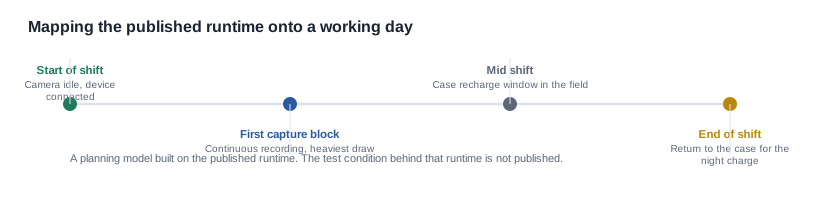
Planning a shift around an approximate figure. If you are mapping the runtime onto a working day, the honest approach is to treat the published figure as the reference point and then apply your own worst case on top of it, not to subdivide the seven hours into blocks and hope. The plan below is a planning model built on the published figure, not a measurement, and the moment the test condition arrives the same picture has to be rebuilt around it.

What the catalogue does not publish about the L1 Pro battery
There is one gap that is specific to this model, and a longer list of gaps that every model in this range shares. Both matter to a buyer, and they need to be handled in different ways.
The model-specific gap is the charging method. Everything else about the L1 Pro battery is either published or blank in the same way it is blank for its siblings. The charging method is blank in a way that has no sibling precedent except one: the L2 Utral in the same 290 mAh group does have a published charging method, listed as Type C, and a published case option of 900 mAh or 1400 mAh. So the row is fillable for this family, which means the blank on the L1 Pro is a specific piece of information that has not been printed rather than a category that the catalogue never covers. Get it in writing, and ask it precisely: how the frame is charged from the case, how the frame is charged when no case is present, what cable or adapter is supplied, whether the case is charged over the same interface, and what the interface is.
The weight is not published, and only one frame weight exists anywhere in this range. The MT6 is the only model in the catalogue with a published frame weight, at 158 g for the frame itself, excluding its folding case. For the L1 Pro the weight row is empty. That matters for more than comfort: a heavier frame changes the power budget indirectly, and it changes the way a customer experiences the product at the end of a long shift. Any weight number attached to the L1 Pro in a quotation, a competitor sheet or a spreadsheet did not come from the catalogue, so re-confirm it against the model you are buying and file it with the technical documentation.
There is no ingress rating for this model. The only ingress-protected models in this range are the V06 and the S7, both published at IP54. The L1 Pro carries no published rating, so the correct statement is that no rating is published — not that the product is protected, and not that it is unprotected. If your use case involves rain, spray or dust, that is a question for the supplier and for the test report behind it, and it should be asked before you order rather than discovered by a customer.
Several feature rows that would change the power draw are simply absent. There is no capacitive touch row in this catalogue, no translation row, and no surround sound annotation — the only model that publishes surround sound is the D11. So the feature set of the L1 Pro cannot be reconstructed from the catalogue, and neither can its effect on the battery. A translation feature, an always-listening audio path or a touch controller that wakes the camera all change the draw, and none of them is documented here. This is a good example of why a runtime figure without a test condition is close to unusable: the variables that would let you reason about the drain are exactly the variables that are missing.
On certification, the catalogue gives you nothing to copy. The catalogue body contains no CE, FCC, RoHS or RED wording anywhere, and the export certification page is an image page with no per-model certification lines. There is therefore no certificate number, no declaration reference and no test report identifier to transcribe into your file for the L1 Pro. What you can do is ask the supplier for the compliance documents that belong to this specific model and ask for them by name, and then attach the document list to the purchase order so that the shipment and its paperwork travel together.
No commercial terms are published for any model in this range. Price, minimum order quantity, lead time, sample order cost and policy, warranty, production capacity and payment terms are all absent from the catalogue for every model, including this one. That is not a defect in the data; it is what a catalogue is. It does mean that a buyer has to collect all of them in the same request, in writing, before a comparison between models means anything commercially.
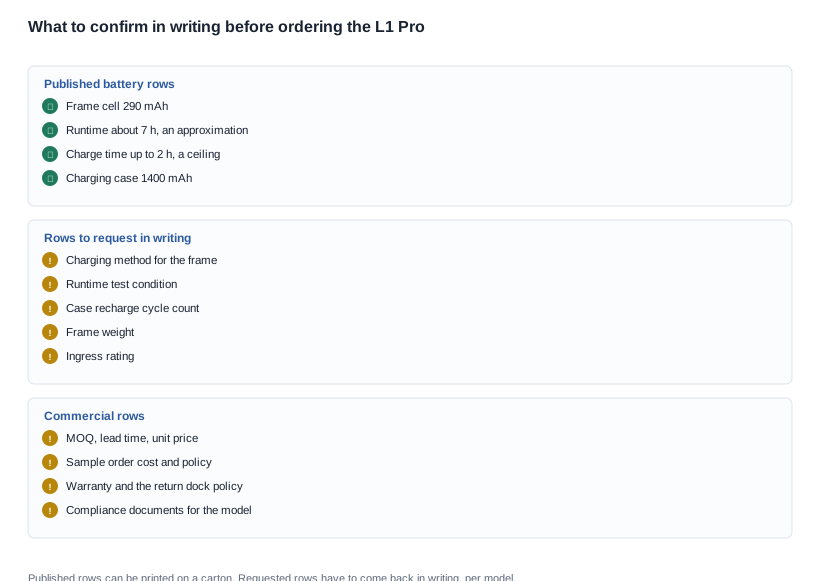
The questions to ask, in the order that returns the most. These are the specific questions to put into the quotation, and each one is written so that the answer is a value you can put in the technical file rather than a sentence you have to interpret later.
- How is the frame charged, from the case and without it, and what cable or adapter is supplied? This is the model-specific blank and the first thing to ask.
- What is the runtime test condition behind the published figure of about 7 h? Ask whether the camera was powered during the measurement, how long each recording lasted, what the connection state was, and whether the value is a typical figure, an average or a minimum.
- How many frame recharges does a full 1400 mAh case support? Ask for the count and the transfer efficiency assumption behind it.
- What is the frame weight, and what is the shipped weight with the case and packaging? Ask for the measurement method as well as the number.
- Is there an ingress rating for this model, and which test report covers it? If the answer is no rating, ask for that in writing so the file is complete.
- Which compliance documents ship with this model, and which document must accompany the shipment? Ask for the model's own documents, by name, and for the declaration that accompanies them.
- What are the commercial terms? Ask for the minimum order quantity, the lead time, the unit price and its price breaks, the sample order cost and policy, the warranty period and what it covers, the monthly production capacity, the payment terms and the incoterms on which the quotation is based.
- What is the Bluetooth version? A one-line answer that belongs in the model file.
A checklist is worth more than a paragraph. The list above works as a questionnaire, but as a sheet it does more, because every line can carry a status, a source and a date, and a status column is what stops an open row from quietly closing itself between the quotation and the purchase order. Where the same factory builds several models, the shared rows can be answered once and referenced, which is how the due diligence effort stays proportionate instead of growing with every model you add to the range.

The L1 Pro runtime in our own record
On the L1 Pro battery, our position is that the published row is strong on the packaging side and thin on the operation side, and that a buyer deserves to know which is which before the quotation rather than after the first returns. The case capacity of 1400 mAh is a published number you can build a product story and a shipping plan around. The runtime of about 7 h is an approximation with no condition attached to it, and the charging method, which is the operationally decisive row for this model, is not published at all.
We will not convert a published range into a fixed hour figure, so a buyer planning a shift should treat the row as a range and confirm the test condition in writing. We will not print seven hours on a carton when the catalogue says about seven hours, and we will not attach a weight, an ingress rating or a Bluetooth version to this model because some other model in the range publishes one. We will quote the cell, the runtime, the charge time ceiling and the case capacity exactly as the catalogue prints them, and we will put every blank row into the comparison sheet as a written request rather than closing it with an estimate.
What to do with the approximation commercially. If your listing states a runtime, state it with the qualifier that the catalogue itself uses, and print the same qualifier on the packaging. That single decision removes most of the exposure that comes from an unconditioned runtime claim, because the claim you make is the claim the manufacturer made. The better version, if the factory can supply it, is to obtain the test condition and state the runtime precisely in your own terms, with the condition attached. The second option is obtainable and it is worth the email.
What to write into the purchase order and the contract. The PO should name the model and the cell, the runtime figure as it will appear on the packaging, the charge time ceiling, the charging method once it is confirmed, the case contents, the documents that ship with the goods, and the approved sample the production goods must match. Add a change control clause that no change may be made to the cell, the charging method, the case configuration, the firmware behaviour that affects the published runtime, or the packaging without a written change request and a re-approval of the golden sample. Name the approver. If the runtime or the charging method is confirmed in a later message, make that confirmation part of the contract record rather than a note in a mailbox, because the factory's own published row is the one line that has to stay true for the life of the programme.
What to freeze, and what to keep open. Freeze the packing list line by line: the model designation, the frame, the charging cable or adapter, whether the charging case is in the box, the case capacity as printed, the manual and its language, the compliance documents that travel with the shipment, and the printed materials. Where a row is still open at the moment the PO is signed, decide explicitly that it is provisional for the first bulk order, and record that decision. Rows that are closed by assumption rather than by answer are the ones that come back at pre-shipment inspection, when the container is loaded and the payment terms, the deposit and the incoterms have all been committed.
What to verify at the factory end. A battery row is the easiest place for a substitution to hide, because the cell is invisible in the finished product and the runtime is a claim rather than a measurement. Put the cell specification and the charging method into the quality control plan rather than the commercial annex, have the golden sample re-measured against the confirmed test condition on the production line, and keep one unit from the first bulk order in your own hands as a reference unit for the life of the programme. Where you buy in volume, the warranty terms should say what happens to a unit that fails to hold the published runtime within the agreed condition, and the accessory plan should say what happens when a customer loses the case or the cable, since those are the failures most likely to come back as a full return.
How to evaluate the model once the open rows are answered. Put the runtime measurement on a sample order against your own duty cycle, log it in the technical file next to the published row, and let the two live together. If the measurement supports the published approximation, you have a listing you can defend. If it does not, you have discovered the gap while the programme was still cheap to fix, which is the only good place to discover it. The wider camera line-up, and where this model sits among the other camera models in the range, is on AI camera glasses; how runtime is measured and compared across the range is covered in smart glasses battery life; the charging configurations and what each one does to your shipment are in charging solutions; and the imaging questions that the battery row does not answer are handled in AI camera glasses imaging.
If you want the answers in writing, tell us the quantity, the market and whether the case ships in the box, and we will put the open rows of this model into the quotation so the sheet comes back answered rather than open. Where a figure is not in our record, we will say so instead of estimating it, because an honest blank is easier to plan around than a confident number that turns out to be wrong.
Related reading
- How runtime is measured across the range — smart glasses battery life
- The full model line-up in the camera tier — AI camera glasses
- How the charging configurations affect a shipment — charging solutions
- The imaging questions the battery row does not answer — AI camera glasses imaging
Tell us the target market, the quantity and the required configuration, and we will come back with what is available and what is not.


