

Any honest comparison of this model against the ones around it has to begin with an uncomfortable observation: the catalogue gives the reader almost no basis for preferring it. On the fields that are published — cell configuration, rated endurance, charge ceiling, charging method and radio version — the entries in the audio section of the range are close to interchangeable, and one of them is published on a row that is character-for-character the same as this model's.
That is not a defect in the comparison. It is the finding, and it is more useful than a ranking would be, because it tells a buyer exactly where the decision actually lives. It does not live in the specification table. It lives in the things the table does not contain: the platform, the form, the acoustic behaviour, the weight, the price and the documentation. This article sets out the framework for making that comparison properly, states the twin-model position in full because it is the sharpest case in the range, and gives the form of clarification request that closes it.
The dedicated comparison pages for the individual sibling models sit alongside this one, and the specification record holds the authoritative published fields for this model. What follows is about how to compare, not about which model to choose.
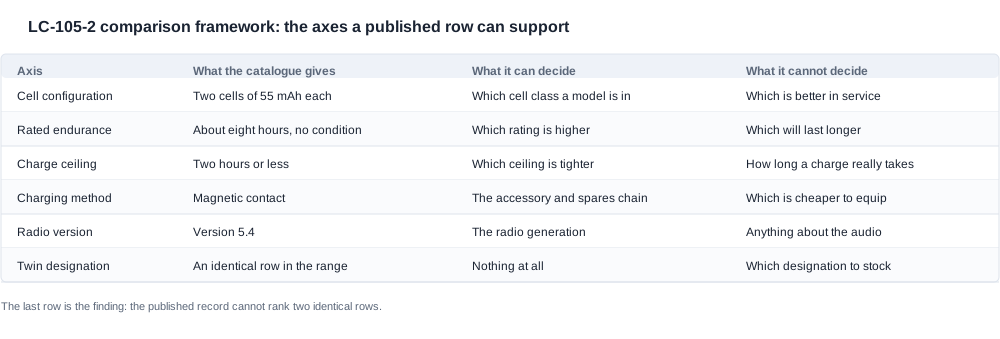
LC-105-2 compared with the models around it, and the question the catalogue cannot settle
Start with the shape of the range, because a comparison without a map produces a list. The catalogue covers twenty-eight products across several distinct classes — audio models, sport models and camera models, plus a few specialist entries — and the charging method across the whole range splits three ways. Seventeen entries use magnetic charging, seven use a different connector, and four publish no charging-method row at all. Radio versions cluster around two generations, and the cell configurations cluster into a small number of classes.
Within the audio section of that range, this model sits in a cluster of entries that share a cell class, a rated runtime, a charge ceiling and a radio version. The published row for this model reads: two 55 mAh cells, roughly eight hours of rated use, a two-hour charge ceiling, magnetic charging, and a radio at version 5.4.
The interesting result of the comparison is not a ranking. It is a demonstration that the published rows, taken on their own, are not sufficient to select between models in this section of the range. Two products with the same cell class, the same runtime rating, the same charge ceiling, the same charging method and the same radio version will be compared by buyers on something other than the specification, and a buyer who wants to know what that something is should examine what the catalogue does not publish for any of them.
There is one further complication, and it is the reason this article is worth reading in full. A sibling in the range is published on a row that matches this model's row exactly. When two model designations share a published specification line for line, a comparison between them has no technical content at all, and any comparative statement a buyer makes about them is an invention. That is not a reason to avoid the question. It is a reason to put the question to the supplier in a specific form, which is what the second section below sets out.
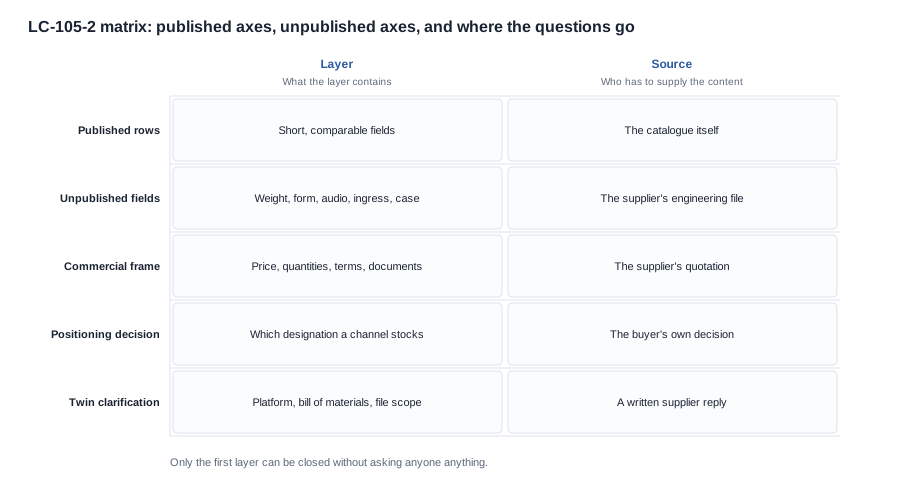

The twin: two model names, one published row
The catalogue lists LC-105-1 and LC-105-2 as two AI Bluetooth audio glasses entries. Both rows read the same way: two 55 mAh cells, about eight hours of rated endurance, a charge ceiling of two hours, magnetic charging, and a radio at version 5.4. The two entries differ in the model designation and in the product name, and in nothing else the catalogue records for them.
What follows from that is a set of prohibitions and a set of obligations, and both matter commercially.
The prohibitions. Nobody working on this product may state or imply that one of the two is lighter, stronger, longer-lasting, better specified, newer or better value. None of those statements is supported, and all of them are easy to make accidentally, because a buyer who has a product in hand and a competitor's model in hand will assume the difference exists and will go hunting for it. A buyer who has already written such a sentence in a channel document has created a problem that will surface in a comparison conversation, usually with a distributor rather than with a customer.
The obligations. The two designations are a published fact about the range, and a buyer who has spotted it has two options: treat it as a closed question and stock whichever designation the supplier quotes, or treat it as an open question and resolve it before the first order. The second option is clearly better, and it is not expensive, because the answers are the kind that a supplier can give in a single reply.
The answers worth obtaining are the ones a buyer's own documentation depends on. Are the two designations the same product platform, or two platforms with the same published specification? If they are the same platform, what is the reason for two designations, and does it correspond to a different market, a different customer or a different configuration? If they are different platforms, what is the engineering difference that the published rows do not capture? Can a single conformity document cover both designations, or does each require its own file? And does a colour, packaging or market difference exist that is not recorded in the catalogue?
The fourth of those questions is the one that determines whether a buyer can consolidate its documentation, and it is the one with the largest effect on the cost of entering the market. A file that covers one designation is a file the buyer keeps; a file that covers two is a file the buyer keeps once. For a distributor stocking both, the difference is straightforwardly a cost difference.
There is a commercial dimension as well. Two designations with identical published rows create a question that the channel will ask before the buyer has decided it: which of the two should a retailer stock? A buyer that cannot answer that question will be asked it by a partner, and the answer determines whether the two are an alternative or a complement. That is a decision about positioning rather than about specification, and it is exactly the kind of decision that a published row cannot inform.

What the horizontal comparison framework actually is
The useful framework for a range like this has three layers, and they have to be kept apart, because mixing them is what produces the flattened comparison tables that appear on retail listings and that nobody can act on.
The first layer is what is published, and for each model it is a short list: the cell configuration, the rated endurance, the charge ceiling, the charging method and, where published, the radio version. These are the only fields on which two entries can be said to differ, and the discipline is to write them down per model in a table rather than in a sentence, so that a difference is visible as a difference.
The second layer is what is not published, and this layer is where the decision actually sits. For every model in the range, the following are absent or only partly present: the product weight, the frame and temple materials, the acoustic description, the microphone and noise-reduction specification, the ingress rating, the charging-case arrangement, and the per-model conformity documentation. A comparison table built only on the first layer will show a field of near-identical rows and a buyer will conclude that the products are the same. They may be; the catalogue simply does not say, and the second layer is where the supplier's answers will separate them.
The third layer is the commercial frame — price, minimum order quantity, lead time, packaging, warranty and the scope of the documents supplied. None of it is published, and all of it is where the total cost of a model is decided. It is also the layer that a buyer assembles last, because it depends on the answers from the first two.
The framework in practice is a spreadsheet with three blocks, and the discipline that makes it work is that a cell which is not published is marked as not published rather than left blank. A buyer who has built that table once for this model has, in effect, built the template for every other model in the range, and the second build is a matter of filling in two columns rather than designing a method again. That is worth saying because the cost of the method falls on the second use and the cost of not having one is paid every time a new product is added to the range.
The three blocks also answer three different audiences, and keeping them apart prevents a common error. A distributor reads the first block and wants to know what differs; a compliance buyer reads the second and wants to know what is unproven; a finance buyer reads the third and wants to know what it costs. One table that tries to serve all three usually serves the first audience and leaves the other two with assertions. A blank cell is read as an oversight; a marked cell is read as a question. For a range where so much is undocumented, the count of marked cells is itself a useful comparison output: the model with the most open questions is not the worse model, but it is the one whose total cost is least certain.
Two features of the framework are worth stating because they are where buyers go wrong. First, the published rows are not measured values, and comparing them as though they were produces conclusions the data cannot support. A rated endurance is a published rating without a stated condition, and a charge ceiling is an upper bound rather than a duration; two models that read identically on those two fields may behave differently in service, and the published row cannot tell you which. Second, an identical row between two models is not a data error to be smoothed over. It is a finding to be escalated, and the escalation is cheap at the quotation stage and expensive at the sampling stage.


Comparing on the four axes that a published row can support
Stripping the comparison down to the fields that a published row genuinely supports leaves four productive axes and one that is only decorative.
The cell axis. The number of cells and their capacity is the first thing a buyer checks, because it drives the runtime and the charge time, and because it is a proxy for what the product can do. For this model the published configuration is two cells of 55 mAh each. A buyer comparing on this axis has to be careful about one thing: the catalogue publishes the cell values and the count, and a total is a derived figure rather than a published one. Comparing a derived total against a published single-cell value is a comparison between two different kinds of number, and it flatters whichever model is described with a total.
The runtime axis. A rated endurance of about eight hours, published without a test condition. The axis is usable for separating models that differ in the published figure, and it is not usable for separating models that do not, because two equal ratings say nothing about which will last longer in a particular deployment. A buyer who has to choose on runtime alone should ask for the reference condition behind the rating, and should treat the rating as a planning figure in the meantime.
The charge axis. The charge ceiling, at two hours or less, is published for this model. A ceiling is comparable across models only if everyone is quoting a ceiling, and the risk here is that a buyer compares a ceiling against another supplier's typical value and reads the difference as a capability gap. It is not. The comparison that is worth making is ceiling against ceiling, and the separate question of what the ceiling is measured from and to.
The charging-method axis. Magnetic charging is published for this model, and it is the axis with the largest operational consequence in the range, because it decides the accessory chain, the spare-parts policy and the retail fixture question. A model on a different connector in the same range is easier to equip with generic accessories; a model on magnetic charging is not. Comparing on this axis is comparing on total cost rather than on specification, and it is the axis where a purchase decision is usually actually made.
The radio axis. A radio at version 5.4 is published here, and it is the axis with the most limited commercial value. The version identifies a generation, and the generation is relevant to compatibility expectations and to a distributor's own stock of peripherals. It says nothing about the audio behaviour, the range or the power consumption, none of which are published, so a buyer who selects on this axis alone is selecting on the least differentiating field in the table.
That last observation is worth making explicitly, because radio version is what tends to end up in a retail comparison table: it is easy to print, it appears precise, and it is close to meaningless as a selection criterion. The same is true of cell capacity, which is why both of those axes belong in a technical comparison and neither of them belongs in a buying decision on its own.
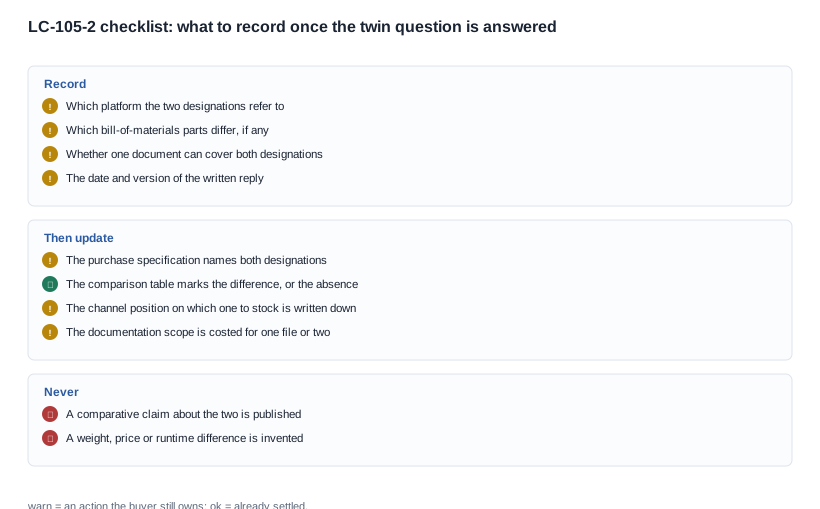
The clarification letter that resolves the twin question
The clarification does not need to be a formal letter, and making it formal is a common reason it does not get sent. What it needs is to be a numbered set of questions, addressed to a named person, with a deadline, and with a clear statement of what form the answer has to take. The form matters more than the tone, because the answer is going into a file.
- State the observation, not the suspicion. Say that the catalogue publishes two model designations with matching rows, and that the buyer is unable to establish a technical difference from the published record. It is a question about the record, not an accusation.
- Ask whether the two designations correspond to the same product platform. A yes or no, with an explanation if yes.
- Ask whether the two carry identical bill-of-materials content, and if not, which parts differ. This is the question that produces the real information, and it is the one to ask even if the answer to the first question was no.
- Ask whether a single conformity document can cover both designations, and if not, what each file needs to contain separately.
- Ask whether the two are intended for different markets, channels or customer groups, and whether the distinction affects anything the buyer has to do.
- Ask what the practical difference is for a buyer placing an order — different tooling, different packaging, different minimum quantities, different lead times — because that is where a difference that matters will actually show up.
- Ask for the answer in writing, on the supplier's letterhead or in a signed technical reply, and ask for a date and a version so it can be filed.
- Record the answer in the purchase specification alongside the two designations, so that the documentation a buyer holds is the documentation the supplier issued.
The reason the seventh point is the one that decides everything is that the answer has to be usable by somebody else. A buyer's technical file is read by a customs broker, by a compliance consultant, by a distributor's quality team and, two years later, by whoever takes over the product line. An answer that exists only as an email thread, in one person's inbox, with no date on it, is not part of the file at all, and the buyer will pay for that later in the form of a document that has to be re-obtained while a shipment is waiting.
Once the answer exists, the comparison framework can be completed. The twin entry stops being an anomaly in the table and becomes either a confirmed duplicate that the buyer consolidates, or a documented difference that the buyer can use. Either outcome is useful; what is not useful is the third possibility, which is the default one: two designations that sit in the range indefinitely, with the buyer unable to say which one to stock and unable to find out why.
Our own position on this is narrow and, we think, the only defensible one. We publish the rows the catalogue publishes, we do not assert a difference between two entries that the catalogue does not record, and we do not fill the gap with an industry-typical figure or with a plausible guess about which variant is the better one. What we can do is tell you which questions close the gap, in what order, and in what form the answer has to arrive to be worth keeping. The limitations of this model sets out the rest of what is undocumented about it, and the value note deals with how to judge the product when the price is not published either.
If you are holding both designations in a range you plan to stock, send us the two catalogue rows and the two quotations you have, and we will set out which of the eight questions above is already closed by the documentation and which one is still the reason you cannot answer your own distributor.


