

A limitation that nobody has priced is a limitation that gets paid for later, usually in the most expensive place available. That is the practical argument for reading the catalogue for this model as a list of gaps rather than as a list of features, and for spending an hour on the gaps before the first quotation rather than a week on them after the first shipment.
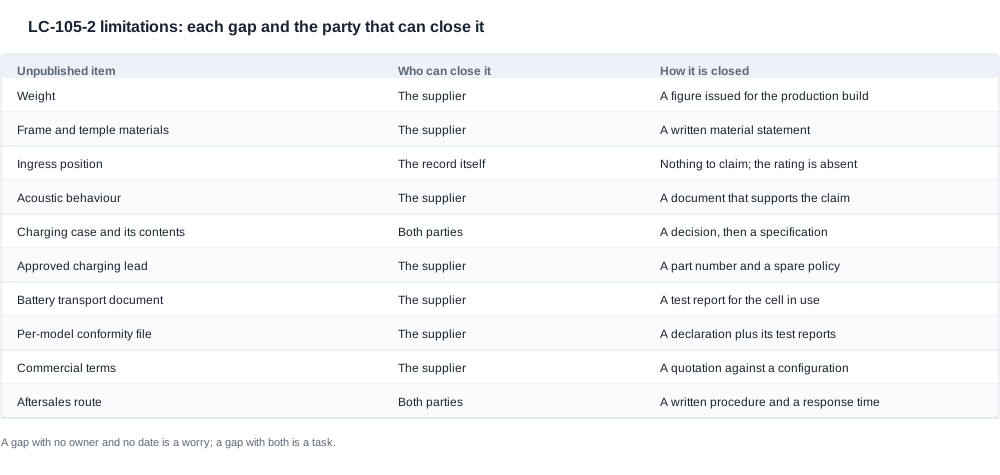
The published record for this model is short and entirely about power and connectivity: two cells of 55 mAh, a rated endurance of roughly eight hours, a charge ceiling of two hours, magnetic charging, and a Bluetooth 5.4 radio. Around that, the catalogue is silent on a long list of things a buyer will be asked about — the weight, the materials, the ingress position, the acoustic behaviour, the charging case, the transport documentation, the per-model conformity file, the commercial terms, and the aftersales route.
The point of this article is not to list them. Every model in every range has a list like this, and a list on its own generates anxiety rather than action. The point is to work out which of these gaps are cheap to close, which are expensive, which will never close, and what each one costs if it is left open. That turns a set of unknowns into a set of line items, which is the only form in which a procurement team can actually budget.
The specification record for this model is where the published fields are set out; the charging options note covers the operational side of the charging rows in detail.
LC-105-2 limitations: the gaps that have to be priced into the order
The most common way a buyer handles an unpublished field is to assume a plausible value and carry on. It is a reasonable-sounding practice and it is the mechanism behind most of the problems that show up in this category, because a plausible value gets into a document, a document gets into a listing, and a listing becomes a commitment that somebody has to honour.
Worked examples from this model make the mechanism concrete. A buyer assumes a weight because the retail partner needs a figure for the product page, and the assumption becomes a published weight that the customer holds the parcel to. A buyer assumes a case is included because the retail fixture has a slot for one, and the packaging design, the freight calculation and the retail proposition are all built on that assumption. A buyer assumes an ingress protection because a competitor's product in the same channel has one, and the listing carries a claim that no document supports.
None of these is a rare failure. All of them are avoidable, and they are avoidable at the point where the document is requested rather than at the point where the document is needed.
The more useful framing is to ask what each gap is worth, and in what unit. Some gaps are worth a fixed number of dollars, and they scale with volume. Some are worth a fixed amount of time, and they scale with the programme. Some are worth nothing at all until somebody asks a particular question. And a few cannot be closed by any amount of money, because they are absences in the record that only a supplier's engineering file can fill.
The first category is the easiest to handle and the most often mishandled, because it is the one where the answer is a number. The second is the one where a schedule slips. The third is where a buyer discovers an unanswerable question in a customer conversation. The fourth is where a buyer discovers that a claim cannot be substantiated at all, and has to withdraw it.
There is one more category that deserves separate mention, because it is the only one that is actually a problem with the product rather than with the documentation. A product whose specification is fully published can still be a poor commercial decision. A product with a published specification of two small cells, a rated runtime in the region of eight hours, a two-hour charge ceiling and magnetic charging is a product with a real operating profile, and that profile has to be compatible with how the buyer intends to deploy it. Nothing in the gaps analysis changes that: it tells you what you do not know, and separately you have to be satisfied with what you do know.

What the catalogue does not publish, grouped by who can close it
The gaps fall into three groups according to who is able to close them, and the group a gap belongs to tells you how long it will take and what it will cost.
The supplier closes these, with a document. The battery transport documentation for the two 55 mAh cells. The per-model conformity file, with its test reports and its declaration. The approved charging lead and its part number. The weight, issued against the production configuration. The material statement for the frame and the temple. Whether a charging case exists and what it contains. This group is closable and has a cost, because documents take engineering time to produce and the supplier will usually price that time.
The buyer closes these, with a decision. Whether the retail set includes a case. Whether the product is sold bare or as a bundled set. Which colourways are offered in which market. Whether the listing makes an acoustic claim at all. Whether the weight is published by the brand or provided privately to the distributor. This group is closable immediately, at no cost, and it is the group that gets postponed, usually because nobody has noticed that a decision is being made by default.
The market closes these, and nobody can hurry them. Whether a claim is permitted in a given destination, and what wording is acceptable for it. Whether an integrated battery in the product is accepted in a particular waste and recycling regime. Whether a radio product needs a separate national approval in a given market. This group cannot be closed by the buyer's diligence, only by compliance work in the destination market, and it has the longest lead time of the three.
The value of the grouping is that it separates the gaps that a buyer is allowed to close from the ones that are not, and it prevents the common substitution of asking a supplier a question that is actually a decision the buyer has to make. A supplier asked whether the product is sold with a case will give a helpful answer, and the answer will be a description of what is technically possible rather than a decision about what the buyer should do.
Two gaps sit outside all three groups and are worth naming separately. The first is the twin-designation question, which is a supplier question and a documentation question at the same time, and which is dealt with in the comparison against the models around it. The second is the absence of a per-model conformity row, which is a company-level fact rather than a model-level one: the certification material in the catalogue is images rather than text, and no model in the range carries a conformity row of its own. That means the entire technical file for this model has to be requested, and it means the same is true of every other model in the range, which is a useful thing for a buyer to know before assuming that another supplier will have published theirs.

What each gap actually costs at different order volumes
Exposure to a gap is not constant. It changes with the order, because the things a gap breaks fall into two very different cost structures: per-unit costs and per-programme costs.
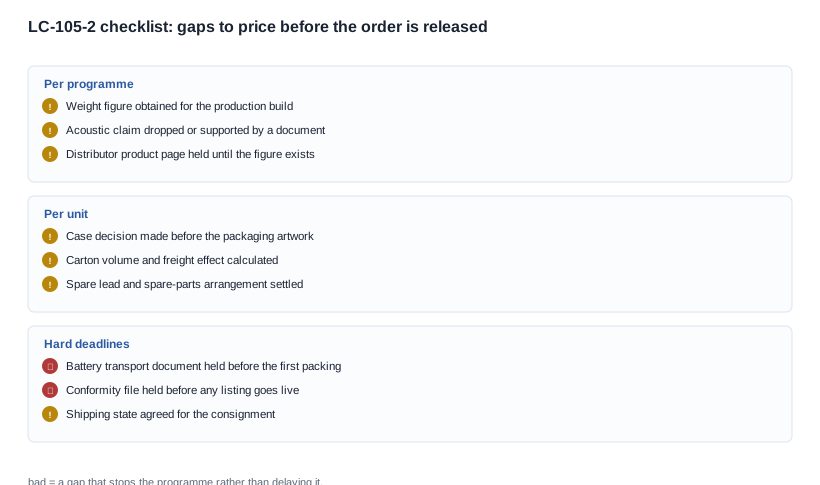
A missing weight figure is a good example of a gap whose cost is almost entirely per-programme. Nothing about the product changes if the weight is unknown — the product is the same size, the carton is the same carton — but the retail listing cannot carry a figure, the distributor's product page needs one, and the channel will keep asking. The cost is a repeated conversation, a delay to the listing going live, and eventually an assumption made by somebody who should not have made it. None of that scales with units. A buyer moving ten thousand units and a buyer moving a hundred thousand units feel the same inconvenience.
A missing charging-case arrangement is the opposite. Here the gap changes the product. The carton dimensions change, the volumetric freight per unit changes, the retail proposition changes, and the accessory file changes. Every one of those is a per-unit cost that recurs on every subsequent order, and it compounds because the buyer also has to hold a different spare-parts arrangement and a different retail fixture plan. This is the kind of gap that is cheap to close before an order and expensive to close after one, because the packaging artwork and the freight contract both have to be reworked.
A missing battery transport document is a third kind again: a per-shipment cost, but with a catastrophic downside rather than a proportional one. One missing document does not make a consignment slightly more expensive; it stops it. The exposure is a delayed shipment, a demurrage charge, a stock-out in the channel and a customer conversation about availability.
A missing per-model conformity file is the fourth: a per-market cost, and a long one. It is the gap that determines whether a market can be entered at all, and it does not scale with units either — it scales with the number of markets a buyer wants to serve.
Sorting the gaps this way gives a buyer a genuinely usable answer to the question of where to spend attention. Per-programme gaps deserve a scheduled task. Per-unit gaps deserve a decision before the artwork is locked. Per-shipment gaps deserve a hard deadline in the delivery plan. Per-market gaps deserve a compliance budget. And the gap with the catastrophic downside deserves to be closed first, whatever volume it was ever going to reach.


The claims that cannot be made from this record
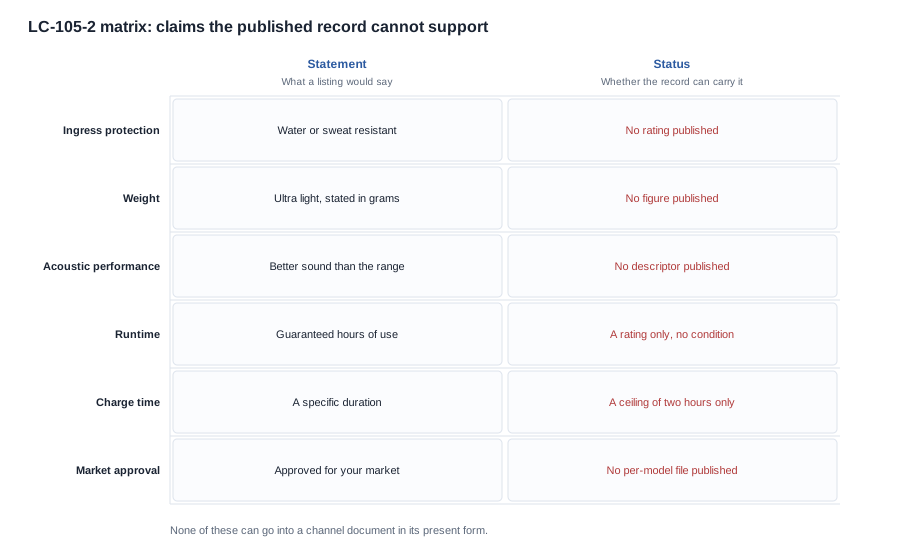
Alongside the gaps there is a separate question, and it is the one that reaches the customer. Some claims cannot be made at all from this published record, and the list is short enough to be memorised, which is the point.
No ingress claim may be made. No ingress rating is published for this model, so no water, sweat or rain language can appear in a listing, an instruction insert or a distributor's product page. This is not a close call: the claim is either supported by a rating that names the model or it is not available.
No quantified weight claim may be made. Where a channel describes a product of this kind as ultra-light or lightweight — and descriptions like that circulate widely for frames of this class — the catalogue publishes neither a weight nor a frame material, so that description cannot be presented as a measured figure. It can be used as a qualitative description of the design intent; it cannot be turned into a number, and it cannot be the basis of a comparison with a product whose weight is published.
No acoustic claim may be made beyond what a document supports. The published row carries the radio version and nothing about the sound, and a claim about the audio is a claim the buyer carries unless a supplier document underwrites it.
No runtime guarantee may be made. The published endurance is a rating without a stated condition, so it can be quoted as a rating and planned against, but it cannot be written as a guaranteed duration for a specific deployment.
No charge-time guarantee may be made beyond the ceiling. Two hours or less is what is published, and a listing that promises a shorter time than the ceiling asserts something the record does not.
No conformity claim may be made. In the absence of a per-model file, a buyer cannot assert that the product is approved anywhere.
And no comparative claim may be made between this model and the designation whose published row it matches. A statement that one is lighter, better specified, longer-lasting or better value would be an invention, and the two designations in question are documented on the same line in the range.
Turning a limitation into a written condition in the purchase order
The useful move, and the one that makes a gap bearable, is to convert it from an unknown into an obligation. An unknown has no owner and no date. An obligation has both, and it can be scheduled, chased and, if necessary, enforced.
The conversion is straightforward in form. Where a field is not published, the purchase specification should carry a line that names the field, names the party who will supply it, and states the point in the programme by which it is needed. The date is a commercial agreement with the supplier rather than a number this article can supply, and the reason it matters is that a gap with a date attached is a project task, while a gap without one is a background worry that nobody ever schedules.
Four lines of that kind are worth writing before anything else, because they are the ones with a downside rather than a delay, and the criteria for putting them first are worth making explicit.
- The battery transport documentation, needed before the first consignment is packed. Missing it does not delay a shipment; it stops one.
- The conformity file, with its model designation, needed before the listing goes live in any market that requires it. This is the line that decides whether a market is open or closed.
- The weight figure, needed before the retail product page is created. It is the field the channel will ask for most often and the one most likely to be filled with an assumption.
- The case decision, needed before the packaging artwork is locked, because it changes the carton and the freight per unit.
- The colour and packaging configuration for the first market, needed before the artwork is finalised, and cheap to fix while it is still a conversation.
- The aftersales route and response commitment, needed before the distributor agreement is signed, because a partner will ask for it in the first commercial meeting.
Those six are the lines with a hard deadline attached. A buyer who uses the criteria in this article to build the shortlist will notice that none of them is expensive in engineering time, and that the reason they are frequently left open is that nobody has written them down as obligations.
Beyond those, the remaining gaps are better handled as a list attached to the purchase specification than as clauses inside it, because they are the kind of thing that changes and the specification is the kind of thing that should not. A list that is versioned and referenced from the specification gives the buyer a place to record what has arrived, and it gives the supplier a clear view of what is outstanding. The list is also where a re-order gets its value: at the second order, the list is the shortest possible statement of what still has to be closed, and the total cost of the programme is the sum of the gaps that were closed rather than the ones that were carried.
The due diligence question behind all of this is who is carrying the risk while the gaps are open, and the answer has to be written down rather than assumed. In a buyer's own file the answer is usually nobody, which means that in practice somebody in the organisation is carrying it, and that person is usually the person who discovers it first.
There is a fifth thing worth converting, and it is the one buyers most often leave alone. The limits above are not all gaps; some of them are the boundaries of the product as it is, and the right treatment for those is a claim that is not made. Writing a list of claims the brand will not make — no ingress language, no quantified weight, no acoustic comparison, no comparative statement against the twin designation — is a cheap and unusually effective control, because it stops the claims being made in a channel document by somebody who has never been told they should not be made.
Our own position is the one we take throughout this range, and it is worth stating in plain terms at the end. We publish the fields the catalogue publishes and we do not fill the rest with typical figures from the industry, because a borrowed number in a specification becomes a claim in a listing and a commitment in a dispute. Where the record is silent we will say that it is silent, and we will tell you which party has to close the gap and what form the answer has to take. The value note for this model deals with the other half of the same problem, which is how to judge the product on evidence when no price is published.
One last practical note for anyone carrying these gaps into a supplier conversation: a gap that has been named, owned and dated is a far smaller problem than a gap that has been described as an open question, because a named gap can be escalated, tracked and eventually closed, while a described question simply sits in the file.
If you are building a purchase specification for this model and want the gap list in a form you can send to a supplier, tell us the destination markets and the planned first order quantity, and we will return the list of unpublished items with the party that has to close each one, the stage by which it is needed, and the claims that have to be ruled out of the channel documents before the first shipment.


